Dielectric screening is the rearrangement of a medium's charges in response to an applied charge. In a metal, mobile Electrons accumulate near a positive perturbation and reduce its long-range potential. Thomas-Fermi screening treats the electron gas locally as an equilibrium gas whose density responds to the local electrostatic potential, ignoring gradients of the density on the microscopic wavelength scale.
Take , background permittivity , and electrostatic potential . An Electron's potential energy is , so the local kinetic Fermi energy becomes . For a three-dimensional spin-degenerate parabolic band at zero temperature,where is the spin-summed density of states per volume per energy. The induced charge is . Combining it with Poisson equation givesFor a point external charge , spherical symmetry and decay at infinity selectThus the bare potential is cut off exponentially. Fourier transformation makes the same result transparent: , so the static longitudinal dielectric factor is relative to the background. For a free Electron band, and .
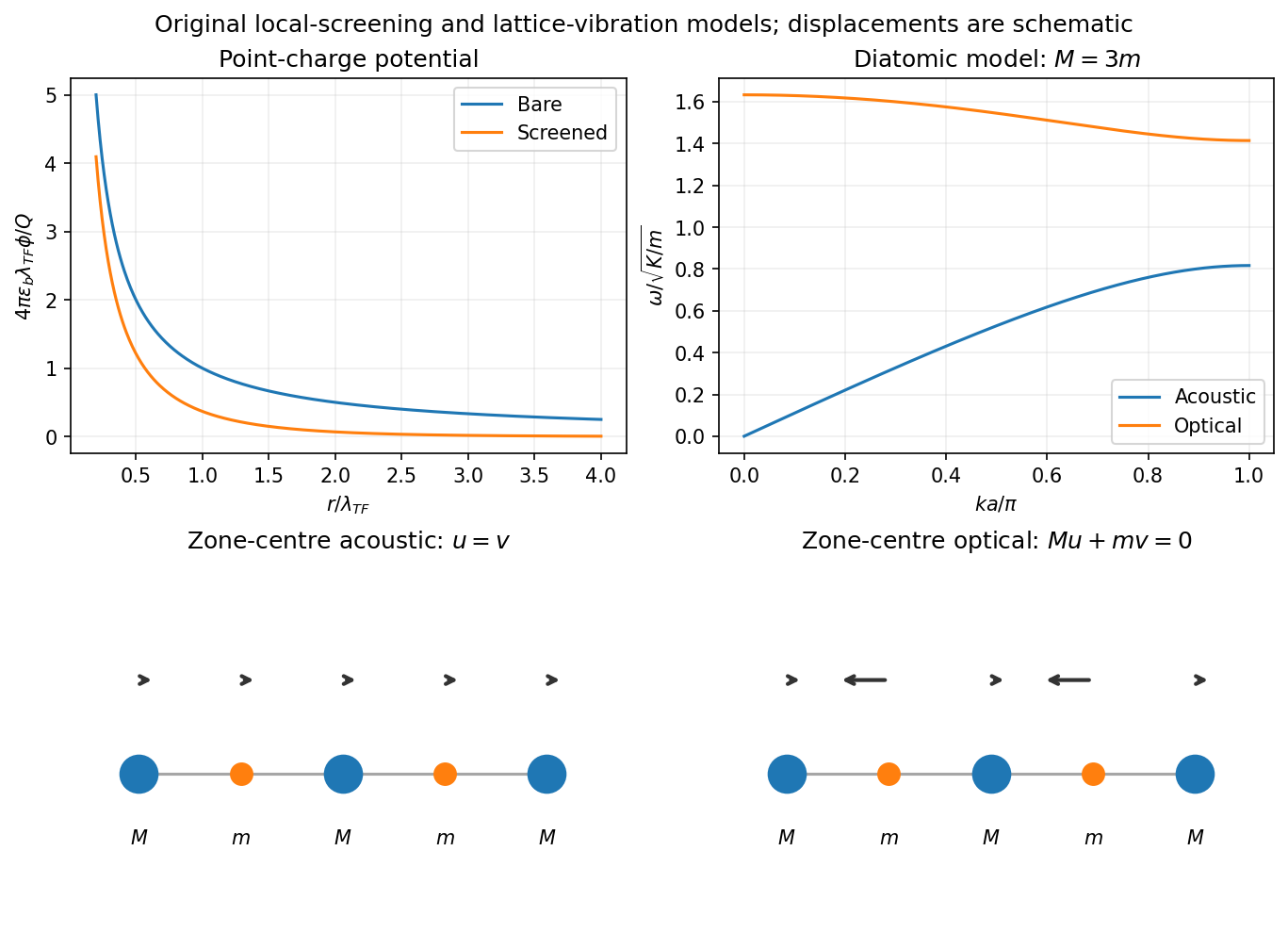
Local Thomas-Fermi screening and optical/acoustic modes of an illustrative diatomic chain
. Details. 
The local linear approximation requires a weak perturbation and slowly varying fields on the relevant microscopic scale. It omits nonlocal Friedel oscillations and atom-scale structure; a nonlinear local-density treatment is needed near a sufficiently strong charge. Finite temperature replaces by the appropriate compressibility derivative . The nondegenerate limit gives classical screening rather than the degenerate Thomas-Fermi length. A larger density of states means that a smaller potential can move more carriers, hence stronger screening.
A primitive cell containing two atoms has two independent displacement coordinates for each chosen polarization. Their coupled normal modes split into an acoustic phonon branch, which translates the cell at long wavelength, and an optical phonon branch, which moves its constituents against one another. The nonzero restoring force for the relative displacement gives a nonzero optical frequency even at the zone centre.
For an explicit scalar model, take alternating masses , equal nearest-neighbor spring constant , and cell length . If are the displacements of the two atoms in cell , Newton's second law givesA mode proportional to has a nonzero amplitude only when the two-by-two dynamical determinant vanishes. The resulting diatomic-chain dispersion relation with equal springs, in this cell-length convention, isThe minus branch is acoustic, with and a linear small- dispersion. The plus branch is optical, withAt , the acoustic eigenvector has . The optical eigenvector instead satisfies : its cell centre of mass stays fixed while the atoms move oppositely. At the zone edge, for , the frequencies are and , giving a gap between branches. Both slopes vanish there. The dispersion and displacement patterns are shown in the preceding original figure.
If the two atoms carry opposite effective charges, the relative motion creates an oscillating electric dipole moment, enabling infrared absorption by long-wavelength light. The photon momentum is tiny compared with the zone size, so ordinary optical absorption principally excites modes close to . Raman activity instead depends on modulation of polarizability; the name optical does not imply that every such mode is infrared active. Three-dimensional crystals have separate longitudinal and transverse polarizations, and long-range Coulomb forces can split their optical frequencies. A monatomic primitive cell has no internal relative coordinate and therefore no optical branch of this type.
A normal Fermi liquid has interacting fermions whose low-energy excitations can be followed continuously from those of a Fermi gas, provided no phase transition destroys that correspondence. A Landau quasiparticle is a particle together with the surrounding many-body response. It has the appropriate charge and spin, a renormalized dispersion and a long lifetime close to the Fermi surface. Interactions remain in both the quasiparticle parameters and the interactions between quasiparticles; they have not been discarded.
Near an isotropic Fermi surface,The last relation defines the local isotropic Fermi-liquid effective mass. The Landau quasiparticle energy functional expresses how changing occupations shifts other quasiparticle energies:with normalization of the sum absorbed into . Its angular components give Landau parameters describing collective density and spin response.
The Pauli exclusion principle severely restricts the available final states for low-energy collisions. In an ordinary three-dimensional Fermi liquid with regular interactions,At zero temperature the decay width decreases faster than , making quasiparticles increasingly sharp near the Fermi surface. Their coherent spectral weight is the quasiparticle residue , and the true Electron momentum distribution has a discontinuity of height at zero temperature. The rest of the spectral weight is incoherent. The quasiparticle occupation itself still follows a Fermi-Dirac distribution.
The low-temperature electronic heat capacity is linear, , where is the spin-summed quasiparticle density of states. In an isotropic spin-one-half model, the uniform spin susceptibility and compressibility take the formsThus enhanced effective mass and residual interactions can separately change observable responses. The familiar electrical resistivity requires a mechanism relaxing electrical current, such as allowed Umklapp processes; collisions in a perfectly clean Galilean-invariant continuum conserve total momentum and do not alone produce a finite dc resistivity.
Zero sound is a collisionless collective density oscillation sustained by the quasiparticle interaction; ordinary first sound occurs when collisions establish local equilibrium during a cycle. Metals and normal liquid helium-3 supply important examples. The description fails in phases with no sufficiently sharp low-energy quasiparticles, such as generic interacting one-dimensional systems, and must be modified after pairing or another ordering transition.
Articles by others on the same topic
There are currently no matching articles.