Original paper: 13 January 2014, physical PDF pages 658–660.
velocity , length and diffusivity have dimensions , , and . Their dimensionless Péclet number isdiffusion dominates for , advection for . At fixed , the crossover length is ; neglecting advection requires .
TODO: user-deferred organism-specific swimming-speed and detection-scale estimates. No biological numerical substitution is made.
For the generic equilibrium transport derivation, let an external potential give force and drift . Boltzmann equilibrium has , hence . Substituting in the zero-current condition givesThe Stokes–Einstein relation in the final equality is for an isolated no-slip sphere in a Newtonian liquid at low Reynolds number. Zero flux alone is insufficient: the equilibrium distribution and mechanical mobility law are also needed.
TODO: user-deferred organism-specific absorbing-surface calculation and its biological flux interpretation.
TODO: user-deferred receptor-number, receptor-density and receptor-competition calculations. These continuations have not been solved.
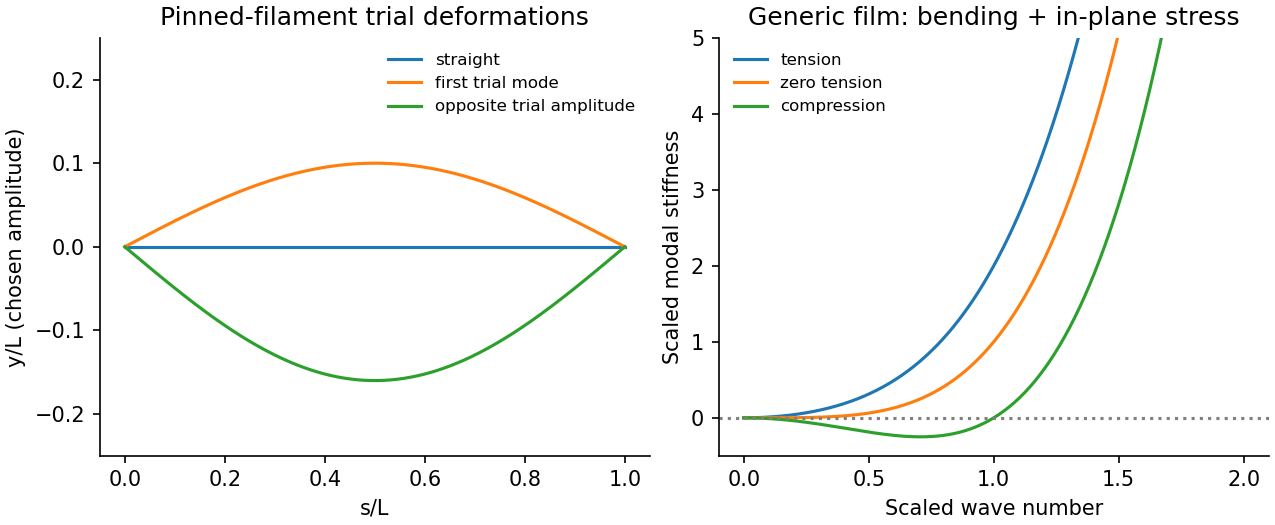
Consider generic synthetic filaments and films. buckling occurs when compression makes a transverse deformation lower the energy. For a straight filament of bending rigidity under compressive force ,Pinned ends admit , giving . The first instability is therefore . True clamping raises this to ; a clamped-free rod has . boundary conditions are part of the threshold, not a minor correction. Above threshold geometric nonlinearities and end constraints determine the buckled amplitude.
For buckling of a synthetic film, let the bending modulus be and the isotropic in-plane tension be . The small-slope quadratic energy isA mode of wave number has stiffness . tension stabilizes it; compression corresponds to and makes modes with unstable. A finite sheet has a smallest allowed , giving a finite threshold. A supporting foundation adds positive stiffness and can select a nonzero wrinkle wavelength.
Approaching either threshold softens a fluctuation mode: its thermal variance is proportional to divided by modal stiffness. The apparent quadratic-theory divergence is rounded by nonlinear geometry, finite size and imperfections. Experimentally vary end shortening or load, measure the transverse profile, and control attachment stiffness and initial curvature. Load control and displacement control need not trace the same postbuckling response. Biological applications are outside this generic mechanics note.
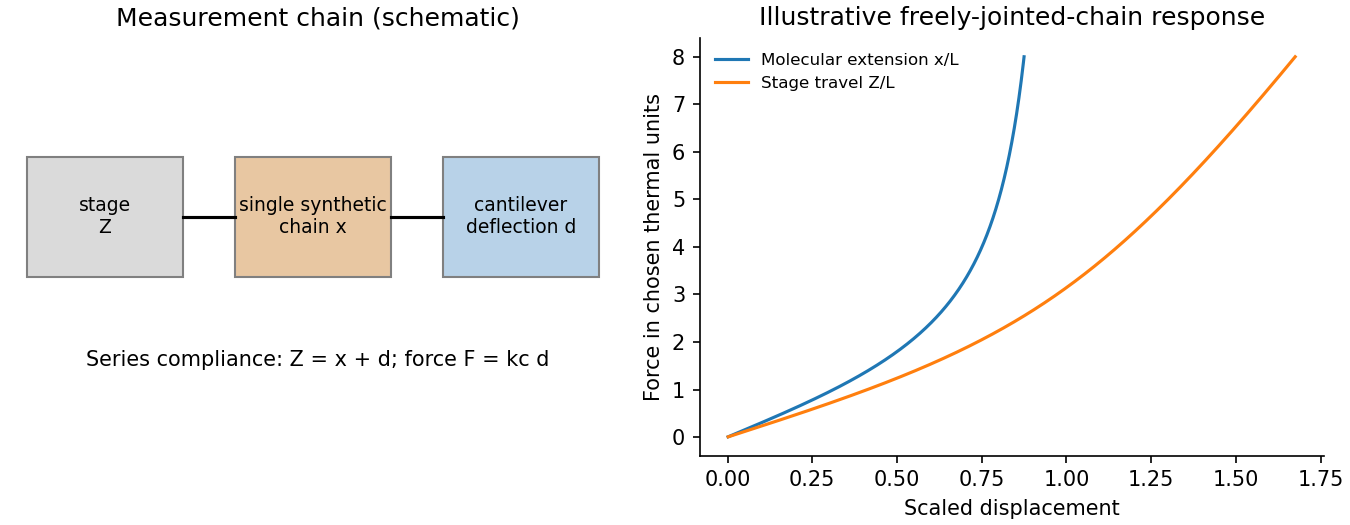
single-molecule force spectroscopy measures force and extension of an individual tether while controlling position or load. In an atomic-force arrangement, a synthetic chain connects a cantilever probe to a translated substrate. For the cantilever compliance correction, a deflection sensor gives , a calibrated spring constant gives , and substrate displacement gives chain extension after geometric offsets are removed. Additional linkers and instrument compliance must be included if appreciable. Thermal deflection calibration uses only after isolating the cantilever's calibrated thermal contribution.
An optical-tweezers implementation detects a tethered bead's displacement from a calibrated trap centre, with in the harmonic regime. Detector calibration, drag and trap linearity determine the usable force and frequency range. These instruments measure individual force–extension curves and distributions; averaging many curves can hide multiple tether populations.
For a synthetic freely jointed chain with Kuhn length ,A strongly stretched worm-like chain instead has before backbone stretching becomes important. Fits can estimate contour and persistence lengths only in their appropriate regimes. Hysteresis and pulling-rate dependence test whether an apparent mechanical transition is quasistatic or activated.
Control single versus multiple attachments, subtract nonspecific adhesion, vary pulling speed, calibrate temperature and stiffness, and correct drift. A rupture peak is not a universal bond strength independent of loading history. A primary nonbiological example measured individual polydimethylsiloxane chains by atomic-force methods; its flexibility interpretation combines those measurements with molecular calculations.[ref]
TODO: user-deferred biological kinetic mechanism and its biochemical pattern-forming applications. The remainder treats generic two-field reaction-diffusion physics only.
Let obey . At a uniform steady state, write its reaction Jacobian as . Without diffusion stability requires and . A Fourier perturbation evolves under , whose determinant isIts trace becomes more negative with increasing . A stationary diffusion-driven instability therefore requireswith an allowed domain mode in the resulting negative-determinant band. Equal diffusivities cannot satisfy this while . The physical mechanism is that transport can destabilize coupled fields even when the local kinetics relaxes a spatially uniform perturbation. Faster diffusion of an inhibitory response is one possible realization.
The selected wave numbers depend on growth rates and boundaries; nonlinear saturation determines the final stripes, spots or other states. Linear instability alone neither supplies a biochemical mechanism nor uniquely predicts a final finite-amplitude pattern.
Let the channel length be and assume uniform solution conductivity. Its Ohmic resistance scales as , whereas access resistance of a reservoir mouth scales as . The fraction of voltage in the entrance regions is therefore of order . Most of the potential drop lies inside the long channel; the small entrance field region is neglected in the model, not asserted identically zero.
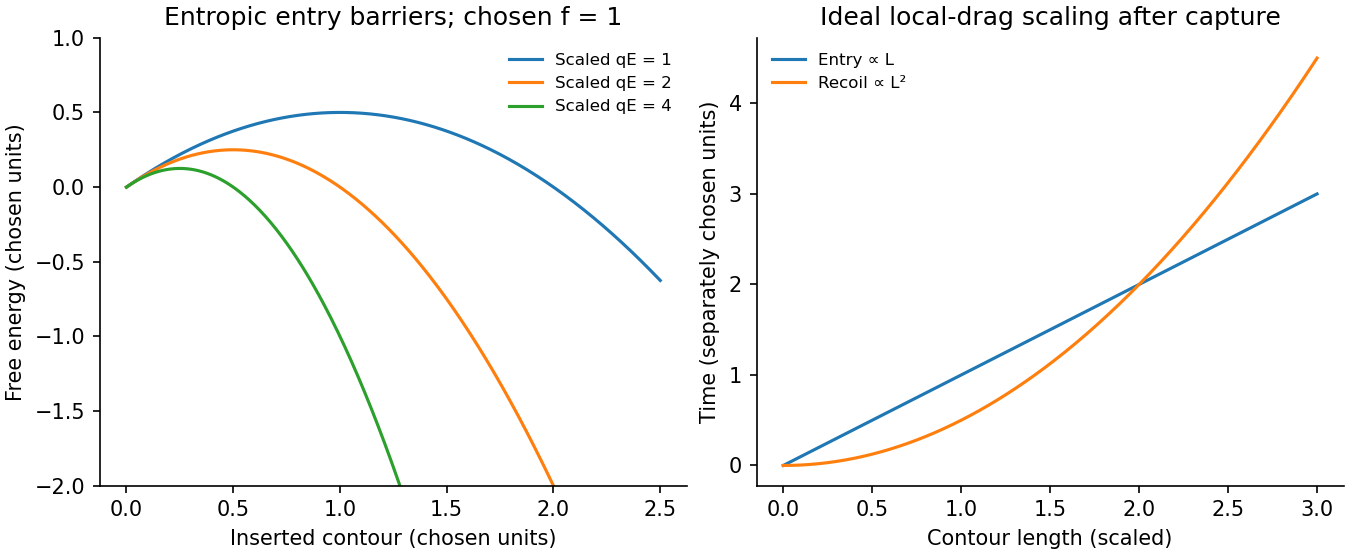
Write for inserted contour length and choose to pull the chain inward. The charge already inside feels force , givingConfinement removes polymer configurations. In the stiff-chain regime, the confinement deflection length obeys , hence . A free-energy cost of order per deflection gives a roughly constant resisting entropic force . The insertion barrier of a charged polymer follows from , with an entry maximum at when that point lies within the insertion interval. Its height is . The field supplies work against this confinement entropy.
Put , so . After capture, neglect the entry barrier, exterior-chain drag and thermal corrections to strong directed motion. ThenThe confined-polymer entry and recoil times have different length dependence; this entry graph is linear through the origin. Charge and drag both grow with inserted length, leaving a constant velocity. The same cancellation explains length-independent mobility in an ideal free-draining electrophoresis model. It does not include a capture waiting time or claim that every free-solution chain has identical hydrodynamic drag.
A measured superlinear entry time can arise when exterior-coil drag, tension propagation, wall adsorption or nonuniform friction adds length dependence absent from this model. For example with the same drive gives for . Under the assumptions of uniform wall charge and polymer entry scaling, a homogeneous thin-double-layer electro-osmotic model adds a length-independent fluid velocity . It changes the drift coefficient, not its length exponent. This does not rule out charge heterogeneity, adsorption or near-cancellation followed by diffusion in a real channel; those are additional mechanisms.
With the field off, the confinement entropy drives outward motion. Assuming the constant force and the same local friction,The small final end region lies outside the long-confined-segment approximation but gives only a small correction. Thus ideal insertion scales as , while recoil scales as .
TODO: user-deferred DNA-specific numerical stopping-voltage estimate and its biological parameter-based inference. No biological quantities are evaluated.
For entropic-trap length separation, a reservoir/channel array can repeat length-dependent capture, confinement and relaxation delays, turning them into different mean residence times. The uniform inside-channel drift speed derived above is itself length independent, so that drift alone cannot separate lengths. Separation must retain length dependence of the barrier or of the capture/recoil dynamics and can be tuned with a forward-biased time-dependent field. For large bulk throughput, pressure-driven advection is preferable to diffusion alone; a pressure gradient can be combined with electric capture control. In the unobstructed continuum limit . Excessive driving erases trapping differences, so throughput and resolution compete; the question supplies no geometry or adsorption law selecting a unique optimal drive.


Articles by others on the same topic
There are currently no matching articles.