Given observed data , a credible interval has posterior probability :For a continuous posterior distribution with probability density function , this is . The probability is conditional on the observed data and concerns the statistical parameter under its posterior distribution; it does not assert frequentist coverage probability.
An equal-tailed credible interval allocates equal posterior probability to its two excluded tails:For a continuous strictly increasing posterior cumulative distribution function , the endpoints are and .
A highest posterior density interval instead includes the parameter values of greatest posterior density: there is a cutoff such that the retained region is a superlevel set of , of posterior mass . Every interior retained value has density at least as large as every excluded value, apart from possible ties. For a unimodal continuous density this is an interval; when both endpoints lie inside the support they have equal posterior density. For a multimodal posterior distribution, a highest-density region may be a union of intervals, rather than one interval. Equal tail probabilities and highest density are different criteria.
Let , and . Conditional independence gives the Poisson distribution's likelihoodMultiply by the prior gamma distribution's density and discard factors independent of :Normalizing with the gamma function identifiesHere is the shape and is the rate, not the scale. This is conjugate prior updating for a Poisson distribution.
The mean of a shape-rate gamma distribution is shape divided by rate. Hence the posterior mean isBoth weights are positive and sum to one. This is a convex combination of the prior mean and the sample mean, provingFor it lies strictly between them if the two means differ, and equals both if they agree. The rate acts as the prior weight relative to the observed exposure units.
Let be the cumulative distribution function of a gamma distribution with shape and rate ; explicitly,The posterior distribution is continuous and has positive density on , so its quantiles give the requested equal-tailed credible interval:Equivalently, , so the endpoints can be written as the corresponding chi-squared distribution quantiles divided by . Either form excludes posterior probability from each tail.
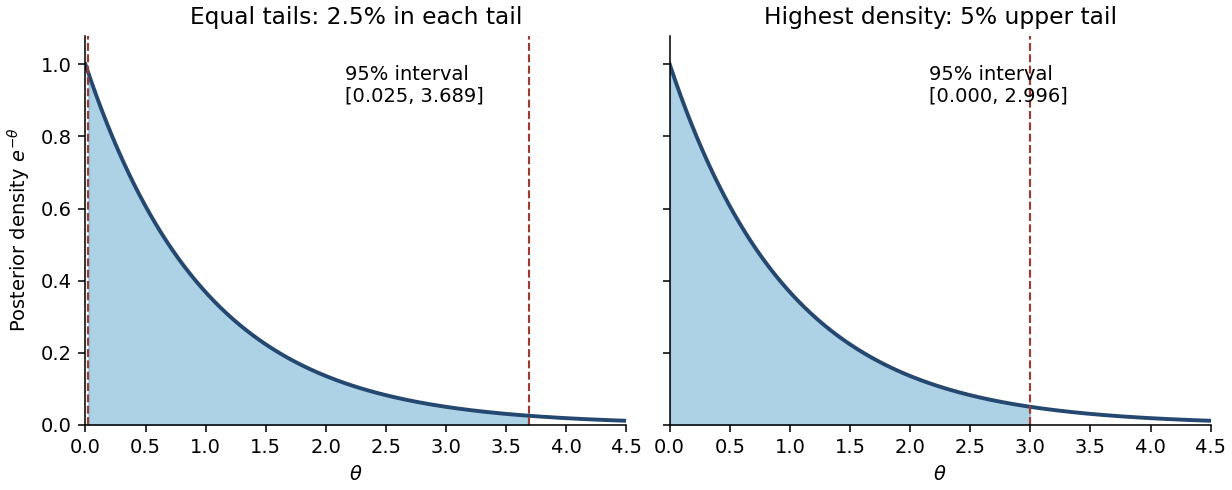
No. A permitted counterexample is with all observed counts zero. Then and the posterior distribution is an exponential distribution with rate , whose density decreases strictly from the left boundary. Its equal-tailed credible interval isHere . This excludes values just above zero whose posterior density is larger than that of retained values near , violating the highest-density criterion. The actual highest posterior density interval starts at the support boundary and solves :Writing zero as the endpoint causes no problem because a single point has zero posterior probability. Thus even within the gamma family the two intervals need not agree. More generally, for an interior unimodal gamma distribution, highest-density endpoints have equal densities, whereas equal-tailed endpoints need not.

Use and as above. The future observation is independent of the old observations conditional on , so the posterior predictive probability is obtained by integrating its Poisson distribution against the posterior distribution of :The last integral is the normalizing gamma function integral, equal to . This is a negative binomial distribution in the count-of-failures convention with shape and success probability ; the gamma-function expression remains valid for noninteger . As checks, its mean is , and the law of total variance gives variance . The additional term is the contribution of posterior uncertainty in .
Articles by others on the same topic
There are currently no matching articles.