Original public paper: Physical PDF pages 839–841. All four alternatives in question 1 and both later questions are answered. We distinguish collective order-parameter oscillations from individual quasiparticles, and use the dimensionless units of question 2 only in that question.
An Abrikosov vortex combines a core of suppressed superconducting order parameter, circulating electric current and a winding of the quantum phase. In the bulk limit a singly wound vortex carries the superconducting flux quantum . More precisely it is the fluxoid that is quantized; appreciable current on the integration contour prevents identifying enclosed flux alone with the integer.
For a type-II superconductor, the Ginzburg-Landau parameter is . The superconducting mixed state allows vortices between the lower critical magnetic field and upper critical magnetic field. A short superconducting coherence length permits a high orbital upper field,Thus surviving a large applied field generally requires accommodating many vortices, not excluding flux everywhere. The Abrikosov vortex lattice provides their equilibrium arrangement in the simplest isotropic model. Material anisotropy, disorder and thermal fluctuations can change that arrangement and its stability. Spin-polarization limits can also constrain an actual upper field, beyond this orbital estimate.
Carrying a large transport current density is a separate problem. For a straight vortex with tangent , the driving Lorentz force per unit length is . Vortex motion produces a mean electric field and hence dissipative power density . A large alone therefore does not imply a large usable superconducting critical current.
Flux pinning holds vortices at favorable defects: suppressing the order parameter costs less where superconductivity is already weakened. Precipitates, dislocations, grain boundaries and deliberately introduced damage can provide pinning, subject to material-specific trade-offs. A defect scale comparable with a core size can be effective; a defect that destroys connected superconducting paths is harmful. In a coarse force balance, a maximum pinning force density gives for transverse transport. Vortex depinning and thermally activated flux creep can produce a voltage below an ideal static threshold.
High-field magnet conductors consequently need both a large upper field and strong, persistent pinning while retaining mechanical integrity and electrical connectivity. Niobium-titanium and niobium-tin conductors illustrate why superconducting composition and microstructural processing are developed together. A critical-current measurement should specify field, temperature and voltage criterion; it is not simply a measurement of the temperature at which resistance first vanishes.
The superconducting gap function is a momentum-dependent pairing amplitude , including a phase as well as a magnitude. A fully gapped isotropic state and a state with symmetry-required nodes can have different low-temperature responses. Heat capacity, thermal transport, London penetration depth and tunnelling spectra probe the low-energy quasiparticle spectrum. Activated behavior suggests a nonzero minimum gap; power laws can indicate nodes. For example, clean line nodes give a penetration-depth correction linear in temperature, whereas disorder can change the apparent power.
Such magnitude-sensitive probes require care: impurities, several bands, anisotropic full gaps and surface states can imitate or modify simple expectations. A node does not by itself establish a particular sign pattern, and the absence of a coherence peak is not a complete symmetry determination. The strongest identification combines momentum-sensitive spectra with phase-sensitive superconducting gap experiments.
For an illustrative state, changes sign under a rotation. A Josephson junction to a conventional s-wave reference can turn that sign into an intrinsic phase shift. In a corner DC SQUID with junctions on orthogonal crystal faces, one branch can acquire an extra relative to the other. For equal junctions and negligible loop inductance,Changing from zero to shifts the interference pattern by half a flux period. The 1993 YBCO–Pb experiment compared phase-coherent junction geometries and found evidence for that sign reversal, while explicitly discussing SQUID asymmetry and trapped vortices. Those controls matter: an arbitrary shifted trace is not by itself a proof of pairing symmetry.[ref]
Experimental determination of the superconducting pairing state in YBCO by D. A. Wollman and others. 1993, phase coherence of YBCO–Pb dc SQUIDs; abstract identifies asymmetry and vortex-trapping qualifications
A tricrystal half-flux experiment arranges grain-boundary junctions so that a sign-changing order parameter produces an odd total shift around a ring. Fluxoid consistency then favors a half-integer flux state, with the detailed spontaneous flux depending on loop inductance and junction strengths. Choosing comparison geometries without that frustration and controlling trapped external flux separates the pairing-phase effect from ordinary flux trapping.[ref]
The conclusion is strongest when the same candidate symmetry explains nodes, crystal-axis dependence and these phase-sensitive interference results. The phase-sensitive observation distinguishes a sign-changing gap from a merely anisotropic positive gap; no single temperature power law supplies that distinction.
The two-fluid model of superfluidity separates mass current into a superfluid fraction and a normal component of a superfluid:The normal component carries entropy and responds to shear viscosity; an ideal superfluid flow is entropy-free. These are interpenetrating hydrodynamic responses, not two permanently distinguishable sets of atoms. Thermal elementary excitations carry momentum relative to the condensate and generate the normal response.
The Andronikashvili experiment gives an operational picture. A closely spaced stack of disks oscillates torsionally in He-II. Viscous coupling entrains the normal response between disks, changing the oscillator's inertia, while vortex-free superfluid need not follow the rotation. The temperature-dependent inertia measures the normal component under the apparatus's coupling conditions. Counterflow also permits second sound, primarily an entropy/temperature wave rather than the ordinary density wave of first sound.
Condensate depletion is a different quantity. The condensate fraction counts occupation of a single-particle mode, while measures the response to phase gradients or motion. In a weak three-dimensional homogeneous Bose gas at zero temperature,so interactions produce quantum depletion even without thermal excitations. In a translation-invariant Galilean system at zero temperature, the superfluid mass density can nevertheless equal the total density. He-II has strong interaction-induced depletion but a nearly complete zero-temperature superfluid response. Lattices, disorder and finite temperature require their own response calculation; condensate and superfluid fractions should not be equated in general.
The Landau criterion follows by considering an excitation of momentum in a moving fluid. Its laboratory-frame creation cost can be . A necessary energetic condition against this decay channel isFor the low-momentum Bogoliubov spectrum of a weakly interacting Bose gas, , giving the sound-speed threshold for that channel. The phonon–roton spectrum of He-II can instead have its minimum ratio near the roton region. Vortex nucleation, boundaries and a moving obstacle can lower a measured critical velocity; the ideal excitation criterion is not a guarantee of dissipation-free flow at every smaller speed in every apparatus. An ideal noninteracting Bose gas has a condensate but quadratic excitations with , another distinction between condensation and robust superfluidity.
A cold-gas test moved a blue-detuned laser beam through a trapped condensate and measured heating as its speed changed. The repulsive optical obstacle supplies a controlled perturbation; strong heating appeared above a threshold. Its interpretation must account for the inhomogeneous cloud and excitation/nucleation mechanism, rather than identify every observed threshold with the central sound speed.[ref]
Evidence for a Critical Velocity in a Bose-Einstein Condensed Gas by C. Raman and others. 1999 abstract: moving blue-detuned laser beam and onset of strong heating
A Josephson junction weakly couples two superconducting condensates. In a consistent orientation convention, its Gauge-invariant Josephson phase obeysThe DC Josephson effect permits a current at zero voltage; the AC Josephson effect gives oscillations at frequency . The junction's energy is . Adding a capacitance gives a charging scale and, in the simplest isolated-island model, Hamiltonian . Competition between phase locking and charge fluctuations permits quantized circuit dynamics, rather than an ordinary linear resistor.
Two junctions in a loop form a DC SQUID. When junctions are equal and loop self-inductance is negligible, their phase difference is fixed by external flux and their currents interfere:This supplies sensitive magnetometry and flux-tunable circuit elements. Unequal junctions leave nonzero minima; finite inductance and screening change the simple pattern. The phase-sensitive gap test in the preceding alternative adds an internal pairing-phase offset to this same interference principle.
Matter-wave interference also compares coherent complex amplitudes. For overlapping condensates with local densities ,An atomic interferometer can split a trapped condensate, evolve its two components, release them and image the overlapping density by absorption of a probe beam. For two initially separated sources a distance apart, free expansion for time gives an approximate far-field fringe spacing . The measured fringe phase encodes relative phase and accumulated dynamical phase; population imbalance lowers visibility. Interference between expanding condensates was an important demonstration of atomic coherence.[ref]
Nobel lecture: When atoms behave as waves: Bose-Einstein condensation and the atom laser by Wolfgang Ketterle. Condensate interference and absorption images of overlapping expanding clouds
Josephson oscillation requires an ongoing weak link that exchanges particles; interference after release need not have such a link. Independent condensates can show fringes with a different relative phase in each realization, so a single image is not evidence of a reproducible phase reference over many runs. In both settings the useful object is relative phase, but superconducting circuits also couple electrically to magnetic flux and charge, while neutral-atom devices accumulate matter-wave phase from motion and external potentials.
An elementary excitation is an approximately independent low-energy normal mode above a many-body equilibrium state. A Bogoliubov transformation mixes creation and annihilation operators to diagonalize a quadratic fluctuation Hamiltonian. For weakly interacting bosons,interpolating between sound and particle-like motion. Bosonic canonical commutators require . In BCS theory, fermionic particle–hole mixtures instead have and excitation energies . These fermionic quasiparticles must be distinguished from collective amplitude and phase oscillations of the pair field.
For the stated dimensionless first-order equation, a nonzero uniform static solution obeys . Thus . The zero field is also stationary, but is not the condensed minimum of the local potential .
Choose . To linear order, , so . Substitution and separation of real and imaginary parts giveDifferentiating the first relation and using the second yieldsThe same elimination holds for . A plane wave therefore givesThe density and phase components share this frequency because of density-phase conjugacy. They are coupled components of one positive-frequency Bogoliubov mode, not two independent excitations that happen to have equal energies. At , a constant phase change is a zero mode; the nonzero- elimination should not be used to assign an independent oscillation to a uniform density change.
Replacing the first-order time derivative by changes the number and structure of dynamical degrees of freedom. The linearized real and imaginary equations now decouple:The amplitude and phase modes of a second-order complex field consequently haveThe amplitude mode has a nonzero gap ; the phase mode is gapless with speed . Frequencies are nonnegative, so the printed expression is understood for or replaced by .
In the complex plane, an amplitude oscillation moves radially relative to the chosen equilibrium , and a phase oscillation moves tangentially, or along a short unit-circle arc beyond linear order. A first-order coupled mode combines them in quadrature. For a fixed spatial factor and , one possible parametrization isso traces a small ellipse about . Choose small enough that both components remain within the linear approximation.
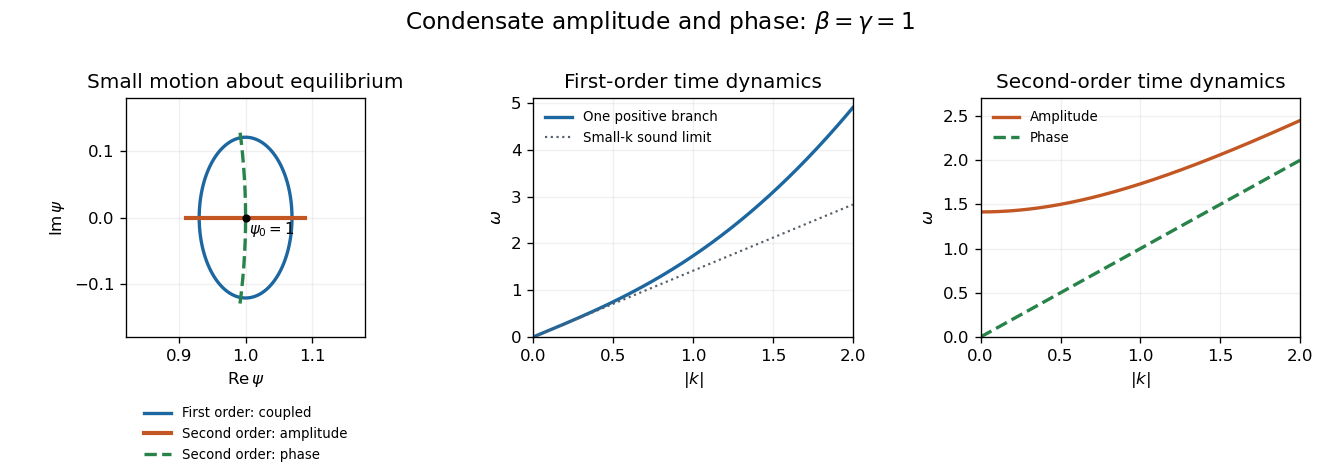

A weak neutral Bose condensate realizes the first-order structure and its sound-like Bogoliubov spectrum. A particle–hole-symmetric effective complex field can realize the second-order structure, with a gapless Goldstone mode and a distinct amplitude mode. A neutral BCS superfluid likewise has collective phase and amplitude responses, although the amplitude response near pair-breaking energy need not be a sharp undamped particle; its fermionic quasiparticles are separate excitations.
In a charged bulk superconductor, long-range Coulomb interactions and electromagnetic dynamics remove the neutral sound-like phase branch from the low-frequency spectrum. The Anderson-Higgs mechanism in a superconductor produces a longitudinal plasma mode, schematically in an appropriate long-wavelength model. The amplitude scale is typically associated with in a simple BCS regime, with damping and mixing dependent on material and symmetry. One should not simply retain the neutral Goldstone dispersion after charging the field, nor identify the static Ginzburg-Landau functional alone with a complete time-dependent microscopic theory.
Ginzburg-Landau theory of superconductivity organizes a continuous superconducting transition through a slowly varying complex order parameter. In the simplest isotropic single-component SI model,Here , , changes sign at , and fixes a charge/phase convention. The phenomenological normalization of determines the coefficient values; it should not be confused without qualification with a literal density of independently identifiable pairs.
Microscopic derivation of Ginzburg-Landau theory expands the BCS response near in small gap amplitude and slow spatial gradients. It identifies the complex order parameter with a scaled pair amplitude, supplies the coefficients from the electronic microscopic parameters, and explains the pair charge in the gauge coupling. The agreement is a controlled near-transition limit, not a statement that the truncated local functional remains exact at all temperatures. Lev Gor'kov established this connection explicitly in 1959.[ref]
Microscopic Derivation of the Ginzburg-Landau Equations in the Theory of Superconductivity by Lev Gor'kov. 1959 abstract and derivation: near- reduction and twice-electron charge
Below the transition, minimization gives and condensation-energy density . A variation with respect to givesVariation with respect to gives the supercurrentcoupled to the magnetostatic Ampère law. For nearly uniform amplitude this reduces to London screening and the Meissner effect. The theory supplies two different length scales:The amplitude can vary over the superconducting coherence length, whereas the magnetic field is screened over the London penetration depth.
The surface-energy distinction at explains why type-I and type-II behavior are possible within the same framework. In the type-II regime, quantized winding produces an Abrikosov vortex with a finite core and circulating current. Periodic solutions yield an Abrikosov vortex lattice. Linearization about the normal state gives , while core and field energetics determine the lower entry field. These predictions connect a spatial field theory to measurable vortex patterns and critical fields, beyond a spatially uniform BCS gap equation. Thin-film critical-field observations helped motivate the large- regime; magnetic-decoration experiments subsequently made vortex positions visible.[ref]
Nobel Lecture: Type-II superconductors and the vortex lattice by Alexei Alexeyevich Abrikosov. pp.975–977, film motivation, mixed-state solutions and experimental vortex evidence
These phenomena also enable applications. Type-II conductors support high-field magnets, but flux pinning is needed to limit vortex-motion losses. Phase coherence and fluxoid quantization permit persistent-current loops and interference devices. A weak link supplies Josephson coupling energy, allowing SQUID magnetometry and nonlinear quantum circuits; a junction's detailed current–phase law requires a weak-link model, rather than following automatically from the spatially uniform bulk functional. Microstructure can raise a useful critical current without greatly changing the equilibrium upper field, illustrating the difference between thermodynamic stability and transport performance.
The simple functional has identifiable limits. Far below , the small-gap expansion is uncontrolled; rapidly varying fields can require nonlocal microscopic electrodynamics. Very near a transition in a fluctuating low-dimensional or strongly anisotropic material, mean-field minimization can miss important thermal or quantum fluctuations. Unconventional or multiband pairing can require several order-parameter components and additional gradient couplings. Strong fields can introduce spin-polarization pair breaking omitted by the orbital model. Finally, the static functional predicts equilibrium extrema, not quasiparticle spectra, dissipation, vortex velocities or a unique amplitude-mode frequency without further dynamical input. These are reasons to choose an appropriate extension or a microscopic calculation, not reasons to discard the successful near-transition predictions.
Articles by others on the same topic
There are currently no matching articles.