Put and suppose , so there are interior grid points , . Write . The fixed ends impose homogeneous Dirichlet boundary conditions,For a sufficiently smooth displacement field, the two Taylor series at fixed time givewhere all displayed derivatives on the right are evaluated at . Adding cancels the odd terms, leaving the second-order central differenceSubstitute this finite difference into the wave equation and retain continuous time. The resulting method of lines gives coupled second-order ordinary differential equations,In particular, the first and last equations are and for . With the interior displacement vector only,Equivalently, , , and all other entries vanish. This entrywise definition also covers small , including when . The matrix is a symmetric matrix and a tridiagonal matrix. The spatial approximation has error in Big O notation; time has not yet been discretized.
For a nonzero, time-independent vector , substitute . Taking two time derivatives givesCancel the nonzero exponential to obtain the eigenvalue problemThus an eigenvector specifies a normal mode shape and its negative eigenvalue specifies the square of its angular frequency, . Real displacements are obtained by taking the real part, or by combining the two temporal solutions as .
The interior grid is , with fixed-end displacements . HenceUse the monic characteristic polynomial convention , where is the identity matrix. Expansion of the determinant along the first row givesThe eigenvalues are the roots of a polynomial . With the alternative determinant convention , the characteristic polynomial is because the matrix has odd size; its roots of a polynomial are unchanged.
For each row, a Gershgorin disc has centre and radius . Here and , so the Gershgorin circle theorem givesSince is a real symmetric matrix, its eigenvalues are real. Intersecting the union of these Gershgorin discs with the real axis yieldsThis bound permits zero but does not assert a zero eigenvalue. The fixed-end Dirichlet boundary conditions exclude it: for any nonzero real vector , extend by and calculateIndeed, equality would force every adjacent value to agree with the zero endpoint. Thus is a symmetric positive-definite matrix, is a negative-definite matrix, and the eigenvalues satisfy . The same argument works for any number of interior grid points, with prefactor in the sum. The fixed string has no zero-frequency rigid translation.
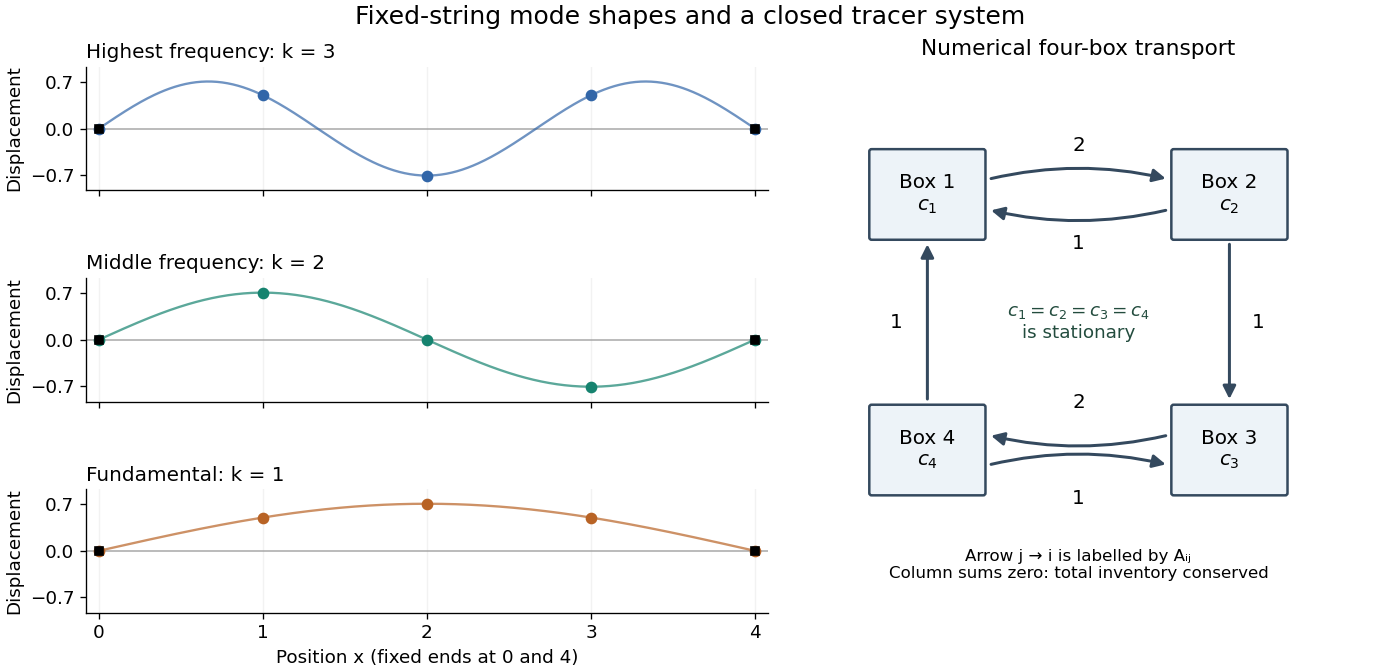
Each supplied eigenvector gives relative displacements at in a standing wave. Insert zero at to describe the whole sampled string. A real normal mode is : its shape stays fixed while its amplitude oscillates.
- is the highest-frequency resolved normal mode. Adjacent interior displacements alternate in sign: the middle point moves opposite to both outer interior points. Its interpolated shape has three lobes, corresponding to the third string normal mode.
- is the middle-frequency normal mode. The midpoint is a node of a standing wave, and the two sides move in opposite directions. It corresponds to the second string normal mode.
- is the lowest-frequency normal mode, corresponding to the fundamental frequency. All interior points move in the same direction, with greatest displacement at the centre; the only nodes of a standing wave are the endpoints in the smooth shape through these samples.
These semidiscrete fixed-string normal modes are samples of , with in the order listed. More precisely, their interior vectors are , which have unit Euclidean norm and form an orthonormal basis of . Their eigenvalues and angular frequencies obeyThus larger absolute value of a negative eigenvalue means faster oscillation, rather than faster decay. The numerical angular frequencies approximate the continuous fixed-string values ; the finite difference spatial approximation changes them. Only three independent interior normal modes exist on this grid, and any interior displacement or initial velocity vector can be expanded in this orthonormal basis.

Articles by others on the same topic
There are currently no matching articles.