Thermoelectric cooling uses the Peltier effect to remove heat from a load using electrical work. A typical thermoelectric module connects many pairs of different semiconductors electrically in a series circuit and thermally in parallel between two faces. For an idealized pair with , positive conventional current crosses n to p at the cold bridge and p to n at the hot return. With common bridge material and isothermal contacts, the intervening metal contributions telescope: the net pair coefficient is . For identical pairs define the module Seebeck coefficient .
Choose fixed face temperatures , , module electrical resistance and open-circuit thermal conductance . All three module parameters are constants over the chosen operating range. Positive is the orientation absorbing Peltier effect heat at c. Define as net heat extracted from the cold reservoir per unit time, as net heat delivered to the hot reservoir per unit time, and as electrical power entering the module. Despite the conventional letters , both denote power in watts, not accumulated energy. Ferrotec gives the corresponding single-stage equations and distinguishes module performance from bypass leaks.[ref]
The chosen steady-state model isHere is the terminal voltage drop along positive electric current through the module. Its Seebeck effect term opposes the cooling supply. The cold Peltier effect term removes heat; Joule heating and returning heat conduction reduce the available cooling. At zero electric current, : the passive leak warms c and removes heat from h, consistent with the stated signs. Subtracting the two face equations cancels heat conduction and gives the electrical power, an independent conservation of energy check.
The factor one half is an ideal-model result, not a universal rule for every contact. To see its origin, let run from cold to hot along a uniform equivalent leg of length , cross-sectional area , electrical resistivity and thermal conductivity . With constant coefficients, insulated sides and no Thomson effect, steady conservation of energy givesThe Fourier's law heat current in the positive direction is . At it equals , and at it equals , using and . Adding the local transported heat current gives the two face equations. Summing equivalent legs preserves this accounting. Nonuniform material properties, side losses or asymmetric contact dissipation require a revised model.
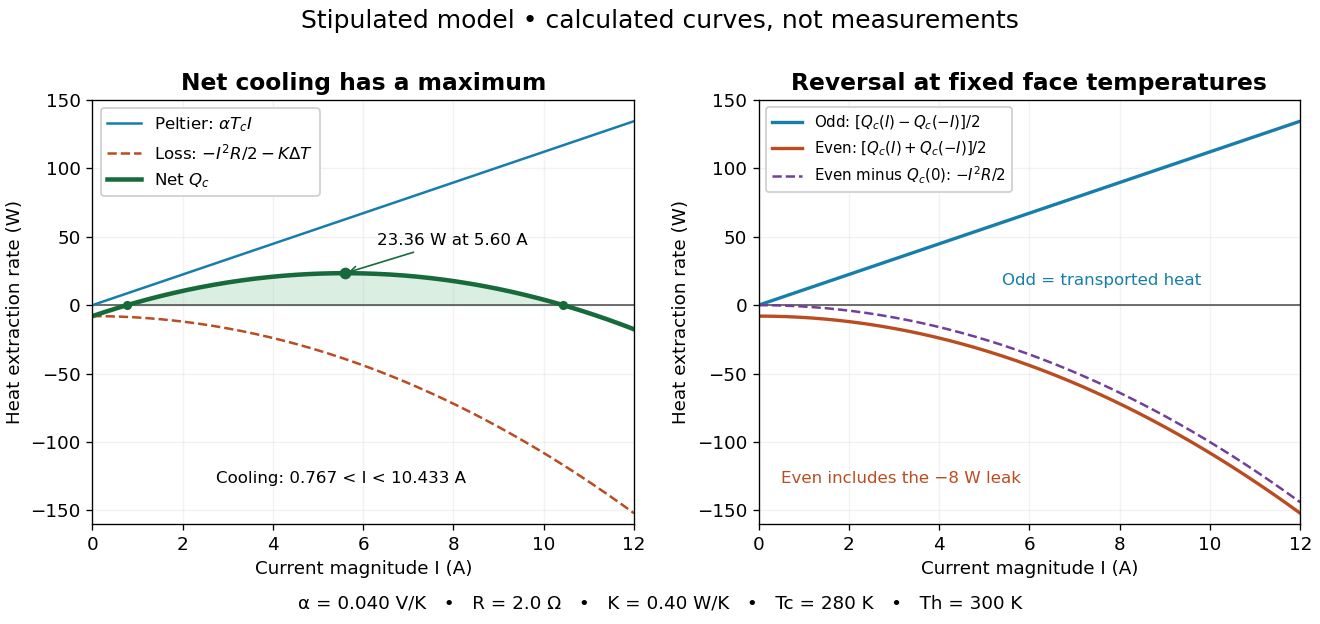
For an original toy module, stipulate , , , and . At ,The coefficient of performance is defined here only for refrigeration with and . The hot-side assembly must remove , not just the extracted . These are stipulated calculations, not measurements or a commercial module specification.
At the same fixed face temperatures but , the same boundary definitions give , , and . The formerly cold face is now heated; the formerly hot reservoir supplies . Still . Reversal changes the linear terms, while and the leak at fixed temperatures remain unchanged. Holding the old labels fixed makes this check meaningful.
The corresponding steady entropy production of the module is the outgoing reservoir entropy minus the incoming reservoir entropy:The Peltier effect terms cancel because they carry the same entropy at each end. This cancellation explains the reversible coupling; it does not make finite-resistance operation reversible. In the toy example the two positive contributions are approximately and , giving for either current direction. In cooling operation, combining this inequality with the energy balance gives the Carnot refrigerator limit , equal to for these reservoir temperatures. A coefficient of performance above one would describe transported heat per electrical work, not the creation of energy.
At fixed face temperatures, differentiation of the thermoelectric cooler energy balance givesThus current chosen for maximum cooling power is not automatically current for maximum coefficient of performance. Cooling exists only when , and then only between the two positive rootsAt equality the parabola merely touches . For the toy module the interval is approximately , with and . At , the object is heated even in the nominal cooling polarity: . This mathematical interval supplies no permission to exceed an actual device's current or temperature ratings.

The fixed-face constraint matters. With fixed but a freely cooling object, must be solved from its heat load and leaks rather than held at while claiming an arbitrary temperature drop. For zero load and optimal current, the same model givesHere has units and is a module parameter. The toy model gives and when . This is an ideal zero-load limit with stipulated constant properties; cooling a real load requires above zero and reduces the attainable drop. Contact thermal resistance, a warming heat sink, external leaks and temperature-dependent coefficients further change the result. Electrical control is convenient, but conservation of energy still requires a thermal path that removes the extracted heat plus the electrical input.
Articles by others on the same topic
There are currently no matching articles.