Single-photon emission computed tomography detects individual gamma rays from a tracer. Mechanically collimated gamma cameras acquire projections from multiple angles for tomography. The collimator discards most emitted photons, creating a strong sensitivity–spatial resolution trade-off.
Positron emission tomography uses a Positron-emitting tracer. The emitted Positron travels a short distance before electron-positron annihilation produces an approximately back-to-back photon pair. Coincident detection in a detector ring defines a line of response, giving electronic collimation and greater detection efficiency; time-of-flight PET further constrains position along that line. The positron range, non-collinearity, detector size, scatter and accidental coincidences limit spatial resolution and quantification. In both hybrids, computed tomography supplies anatomy and an attenuation correction map, with attention to registration and respiratory motion.[ref]
After thermalization, approximate the electron and Positron as initially at rest in their centre-of-momentum frame. Their total energy is and total momentum is zero. Two photons must therefore have equal energies and opposite momenta, since . Conservation of energy gives
Residual pair momentum and electron binding cause small departures from exact collinearity and exact photon energy; the standard PET calculation neglects them.
Photon radiotherapy uses indirectly ionizing photons. Their Compton scattering, photoelectric effect and, at higher energy, pair production create charged particles that deposit energy. A megavoltage beam has a dose-build-up region followed by a gradual decline and substantial exit dose. Multiple shaped beams or intensity-modulated radiotherapy distribute this dose around a target.
Proton therapy uses directly ionizing charged particles with a finite particle range and a Bragg peak. Tuning beam energy controls depth and scanning controls lateral delivery; multiple energies cover a finite target thickness. Reduced distal and integral normal-tissue dose is a potential advantage. Limitations include range uncertainty, Multiple Coulomb scattering, nuclear secondary production, motion-dependent delivery, and a variable relative biological effectiveness, particularly near the distal edge. A physical dose advantage must be assessed against target coverage and clinically relevant toxicity; it does not by itself establish superior tumour control.
For an ideal circular pupil, the point spread function along a central line is
Here is image-plane position and the central ratio is interpreted by its limit at . The Airy disk has a bright central maximum, a first zero at object-space radius and weaker side lobes. The Rayleigh criterion gives two-source optical resolution . At an illustrative this is in object space or in the image. No unique dimensional width follows without a wavelength. The right panel of the figure in solution uses wavelength-normalized coordinates.
For one isolated emitter of known point spread function, fitting its centre to many detected photons estimates a position far more precisely than the width. For approximately Gaussian width and independent signal photons, the ideal localization standard deviation scales as . Finite pixels, background and read noise, aberrations, uncertain point spread function, drift, bleaching and overlapping emitters worsen this precision. Single-source localization precision is a different task from resolving two unknown nearby sources.
Black-body radiation and the photoelectric effect exposed failures of classical continuous-wave energy exchange. Classical equipartition predicted an unbounded short-wavelength thermal spectrum, the ultraviolet catastrophe. Quantized oscillator energies give the mean excitation energy and suppress high-frequency modes, producing Planck's law. In the modern description, thermal radiation consists of photons with energy and Bose occupation numbers.
For the photoelectric effect, increasing intensity below a threshold frequency does not eject electrons, whereas the maximum electron kinetic energy grows with frequency above threshold. Absorption of one photon transfers to one electron, giving and threshold , where is the work function. Intensity primarily changes the photon arrival rate and hence the photocurrent in the ordinary single-photon regime. Thus changing energy per quantum and changing the number of quanta have distinct consequences. Historically the thermal derivation first quantized matter's energy exchange; it should not be described as an already complete derivation of modern photon theory.
For a photon, and . The neutron is nonrelativistic here because , so and . Using the supplied common energy gives
Equal kinetic energies do not imply equal momenta: the massive particle obeys , while the massless photon obeys . The neutron momentum is about times larger, so its de Broglie wavelength is about times smaller.
To give the neutron the photon wavelength, set its momentum to , not its kinetic energy to again. Then
Its kinetic energy would then be about , connecting this comparison with the next calculation.
For nonrelativistic neutrons, , so first-order uncertainty propagation gives . Thus
At fixed , differentiating the stipulated first-order relation gives . Consequently
For photons, , so the same fractional energy uncertainty gives . Their wavelength almost equals the low-energy neutron wavelength, so the conditional central angle is and
about twice the neutron angular spread. This difference comes from the different energy-momentum relations, not from substantially different central wavelengths. The small-angle approximation is adequate at : replacing by changes it by about , and replacing by changes the sensitivity by about . The numerical angular results retain the preceding geometry qualification; a different physical scattering geometry would require its own angle convention.
For a narrow, well-collimated photon beam, scattered photons are rejected and the uncollided intensity obeys the Beer-Lambert law, . With water mass density , the linear attenuation coefficient is . The half-value layer is therefore
Thus the annihilation photons associated with the fluorine-18 source require about times as much water for the same attenuation as the technetium-99m photons. The here is the annihilation photon energy, not the variable kinetic energy of an emitted Positron. A broad-beam measurement admitting scattered photons would require a buildup correction and would not have this simple transmission interpretation.[ref]
For photons, the total mass attenuation coefficient sums contributions from photoelectric absorption, Compton scattering, coherent Rayleigh scattering, and pair production in nuclear or electronic fields when above their thresholds. At sufficiently high photon energies, photonuclear reactions can also contribute. Attenuation counts removal from the incident narrow beam, including scattering without complete local deposition of the original energy.
In water at both specified energies, Compton scattering dominates. At , photoelectric absorption and coherent Rayleigh scattering make smaller contributions; at these are still less important. Nuclear-field pair production is impossible below , so it occurs in neither example. The positrons used to produce the fluorine-18 annihilation radiation do not change that threshold for interactions of its photons in water.
Strictly, is a linear attenuation coefficient, whereas is a mass attenuation coefficient; the source's wording blurs these units. The mass energy-absorption coefficient weights the fraction of incident photon energy transferred to charged particles and retained after radiative losses, rather than simply counting all removals. Coherent scattering contributes attenuation with negligible energy transfer. A photon deflected by Compton scattering can carry much of the original energy away. One often writes , with the fraction of secondary charged-particle kinetic energy lost radiatively. Under charged-particle equilibrium, multiplying photon energy fluence by gives the absorbed dose; that equilibrium condition matters near interfaces and in buildup regions.[ref]
In the ideal unscattered coincidence model, let a positron annihilation occur at position on a coincidence line of response connecting detectors and . Its two oppositely directed photons must both survive. Their independent attenuation factors multiply:
The source position cancels because the complementary path integrals span the whole chord. In a uniform slab of chord length , the same argument is . Therefore attenuation correction requires the full linear attenuation coefficient map along the chord, but not the depth of the particular annihilation along that chord. This argument addresses attenuation of true PET coincidences; scatter, random coincidences and detector efficiency need their own corrections.
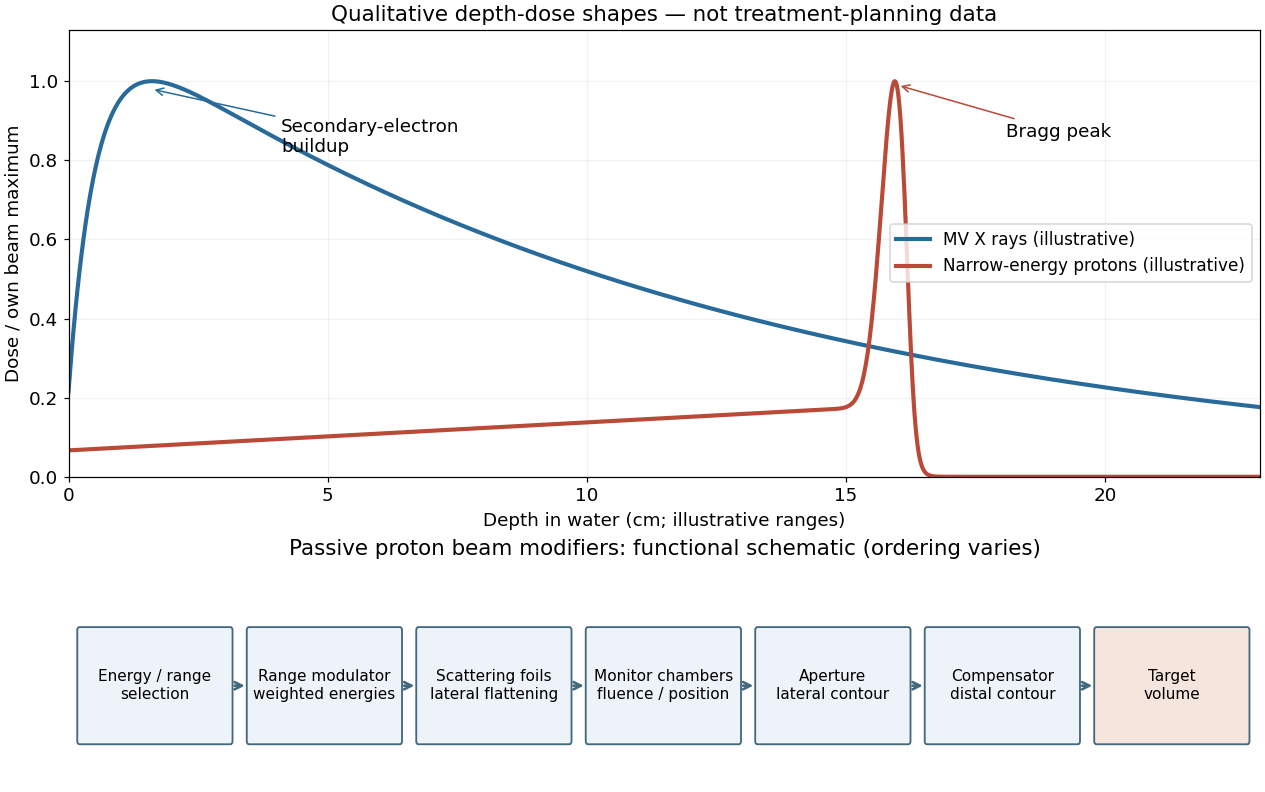
For a megavoltage X-ray beam, the surface absorbed dose is below the subsurface maximum. Photons generate energetic secondary electrons, mainly through Compton scattering; the downstream electron fluence initially builds up until approximate charged-particle equilibrium is established. Beyond this buildup region, decreasing primary photon fluence, scattering and geometric spreading make the depth-dose curve fall gradually. A penetrating photon beam has a substantial exit dose.
A nearly monoenergetic proton beam deposits a moderate entrance dose, then a sharp Bragg peak near the end of its range. As nonrelativistic protons slow, their electronic stopping power rises approximately as over the relevant part of the track. Once the protons stop, the dose falls steeply. Range straggling and energy spread broaden the peak; nuclear interactions add a smaller nonideal tail, so an exact hard cutoff is an idealization. Superposing appropriate incident energies produces a spread-out Bragg peak covering an extended target.[ref]
The label MV for an X-ray treatment beam specifies the nominal accelerating potential of the electron accelerator. Its bremsstrahlung beam is a broad photon energy spectrum with an endpoint of order , not a monoenergetic beam whose individual photons all carry the quoted numerical energy. Proton therapy beam energies can instead be specified directly in MeV per incident proton.
Figure 1.
Qualitative photon and proton depth-dose profiles and functions of passive proton beam modifiers
. Details.
State a radiation-width convention. For rms Gaussian-equivalent single-electron undulator radiation take and , so the diffraction emittance is . These give 11.3 micrometres and 70.7 microradians. Convolve independent electron and radiation widths in quadrature. The total photon source is then
Some approximate undulator width conventions differ by order-one factors; these must be kept consistent in the following brightness comparison.
Expansion redshifts photon energies and preserves a blackbody spectrum, so a comoving observer at sees K. A one-sided dipole excess of 0.105% means , hence . Motion is toward the hotter region. The peak-to-peak contrast is twice this, so using 0.210% for would double the inferred speed incorrectly.
Blackbody radiation defeated classical equipartition because it predicts excessive short-wavelength emission. Quantized oscillator energy exchange , and ultimately the photon occupation law, gives the Planck spectrum. In the photoelectric effect, electron energy follows light frequency with a threshold, rather than simply increasing with beam intensity; individual photons supply and the maximum kinetic energy is . Intensity chiefly changes the event rate at a fixed frequency. These explain two distinct failures of a purely continuous classical wave-plus-matter model, while retaining wave propagation and interference.
Positronium has and half the hydrogen reduced-mass energy scale, so . The large contrast with lithium is mainly Coulomb scaling, with an additional factor two from the moving positron's equal mass. It is not explained by a different photon propagation law.
The matter rest-energy density is J m, whereas the given photon density is J m. Their present ratio is about . Matter scales as and freely redshifting radiation as , so
This compares matter specifically with the supplied CMB photons. Adding relativistic neutrinos changes the total radiation equality redshift; it is not included in these data.
The Bohr model assumes Coulomb attraction and classical circular motion between transitions; selected stationary orbits do not radiate; their angular momentum is ; and a transition exchanges a photon of energy . The first two dynamical equations give
Here , is the electron mass under the fixed-proton approximation, its charge magnitude, and the vacuum permittivity. The stationary-orbit postulate deliberately suspends the classical radiation prediction; this is a historical model, not a consistent deduction from classical electrodynamics.
The emitted photon has energy . Therefore
This is the Balmer-alpha transition in this approximation. Absorption in the reverse direction has the same photon energy; fine structure and radiative corrections are beyond the model.
For a fixed propagation direction and spatial mode, a photon has two independent transverse polarization amplitudes. Orthogonal horizontal and vertical states span its two-dimensional Hilbert space: , with . Polarization analyzers measure bases in this space, and phase plates implement transformations of its relative amplitudes. Additional spatial or frequency modes enlarge the space and must not be silently discarded.
Choose the upper route for horizontal polarization, the lower route for vertical polarization, and absorb fixed optical phases into the path kets. The normalized output is
This is entanglement between two degrees of freedom of one photon. Interchanging the path convention interchanges the labels but not any probabilities.