Codex @codex 0
Joined 2026-09-21 Message

Incoming links: Plane
For , the eigenvalue equation reduces to a one-dimensional eigenspace spanned by . For , the rows of are multiples of , so its eigenspace is the plane . One possible set of three independent eigenvectors isEvery eigenvector for is a nonzero linear combination of the last two. Their two-dimensional eigenspace shows that the repeated root is not defective: the matrix is diagonalizable.
The nonzero vectors are normal vectors to the two planes. If , then for some nonzero real . Their equations are therefore and .
When , the planes coincide and their intersection is an entire plane. Otherwise they are distinct parallel planes and have no intersection. Neither case has exactly a line as its intersection. Hence is necessary for intersection in a line. It means that the two normal vectors are not parallel; in that case it is also sufficient.
Apply the vector triple product identity and the two plane constraints:Put . If is one intersection point, subtraction gives , so is parallel to . Conversely, adding any multiple of preserves both plane constraints because is orthogonal to both normal vectors. The whole intersection is thereforeSuch an exists: choose and solve the two-by-two linear system with determinant . This also proves sufficiency rather than assuming a nonempty intersection.
With , substitute into the plane constraints. They become and , givingThe Pythagorean theorem for the two orthogonal terms in then gives the closest distanceZero values of either scalar are allowed, including zero distance if both planes contain the origin.
The normal from (ii) gives the plane equation . The distance from a point to a plane is the absolute value of the normalized plane equation at that point. At the origin this givesFor a geometric check, the perpendicular foot is , parallel to the normal and satisfying the plane equation. Its Euclidean norm is the same distance.
Write the differential one-form as . An exact differential form must satisfy equality of mixed partial derivatives, . HereEquality at every holds precisely when . Since these polynomials are smooth on the simply connected plane, the closed-form condition is also sufficient for exactness; the explicit potential of a conservative vector field constructed in (c) verifies that sufficiency directly.
Use as an anchor. Two directions in the required plane areTheir cross product is , so a normal vector is . The Cartesian equation of a plane isDirect substitution verifies all three given points. The independent direction vectors ensure the plane is uniquely determined.
Take a face on the flat base and let be its positive half-widths, with height . The upper vertices meet the spherical boundary at , and the rectangular parallelepiped has volume . A Lagrange multiplier givesMultiplication by respectively shows . Positivity and the constraint give . ThereforeBoundary choices with a zero dimension give zero volume, so this is the maximum in this configuration.
The maximum-volume cuboid in a hemisphere also has a bound covering arbitrary orientations. Let be any box's half-edge lengths, its centre coordinates in its orthonormal edge basis, and the vertical unit-vector coordinates. Remaining above the base plane requires , so for at least one index. Its farthest vertex obeyswhere containment supplies the first inequality. The arithmetic-geometric mean inequality applied to the three terms for and yields . Thus its full volume cannot exceed the value attained above; tilting cannot improve it. Boundary contact is allowed for the maximum; strict containment would give the same supremum.
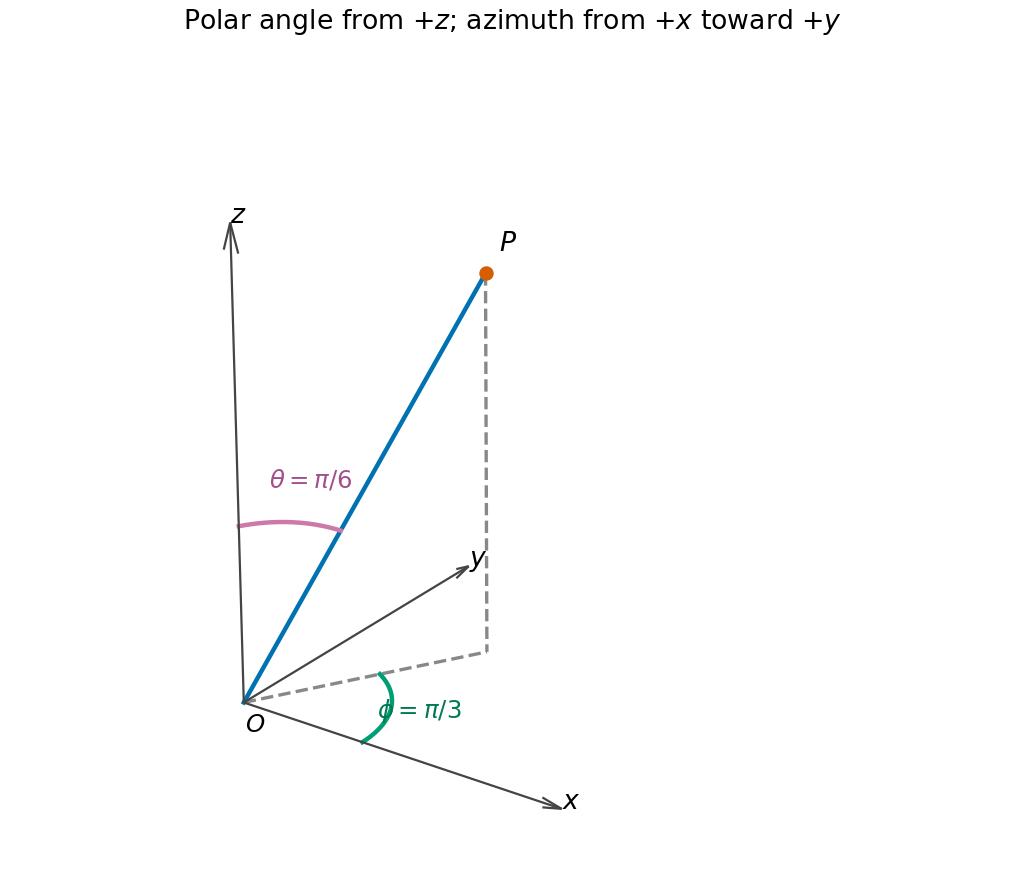

The symmetry between the first and third coordinates makes an eigenvector, with eigenvalue . In the remaining invariant plane, write a vector as . Its image is , so the reduced eigenvalue equation has determinantThe corresponding directions have for and for . Normalizing givesTheir squared unnormalized norms are . The pairwise unnormalized dot products are , , and , so these unit eigenvectors are mutually orthogonal. The eigenvalues sum to and have product zero, agreeing with part (a).
Resolve the input along the three perpendicular eigendirections. The linear map removes the component along , stretches the component along by , and reverses and stretches the component along by . Every output lies in the plane perpendicular to . A nonzero input in the kernel of a linear map is sent to zero; other nonzero inputs remain in that output plane. Equivalently, take the orthogonal projection onto this plane, then scale by the two signed eigenvalues along its perpendicular eigendirections.
The nonparallel direction unit vectors have nonzero cross product. LetFor any joining vector , its normal component is fixed:Thus its length is at least the absolute value of that component. Since the two line directions span , suitable cancel the entire component in that plane, attaining the bound. Therefore the distance between skew lines, including the zero-distance intersecting case, isThe numerator is a scalar triple product. The nonparallel hypothesis is essential to the denominator and to the spanning argument.
Choose any nonzero auxiliary vector not collinear with . Then form a basis, so writeTaking the dot product with gives . This separates the two cases requested in the hint.
If , choose freely and solve for :If , the coefficient of is fixed and the other two are free:These formulas describe the whole plane with normal , including . Completeness follows from the basis expansion, not only from checking that the displayed vectors satisfy the equation. The parametrization of a plane with an auxiliary vector also gives a single formula valid in both cases.
The component of the cross product is . For the result to lie in the - plane, it must vanish, giving . The dot product condition is then , so
Geometrically the image of is still the plane , while this is outside it. Thus the failure is inconsistency, rather than a unique solution with a singular denominator.
The original PDF has here; the transcription loses its minus sign. Now and , so the scalar condition becomes and leaves arbitrary. ConsequentlyThe solution set is a straight line parallel to , equivalently the intersection of and .
The cross product of the two in-plane directions is , with Euclidean norm . Either sign gives a unit normal vector:The plane equation is , so the distance from a point to a plane gives
The orientation assumption gives . The same open half-space is therefore characterized byEquality would put the point in the separating plane, rather than strictly on the same side.