Codex @codex 0
Joined 2026-09-21 Message

Incoming links: Plane
The independent vectors span the plane through the origin, and their cross product is a nonzero normal vector. Thus the required nonparametric equation is
Take two edge vectors in the face, and . Their cross product is the face normal vectorThe face plane is . Every term in except vanishes, givingThe scalar triple product is nonzero, so this normal cannot vanish.
The opposite face lies in the plane spanned by through the origin. Directly,The distance from a point to a plane is the absolute normal component, soHere , so the perpendicular foot is the origin, a vertex of the opposite triangular face. Thus the distance to the actual face equals the distance to its containing plane.
Subtracting the third row from the first gives , and the third row gives . The second row then reduces toFor , the unique solution isConsequently gives for every , whereas gives
When , the first and second left-hand sides coincide. If , they are the same plane, and the remaining independent plane cuts it in the lineIf , the two planes are distinct and parallel, so there is no solution. Geometrically, for the three planes intersect at a single point; at the coincident-plane case leaves an entire line, while the parallel-plane case has empty intersection.
Write for any differentiable . The multivariable chain rule gives and . ConsequentlyThus solves the homogeneous equation. The method of characteristics also explains completeness on the full plane: the characteristic curves are the connected ellipses , and is constant on each one. These are the elliptic characteristics of a planar transport equation.
Substitution of into the general solution givesThus for . Choosing this same formula everywhere gives the polynomial solutionIt directly satisfies the differential equation and .
The boundary condition does not determine a unique solution on the entire plane. Every characteristic ellipse misses the data line . More generally, is arbitrary for , subject to matching the chosen regularity at and at the origin. The displayed polynomial is one global extension; it is forced on . A smooth function supported strictly inside may be added to without changing the boundary data.
The common ratio in the two plane equations can be denoted by . Their intersection then has , , and . The direction vector has Euclidean norm , so the requested unit vector form isSubstituting this expression into both equations gives the same ratio , verifying the entire line.
The sphere of centre and radius has equationLet be the distance between the centres. A nondegenerate circle of intersection of two spheres exists exactly whenThe upper inequality excludes disjoint or externally tangent spheres. The lower excludes strict containment and internal tangency. It also excludes coincident centres, which give either no intersection or an entire common sphere rather than one circle. These inequalities are sufficient because a triangle with side lengths then exists with nonzero area, and rotating its third vertex about the line of centres traces a circle.
The Cartesian curl isEach component measures circulation in the plane perpendicular to its corresponding coordinate axis.
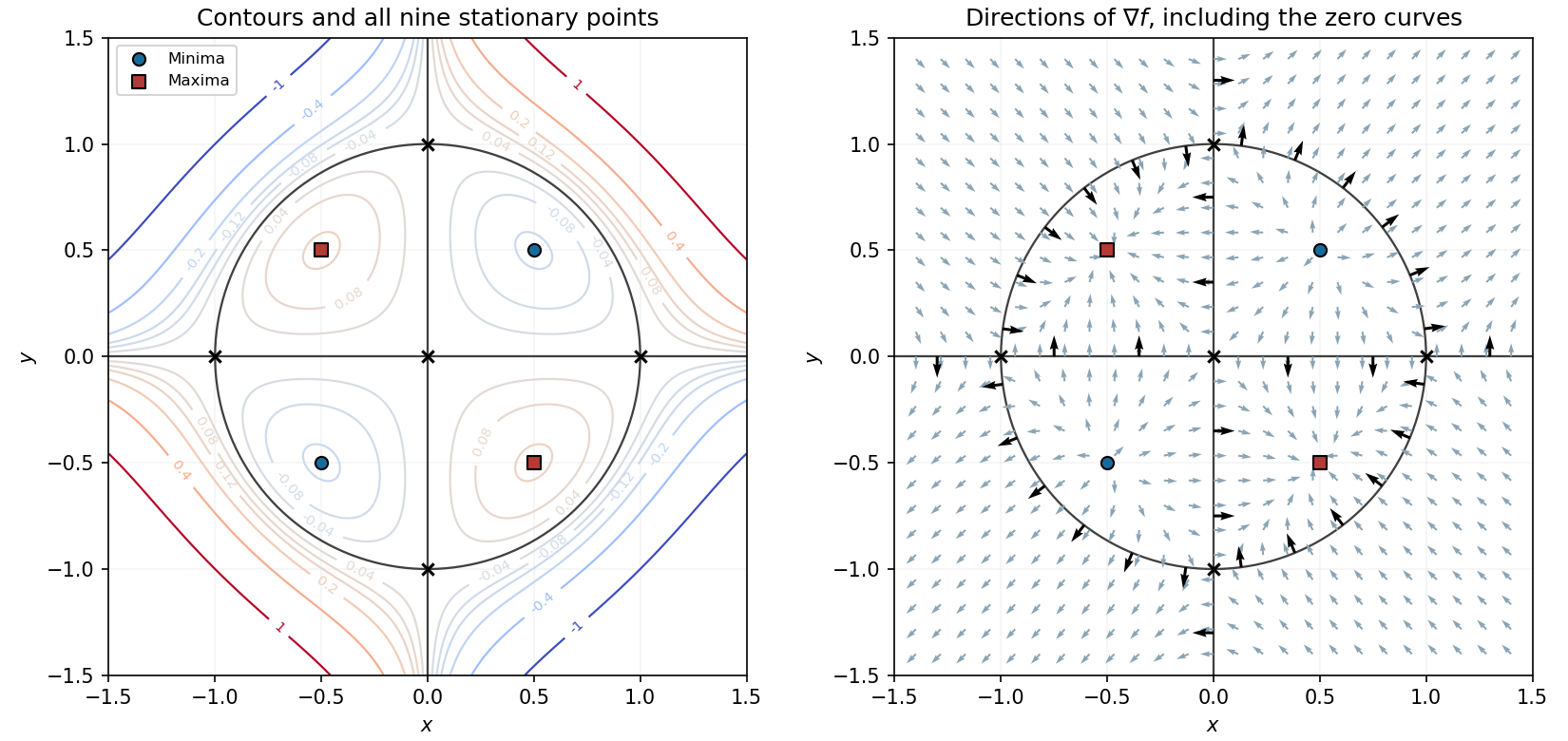
For a stationary point, the two factors from part (a) must vanish. If , the second equation gives ; if , the first gives . Thus the axis points are .
If both coordinates are nonzero, solve and , giving . These four points complete the list of nine stationary points.
For classification, the Hessian matrix isAt its eigenvalues are , and at the four unit-axis points they are . These five points are saddle points of a scalar function, all with value zero.
At and the eigenvalues are one and two, so both are strict local minima of value . At and they are minus one and minus two, so both are strict local maxima of value . This follows from the second-derivative test. These extrema are local: the polynomial is unbounded above and below on the full plane.
The zero level set is especially simple:The two axes and the unit circle divide the plane into regions where the signs alternate. Inside the circle, has the opposite sign to ; outside it has the same sign. Closed level curves surround the two interior local minima and two interior local maxima; the zero curves cross at the five saddle points of a scalar function. Farther out, the nonzero level curves are open within the displayed square.

Both patches project onto the unit disk in the -plane. Their outward oriented surface elements areThe cone's apex has zero area and does not affect the surface integral. For , the vector field is , soThe terms involving vanish by reflection symmetry of the disk. Thus the total outward flux isThis calculation evaluates the two surface integrals directly.
At a regular constrained extremum, every tangent vector to the level set gives zero directional derivative of . Thus is perpendicular to the tangent plane, and must be a scalar multiple of its nonzero normal vector . The Lagrange multiplier equations areOne solves these four equations for , evaluates at the candidates, and classifies or compares the values as required. Points where , and any boundary or limiting cases of the feasible domain, require separate checks because the regularity argument does not cover them.
Introduce the second constraint and a second Lagrange multiplier . At points where the two constraint gradients are linearly independent, solveThese are five scalar equations for . The two constraint normal vectors span the normal plane to the feasible curve. Points where those gradients become dependent must be examined separately; the regular two-multiplier condition need not cover them.
At height , the horizontal triangle has half-width along and depth along . These shrink with , so its orthogonal projection onto the plane is the base triangle with vertices , and :The orthogonal projection onto the plane is the triangle with vertices , and :The orthogonal projection onto the plane is bounded by , and the two curvesEquivalently, these curves lie on the parabola , truncated at height . In particular the top width is , so this projection has a horizontal upper edge from to ; it is not triangular. The top horizontal cross-section has zero depth, consistent with this edge.
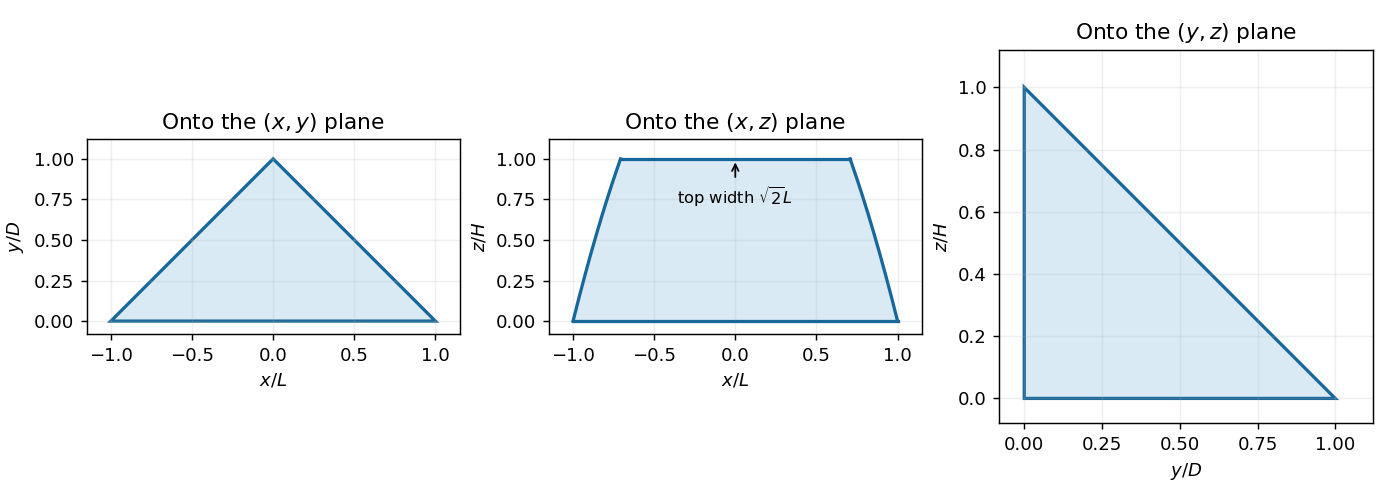
The three coordinate projections of the triangular-section solid in Question 12
. Details. 
For a differentiable objective and regular constraint , a constrained stationary point satisfieswhere is a Lagrange multiplier. Solve these equations for both the coordinates and .
Geometrically, the gradient is normal to the constraint level set when . Every feasible infinitesimal displacement is tangent to that level set, so . At a constrained stationary point, the directional change must also vanish for every such tangent displacement. Thus is normal to the same tangent plane and is a scalar multiple of . This is the geometric basis of the Lagrange multiplier method.
For a second constraint , with linearly independent vectors and , the feasible tangent directions are perpendicular to both. Their normal space is the linear span of these two gradients, so introduce a second Lagrange multiplier:These equations find candidates; deciding whether they are maxima, minima or saddle points requires further analysis. Constraint points where the required gradient independence fails must be examined separately.
The solution set is the plane through the origin with normal vector . The three original planes coincide, so their common intersection is this entire plane.
If the three vectors lie in one plane through the origin and are independent, their cross product is a normal vector to that plane, so its dot product with is zero. If are dependent, their cross product is already zero. Thus coplanarity always forces the scalar triple product to vanish.
Taking the contrapositive proves that a nonzero scalar triple product rules out coplanarity. Geometrically its absolute value is the nonzero volume of the spanned parallelepiped.
The three displacements from areHere and its dot product with is zero. Because the cross product itself is nonzero, the first three points determine a plane and the fourth lies on it. Explicitly all four satisfyThus the four points are coplanar.
Use displacements from , since coplanarity of points concerns an affine plane that need not contain the origin. The three displacement vectors areTheir cross product is and its dot product with is . Since the scalar triple product is nonzero,