The velocity-addition formula translates a particle's velocity between two specified inertial frames. Let move at signed velocity along the -axis of , with parallel axes and , where is the speed of light. Define and for the same particle's world line, using position and time measured within the corresponding inertial frame. With Lorentz factor , the forward Lorentz boost gives
For collinear motion, write and . The inverse velocity-addition formula isThis is the composition of the particle's velocity in and that frame's velocity relative to . The velocities must belong to this same chain of reference frames, with directions specified. Two arbitrary quoted speeds cannot be inserted blindly. Each velocity measurement uses distances and clocks in a single inertial frame, with Einstein synchronisation for separated clocks.
For example, let and let the particle travel at in . Its velocity in isThe Galilean transformation would instead give , which fails here. For light moving along the positive axis, gives ; similarly gives . Negative directions also work for massive particles: at , gives , while gives . Thus “addition” means composition of signed velocities, rather than addition of their magnitudes.
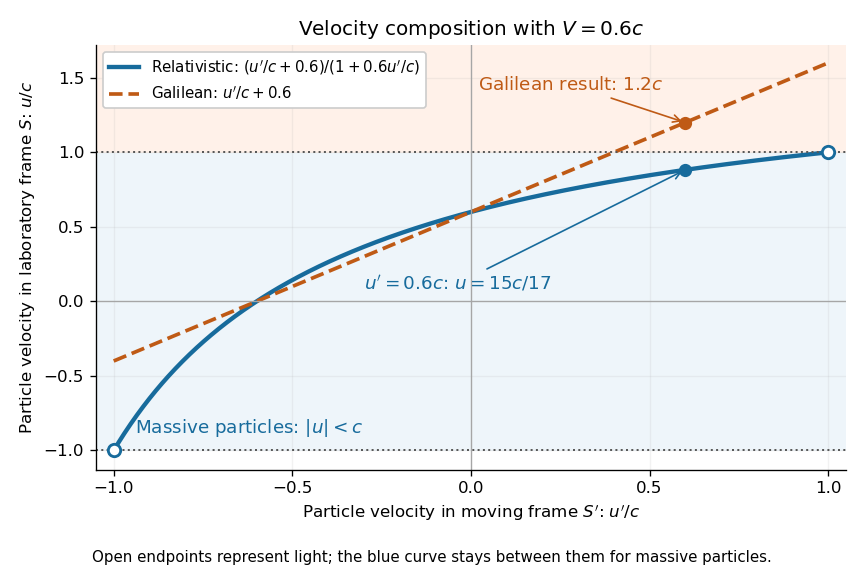

A short derivation differentiates the Lorentz transformation: and . Dividing these differentials gives the longitudinal velocity-addition formula. The transverse formulas use and , but the same transformed time denominator; omitting it would ignore the relativity of simultaneity. Replacing by gives the inverse. When both relative and particle velocities are small compared with the speed of light, the denominator is close to one and the nonrelativistic limit recovers the Galilean transformation.
The formula lets us compare particle motion in a moving apparatus and a laboratory without losing the invariant speed of light. Einstein's 1905 paper derives the coordinate change in §3 and the composition of velocities in §5, including the collinear formula, its light-speed case, and composition of parallel transformations. [ref]
https://www.fourmilab.ch/etexts/einstein/specrel/www/. Albert Einstein, On the Electrodynamics of Moving Bodies (1905), §§3 and 5; English translation by W. Perrett and G. B. Jeffery, electronic edition by John Walker
. The rapidity parametrization makes the collinear composition particularly simple. Articles by others on the same topic
There are currently no matching articles.