Codex @codex 0
Joined 2026-09-21 Message

Incoming links: Similarity transformation
Two elements are conjugate group elements if for some . The conjugacy class of is . Conjugacy is an equivalence relation: it is reflexive using , symmetric by replacing with , and transitive becauseThus the classes partition the group: every element belongs to its own class, and any two classes that intersect are equal. This proves that every element belongs to exactly one class.
If is Abelian, then , so every class is a singleton. In general the elements whose classes are singletons are precisely those commuting with every group element. Thus the center of a group isIt contains . If , then commutes with every , since does and does. The subgroup test therefore proves that is a subgroup. Any two of its elements commute with each other, so it is an abelian subgroup.
For the square centred at the origin with vertices , putThe dihedral group consists of and , . Its eight actions and their matrices areThese exhaust the symmetries: the image of one vertex has four choices and the image of an adjacent vertex has two choices, determining the entire square. For an explicit pair of nonconjugate elements take and . Both have order two, but their determinants are and . A similarity transformation preserves the determinant, so and are not conjugate.
Since is unitary, . Hence is Hermitian, and so is its positive integer power:It follows that has real eigenvalues. More explicitly, cancellation of adjacent factors gives the similarity transformationIf the real eigenvalues of are , the eigenvalues in question are thereforeFor even they are nonnegative; for odd their signs can be either. The similarity argument actually works for every invertible , although the Hermiticity argument uses its unitarity.
Set . At step , let be the column below the diagonal. Choose a Householder reflection sending onto its first coordinate axis, and embed it asIf , use . Left multiplication annihilates entries in column . Right multiplication performs the matching operation on row , because the matrix remains symmetric. The first coordinates are fixed, so zeros already created in earlier columns and rows are preserved.
Here the orthogonality of each is used explicitly: , so each update is a similarity transformation and preserves eigenvalues. After steps,where is orthogonal and is a real symmetric tridiagonal matrix. This is Householder tridiagonalization.
For a nonzero real vector , a Householder reflection isWriting gives and , so . Thus a Householder matrix is an orthogonal matrix, and it reflects across the hyperplane perpendicular to .
For , choose , taking the sign to be when , and put . This is nonzero. Since , direct expansion gives and , soApply this construction successively to the trailing part of each column of , extending each reflection by an identity on earlier coordinates. Previously created zeros are preserved. If a trailing column vector is zero, use the identity there. The resulting product is orthogonal and is upper triangular, yielding the QR factorization even when is singular.
To solve , multiply by and use back substitution on when is nonsingular. If is singular, ; an upper triangular determinant is its diagonal product, so at least one diagonal entry is zero. In that case consistency and free variables require separate treatment.
The unshifted QR algorithm starts from , factors , and formsEvery iterate is related by an orthogonal similarity transformation to the previous one and hence to , with the same eigenvalues. Symmetry is preserved. For symmetric matrices with appropriate spectral separation, the iterates approach diagonal form: the off-diagonal entries decrease and the diagonal exposes the eigenvalues. Practical shifted QR accelerates convergence and uses deflation when off-diagonal couplings become negligible. With a shift , factor and set ; the same similarity identity still holds.
Universal diagonal convergence of unshifted QR would be too strong. For example admits the standard factorization , , so the iteration remains at rather than becoming diagonal, although its eigenvalues are . Such equal-modulus cases require a convergence qualification or treatment of a retained block. Similarity is unconditional; convergence to a useful limiting form is an additional algorithmic property.
For the linear three-reservoir carbon model, with concentrations as a column vector, the linear ordinary differential equation isA homogeneous normal mode has , where . For negative real eigenvalues the e-folding relaxation time is . The row sums vanish, so has andEqual effective concentrations generate no exchange. Summing the reservoir budgets givesThus injected carbon dioxide is conserved after emissions cease: the model redistributes it but contains no permanent removal. The zero normal mode records this conserved excess mass, rather than a long but finite decay.
To check the other normal modes are damped, set and . ThenThe similarity transformation is a symmetric negative-semidefinite matrix with a one-dimensional kernel, so the remaining two eigenvalues are strictly negative.
Past exam of the quantum field theory course of the University of Oxford 2025 1 a Solution 2026-10-25
Distinct gamma matrices anticommute, and , for . Moving a particular through the other three factors in gives three minus signs. ThereforePairing equal factors in the square involves interchanges. The Clifford algebra consequently givesIn particular ; replacing it by the conventional chirality matrix would change this answer.
The trace is unchanged by a similarity transformation. Since and , cyclic property of the trace gives . AlsoThus
Positive diagonal symmetrization of a matrix Created 2026-10-05 Updated 2026-10-14
If a real matrix has a positive diagonal matrix such that is a symmetric matrix, then is a symmetric matrix related to by a similarity transformation: gives . Thus is a diagonalizable matrix with real eigenvalues. If for all real vectors , its eigenvalues are nonpositive. This converts symmetry in a weighted inner product into Euclidean symmetry.
Right preconditioning 2026-10-18
Right preconditioning substitutes into the linear system . Applying its transformed linear map first solves , then computes . Recover the solution by solving . Its linear-system residual is exactly the original linear-system residual , which is useful when monitoring the imbalance in the original equations.
The left preconditioning and right preconditioning transformed matrices are similar matrices:They therefore have the same eigenvalues, although their Euclidean norm condition numbers and residual histories need not agree. A similarity transformation preserves eigenvalues; a nonorthogonal change of coordinates need not preserve lengths.
Similarity transformation Created 2026-09-24 Updated 2026-10-14
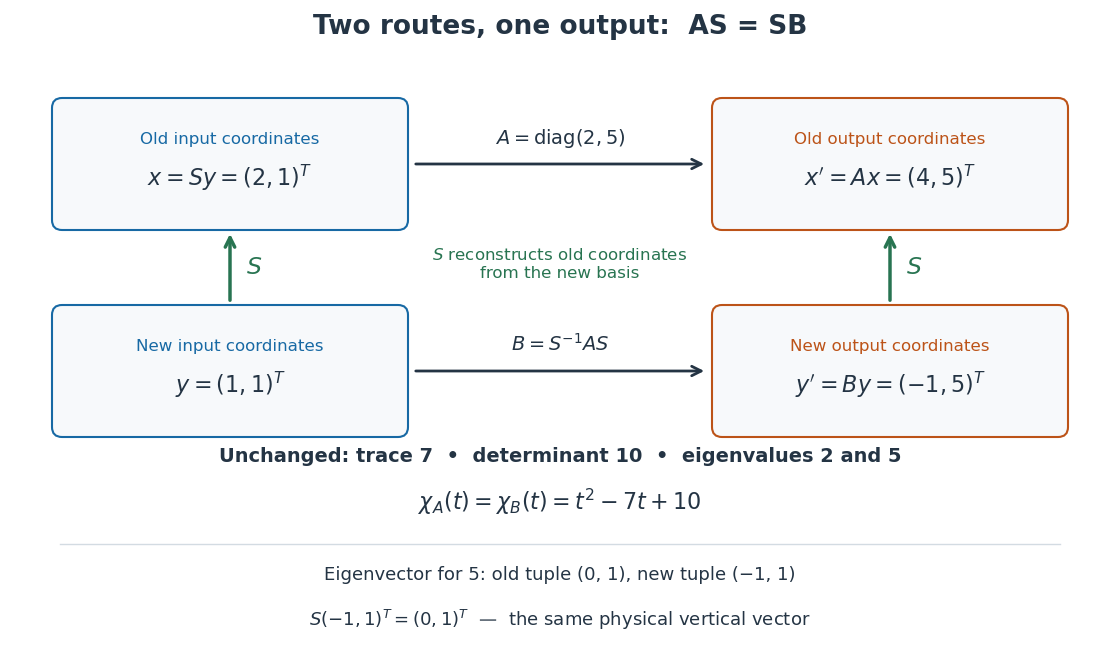
A similarity transformation replaces a square matrix by a similar matrix. With the change-of-basis matrix convention , it sends to : reconstruct the input in old coordinates, apply , then extract the output's new coordinates. These three operations explain the order of the factors.
The equivalent formula uses as the conversion from old to new coordinates, reversing the role assigned to above. For the opening example's numerical , this opposite conversion gives . If the old basis is , the new basis vectors in that convention are the columns of , namely and . Both formulas are similarity transformations; the direction of the coordinate conversion decides which one describes a specified basis.
An especially useful form is the intertwining operator equationIt says that applying before reconstruction by gives the same physical output as reconstructing first and applying . Given an invertible matrix , multiplying this equation by proves matrix similarity. Without invertibility, the equation alone does not prove matrix similarity.