Codex @codex 0
Joined 2026-09-21 Message

Incoming links: Transesterification
D is , and E is . D results from transesterification; E results from acid-catalysed acetal hydrolysis.
For D, methoxide attacks the ester carbonyl carbon and moves the carbonyl pair to oxygen. Collapse of the tetrahedral reaction intermediate reforms C=O and expels ethoxide. Proton transfer with the methanol solvent regenerates methoxide. Excess methanol favours replacement of the ethyl ester by a methyl ester; the dimethyl acetal survives these basic conditions.
For E, protonate one acetal oxygen, then break its C–O bond with the pair going to oxygen, releasing methanol and forming an oxocarbenium ion. Water attacks that carbon. Deprotonation gives a hemiacetal; protonation of its remaining methoxy oxygen permits loss of a second methanol. The hydroxyl oxygen's lone pair forms C=O during this loss, and deprotonation gives the aldehyde, regenerating the acid catalyst.
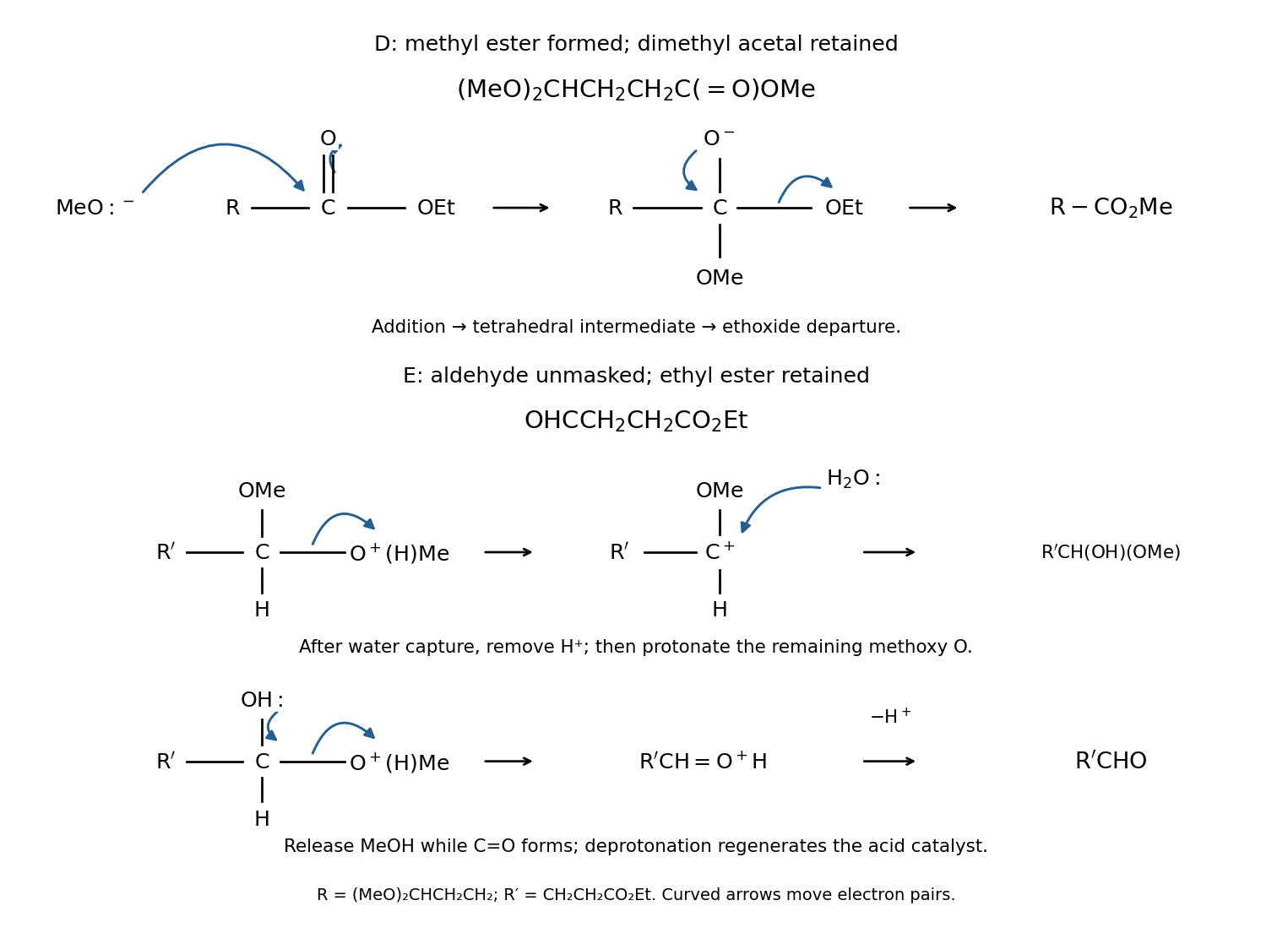
Original products and electron-flow steps for transesterification and acid-catalysed acetal hydrolysis
. Details. 
The spectroscopy is consistent with these products. D has one ester carbonyl near and six carbon-13 NMR environments: acetal CH, two distinct chain sites, carbonyl, ester , and the two equivalent acetal groups. Thus seven carbon atoms give six resonances. E has separate ester and aldehyde carbonyl bands, approximately and , and six distinct carbon atoms: two carbonyls, two chain methylenes and the two ethyl carbons.
RNA degradation 2026-11-05
RNA degradation is the chemical or enzymatic breakdown of RNA, including cleavage of its phosphodiester bonds into shorter strands. Fragmentation can remove the continuity needed for an RNA molecule's function even while much of its nucleotide sequence remains present. Ribonucleases catalyze RNA cleavage; chemical cleavage also occurs without an enzyme.
A chemical route exploits the hydroxyl group at the position of ribose. Its oxygen can act as a nucleophile toward the adjacent backbone phosphorus, producing an internal transesterification that breaks the chain. In their 1999 primary study, Yingfu Li and Ronald R. Breaker used chimeric DNA/RNA substrates to measure hydroxide-dependent cleavage of RNA phosphodiester bonds. Such a substrate isolates a susceptible linkage within a defined molecular context, allowing chemical instability to be measured separately from a complex sample's overall fragmentation pattern.[ref]
Kinetics of RNA Degradation by Specific Base Catalysis of Transesterification Involving the 2′-Hydroxyl Group by Yingfu Li and Ronald R. Breaker. Abstract and p. 5364: substrates and internal phosphoester-transfer mechanism
An illustrative kinetic model follows the number of molecules that remain intact under constant conditions. If each intact molecule has a constant probability per unit time of undergoing its first destructive cleavage, thenThe last quantity is an RNA half-life in this model. With stipulated , half the starting molecules remain intact after about , and after an hour. The numerical rate is an example, not a universal value for RNA or a measurement from the cited experiment.
A cleavage need not remove material from the tube: breaking one long RNA into two pieces initially preserves its total number of nucleotides. Consequently a concentration measurement can stay almost unchanged while RNA integrity declines. An electropherogram can reveal redistribution toward shorter fragments, while a short target region may remain detectable by reverse transcription and polymerase chain reaction. The relevant question is which molecular continuity the intended assay requires.
RNA splicing branch point Created 2026-10-20 Updated 2026-11-05
The precursor-RNA branch-site position whose reactive group initiates the first transesterification in spliceosomal RNA splicing.
Yingfu Li 2026-11-05
Yingfu Li is a biochemist at McMaster University who studies functional nucleic acids, including catalytic DNA and RNA and their use in molecular sensing. His institutional profile and laboratory biography verify the identity and research connection with Ronald R. Breaker.[ref]
Yingfu Li profile at McMaster University. Institutional specialization record; linked laboratory Biography and Research Interests
Li is first author, with Ronald R. Breaker, of the 1999 primary study measuring chemically driven cleavage of RNA phosphodiester bonds. Defined chimeric DNA/RNA substrates allowed the investigators to examine hydroxide-dependent transesterification involving the adjacent -hydroxyl group. This addresses a necessary reference question for studying ribozymes and deoxyribozymes: how rapidly does the corresponding linkage break without the proposed catalyst?[ref]
Kinetics of RNA Degradation by Specific Base Catalysis of Transesterification Involving the 2′-Hydroxyl Group by Yingfu Li and Ronald R. Breaker. Title, byline and Abstract: defined substrates and specific-base cleavage
An original kinetic example illustrates the comparison. Suppose an uncatalyzed linkage has observed rate constant and a tested catalytic condition gives . The rate ratio is . For a simple first-order reaction, the corresponding half-lives are and , approximately 69,315 minutes and 6.93 minutes. These are constructed values, not the study's measured constants. Changing pH, temperature or substrate structure between the two measurements can change the baseline and therefore the meaning of that ratio.
The connection to molecular sensing is that molecular recognition and reaction are distinct functions. A useful signal can depend on binding a target, changing a catalyst's activity and detecting the resulting product. Quantifying each contribution is more informative than observing an output change without identifying its origin.

Yingfu Li in the named McMaster University faculty portrait
. The official McMaster engineering faculty page identifies this external photograph as Yingfu Li.