Whole-cell recording establishes intracellular electrical access by rupturing the membrane under a sealed patch pipette while retaining the gigaohm seal. Under adequate voltage clamp, the measured electric current combines contributions from accessible ion channels, membrane capacitance and seal leak current. Current clamp instead follows membrane potential while supplying a chosen electric current. Whole-cell recording is useful for linking a biological cell's total electrical response to its ion channels, but neither mode automatically controls distant dendrites or preserves the original cytosol.
In the 1981 methods demonstration, a bovine chromaffin biological cell was tested before and after patch rupture. Small voltage clamp steps produced a much larger capacitive transient after break-in. Integrating it gave for a cell; its decay indicated patch-clamp series resistance below . Depolarizing commands then revealed ionic electric currents. Separate current clamp recordings showed spontaneous action potentials. The comparison established access to the cell interior, rather than a claim that every pipette command equals membrane potential. Slower transients sometimes indicated incomplete rupture, and these small-cell results do not establish spatial control of a branched neuron.[ref]
Improved patch-clamp techniques for high-resolution current recording from cells and cell-free membrane patches by O. P. Hamill and others. pp. 98–99, Figure 15 and following voltage-clamp and current-clamp discussion
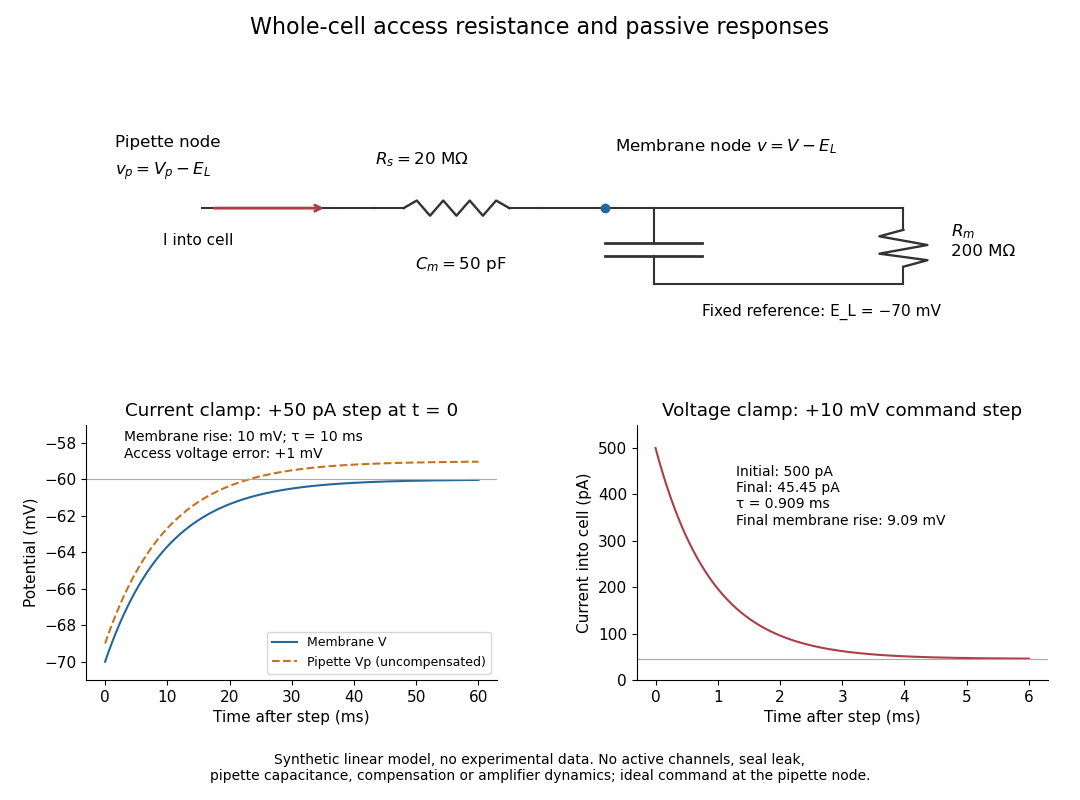
Synthetic whole-cell recording: patch-clamp series resistance and passive responses
. An original equivalent electrical circuit uses , and . The current clamp step and voltage clamp step are separate synthetic experiments. The passive model omits active ion channels, seal leak current, pipette capacitance and amplifier dynamics. Curves are calculations, not experimental measurements. Details.
Patch-clamp series resistance, also called patch-clamp access resistance, is the effective electrical resistance between the pipette's sensed voltage and the cell interior. It includes tip access and any remaining obstruction after break-in. For injected electric current into the biological cell, an ideal resistive access path givesThus through produces a difference: a substantial possible voltage clamp error. The electric current in this equation is the access-path current, excluding any bypass seal leak current. In current clamp, the same access drop contaminates the pipette voltage during injection. Bridge compensation subtracts an estimated ; an estimate that changes during recording leaves an error.
An independent passive voltage clamp calculation makes both speed and error visible. Write and , with fixed leak reversal potential , constant membrane electrical resistance and membrane capacitance . Assume an ideal command at the pipette node and omit seal leak current and pipette capacitance. Electric charge conservation givesFor a step from , the ordinary differential equation givesWith the figure's parameters and , the time constant is , the final membrane rise is , and access-path electric current falls from to . Only when does the time constant approach and the final voltage approach the command. Actual voltage clamp also depends on amplifier feedback control and the space clamp problem.
Membrane capacitance is the capacitance associated with separated electric charge across cell membrane. A local ideal capacitor has charging electric current . If a known actual membrane voltage change is , integrating the charging transient after subtracting sustained ionic and leak components gives . Pipette capacitance, finite patch-clamp series resistance and imperfect transient subtraction can bias the estimate. A capacitive transient is not by itself an ion channel opening.
The space clamp problem is the failure to maintain the commanded membrane potential throughout a spatially extended biological cell. A soma voltage clamp can coexist with substantial voltage changes in distant dendrites or an axon. Reducing patch-clamp series resistance improves access at the recording site, but does not eliminate electrical separation within the neuron.
Cytosol dialysis is exchange between the cytosol and pipette solution through the opening used in conventional whole-cell recording. Diffusion can change ion concentrations and dilute soluble regulators of ion channels. A diminishing response can therefore reflect the recording's alteration of the biological cell, rather than the experimental treatment.
A direct motivating example is the 1988 article Muscarinic activation of ionic currents measured by a new whole-cell recording method. In rat lacrimal gland biological cells, the acetylcholine response in conventional whole-cell recording lasted about five minutes. With a pore-forming substance in the patch pipette instead of open break-in, the response remained undiminished after one hour. The readout was activation of calcium-activated potassium and ion electric currents; preserving the response supported a role for retained cytoplasmic components. The authors also tested the substance extracellularly and observed reversible increases in cation electrical conductance. This comparison motivates perforated patch recording, but does not show that every intracellular constituent or every ion channel response is preserved. [ref]
Practical controls are matched pipette and bath compositions, recording elapsed time after break-in, time-matched untreated preparations, and tracking both patch-clamp series resistance and baseline leakage. Comparing conventional whole-cell recording with perforated patch recording can separate loss of soluble components from an intended treatment effect, but only if electrical access is characterized in both. These are controls suggested by the mechanisms above, not a new set of measured results.
Perforated patch recording obtains intracellular electrical access through pores in the patch under the patch pipette, with less open exchange of large cytoplasmic components than conventional whole-cell recording. Pore selectivity matters: retaining some components does not guarantee unchanged ion concentrations. Monitor patch-clamp series resistance as access develops and distinguish a perforated patch from accidental full rupture.
Articles by others on the same topic
There are currently no matching articles.