Patch clamp connects an electrode to a small area of cell membrane through a solution-filled patch pipette. A gigaohm seal around the rim makes tiny electric currents through ion channels distinguishable from seal leak current. The beautiful change of scale is from a population's average response to individual opening and closing events in single-channel recording.
Separate two questions. The configuration determines which cell membrane is accessible: an intact patch in cell-attached recording, an excised inside-out patch or outside-out patch, or intracellular access in whole-cell recording. The recording mode determines what is commanded and what is observed: voltage clamp commands an electric potential difference and measures electric current; current clamp commands electric current and measures membrane potential. Whole-cell recording supports both modes. A patch can contain several ion channels; a small recording area does not establish that only one is present.
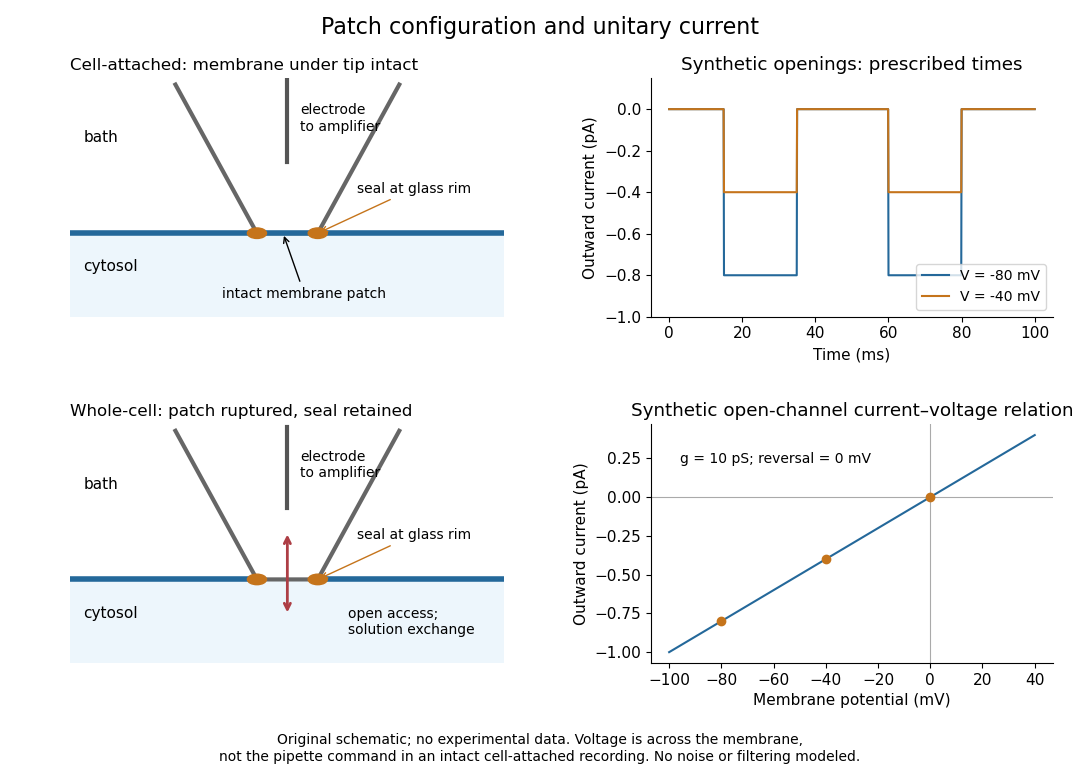
Patch clamp configurations and synthetic single-channel recording
. Original schematic of cell-attached recording and whole-cell recording, with synthetic electric current traces and a single-channel current-voltage relation. The prescribed opening times are identical at and solely to compare amplitudes. These are not experimental data or a model of opening probability. Membrane potential means the actual voltage across the patch, not automatically the pipette command. Details.The 1976 article Single-channel currents recorded from membrane of denervated frog muscle fibres describes an extracellular fire-polished pipette with a – opening and – electrical resistance. It contained saline and a channel-activating compound. Two separate intracellular electrodes supplied local voltage clamp of the muscle fibre; the patch amplifier measured local electric current. Cooling to – and hyperpolarization helped resolve elementary events. Figure 2 shows step-like pulses with a filter at and . Discrete amplitudes and overlapping events supported individual ion channel openings rather than a smoothly varying population response. This was neither whole-cell recording through the patch pipette nor current clamp. The specialized conditions improved visibility but limit generalization to warmer preparations; filtering can conceal brief openings.[ref]
Single-channel currents recorded from membrane of denervated frog muscle fibres by Erwin Neher and others. p. 800, Figures 1–2 and accompanying experimental conditions
For a new single-channel recording experiment, useful controls include a matched recording without the activating compound, controlled membrane potential, repeated seal tests, and an explicitly stated filter frequency response. These are proposed controls, not claims that every one was performed in that 1976 figure. Changing membrane potential tests the single-channel current-voltage relation; changing the recording filter tests whether a short pulse's apparent amplitude is an instrument artifact. A flat baseline establishes neither an absence of ion channels nor an absence of very brief events.
Articles by others on the same topic


Patch clamp is an electrophysiological technique used to measure the ionic currents that flow through individual ion channels or whole cells. It allows researchers to study the electrical properties of excitable cells, such as neurons and muscle cells, as well as non-excitable cells. The technique involves using a glass pipette with a very fine tip that forms a tight seal (often referred to as a "giga-seal") with the cell membrane.