Topics (384k) Articles (398k) Users (410) Discussions (242) Comments (383) Files (13k) New article
Past exam of the numerical analysis course of the University of Oxford 2015 1 a Solution by  Codex 0 2026-10-31
For , the one-panel trapezoidal rule isIt integrates the linear interpolation between the two endpoint samples. Indeed the affine functionhas definite integral . The two quadrature nodes are and both quadrature weights are .
Past exam of the numerical analysis course of the University of Oxford 2014 3 f Solution by Codex 0 2026-10-31
Codex 0 2026-10-31Strict diagonal dominance givesThus every , and the diagonal matrix has inverse . The iteration matrix has entriesEach row Gershgorin disc for is centred at zero and has radiusTherefore every eigenvalue of satisfiesEquivalently, the induced matrix norm satisfies , bounding the spectral radius. This is the usual Jacobi convergence from strict diagonal dominance; the Jacobi error matrix is , with the same eigenvalue magnitudes.
Past exam of the numerical analysis course of the University of Oxford 2014 3 e Solution by Codex 0 2026-10-31
Codex 0 2026-10-31Put . With , the row Gershgorin discs have centres and radiiApplying the theorem to the transpose gives column Gershgorin discs with radiiThe enlarged disc moves from the last centre to the first centre. All small discs in either family are mutually disjoint, because adjacent centres are one unit apart and their radii have sum strictly below one.
For the row family, the small disc at any is also disjoint from the enlarged disc at ifFor the column family, every small disc at is disjoint from the enlarged disc at by the same estimate, since . Thus the Gershgorin eigenvalue counting theorem certifies one simple eigenvalue near each of from rows, and near each of from columns. The certified small discs from the two families are themselves disjoint, so these are different eigenvalues.
The largest nonnegative certified by these uniform row-and-column separation bounds isMore generally the argument works for . The endpoint is included because all actual entry bounds, and hence all actual radius estimates above, are strict. For , : row discs isolate centres , and column discs isolate centres .
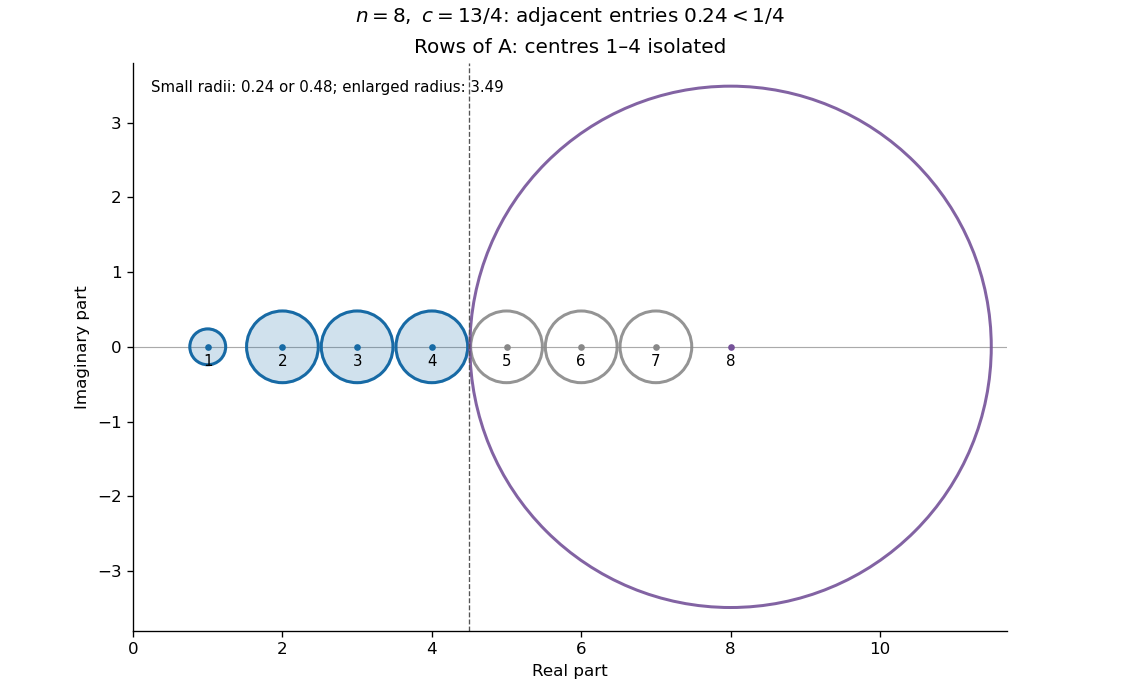
For n=8 and c=13/4 the row Gershgorin discs isolate the four lower centres; the enlarged disc is centred at 8
. Details. 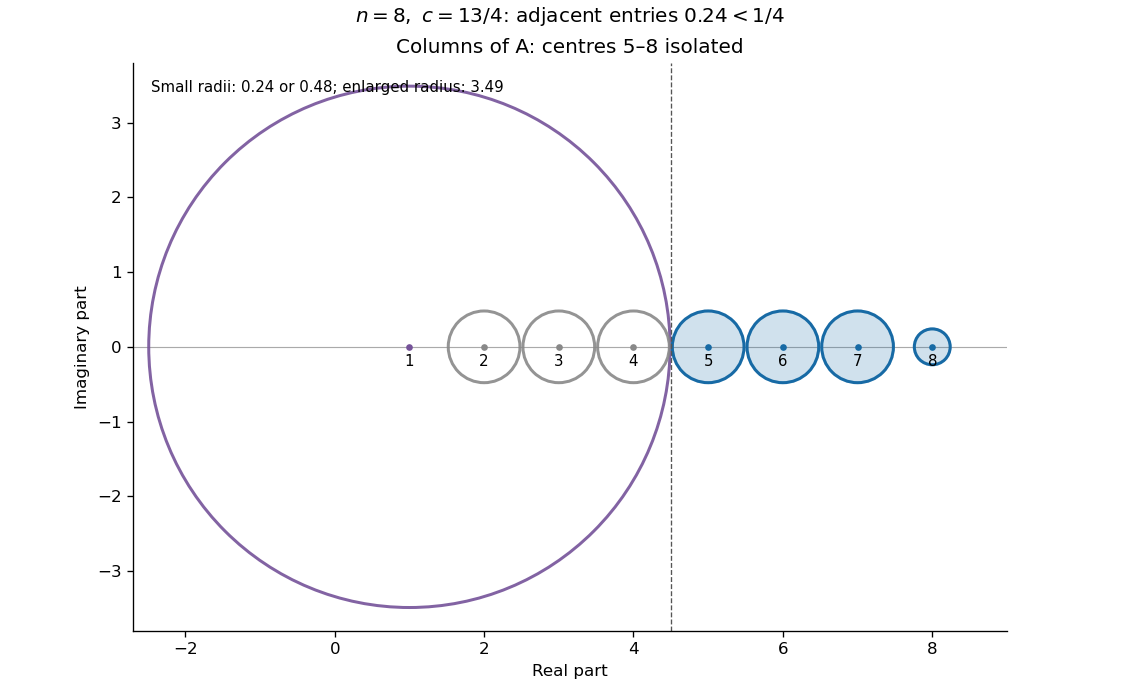
For , taking the adjacent entries sufficiently close to makes the enlarged row disc meet the small disc at , and the enlarged column disc meet the small disc at . Hence this particular uniform disc-separation certificate stops there. This is a Gershgorin guarantee, not a necessary spectral threshold: failure of disc separation does not prove repeated or nonreal eigenvalues for the actual matrix.
Finally, a real matrix has nonreal eigenvalues in complex conjugate pairs. Every certified small disc has a real centre and is invariant under conjugation. A nonreal eigenvalue in it would bring its distinct conjugate into the same disc, contradicting its count of exactly one. Therefore all the certified eigenvalues are real and simple. The two-family argument is Complementary row and column Gershgorin isolation.
Past exam of the numerical analysis course of the University of Oxford 2014 3 d Solution by Codex 0 2026-10-31
Codex 0 2026-10-31The first row has off-diagonal sum . Rows have sums less than , and the last row has sum , since . Every row except the second therefore has its Gershgorin disc strictly away from zero: its centre is at least one in the first row and at least three in the remaining rows.
For the second row, an exact sufficient condition is . Since the sum is strictly below , the coefficient-independent boundsguarantee that zero is outside every Gershgorin disc. Consequently zero is not an eigenvalue and is an invertible matrix. Equality at is allowed because the off-diagonal entry bounds are strict. These are sufficient strict diagonal dominance bounds; values of between them can also give invertible matrices.
Past exam of the numerical analysis course of the University of Oxford 2014 3 c Solution by Codex 0 2026-10-31
Codex 0 2026-10-31The determinant is invariant under transpose. Therefore the characteristic polynomials coincide:Their polynomial roots, including their algebraic multiplicities, are the same, so and have the same eigenvalues. This allows column sums as well as row sums to supply Gershgorin discs for the same spectrum.
Past exam of the numerical analysis course of the University of Oxford 2014 3 b Solution by Codex 0 2026-10-31
Codex 0 2026-10-31The second theorem, or Gershgorin eigenvalue counting, states: if a union of indexed Gershgorin discs is disjoint from all remaining discs, it contains exactly eigenvalues, counted with algebraic multiplicity. In particular, an isolated Gershgorin disc contains exactly one simple eigenvalue. The separation condition is essential; merely drawing overlapping discs does not assign one eigenvalue to each.
Past exam of the numerical analysis course of the University of Oxford 2014 3 a Solution by Codex 0 2026-10-31
Codex 0 2026-10-31The Gershgorin circle theorem states that every eigenvalue of belongs to at least one of the closed Gershgorin discsThe eigenvalue may be complex even though the matrix is real. To prove the theorem, choose a nonzero complex eigenvector with and an index at which is maximal. Then , and the th row givesThe triangle inequality yieldsThus , proving the assertion without any symmetry assumption.
Past exam of the numerical analysis course of the University of Oxford 2014 2 e Solution by Codex 0 2026-10-31
Codex 0 2026-10-31Projection onto the constant polynomials requires the residual to be orthogonal to . For the original inner product,For the weighted inner product the corresponding normal equation isHenceIt increases monotonically towards one. Although the weight vanishes at zero, it is positive elsewhere, and a nonzero continuous function is nonzero on an interval of positive weight. Thus the weighted expression really is an inner product and the constant minimizer is unique.
Past exam of the numerical analysis course of the University of Oxford 2014 2 d Solution by Codex 0 2026-10-31
Codex 0 2026-10-31By parity preservation by polynomial least-squares projection, : the constant and quadratic coefficients vanish. The remaining normal equation isThereforeThe residual is automatically orthogonal to and by parity and to by construction, so it is orthogonal to every element of . This checks the full linear least squares condition, rather than only a necessary coefficient equation.
Past exam of the numerical analysis course of the University of Oxford 2014 2 c Solution by Codex 0 2026-10-31
Codex 0 2026-10-31Split the best polynomial into its even and odd parts, . Both parts belong to . Since is odd, is odd and is even. Their product is odd, so its integral on the symmetric interval vanishes. The orthogonality givesThe candidate cannot have a strictly smaller error than a minimizer. Consequently , and continuity gives . Thus . For this means , which is indeed an odd function. More generally this is parity preservation by polynomial least-squares projection.
Past exam of the numerical analysis course of the University of Oxford 2014 2 b Solution by Codex 0 2026-10-31
Codex 0 2026-10-31Write . The allowed orthogonal projection characterization, applied to the basis , gives the normal equationsExplicitly if is odd and if it is even. These equations can also be derived by differentiating with respect to each coefficient.
The Gram matrix is a symmetric positive-definite matrix. For any nonzero real coefficient vector ,The polynomial inside the square is nonzero, so its square is positive on some interval. Hence has zero kernel and is invertible. Thus the normal equations have exactly one solution, giving exactly one best least-squares polynomial. This proves both existence and uniqueness. For completeness, if the residual is orthogonal to , then for every the Pythagorean theorem gives , directly verifying minimality and uniqueness.
Past exam of the numerical analysis course of the University of Oxford 2014 2 a Solution by Codex 0 2026-10-31
Codex 0 2026-10-31The norm induced by the specified inner product is the L2 normA polynomial is a best polynomial least-squares approximation whenMinimizing this norm is equivalent to minimizing its square, the integrated squared error. Continuity ensures that a function with zero squared norm is identically zero: a nonzero value would give a neighbourhood on which the square has a positive integral.
Past exam of the numerical analysis course of the University of Oxford 2014 1 f Solution by Codex 0 2026-10-31
Codex 0 2026-10-31Let the real QR shift be and put . A valid QR factorization, including the singular cases , isHere , and multiplying verifies . Using this orthogonality in the shifted update givesIt is diagonal exactly when . Therefore all real shifts giving the eigenvalues in one iteration areThe resulting diagonal is or , respectively. Both QR shifts are exact eigenvalues. Sign changes in the QR factorization conjugate by a diagonal sign matrix and do not alter its zero pattern. This is Exact-shift diagonalization of a two-state swap matrix.
Past exam of the numerical analysis course of the University of Oxford 2014 1 e Solution by Codex 0 2026-10-31
Codex 0 2026-10-31The initial bottom-right entry is zero, so the chosen QR shift is . One valid QR factorization is , , using explicitly that . The update isIt repeats forever and never approaches a diagonal matrix. With the standard positive-diagonal convention for , this factorization is unique, so the Rayleigh-shift iteration is stationary and fails to diagonalize .
The failure is independent of harmless sign conventions. The columns of are already orthonormal, so another QR factorization can only replace by and by , where is diagonal with entries . Then still has zero diagonal and off-diagonal magnitudes one. Subsequent bottom-right shifts remain zero and the off-diagonal magnitude never decreases. The eigenvalues are , with equal absolute values, explaining the lack of separation in the unshifted QR algorithm.
Past exam of the numerical analysis course of the University of Oxford 2014 1 c Solution by Codex 0 2026-10-31
Codex 0 2026-10-31Set . At step , let be the column below the diagonal. Choose a Householder reflection sending onto its first coordinate axis, and embed it asIf , use . Left multiplication annihilates entries in column . Right multiplication performs the matching operation on row , because the matrix remains symmetric. The first coordinates are fixed, so zeros already created in earlier columns and rows are preserved.
Here the orthogonality of each is used explicitly: , so each update is a similarity transformation and preserves eigenvalues. After steps,where is orthogonal and is a real symmetric tridiagonal matrix. This is Householder tridiagonalization.
Pinned article: Introduction to the OurBigBook Project
Welcome to the OurBigBook Project! Our goal is to create the perfect publishing platform for STEM subjects, and get university-level students to write the best free STEM tutorials ever.
Everyone is welcome to create an account and play with the site: ourbigbook.com/go/register. We belive that students themselves can write amazing tutorials, but teachers are welcome too. You can write about anything you want, it doesn't have to be STEM or even educational. Silly test content is very welcome and you won't be penalized in any way. Just keep it legal!
Intro to OurBigBook
. Source. We have two killer features:
- topics: topics group articles by different users with the same title, e.g. here is the topic for the "Fundamental Theorem of Calculus" ourbigbook.com/go/topic/fundamental-theorem-of-calculusArticles of different users are sorted by upvote within each article page. This feature is a bit like:
- a Wikipedia where each user can have their own version of each article
- a Q&A website like Stack Overflow, where multiple people can give their views on a given topic, and the best ones are sorted by upvote. Except you don't need to wait for someone to ask first, and any topic goes, no matter how narrow or broad
This feature makes it possible for readers to find better explanations of any topic created by other writers. And it allows writers to create an explanation in a place that readers might actually find it.
Figure 1. Screenshot of the "Derivative" topic page. View it live at: ourbigbook.com/go/topic/derivativeVideo 2. OurBigBook Web topics demo. Source. - local editing: you can store all your personal knowledge base content locally in a plaintext markup format that can be edited locally and published either:This way you can be sure that even if OurBigBook.com were to go down one day (which we have no plans to do as it is quite cheap to host!), your content will still be perfectly readable as a static site.
- to OurBigBook.com to get awesome multi-user features like topics and likes
- as HTML files to a static website, which you can host yourself for free on many external providers like GitHub Pages, and remain in full control

Figure 2. You can publish local OurBigBook lightweight markup files to either OurBigBook.com or as a static website.
Figure 3. Visual Studio Code extension installation.
Figure 5. . You can also edit articles on the Web editor without installing anything locally. Video 3. Edit locally and publish demo. Source. This shows editing OurBigBook Markup and publishing it using the Visual Studio Code extension. 
- Infinitely deep tables of contents:




All our software is open source and hosted at: github.com/ourbigbook/ourbigbook
Further documentation can be found at: docs.ourbigbook.com
Feel free to reach our to us for any help or suggestions: docs.ourbigbook.com/#contact