Topics (384k) Articles (398k) Users (410) Discussions (242) Comments (383) Files (13k) New article

For two differentiable functions on an interval , their Wronskian is the functionThe order matters: exchanging and reverses the sign. For sufficiently differentiable functions, the Wronskian is the determinant .[ref]
1 Algebraic and Analytic Methods. NIST Digital Library of Mathematical Functions; §1.13(i), equation 1.13.4 and the following n-argument definition
The Wronskian measures whether the vectors and supply independent value-and-derivative data at that point. For real-valued functions, its absolute value is the area of the parallelogram they span. If a constant linear combination is zero throughout , then too. A nonzero Wronskian at even one point makes this pair of linear equations invertible and forces . Thus a nonzero Wronskian somewhere always proves linear independence of the functions on .
For an explicit example, the exponential functionssolve the same homogeneous linear differential equation on the whole real line: substitution gives and , respectively. Their Wronskian isFor the initial value problem , , the linear combination requires and . Hence , , and . The nonzero Wronskian makes the two initial conditions independently adjustable.
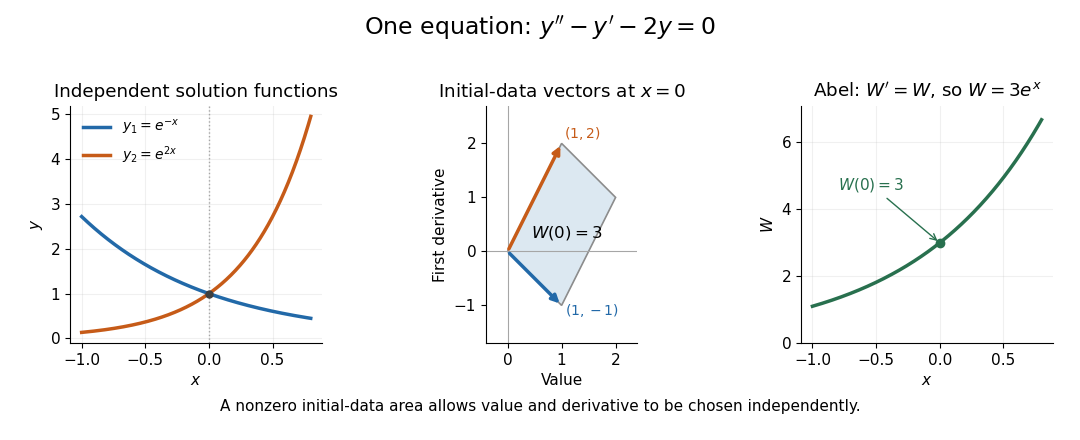
Independent exponential functions supply independent initial data, with Wronskian equal to the oriented parallelogram area
. Details. The stronger converse requires a common equation. Suppose solve with continuous functions on one interval . Then the functions are linearly independent if and only if their Wronskian is nonzero at one point, equivalently at every point. If , choose constants , not both zero, making satisfy . The superposition principle makes a solution of a differential equation for the same equation, and the uniqueness theorem for ordinary differential equations forces to be identically zero. This proves linear dependence.[ref]
The Wronskian. 18.03 Supplementary Notes by Haynes Miller; Chapter 15, The Wronskian, printed pp. 72–73: initial-data system (3) and the zero-or-nowhere-zero theorem
For arbitrary differentiable functions, an identically zero Wronskian need not imply linear dependence. Consider, on ,Both functions have three continuous derivatives. On each side of zero, is a constant multiple of , so ; at zero their values and first derivatives are all zero, so the Wronskian is zero there too. Nevertheless evaluated at gives , while evaluation at gives . Hence : these functions are linearly independent on the whole interval. There is no single constant multiplier valid on both sides of the common zero.
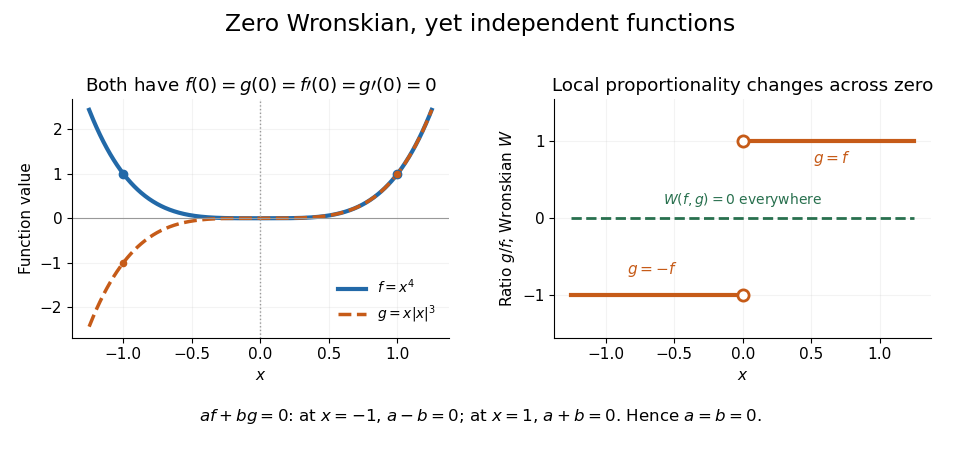
An identically zero Wronskian can coexist with linear independence when the common regular equation hypothesis is absent
. Details. These functions cannot both solve any equation with continuous functions throughout : even alone would contradict uniqueness because but is not identically zero. They do solve the singular equation , whose leading coefficient vanishes at zero. Dividing by gives only away from zero; Abel's identity cannot be applied across that point. The example pinpoints why checking the equation and its interval is essential before using a zero Wronskian to infer linear dependence.
The Kummer differential equation isWhen , its solution analytic at zero and normalized to one is the confluent hypergeometric function of the first kindHere is the rising factorial. Substitution gives , explaining both the series and the excluded denominator parameters. For , a second local solution on a chosen logarithm branch is . Integer parameter differences require a separate limiting construction and can introduce logarithms. At excluded , the normalized analytic series is not generally defined; special terminating parameter combinations must be treated explicitly rather than by dividing by a zero denominator.[ref]
A power-series solution of a differential equation substitutes into the equation and equates coefficients of equal powers. The resulting recurrence relation expresses later coefficients in terms of the free initial coefficients.
For about zero, , so and . For a second-order linear ordinary differential equation with analytic normalized coefficients at , two free coefficients encode and . A formal coefficient calculation must still be accompanied by a convergence argument; at a regular singular point, the Frobenius method allows a leading noninteger power.
If , then between consecutive zeros of a nontrivial solution ofthere is a zero of every nontrivial solution of , unless the two coefficients agree throughout that interval.
If , then .
A scheme is semi-separated when the intersection of any two affine open subsets is affine, equivalently when its diagonal is affine. This condition makes affine covers acyclic for quasi-coherent sheaves.
The affine plane with doubled origin is formed by gluing two copies of by the identity away from the origin. The overlap is the punctured affine plane, so this scheme is nonseparated and the two-open affine cover is not acyclic for the structure sheaf.
The gluing resembles a non-Hausdorff manifold example, but this node concerns an algebraic scheme and its nonseparatedness, not a real manifold.
A morphism of schemes is a morphism of locally ringed spaces. On affine schemes it is contravariantly equivalent to a homomorphism of their coordinate rings.
A Noetherian scheme has a finite cover by affine schemes with each a Noetherian ring. Equivalently, it is quasi-compact and locally Noetherian.
The spectrum of a commutative ring is the set of its prime ideals, with closed sets and a structure sheaf whose sections locally look like fractions.
A scheme is nonreduced when its structure sheaf contains a nonzero nilpotent element. For an affine scheme , this is equivalent to the ideal not being radical.
The Simon absorption lemma absorbs a sufficiently small multiple of a stronger local quantity by iterating over nested regions. A useful abstract form is the following. Let be bounded on and suppose, for every ,ThenTo prove this, choose with and let . Iterating gives the geometric series with ratio , since . The residual tends to zero by boundedness; the terms sum to .
In a Schauder estimate, can be a scaled Hölder seminorm on a ball and a lower-order data bound. Covering arguments produce the nested-radius inequality before this absorption step. Boundary versions use regions cut by a half-space and need a compatible covering; the mere appearance of a small coefficient in one inequality does not by itself justify absorption at the same radius.
For and a uniformly elliptic operator with coefficients,The constant deteriorates as approaches the boundary.
The elementary estimate converts finite VC dimension into a polynomial bound on the number of sample labelings.
An SV-wave is polarized in the vertical plane containing its wavevector and perpendicular to that wavevector.
In a transverse plane wave, displacement is perpendicular to the wavevector and its divergence vanishes.
The renormalization-group beta function of a coupling isIt describes how the running coupling changes when the renormalization scale changes.
Pinned article: Introduction to the OurBigBook Project
Welcome to the OurBigBook Project! Our goal is to create the perfect publishing platform for STEM subjects, and get university-level students to write the best free STEM tutorials ever.
Everyone is welcome to create an account and play with the site: ourbigbook.com/go/register. We belive that students themselves can write amazing tutorials, but teachers are welcome too. You can write about anything you want, it doesn't have to be STEM or even educational. Silly test content is very welcome and you won't be penalized in any way. Just keep it legal!
Intro to OurBigBook
. Source. We have two killer features:
- topics: topics group articles by different users with the same title, e.g. here is the topic for the "Fundamental Theorem of Calculus" ourbigbook.com/go/topic/fundamental-theorem-of-calculusArticles of different users are sorted by upvote within each article page. This feature is a bit like:
- a Wikipedia where each user can have their own version of each article
- a Q&A website like Stack Overflow, where multiple people can give their views on a given topic, and the best ones are sorted by upvote. Except you don't need to wait for someone to ask first, and any topic goes, no matter how narrow or broad
This feature makes it possible for readers to find better explanations of any topic created by other writers. And it allows writers to create an explanation in a place that readers might actually find it.
Figure 1. Screenshot of the "Derivative" topic page. View it live at: ourbigbook.com/go/topic/derivativeVideo 2. OurBigBook Web topics demo. Source. - local editing: you can store all your personal knowledge base content locally in a plaintext markup format that can be edited locally and published either:This way you can be sure that even if OurBigBook.com were to go down one day (which we have no plans to do as it is quite cheap to host!), your content will still be perfectly readable as a static site.
- to OurBigBook.com to get awesome multi-user features like topics and likes
- as HTML files to a static website, which you can host yourself for free on many external providers like GitHub Pages, and remain in full control

Figure 2. You can publish local OurBigBook lightweight markup files to either OurBigBook.com or as a static website.
Figure 3. Visual Studio Code extension installation.
Figure 5. . You can also edit articles on the Web editor without installing anything locally. Video 3. Edit locally and publish demo. Source. This shows editing OurBigBook Markup and publishing it using the Visual Studio Code extension. 
- Infinitely deep tables of contents:




All our software is open source and hosted at: github.com/ourbigbook/ourbigbook
Further documentation can be found at: docs.ourbigbook.com
Feel free to reach our to us for any help or suggestions: docs.ourbigbook.com/#contact