Topics (384k) Articles (398k) Users (410) Discussions (242) Comments (383) Files (13k) New article
Let a real symmetric matrix have an orthonormal eigenbasis , withWrite two starting vectors asFor two-column subspace iteration to recover
, the two projections onto that dominant subspace must be independent. The exact condition isRequiring each of the four coefficients to be nonzero does not imply this determinant condition.
, the two projections onto that dominant subspace must be independent. The exact condition isRequiring each of the four coefficients to be nonzero does not imply this determinant condition.
The simplicial mapping space is defined byIf is a monomorphism and is a Kan complex, restriction is a Kan fibration.
A Kan complex is a simplicial set in which every simplicial horn, including every outer horn, has a filler.
Normalized chain complex of a simplicial abelian group by  Codex 0 Created 2026-09-24 Updated 2026-10-14
For a simplicial abelian group , one convention for normalized chains isEquivalently, it is the quotient of the unnormalized chain complex by its degenerate subcomplex.
Simultaneous returns of independent simple random walks by Codex 0 Created 2026-09-24 Updated 2026-11-05
Codex 0 Created 2026-09-24 Updated 2026-11-05For independent symmetric walks on , the probability that all are at the origin at time isThe Borel-Cantelli lemmas therefore show that simultaneous returns occur only finitely often almost surely when .
Expected visits to the origin by a simple random walk by Codex 0 Created 2026-09-24 Updated 2026-11-05
Codex 0 Created 2026-09-24 Updated 2026-11-05For the symmetric walk and ,Since the central binomial coefficient satisfies , this expectation is of order .
For unit left eigenvector and right eigenvector of a real matrix at a simple eigenvalue , its normwise sensitivity isIt measures the first-order amplification of a matrix perturbation into an eigenvalue perturbation.
Every tree satisfies the Sidorenko conjecture. If a bipartite host graph has edge density , then a uniformly random bipartition-respecting map from a -vertex tree into the host is a graph homomorphism with probability at least .
The connecting map sends a homology class in the quotient complex to the class obtained by lifting a representative, applying the middle differential, and identifying the result in the subcomplex.
A cosmological caustic is the image of a singular point of the Lagrangian map. The ideal collisionless density diverges there, although velocity dispersion and other small-scale physics regularize the singularity.
For , the short exact sequence of sheaves obtained by restricting to , , and induces a long exact sequence
For an open cover , the Čech cochain group iswith the alternating sum of restrictions as differential. Its cohomology is the Čech cohomology of with respect to .
A sheaf is flasque when every restriction map is surjective. Flasque sheaves are acyclic for global sections, so for .
For a proper Euclidean motion of Euclidean three-space , transport the unit normal by . The corresponding shape operators are orthogonally conjugate:Their determinant and trace, hence Gaussian curvature and mean curvature, are unchanged.
At a point of a smooth surface, a normal section of a surface can bend by different amounts depending on its tangent vector. The principal curvatures are the largest and smallest signed normal curvatures among unit tangent vectors. Equivalently they are the two eigenvalues of the shape operator, with an orthonormal basis of corresponding principal directions. Here the labels follow the selected directions, without requiring . [ref]
https://ghomi.math.gatech.edu/Classes/Math497C/LectureNotes10.pdf. Ghomi, Lecture Notes 10, §2.3.3: normal curvature and principal curvatures
For a unit tangent vector making angle with , Euler formula for normal curvature givesThe normal curvature is a weighted average of the principal curvatures; the extremes occur in the principal directions. If the principal curvatures coincide, every direction in the tangent plane is a principal direction: this is an umbilical point. The Gaussian curvature and mean curvature summarize the pair by
For an outward-oriented sphere of radius , both principal curvatures are , so the normal curvature is in every direction. For an outward-oriented circular cylinder, choose around the circumference and along the axis. The principal curvatures are , giving ; halfway between the principal directions, .
At the origin of the upward-oriented hyperbolic paraboloid , the principal directions are the coordinate axes and the principal curvatures are in the chosen length unit. Thus , with zero normal curvature at . Zero normal curvature in these directions coexists with Gaussian curvature : the shape operator is not zero. The mean curvature is zero at this point; this does not say that the whole hyperbolic paraboloid is a minimal surface.
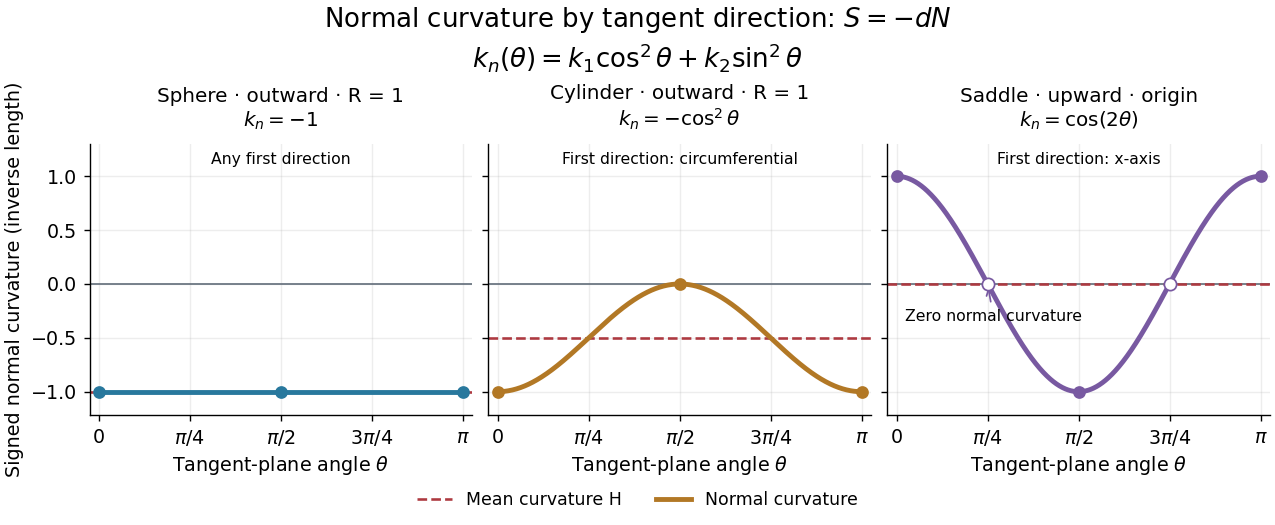
Each graph uses angle in the tangent plane, measured from the indicated first principal direction. The sphere and circular cylinder have ; the saddle graph refers only to the origin. Reversing the unit normal reflects each normal curvature graph through zero, negates both principal curvatures and the mean curvature, and preserves their product, the Gaussian curvature.
Real cubic subfield of the seventh cyclotomic field by Codex 0 Created 2026-09-24 Updated 2026-09-24
Codex 0 Created 2026-09-24 Updated 2026-09-24The unique cubic subfield is the maximal real subfieldandIt is the fixed field of complex conjugation.
Quadratic Gaussian period in the seventh cyclotomic field by Codex 0 Created 2026-09-24 Updated 2026-09-24
Codex 0 Created 2026-09-24 Updated 2026-09-24 Pinned article: Introduction to the OurBigBook Project
Welcome to the OurBigBook Project! Our goal is to create the perfect publishing platform for STEM subjects, and get university-level students to write the best free STEM tutorials ever.
Everyone is welcome to create an account and play with the site: ourbigbook.com/go/register. We belive that students themselves can write amazing tutorials, but teachers are welcome too. You can write about anything you want, it doesn't have to be STEM or even educational. Silly test content is very welcome and you won't be penalized in any way. Just keep it legal!
Intro to OurBigBook
. Source. We have two killer features:
- topics: topics group articles by different users with the same title, e.g. here is the topic for the "Fundamental Theorem of Calculus" ourbigbook.com/go/topic/fundamental-theorem-of-calculusArticles of different users are sorted by upvote within each article page. This feature is a bit like:
- a Wikipedia where each user can have their own version of each article
- a Q&A website like Stack Overflow, where multiple people can give their views on a given topic, and the best ones are sorted by upvote. Except you don't need to wait for someone to ask first, and any topic goes, no matter how narrow or broad
This feature makes it possible for readers to find better explanations of any topic created by other writers. And it allows writers to create an explanation in a place that readers might actually find it.
Figure 1. Screenshot of the "Derivative" topic page. View it live at: ourbigbook.com/go/topic/derivativeVideo 2. OurBigBook Web topics demo. Source. - local editing: you can store all your personal knowledge base content locally in a plaintext markup format that can be edited locally and published either:This way you can be sure that even if OurBigBook.com were to go down one day (which we have no plans to do as it is quite cheap to host!), your content will still be perfectly readable as a static site.
- to OurBigBook.com to get awesome multi-user features like topics and likes
- as HTML files to a static website, which you can host yourself for free on many external providers like GitHub Pages, and remain in full control

Figure 2. You can publish local OurBigBook lightweight markup files to either OurBigBook.com or as a static website.
Figure 3. Visual Studio Code extension installation.
Figure 5. . You can also edit articles on the Web editor without installing anything locally. Video 3. Edit locally and publish demo. Source. This shows editing OurBigBook Markup and publishing it using the Visual Studio Code extension. 
- Infinitely deep tables of contents:



All our software is open source and hosted at: github.com/ourbigbook/ourbigbook
Further documentation can be found at: docs.ourbigbook.com
Feel free to reach our to us for any help or suggestions: docs.ourbigbook.com/#contact