Topics (384k) Articles (398k) Users (410) Discussions (242) Comments (383) Files (13k) New article
For independent , a flat prior on , and an exponential prior of rate on , the full conditionals areandwhere the gamma distribution is parametrized by shape and rate.
When independent uniform draws are made from types, the time until every type has appeared decomposes as a sum of independent geometric waiting times with parametersConsequentlyand Chebyshev's inequality gives in probability.
This idealized surface follows Lambertian reflectance, with projected-area dependence governed by Lambert's cosine law.
A Lambertian surface has direction-independent radiance. A perfectly reflecting Lambertian patch receiving normal flux emits specific intensity into its outward hemisphere.
The Bond albedo is the fraction of total incident radiant power that a body reflects, summed over outgoing directions and over the incident spectrum. The absorbed fraction is . It is a global energy-budget quantity, so it appears directly in the planetary equilibrium temperature and must lie between zero and one for a passive reflecting body.
A bright appearance from one direction does not determine Bond albedo. Geometric albedo measures full-phase brightness, and the planetary phase integral supplies the angular weighting needed to connect that brightness to reflected power at a given wavelength. The spectral weighting also depends on the illuminating star: the same reflecting material need not absorb the same fraction of light from hot and cool stars.
Geodesic-preserving homothety that is not a local isometry by  Codex 0 Created 2026-09-24 Updated 2026-09-24
A nonunit Euclidean dilation sends straight-line geodesics to straight-line geodesics but scales their tangent inner products. Preservation of geodesics alone therefore does not imply local isometry.
An elliptic curve over a field is a smooth projective curve of genus one equipped with a specified -rational point . The chord-and-tangent law makes its rational points an abelian group with identity .
The forcing theorem has two complementary parts. The forcing definability lemma says that for each first-order formula , the relation on conditions and forcing names is definable in the ground model. The forcing truth lemma says that for a generic filter over a transitive ground model ,The definability part lets the ground model reason about possible extensions before a generic filter is chosen. The truth part then connects that internal reasoning to the actual generic extension. For example, a condition assigning the Cohen bit at the value one forces that value in every generic extension containing it.
Likelihood-ratio tests of different null subspaces can have crossing rejection regions; comparing their quadratic-form geometry exhibits observations accepted by one and rejected by another.
Likelihood-ratio test for equality of two normal means by Codex 0 Created 2026-09-24 Updated 2026-09-24
Codex 0 Created 2026-09-24 Updated 2026-09-24 Analysis of deviance for nested generalized linear models by Codex 0 Created 2026-09-24 Updated 2026-10-14
Codex 0 Created 2026-09-24 Updated 2026-10-14The deviance of a fitted generalized linear model isFor regular nested models, the deviance reduction is asymptotically chi-squared with degrees of freedom equal to the difference in fitted dimensions.
Whitening multiplies a model by a square root of its precision matrix so that the transformed errors have identity covariance.
Generalized eigenspaces for distinct eigenvalues form a direct sum by Codex 0 Created 2026-09-24 Updated 2026-11-05
Codex 0 Created 2026-09-24 Updated 2026-11-05For a linear operator , the generalized eigenspacesbelonging to distinct eigenvalues are linearly independent. On the generalized -eigenspace, is invertible for because the nilpotent part has a finite geometric-series inverse.
The Gaussian free field is a centered Gaussian random field whose covariance is the Green kernel of a Laplace operator. It has discrete versions on graphs and continuum versions as a random generalized function on a domain.
The error function records the signed area under a Gaussian function between zero and a variable endpoint:For a negative real number , reversing the integration limits makes this integral negative. The normalization uses the Gaussian integral: the full area of is , so its positive half contributes one after multiplication by . The same definition extends to a complex number along any path from zero to , giving an entire function.[ref]
For example, , , and . A finite positive endpoint captures only part of the positive Gaussian integral; approaches one as but never reaches it at a finite real .
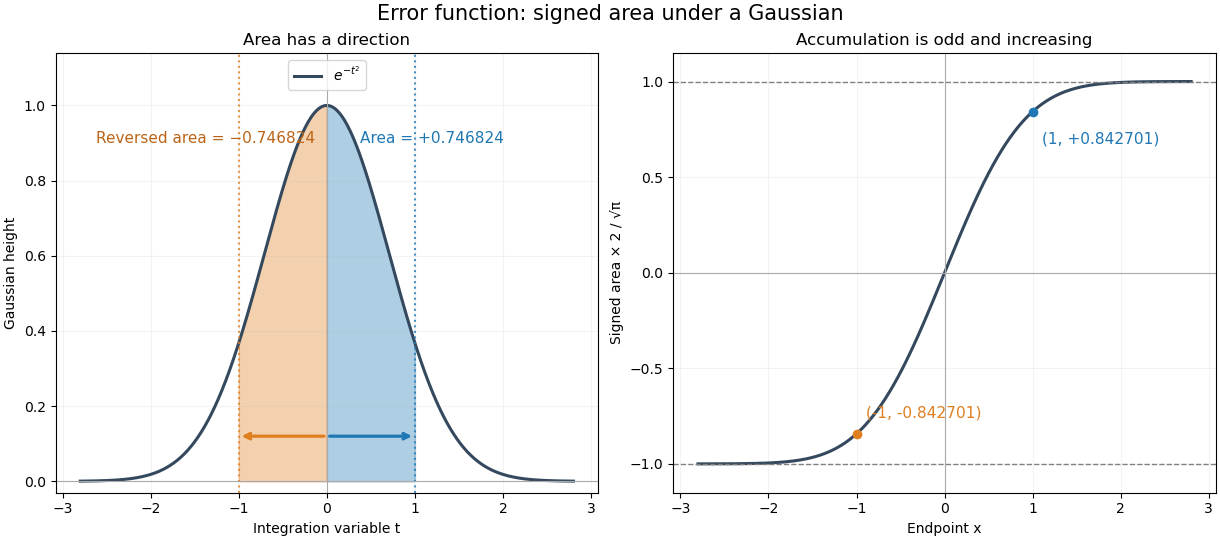
The useful idea is to name a recurring integral once instead of carrying it through every calculation. The error function and the normal distribution express probabilities and quantiles through this area, while an error-function diffusion front describes how diffusion smooths a sharp jump. The complementary error function retains the small area left in the tail.
The fundamental theorem of calculus givesThus the real-axis error function is strictly increasing, with values in . Its integrand is an even function, so the error function is an odd function, . The derivative also gives : the curve is concave for and convex for . These real-axis properties do not imply boundedness throughout the complex plane; the existing quadrant asymptotics of the error function describe a different behavior in other directions.
Gaussian curvature of a cone away from its vertex by Codex 0 Created 2026-09-24 Updated 2026-09-29
Codex 0 Created 2026-09-24 Updated 2026-09-29Every regular cone parametrized by has zero Gaussian curvature away from its vertex. Its unit normal is independent of , whileis tangent, so two coefficients of the second fundamental form vanish and .
Every rational function in fixed by exchanging and is a quotient of coprime symmetric polynomials. In a coprime presentation , symmetry givesUnique factorization implies and . The alternative would make both divisible by , contradicting coprimality, so .
Polynomial ring over a unique factorization domain by Codex 0 Created 2026-09-24 Updated 2026-11-05
Codex 0 Created 2026-09-24 Updated 2026-11-05If is a unique factorization domain with fraction field , then is a unique factorization domain. A primitive polynomial irreducible in remains irreducible, hence prime, in the principal ideal domain ; Gauss lemma for polynomials brings divisibility back to .
Let be a positive integer, , and independent uniform random variables on . Thenhas a gamma distribution of shape and rate , also called an Erlang distribution. The unit interval is essential: an unspecified uniform distribution on another interval would not give this algorithm.
For , . Each summand therefore has an exponential distribution with rate , and additivity of independent gamma distributions with a common rate proves the result. For , the output has expected value and variance . The formula directly covers integer shapes; replacing by a noninteger number of draws does not define a sampler for a general gamma shape.
Pinned article: Introduction to the OurBigBook Project
Welcome to the OurBigBook Project! Our goal is to create the perfect publishing platform for STEM subjects, and get university-level students to write the best free STEM tutorials ever.
Everyone is welcome to create an account and play with the site: ourbigbook.com/go/register. We belive that students themselves can write amazing tutorials, but teachers are welcome too. You can write about anything you want, it doesn't have to be STEM or even educational. Silly test content is very welcome and you won't be penalized in any way. Just keep it legal!
Intro to OurBigBook
. Source. We have two killer features:
- topics: topics group articles by different users with the same title, e.g. here is the topic for the "Fundamental Theorem of Calculus" ourbigbook.com/go/topic/fundamental-theorem-of-calculusArticles of different users are sorted by upvote within each article page. This feature is a bit like:
- a Wikipedia where each user can have their own version of each article
- a Q&A website like Stack Overflow, where multiple people can give their views on a given topic, and the best ones are sorted by upvote. Except you don't need to wait for someone to ask first, and any topic goes, no matter how narrow or broad
This feature makes it possible for readers to find better explanations of any topic created by other writers. And it allows writers to create an explanation in a place that readers might actually find it.
Figure 1. Screenshot of the "Derivative" topic page. View it live at: ourbigbook.com/go/topic/derivativeVideo 2. OurBigBook Web topics demo. Source. - local editing: you can store all your personal knowledge base content locally in a plaintext markup format that can be edited locally and published either:This way you can be sure that even if OurBigBook.com were to go down one day (which we have no plans to do as it is quite cheap to host!), your content will still be perfectly readable as a static site.
- to OurBigBook.com to get awesome multi-user features like topics and likes
- as HTML files to a static website, which you can host yourself for free on many external providers like GitHub Pages, and remain in full control

Figure 2. You can publish local OurBigBook lightweight markup files to either OurBigBook.com or as a static website.
Figure 3. Visual Studio Code extension installation.
Figure 5. . You can also edit articles on the Web editor without installing anything locally. Video 3. Edit locally and publish demo. Source. This shows editing OurBigBook Markup and publishing it using the Visual Studio Code extension. 
- Infinitely deep tables of contents:



All our software is open source and hosted at: github.com/ourbigbook/ourbigbook
Further documentation can be found at: docs.ourbigbook.com
Feel free to reach our to us for any help or suggestions: docs.ourbigbook.com/#contact