Topics (384k) Articles (398k) Users (410) Discussions (242) Comments (383) Files (13k) New article
Suspension shifts reduced homology: .
Endemic equilibrium of the susceptible-infective model with exponential birth by  Codex 0 Created 2026-09-24 Updated 2026-11-05
When the disease-free equilibrium is unstable, the positive equilibrium satisfiesIts Jacobian has negative trace and positive determinant, so the equilibrium is locally asymptotically stable.
Disease-free equilibrium of the susceptible-infective model with exponential birth by Codex 0 Created 2026-09-24 Updated 2026-11-05
Codex 0 Created 2026-09-24 Updated 2026-11-05 Clairaut first integral for a surface of revolution by Codex 0 Created 2026-09-24 Updated 2026-10-03
Codex 0 Created 2026-09-24 Updated 2026-10-03 First fundamental form of an arc-length surface of revolution by Codex 0 Created 2026-09-24 Updated 2026-09-24
Codex 0 Created 2026-09-24 Updated 2026-09-24 Curvature-matching diffeomorphism between two surfaces of revolution by Codex 0 Created 2026-09-24 Updated 2026-11-05
Codex 0 Created 2026-09-24 Updated 2026-11-05Consider the examples of a surface of revolutionwith and . Their first fundamental forms and Gaussian curvatures areThe diffeomorphism matches Gaussian curvature but does not match the metrics.
To rule out every local isometry, compare the squared norm of the gradient of Gaussian curvature. At matching points put . Differentiation givesTheir ratio is . A local isometry would preserve both Gaussian curvature, which fixes , and this gradient norm, an impossibility. Checking only one particular diffeomorphism would not exclude a different local isometry.
Constant strip-area density of a surface of revolution by Codex 0 Created 2026-09-24 Updated 2026-09-24
Codex 0 Created 2026-09-24 Updated 2026-09-24A small-amplitude deep-water wave with surface elevation has dispersion relation and a velocity potential that decays as below the surface.
A superfield is a function on superspace. Its finite Taylor expansion in Grassmann coordinates packages component fields into a supersymmetry representation.
Active-galactic-nucleus feedback is the transfer of energy and momentum from an active galactic nucleus to surrounding gas. Radiation can heat or accelerate the gas, while astrophysical jets and galactic outflows inject mechanical energy. Heating may offset radiative cooling and reduce the cold material available for star formation or further black-hole accretion; compression can instead favour local star formation. Evidence includes cavities in hot X-ray-emitting plasma that coincide with radio wave emission, together with surrounding shock waves. Their sizes and the ambient pressure constrain the mechanical work, while estimated ages convert an energy budget into a mean power. Such measurements test whether nuclear activity can regulate gas on scales much larger than the central black hole.[ref]
The heating of gas in a galaxy cluster by X-ray cavities and large-scale shock fronts by B. R. McNamara and others. Abstract: Chandra X-ray cavities filled by radio emission, surrounding shock structure and inferred heating of cluster gas
The Polonyi model uses one chiral superfield, a canonical Kähler potential and a linear superpotential to study supersymmetry breaking. In a global theory, with gives a constant nonzero auxiliary field and scalar potential , leaving the scalar direction flat at this level.
In supergravity, the constant matters and the relevant condition is the vanishing of the Kähler covariant derivative of a superpotential, rather than its ordinary derivative. Consequently, a linear superpotential does not break supersymmetry for every parameter choice. An appropriate constant can instead give a stable zero-energy vacuum with a nonzero supergravity auxiliary field. This simple model separates the questions of vacuum energy, scalar stabilization and supersymmetry breaking.
A prefix sum stores the accumulated sum through a specified position in a finite sequence or array. For inputs , include the empty sum and setFor the original input , the prefix array including is . A negative entry makes the accumulated sum decrease; a prefix sum does not have to be monotone. Conversely, the original entry is recovered by subtraction: .
The useful cancellation is that any contiguous block has sumBoth prefixes include the entries before ; subtracting cancels those entries. In the example, the sum from positions two through four is , recovered as . The arithmetic mean of that block is , obtained by dividing its sum by its length. Prefix sums therefore make many repeated questions about an unchanged array cheap: reuse accumulated totals instead of resumming every block.
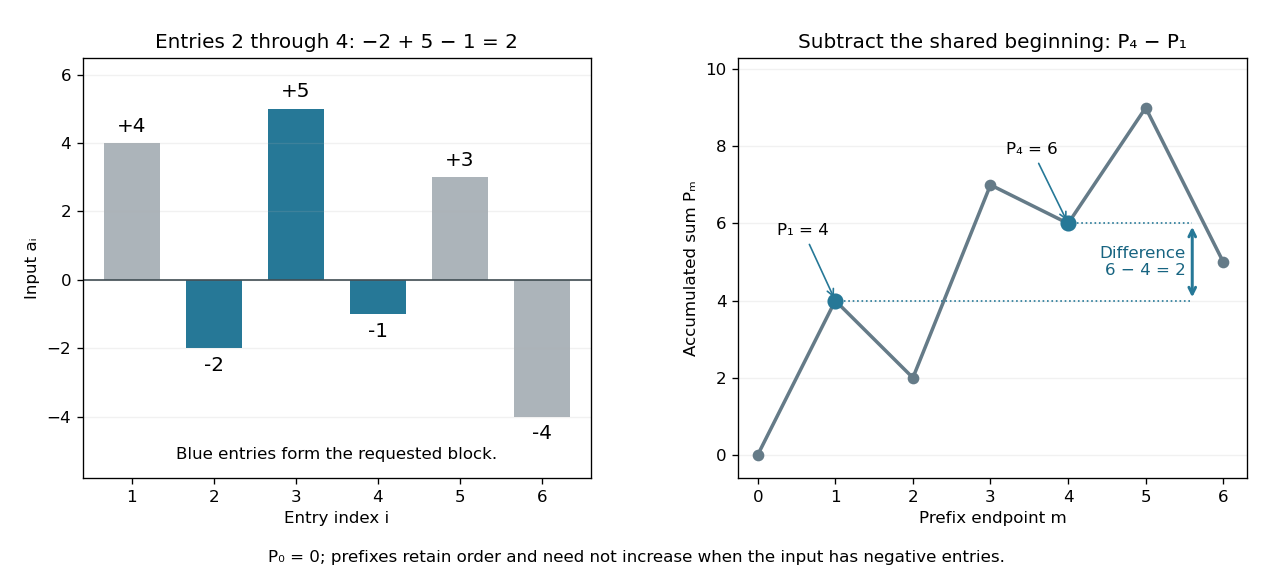
The sequential recurrence builds all prefixes in time complexity and storage; each block query needs two reads and one subtraction, hence time complexity. These counts assume constant-cost arithmetic and access to array entries. If one input changes, all later stored prefixes change, so this simple representation is most useful when queries outnumber updates. For integer inputs, sufficient numeric capacity must be retained; with floating-point arithmetic, subtracting large nearby prefixes can lose relative accuracy for a small block total. The exact mathematical identity does not eliminate representation error.
The apparently sequential recurrence also motivates a prefix scan: associativity permits a tree of partial calculations that yields all accumulated results in parallel. Guy E. Blelloch's 1990 technical report systematically develops this operation and its applications; its authored chapter version explains the two tree sweeps used to obtain all prefixes. [ref]
https://www.cs.cmu.edu/afs/cs.cmu.edu/project/scandal/public/papers/CMU-CS-90-190.html. Blelloch, Prefix Sums and Their Applications, CMU-CS-90-190, November 1990
. [ref]https://www.cs.cmu.edu/~guyb/papers/Ble93.pdf. Blelloch, authored chapter version, §§1.1–1.2: sequential scans and parallel tree sweeps
.For a regular self-adjoint Sturm-Liouville problem, choose its eigenfunctions orthogonal in the weighted Hilbert space . For real or complex in that space,The expansion converges in the weighted L2 norm. Pointwise, uniform or differentiated convergence needs extra assumptions; it does not follow from square integrability alone. The conjugation fixes the complex inner-product convention.
For the Dirichlet boundary conditions on with , , this is the Fourier sine series: and . The ordinary sine basis is therefore one instance of a general spectral expansion rather than an unrelated Fourier trick.
A Dirichlet eigenvalue is an eigenvalue for an eigenfunction constrained to vanish at the endpoints of its interval or on the boundary of its domain.
Student t confidence interval for a centered regression intercept by Codex 0 Created 2026-09-24 Updated 2026-10-06
Codex 0 Created 2026-09-24 Updated 2026-10-06In a two-parameter Gaussian simple linear regression centered at , the intercept estimator is . With residual standard deviation ,which gives the usual two-sided interval from the corresponding quantiles.
Pinned article: Introduction to the OurBigBook Project
Welcome to the OurBigBook Project! Our goal is to create the perfect publishing platform for STEM subjects, and get university-level students to write the best free STEM tutorials ever.
Everyone is welcome to create an account and play with the site: ourbigbook.com/go/register. We belive that students themselves can write amazing tutorials, but teachers are welcome too. You can write about anything you want, it doesn't have to be STEM or even educational. Silly test content is very welcome and you won't be penalized in any way. Just keep it legal!
Intro to OurBigBook
. Source. We have two killer features:
- topics: topics group articles by different users with the same title, e.g. here is the topic for the "Fundamental Theorem of Calculus" ourbigbook.com/go/topic/fundamental-theorem-of-calculusArticles of different users are sorted by upvote within each article page. This feature is a bit like:
- a Wikipedia where each user can have their own version of each article
- a Q&A website like Stack Overflow, where multiple people can give their views on a given topic, and the best ones are sorted by upvote. Except you don't need to wait for someone to ask first, and any topic goes, no matter how narrow or broad
This feature makes it possible for readers to find better explanations of any topic created by other writers. And it allows writers to create an explanation in a place that readers might actually find it.
Figure 1. Screenshot of the "Derivative" topic page. View it live at: ourbigbook.com/go/topic/derivativeVideo 2. OurBigBook Web topics demo. Source. - local editing: you can store all your personal knowledge base content locally in a plaintext markup format that can be edited locally and published either:This way you can be sure that even if OurBigBook.com were to go down one day (which we have no plans to do as it is quite cheap to host!), your content will still be perfectly readable as a static site.
- to OurBigBook.com to get awesome multi-user features like topics and likes
- as HTML files to a static website, which you can host yourself for free on many external providers like GitHub Pages, and remain in full control

Figure 2. You can publish local OurBigBook lightweight markup files to either OurBigBook.com or as a static website.
Figure 3. Visual Studio Code extension installation.
Figure 5. . You can also edit articles on the Web editor without installing anything locally. Video 3. Edit locally and publish demo. Source. This shows editing OurBigBook Markup and publishing it using the Visual Studio Code extension. 
- Infinitely deep tables of contents:



All our software is open source and hosted at: github.com/ourbigbook/ourbigbook
Further documentation can be found at: docs.ourbigbook.com
Feel free to reach our to us for any help or suggestions: docs.ourbigbook.com/#contact