Topics (384k) Articles (398k) Users (410) Discussions (242) Comments (383) Files (13k) New article

A stationary distribution is a probability distribution preserved by a Markov chain's evolution. For a Discrete-time Markov chain in the row convention,Thus is a normalized nonnegative left eigenvector of the transition matrix for eigenvalue one. Starting with distributed as makes every have that same probability distribution. For a time-homogeneous Markov chain, the path probabilities are also unchanged by shifting all observation times together: the process has strict stationarity. This does not mean its individual paths are constant. See Hao Wu's MIT lecture 2, stationary distributions.
For the sunny/rainy transition matrix, write . The sunny component of gives , so andMoreover,These equal stationary flows verify detailed balance and show that the Markov chain is reversible. The diagonal detailed balance equations hold automatically. Only of the stationary days are rainy, but of the days following a rainy day are rainy: stationarity permits dependence.
A finite Markov chain that is an irreducible Markov chain has a unique stationary distribution. If it is also an aperiodic Markov chain, for every initial probability distribution. The sunny/rainy example satisfies both conditions: both directions are possible and each state has a positive holding probability of a Markov chain. See Hao Wu's MIT lecture 4, convergence theorem. For an infinite state space, the additional positive recurrence hypothesis in the countable-state Markov chain convergence theorem matters.
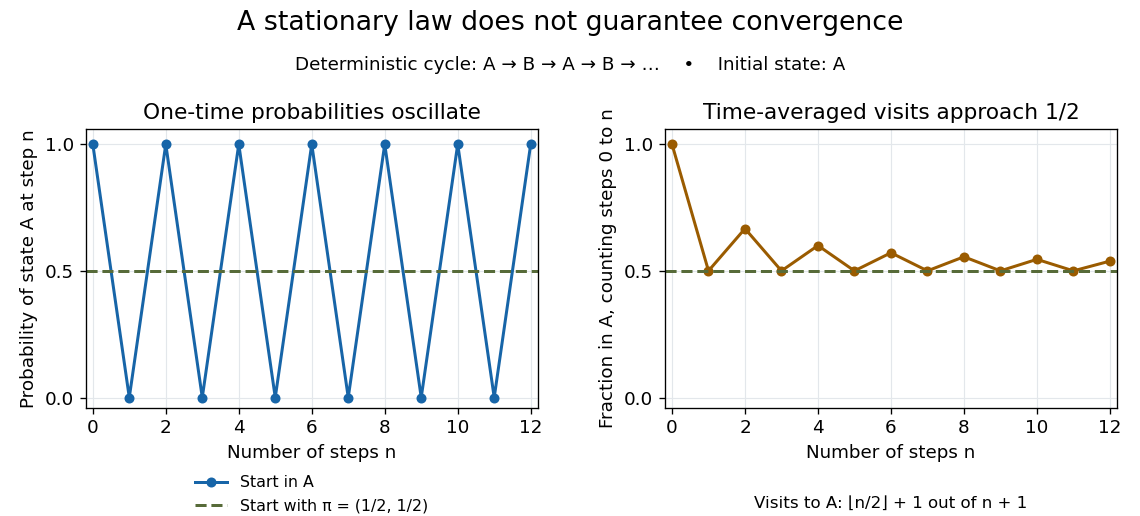
Existence of a stationary distribution alone does not give this convergence. Consider the deterministic two-cycleHere , but starting in the first state gives alternating probability distributions . Its period of a state in a Markov chain is two. The running fraction of visits to either state nevertheless tends to , illustrating the Markov chain ergodic theorem. Starting with instead keeps the one-time probability distributions stationary even though every path alternates.
In a finite, time-homogeneous Discrete-time Markov chain with row-stochastic transition matrix , write when is accessible from , meaning for some . States communicate, written , when both and . Communication is an equivalence relation, and a communicating class is an entire equivalence classThus communicating classes form a partition of the state space; a smaller mutually communicating subset is not itself a class. See Maria Cameron's Markov Chains notes, section 1.2.
The allowance of zero steps matters: , the identity matrix, makes true even for a state with no possible positive-time return. Symmetry is built into communication. For transitivity, concatenate a positive-probability path from to with one from to , and do the same in reverse. These observations prove the equivalence relation directly. One-way accessibility alone is not symmetric and does not define the classes; see Accessible state of a Markov chain.
A closed communicating class satisfies for every and . Once entered, it cannot be left. A singleton class is an absorbing state exactly when it is closed. An open communicating class has an outgoing transition; after a path leaves it, it cannot return, since that would make the visited outside states communicate with it. The internal motion of a closed class can nevertheless continue forever.
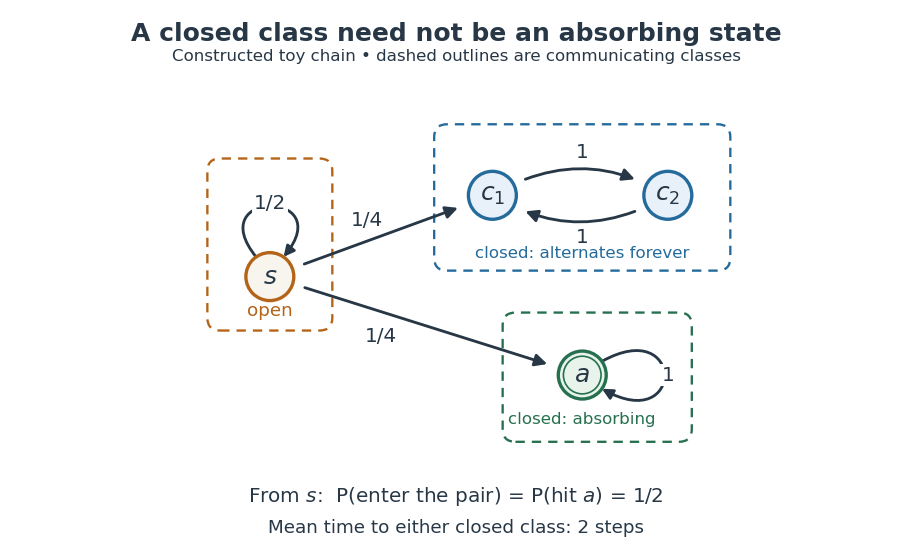
A constructed chain has three communicating classes: an open singleton, a closed alternating pair, and a closed absorbing singleton; dashed outlines group states into classes.
Details. For this constructed example, in state order , the transition matrix isThere are exactly three communicating classes: , , and . Only the first is open. The second is closed but neither of its states is an absorbing state; they alternate deterministically. Although via , the reverse accessibility fails. A direct matrix power check gives and .
Starting at , let be the first hitting time of either closed class. Staying at for steps has probability , so and . The two eventual destination classes each have probability . Hence the hitting probability of the absorbing state is only , and its unconditional expected hitting time from is infinite: on half the paths it is never hit. In particular, entering a closed class with certainty does not imply entering an absorbing state with certainty.
Classifying the state space separates two questions: which closed region will eventually be entered, and how does the Markov chain move inside that region? In this example the restriction to is an irreducible Markov chain with period two; the restriction to is a one-state irreducible Markov chain with period one. The whole Markov chain is reducible. The absorbing state example illustrates a different possibility: every closed class is a singleton, so eventual class selection is also terminal outcome selection.
A finite Markov chain is a Markov chain with a finite state space, represented in discrete time by a transition matrix whose entries are nonnegative and whose rows sum to one. A row-vector distribution evolves by . Every such chain has a stationary distribution; irreducibility makes it unique and positive, while aperiodicity additionally ensures convergence from every starting distribution. For the stationary distribution is , but a chain started at one state alternates forever and does not converge.[ref]
A Continuous-time Markov chain on a finite or countable state space is specified by transition rates for , with finite total exit rate . At a state with , it waits an exponential time of rate and then moves to with probability . A state with is absorbing: it has infinite holding time rather than a zero-rate exponential waiting law.
Its transition-rate matrix is , with off-diagonal entries and diagonal entries , so each row sums to zero. The rates describe first-order transition probabilities: for . On a finite state space, the transition semigroup is and explosion is impossible. On a countably infinite state space, finite individual exit rates do not alone exclude infinitely many jumps in finite time; nonexplosion must be checked separately.
For two states with rates and , the mean holding times are and . Detailed balance gives Stationary distribution , andThis starts at one and relaxes to the stationary mass of state zero. Changing holding rates can preserve an embedded jump chain while changing the proportions of elapsed time spent in its states.
The Markov property says that, conditional on the present state, the future evolution is independent of the past.
For an irreducible positive recurrent Discrete-time Markov chain with Stationary distribution , fix a state and its positive first return . The Stationary cycle occupation formula isThe cycle includes the initial visit to and excludes the returning visit. Thus for the left side is exactly one, consistent with the ratio.
Successive return cycles are independent with the same law by the Strong Markov property. The renewal reward ratio gives the long-run visit fraction as expected cycle occupation divided by expected cycle length. Kac's lemma supplies , so the ergodic visit fraction gives the displayed identity. positive recurrence ensures the cycle length and all its occupation rewards are integrable.
For distinct , the Two-state excursion visit law gives the same expected occupation as , where and . ConsequentlyThis identity does not require reversibility: it follows from return-cycle occupation. It also does not require aperiodicity, since time averages still converge in a periodic positive recurrent chain.
At an almost surely finite Stopping time, a Markov process restarts from its stopped state with the same transition law and independently of the history conditional on that state.
Gambler's ruin is the absorption problem for a fortune that changes by one unit per game. Let , with independent wins of Probability and losses of Probability . Stop when the fortune reaches zero or the target . Zero is ruin; reaching is success.
The success Probability has boundary values , and satisfies . Solving this second-order recurrence givesFinite-interval exit times have geometric tails, so absorption occurs almost surely and ruin has Probability . The fair case is linear because the fortune itself is harmonic; the biased case uses the harmonic exponential .
For a fair game with initial fortune three and target ten, success has Probability . The Expected duration of symmetric gambler's ruin is , giving 21 steps in this example. The same local first-step method produces expected durations, discounted absorption probabilities and conditional durations; their different boundary conditions encode different questions about the same paths.
A random walk on a graph is a Markov chain whose allowed moves follow the graph edges. For the simple random walk on an unweighted graph, a graph vertex of positive finite vertex degree chooses each neighbor with transition probability . A weighted graph instead uses normalized edge weights, and directed graph edges permit asymmetric transitions. At an isolated graph vertex, a holding or termination convention is needed.
On a three-vertex path , the transition matrix in that order isIts stationary distribution is because the central graph vertex has twice the vertex degree of either endpoint. Starting at , the probability distribution nevertheless alternates between the two parts of the bipartite graph, so stationarity does not by itself imply convergence. Hitting times, recurrence, and mixing times ask different questions about the same Markov chain.
A Recurrent Markov chain returns to its states rather than eventually leaving them forever. A state is recurrent if its positive first return time satisfies . A chain is recurrent when every state is recurrent. Within an irreducible class, recurrence is shared by every state, so testing one state suffices.
The Strong Markov property at successive return times shows that a Recurrent state is visited infinitely often almost surely when starting there. If its return Probability is , the number of visits including time zero has a geometric distribution on the positive integers, with mean . Consequently the Green-function criterion isTonelli's theorem identifies this sum with the expected number of visits. recurrence does not require a finite mean return time: null recurrence and positive recurrence distinguish infinite from finite mean recurrence time. simple symmetric random walk on the integers is null recurrent, whereas every finite irreducible chain is positive recurrent.
Under the usual discrete-time convention, a Lazy Markov chain has holding probability at least at every state. Starting with transition matrix , its standard lazy version isToss a fair coin at each step: stay put on one outcome and perform a transition on the other. Every Stationary distribution of is stationary for , because . An irreducible class becomes aperiodic because of its self-loops.
More generally, adding the same holding probability at every state gives and preserves stationary distributions, although the conventional half-holding threshold need not hold. For a reversible chain, half-laziness sends each eigenvalue to , explaining why ordinary and absolute spectral gaps then coincide.
State-dependent holding can change stationarity. Begin with the alternating two-state chain, whose Stationary distribution is . Holding at state zero with Probability and at state one with Probability produces with Stationary distribution . Thus uniform slowing preserves the invariant law; arbitrary extra self-loops need not.
For a state of a Markov chain, its period is the greatest common divisor of the positive return lengths,A state is periodic when . All states in an irreducible class have the same period: paths connecting two states transfer return cycles between them. A reducible chain can have classes of different periods, so a single period for the whole chain requires qualification.
The deterministic two-state chain has period two: its distributions alternate forever despite the existence of the uniform Stationary distribution. More generally, an irreducible nearest-neighbour walk on a bipartite graph alternates its two vertex classes. A positive holding probability at any state of an irreducible class supplies a one-step return and makes the entire class aperiodic. Aperiodicity therefore concerns possible return lengths rather than merely the existence of an invariant law.
A Conditional hitting time describes a target-passage time after conditioning on a specified successful outcome. Let a Finite Markov chain hit disjoint sets almost surely, put , and let . For states with , the conditional mean isThe weighting matters: conditioning changes the probabilities of the next state. The successful conditional transition kernel, a Doob h-transform, is outside . Transitions into receive weight zero and is the terminal target. Therefore on andEquivalently, the weighted moments satisfy , with zero boundary values.
For symmetric random walk on absorbed at zero or three, condition on reaching three first. Since , the conditioned chain moves from one to two with Probability one, and from two to one or three with probabilities and . Its means satisfy and , giving . The unconditioned absorption mean from one is two. A successful path need not have the same waiting-time distribution as an unconditioned path.
For a target set , the Expected hitting time satisfies on andoutside , whenever the expectation is finite.
A Hitting probability describes reaching a target, possibly before a competing target. For a Markov chain and disjoint sets , let and defineIts boundary values are on and on . Outside , first-step analysis gives the discrete harmonic equation . If the finite chain hits almost surely from every state, these equations determine uniquely: stop at the boundary or use the maximum principle for the difference of two solutions.
For a symmetric nearest-neighbour random walk on absorbed at its endpoints, the Probability of hitting before zero is . It has the correct endpoint values and equals the average of its two neighbours; for example, starting at two on gives Probability .
On an infinite state space, boundary values and harmonicity need not imply uniqueness. The Hitting probability is the minimal nonnegative solution, obtained as the increasing limit of finite-horizon hitting probabilities. Taking empty gives the Probability of ever hitting , with paths that never hit contributing zero. A Hitting probability concerns an entire sample path; it differs from the Probability of occupying the target at a specified time.
A Lumped Markov chain records only a partition class of the original state. It is Markov when the Transition probability into every class is constant within each source class.
The -mixing time is the least for which every initial state has total variation distance at most from the invariant distribution after steps.
Pinned article: Introduction to the OurBigBook Project
Welcome to the OurBigBook Project! Our goal is to create the perfect publishing platform for STEM subjects, and get university-level students to write the best free STEM tutorials ever.
Everyone is welcome to create an account and play with the site: ourbigbook.com/go/register. We belive that students themselves can write amazing tutorials, but teachers are welcome too. You can write about anything you want, it doesn't have to be STEM or even educational. Silly test content is very welcome and you won't be penalized in any way. Just keep it legal!
Intro to OurBigBook
. Source. We have two killer features:
- topics: topics group articles by different users with the same title, e.g. here is the topic for the "Fundamental Theorem of Calculus" ourbigbook.com/go/topic/fundamental-theorem-of-calculusArticles of different users are sorted by upvote within each article page. This feature is a bit like:
- a Wikipedia where each user can have their own version of each article
- a Q&A website like Stack Overflow, where multiple people can give their views on a given topic, and the best ones are sorted by upvote. Except you don't need to wait for someone to ask first, and any topic goes, no matter how narrow or broad
This feature makes it possible for readers to find better explanations of any topic created by other writers. And it allows writers to create an explanation in a place that readers might actually find it.
Figure 1. Screenshot of the "Derivative" topic page. View it live at: ourbigbook.com/go/topic/derivativeVideo 2. OurBigBook Web topics demo. Source. - local editing: you can store all your personal knowledge base content locally in a plaintext markup format that can be edited locally and published either:This way you can be sure that even if OurBigBook.com were to go down one day (which we have no plans to do as it is quite cheap to host!), your content will still be perfectly readable as a static site.
- to OurBigBook.com to get awesome multi-user features like topics and likes
- as HTML files to a static website, which you can host yourself for free on many external providers like GitHub Pages, and remain in full control

Figure 2. You can publish local OurBigBook lightweight markup files to either OurBigBook.com or as a static website.
Figure 3. Visual Studio Code extension installation.
Figure 5. . You can also edit articles on the Web editor without installing anything locally. Video 3. Edit locally and publish demo. Source. This shows editing OurBigBook Markup and publishing it using the Visual Studio Code extension. 
- Infinitely deep tables of contents:




All our software is open source and hosted at: github.com/ourbigbook/ourbigbook
Further documentation can be found at: docs.ourbigbook.com
Feel free to reach our to us for any help or suggestions: docs.ourbigbook.com/#contact