Topics (384k) Articles (398k) Users (410) Discussions (242) Comments (383) Files (13k) New article
Galactic multiwavelength astronomy compares observations of the Milky Way in different parts of the electromagnetic spectrum to distinguish its overlapping physical components. The neutral-hydrogen 21-centimeter line traces neutral atomic gas, carbon monoxide spectral lines trace molecular clouds, and infrared emission reveals warm interstellar dust and stars hidden at visible wavelengths. Radio waves from synchrotron radiation trace energetic electrons in magnetic fields, while X-rays reveal hot plasma and compact sources. Maps of the same sky region can therefore test whether a feature is a stellar concentration, an obscuring cloud or shocked gas. Comparing them also requires attention to differing angular resolution and foreground absorption.[ref]
Multiwavelength Milky Way by NASA. Map descriptions: atomic hydrogen, molecular hydrogen, infrared, radio continuum and X-ray images
The interstellar medium is the gas, interstellar dust, magnetic field and cosmic rays between stars in a galaxy. It is a changing reservoir: molecular clouds supply star formation, while stellar winds and supernova remnants return material and stir or heat it. Different regions occupy different temperature and ionization states, so no single observation measures the whole medium. For example, the neutral-hydrogen 21-centimeter line probes neutral atomic hydrogen, whereas X-rays reveal much hotter plasma. Even neutral atomic gas can occupy cold and warm phases: the heating and cooling balance in the interstellar medium permits both over a restricted range of pressure.[ref]
The Neutral Atomic Phases of the ISM in the Galaxy by Mark G. Wolfire and others. Abstract: cold and warm neutral phases, thermal balance and the pressure range for coexistence
The Zweifach--Fung effect, or plasma skimming, is the disproportionate entry of red blood cells into the higher-flow daughter at an asymmetric microvascular bifurcation.
Murray's law predicts for an ideal blood vessel whose radius balances pumping power against the cost of maintaining its blood volume. Cecil D. Murray formulated this minimum-cost model in 1926. [ref]
Consider a cylindrical segment of fixed length , prescribed positive volumetric flow rate and constant dynamic viscosity . The Hagen-Poiseuille equation gives pumping power . Adding a maintenance cost per unit volume per unit time givesDifferentiation givesThe pumping term diverges as , while the maintenance term diverges as ; the unique stationary radius is the minimum.
At an ideal bifurcation, conservation of mass for an incompressible flow gives . If the three segments have the same and , their common proportionality constant cancels:Equal daughters therefore have , approximately . This prediction depends on the model: pulsatile inertia, differing maintenance costs and radius-dependent apparent viscosity, including the Fahraeus--Lindqvist effect, can change the optimum.
A point of a metric space is isolated when some open ball about contains no other point of the space, equivalently when the singleton is open.
For a nonempty subset of a metric space, the distance to a set is . The triangle inequality gives ; swapping proves . Thus it is one-Lipschitz. Its zero set is exactly the closure of : every neighbourhood of meets precisely when this infimum vanishes. For a closed set, zero distance therefore implies membership. When the empty set is allowed, use the convention ; the finite-valued Lipschitz assertion applies to nonempty sets.
Uniform continuity requires one input tolerance to work at every point of the domain for a chosen output tolerance.
A metric satisfies : visiting an intermediate point cannot beat the direct endpoint distance. A norm satisfies the corresponding inequality .
Take , , and . For Euclidean distance, the triangle inequality reads . The direct line segment has metric path length , while the route through has metric path length . For Manhattan distance, the same comparison becomes : both routes are shortest. The line segment and the bent route both become metric geodesics when progress is measured by metric path length. For Chebyshev distance, the direct line segment has metric path length , while the same bent route still costs .
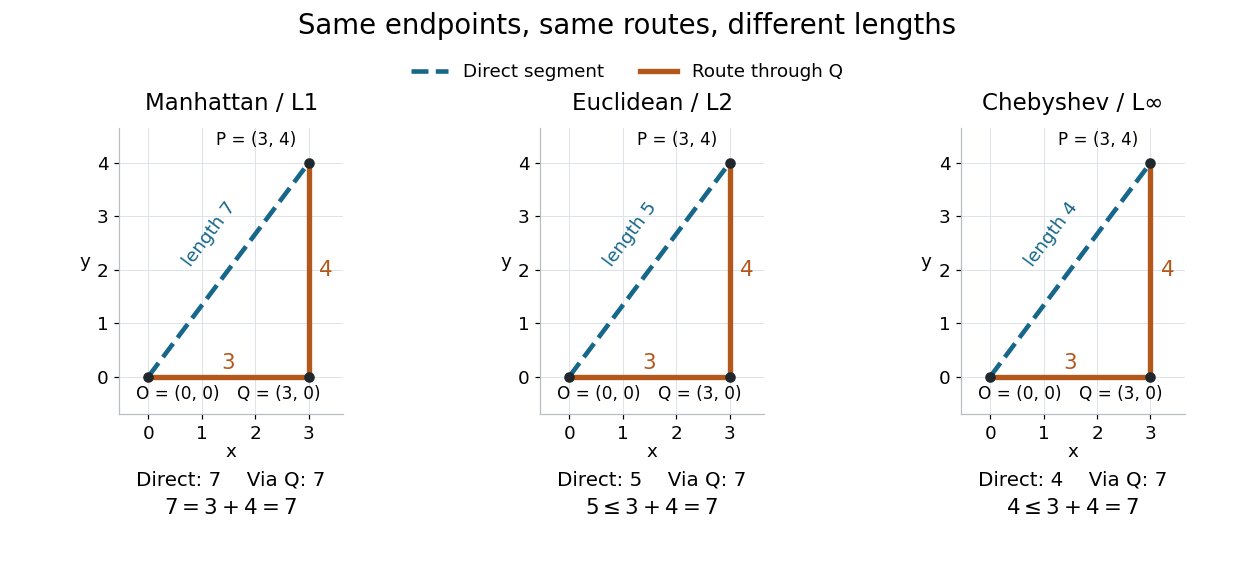
Repeated application of the triangle inequality bounds the endpoint distance by the sum along any finite chain of intermediate points. This explains why metric path length is always at least the distance between endpoints. Equality reveals a shortest route, but its shape and uniqueness depend on the chosen metric.
Bounded-continuous-function characterization of compact metric spaces by  Codex 0 Created 2026-09-24 Updated 2026-09-24
A metric space is compact exactly when every continuous function is bounded. For the converse, a noncompact metric space contains a closed discrete sequence; the unbounded function assigning its th point the value extends to by the Tietze extension theorem.
Every metric space is normal. For disjoint closed sets , the functionis continuous, equals zero on , and equals one on ; inverse images of disjoint neighbourhoods of zero and one separate the sets.
Every sequence in a compact metric space has a convergent subsequence. Conversely, sequential compactness and compactness are equivalent for metric spaces.
Sequential characterization of continuity in metric spaces by Codex 0 Created 2026-09-24 Updated 2026-10-25
Codex 0 Created 2026-09-24 Updated 2026-10-25A map between metric spaces is continuous exactly when always implies . If an inverse image of an open set were not open, points outside it could be chosen within distance of a point inside it, proving the converse by contradiction.
A sequence converges to in a metric space when , equivalently when every neighbourhood of contains all sufficiently late terms.
A saddle point of a differentiable real-valued function is a critical point which is neither a local maximum nor a local minimum. For example has a saddle at the origin. For a nonconstant holomorphic function, critical points of its real part supply the complex-phase application used by the method of steepest descent.
Pinned article: Introduction to the OurBigBook Project
Welcome to the OurBigBook Project! Our goal is to create the perfect publishing platform for STEM subjects, and get university-level students to write the best free STEM tutorials ever.
Everyone is welcome to create an account and play with the site: ourbigbook.com/go/register. We belive that students themselves can write amazing tutorials, but teachers are welcome too. You can write about anything you want, it doesn't have to be STEM or even educational. Silly test content is very welcome and you won't be penalized in any way. Just keep it legal!
Intro to OurBigBook
. Source. We have two killer features:
- topics: topics group articles by different users with the same title, e.g. here is the topic for the "Fundamental Theorem of Calculus" ourbigbook.com/go/topic/fundamental-theorem-of-calculusArticles of different users are sorted by upvote within each article page. This feature is a bit like:
- a Wikipedia where each user can have their own version of each article
- a Q&A website like Stack Overflow, where multiple people can give their views on a given topic, and the best ones are sorted by upvote. Except you don't need to wait for someone to ask first, and any topic goes, no matter how narrow or broad
This feature makes it possible for readers to find better explanations of any topic created by other writers. And it allows writers to create an explanation in a place that readers might actually find it.
Figure 1. Screenshot of the "Derivative" topic page. View it live at: ourbigbook.com/go/topic/derivativeVideo 2. OurBigBook Web topics demo. Source. - local editing: you can store all your personal knowledge base content locally in a plaintext markup format that can be edited locally and published either:This way you can be sure that even if OurBigBook.com were to go down one day (which we have no plans to do as it is quite cheap to host!), your content will still be perfectly readable as a static site.
- to OurBigBook.com to get awesome multi-user features like topics and likes
- as HTML files to a static website, which you can host yourself for free on many external providers like GitHub Pages, and remain in full control

Figure 2. You can publish local OurBigBook lightweight markup files to either OurBigBook.com or as a static website.
Figure 3. Visual Studio Code extension installation.
Figure 5. . You can also edit articles on the Web editor without installing anything locally. Video 3. Edit locally and publish demo. Source. This shows editing OurBigBook Markup and publishing it using the Visual Studio Code extension. 
- Infinitely deep tables of contents:



All our software is open source and hosted at: github.com/ourbigbook/ourbigbook
Further documentation can be found at: docs.ourbigbook.com
Feel free to reach our to us for any help or suggestions: docs.ourbigbook.com/#contact