Topics (384k) Articles (398k) Users (410) Discussions (242) Comments (383) Files (13k) New article
Let be a real irrational algebraic number of field extension degree , and let be its primitive algebraic minimal polynomial. For any rational with positive integer , irreducibility gives . Consequently the nonzero integer givesOn a fixed closed interval around , the mean value theorem gives , where on that interval. Thus rational points in the interval satisfy . Outside it, a fixed positive distance from gives the same type of bound after decreasing the constant. Choosing a smaller constant makes the inequality strict, proving the Liouville approximation theorem.
For nonreal algebraic numbers, the positive distance from the real axis already gives a uniform lower bound against rational approximations. The substantive approximation argument is therefore the real case.
For a complex -by- matrix , the linear system has a solution precisely when is orthogonal to every vector in , where is the conjugate transpose. For a real matrix, use the transpose instead. Indeed,because the defining adjoint operator identity turns orthogonality to every into . Taking the orthogonal complement again recovers in finite dimensions. Thus a linear functional in the annihilator of a vector subspace gives the exact obstruction to solvability, rather than just a necessary test.
For , its image of a linear map is the first coordinate axis and is the second. Consequently is solvable exactly when .
A linear equation is an equation in which the unknowns occur only to the first power and are combined linearly.
If a linear system has negative eigenvalues with widely separated magnitudes, an explicit method can be forced to resolve the fastest decaying mode solely for stability. For eigenvalues and , forward Euler requires , whereas backward Euler is stable for every positive step size.
For a real Jacobian matrix , both eigenvalues have strictly negative real parts if and only ifThe characteristic polynomial is . If its roots are real, positive product makes their signs agree and negative sum makes both negative. If they are a complex conjugate pair, each real part is half the trace. Conversely, two eigenvalues with negative real parts have negative real sum and positive product.
For a continuous-time nonlinear system, the linearization stability theorem turns this strict test into local asymptotic stability. If , the real eigenvalues have opposite signs and the equilibrium is a saddle. Equality in either condition needs separate analysis. A discrete map instead requires eigenvalues inside the unit disk; the trace-determinant inequalities for negative real parts are not its stability test.
This criterion concerns travelling-front solutions of Fisher's equation.
For diffusion coefficient and leading-edge growth rate , a Fisher-KPP-type pulled front has minimum speed .
The transportation problem minimizes linear shipping cost while matching prescribed row supplies and column demands.
This is the finite discrete optimal transport problem with prescribed supply and demand marginals.
For the primal maximization , and dual minimization , , a feasible pair has the nonnegative objective-gap decompositionThus equal objective values are equivalent toThese are complementary slackness. Combined with primal and dual feasibility they certify optimality by weak duality. Conversely, primal and dual optima satisfy them by strong duality.
A positive dual multiplier forces its primal constraint to be tight, and a positive primal variable forces its dual constraint to be tight. A tight constraint need not have a positive multiplier: both factors in a complementary product may be zero. This distinguishes ordinary complementary slackness from a stronger strict-complementarity assertion. In the example under linear programming, the third primal inequality is slack and its multiplier is zero.[ref]
Convex Optimization by Stephen Boyd and Lieven Vandenberghe. §5.5.2, complementary slackness; inequalities and equality of optimal objectives
Weak duality bounds every feasible primal objective by every feasible dual objective, with the direction set by the primal convention. For the primal maximization , , dual feasibility means and . HenceThe first inequality uses ; the last uses . For a minimization primal, feasible dual values instead provide lower bounds. The argument is algebraic and needs no assumption that optima exist or are equal.
If a feasible pair attains equal objective values, each side must already be optimal. If a maximization primal is unbounded above, no feasible finite-valued dual vector can exist. The converse of that last statement is not automatic: dual infeasibility can also occur when the primal is infeasible. Strong duality is the additional theorem asserting equality under suitable conditions.
Dual of a minimization linear program in inequality form by  Codex 0 Created 2026-09-24 Updated 2026-09-24
The rational canonical form of a linear operator on a finite-dimensional vector space over a field is a direct sum of companion matrices, where the monic nonconstant invariant factors of a linear operator satisfy . Their degrees sum to the dimension of the space. It exists over any field and classifies similar matrices, without requiring their eigenvalues to lie in that field. It comes from the structure theorem for finitely generated modules over a principal ideal domain, applied to the module in which the indeterminate acts as the given operator.
An invariant direct-sum decomposition splits a space into nonzero subspaces preserved by the operator.
For a monic polynomial , its companion matrix represents multiplication by on the quotient module in the basis . With column vectors it has ones on the subdiagonal and last column . For example, . Transposing this matrix gives another common convention, so the subdiagonal convention should be specified when giving entries.
For a linear operator , a cyclic vector is a vector whose iterates span the entire vector space. In finite dimension , the vectors then form a basis: the first linear dependence makes the preceding span invariant under , so later iterates cannot enlarge it. In topological settings one often requires the iterates to have dense span instead; that closure convention must be stated.
The Rayleigh quotient measures the quadratic form of a self-adjoint operator per unit squared norm. For a nonzero vector and a finite-dimensional Hermitian matrix ,For a real symmetric matrix, replace the conjugate transpose by . More generally, for a self-adjoint operator on a Hilbert space, use for nonzero in its operator domain. On an eigenvector it returns the exact eigenvalue. Multiplying the vector by any nonzero scalar leaves the quotient unchanged, so it measures a direction rather than a chosen length.
For the symmetric matrix from the finite-dimensional spectral theorem example,The first value is not an eigenvalue: it is an average of the two directional responses. To see every direction, write the unit vector in the orthonormal eigenbasis. ThenThe largest value is along ; the smallest is along . A direction halfway between them has quotient . In the left panel, the color on the unit circle represents the quotient; in the right panel, the same values are plotted against the angle measured from .
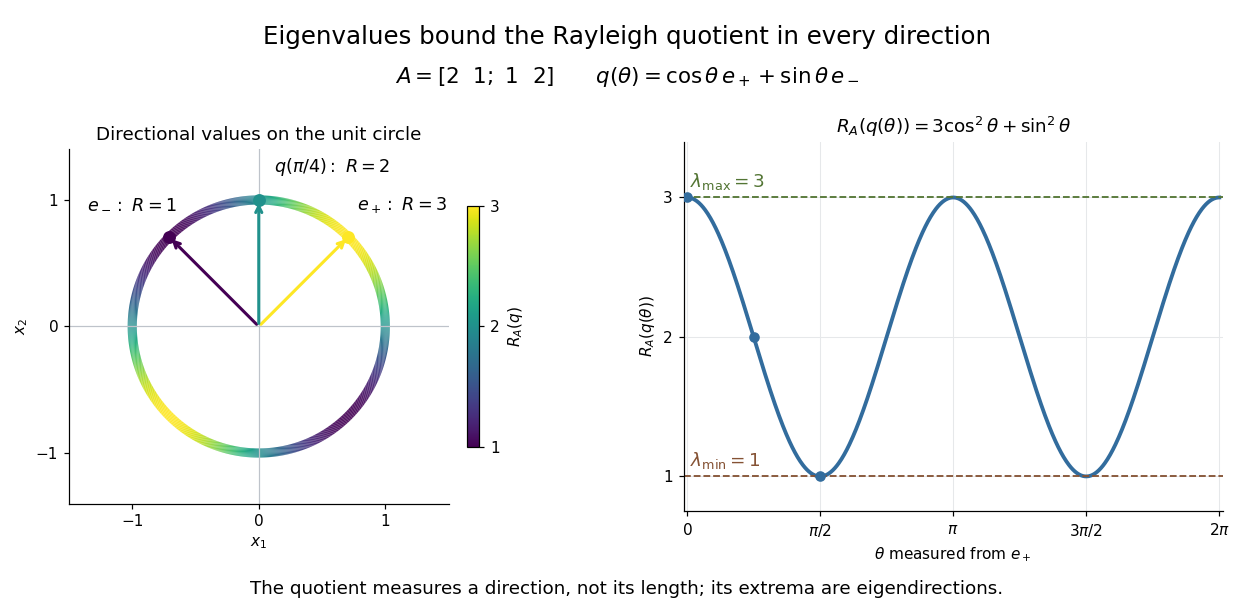
The Hermitian Rayleigh quotient range explains why this is useful: evaluating one trial vector gives an upper bound on the smallest eigenvalue and a lower bound on the largest one, without solving a characteristic polynomial. At an extreme eigenvector, a small angular error changes the quotient only quadratically. Near in this example, . This is the geometric reason for quadratic Rayleigh-quotient improvement for the power method and motivates the Rayleigh-Ritz method.
There is a concrete historical link with normal modes. In The Theory of Sound (1877), Volume I, Sections 88–89, Lord Rayleigh studies the period of a constrained trial vibration. He shows that the period has a stationary point at a normal mode and that a trial type bounds the longest natural period. These energy ratios are a mechanical setting for the modern Rayleigh quotient and generalized Rayleigh quotient; the book describes the result through vibration periods, rather than today's matrix notation.[ref]
https://archive.org/details/theorysound06raylgoog. Rayleigh, The Theory of Sound, Volume I, 1877, Sections 88–89, printed pp. 84–87
Pinned article: Introduction to the OurBigBook Project
Welcome to the OurBigBook Project! Our goal is to create the perfect publishing platform for STEM subjects, and get university-level students to write the best free STEM tutorials ever.
Everyone is welcome to create an account and play with the site: ourbigbook.com/go/register. We belive that students themselves can write amazing tutorials, but teachers are welcome too. You can write about anything you want, it doesn't have to be STEM or even educational. Silly test content is very welcome and you won't be penalized in any way. Just keep it legal!
Intro to OurBigBook
. Source. We have two killer features:
- topics: topics group articles by different users with the same title, e.g. here is the topic for the "Fundamental Theorem of Calculus" ourbigbook.com/go/topic/fundamental-theorem-of-calculusArticles of different users are sorted by upvote within each article page. This feature is a bit like:
- a Wikipedia where each user can have their own version of each article
- a Q&A website like Stack Overflow, where multiple people can give their views on a given topic, and the best ones are sorted by upvote. Except you don't need to wait for someone to ask first, and any topic goes, no matter how narrow or broad
This feature makes it possible for readers to find better explanations of any topic created by other writers. And it allows writers to create an explanation in a place that readers might actually find it.
Figure 1. Screenshot of the "Derivative" topic page. View it live at: ourbigbook.com/go/topic/derivativeVideo 2. OurBigBook Web topics demo. Source. - local editing: you can store all your personal knowledge base content locally in a plaintext markup format that can be edited locally and published either:This way you can be sure that even if OurBigBook.com were to go down one day (which we have no plans to do as it is quite cheap to host!), your content will still be perfectly readable as a static site.
- to OurBigBook.com to get awesome multi-user features like topics and likes
- as HTML files to a static website, which you can host yourself for free on many external providers like GitHub Pages, and remain in full control

Figure 2. You can publish local OurBigBook lightweight markup files to either OurBigBook.com or as a static website.
Figure 3. Visual Studio Code extension installation.
Figure 5. . You can also edit articles on the Web editor without installing anything locally. Video 3. Edit locally and publish demo. Source. This shows editing OurBigBook Markup and publishing it using the Visual Studio Code extension. 
- Infinitely deep tables of contents:



All our software is open source and hosted at: github.com/ourbigbook/ourbigbook
Further documentation can be found at: docs.ourbigbook.com
Feel free to reach our to us for any help or suggestions: docs.ourbigbook.com/#contact