Topics (384k) Articles (398k) Users (410) Discussions (242) Comments (383) Files (13k) New article
The residue field at a maximal ideal is the quotient field . At a prime ideal , the residue field is the fraction field of .
In cosmic time during matter domination, and the pressureless density contrast obeysIts growing and decaying solutions are and .
Laplace-transform solution of a constant-coefficient vector ODE by  Codex 0 Created 2026-09-24 Updated 2026-11-05
For a constant matrix and a forcing vector-valued function , considerWhen the component Laplace transforms converge and the Laplace transform of a derivative applies, setting and givesChoose in the convergence half-plane and outside the spectrum of . The resolvent is the Laplace transform of the matrix exponential for sufficiently large real part. Inverting gives the variation-of-constants formulaThe matrix acts on the forcing from the left, so there is no implicit commutation of a time-dependent forcing with .
If is an -by- matrix and is an -by- matrix over the same field, both products are square matrices andThe products can even have different sizes: for and , and , but both have trace .[ref]
Linear Algebra Done Right by Sheldon Axler (4th edition). Axler, Linear Algebra Done Right, fourth edition, §8D, result 8.49
Grouping all but one factor proves that is unchanged by a cyclic permutation whenever the cyclic products are defined and square. In particular, every commutator has trace zero, since by linearity.
An MPS parent Hamiltonian is a sum of local projectors onto the orthogonal complement of the tensor's local support. The MPS is a frustration-free ground state.
Caliper matching permits a candidate matching pair only when a prespecified distance is at most a tolerance . For propensity score , possible rules are or . These are different distances; the numeric tolerance must be interpreted on the selected scale.[ref]
For a treated unit with propensity score , a raw-score caliper admits a control with score and excludes one with score . The matching algorithm still has to choose among admissible controls and decide whether controls may be reused. A tighter caliper excludes distant pairs but can leave more treated units unmatched. Excluding those units changes the population represented by the matched estimate; a caliper is not a guarantee of an unchanged average treatment effect on the treated. Check covariate balance after matching, and account for the paired or reused-control structure in statistical inference.
Covariate balance means that the compared treatment groups have similar distributions of specified pretreatment covariates. Exact distributional balance in a weighted population isThis is a property of the represented covariates and chosen weights. Matching and inverse probability weighting can aim to approximate it.
Equal means are weaker than equal probability distributions. For example, a covariate taking values equally often in one group and equally often in the other has mean zero in both, but variances one and four. A zero standardized mean difference would miss that discrepancy. Inspect relevant spreads, tails, categories and combinations as well as means.
A nonsignificant difference test does not demonstrate covariate balance: small samples may have low statistical power, while large samples can detect negligible discrepancies. Covariate balance on measured pretreatment variables also cannot establish conditional exchangeability for unmeasured potential outcomes.
Regular-graph matching bound from unmatched vertices by Codex 0 Created 2026-09-24 Updated 2026-11-05
Codex 0 Created 2026-09-24 Updated 2026-11-05For a finite graph , the matching number isIt is the cardinality of a maximum cardinality matching. The vertex capacity constraint gives . The worked path graph examples have and . A perfect matching reaches ; the empty graph has matching number zero.
A maximal matching is a matching in a graph to which no extra edge can be added while retaining all current selected edges. Equivalently, no edge joins two unmatched vertices in a matching; those vertices form an independent set. Every maximum cardinality matching is a maximal matching, but the converse fails.
Take the path graph with vertices and edges . A greedy algorithm that first selects the middle edge produces . Both remaining edges touch a matched vertex, so this size-one matching in a graph is maximal. Yet has two edges. No matching in a graph on four vertices has more than two edges, so is a maximum cardinality matching. The two remaining free vertices of , namely and , are not adjacent; that does not prevent a longer augmenting path in a matching from joining them.
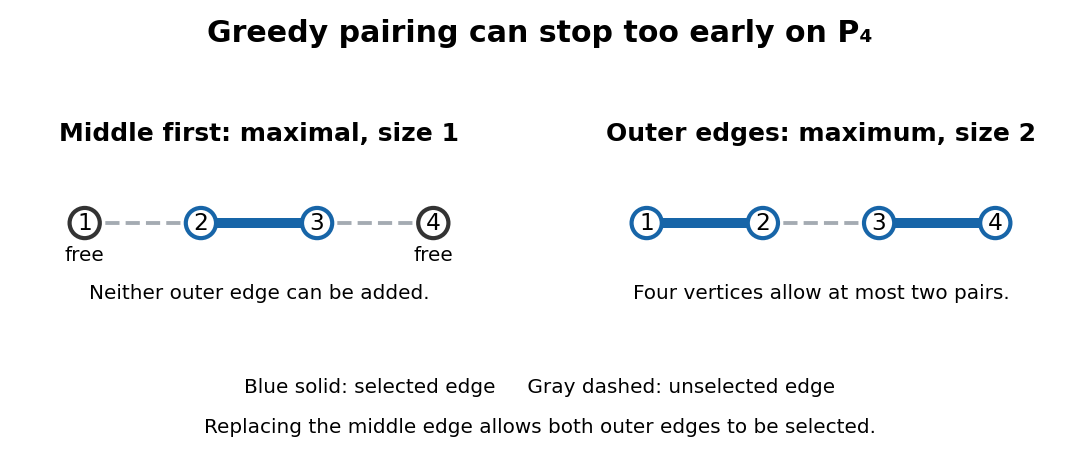
Choosing the middle edge of P₄ gives a maximal matching of size one; the outer edges give a maximum cardinality matching of size two
. Details. Maximality is useful as a quick stopping rule and a modest guarantee. For any maximal matching and maximum cardinality matching in a finite simple graph, every edge of touches an endpoint of an edge of . Assign it to one such edge of . Since has disjoint endpoints, each edge of receives at most two assignments, proving . The P₄ example reaches equality. Thus maximality guarantees at least half the largest cardinality, but says nothing comparable about arbitrary edge benefits. Its selected endpoints also form a vertex cover, as explained under vertex cover.
A perfect matching is a matching in a graph that covers every vertex exactly once. Its edges have no shared endpoints, and every vertex is an endpoint of one selected edge. It is useful when a collection must be divided into disjoint pairs with no element left over.
In a bipartite graph with equally many vertices on its two sides, a perfect matching can assign every person one allowed job and every job one person. The example under permanent of a matrix has three people and three jobs, with exactly three valid assignments. The blue edges below show those three perfect matchings; a crossing in the drawing is not an extra vertex.
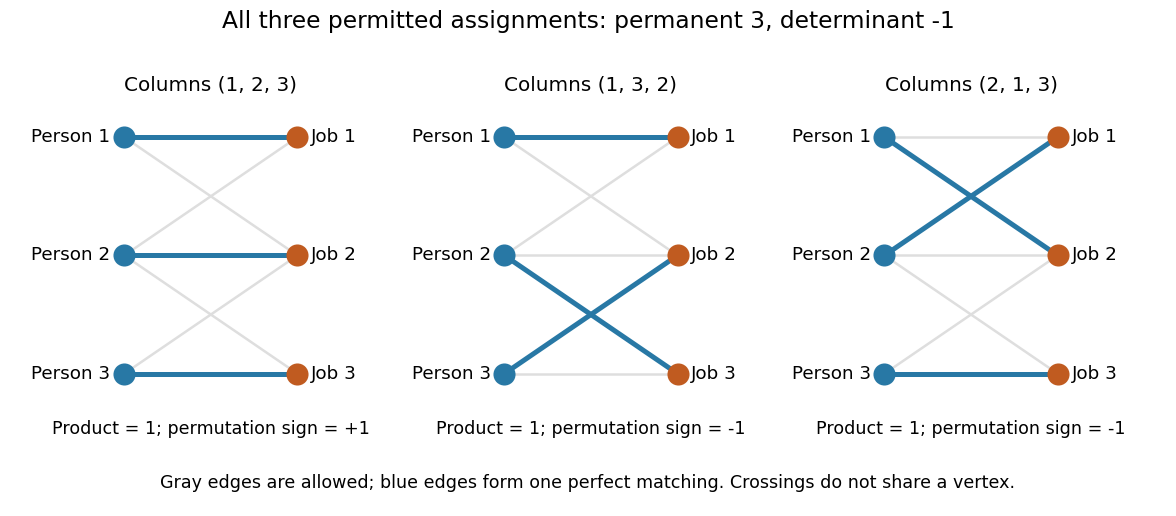
Every selected edge covers two vertices, so a graph with an odd integer number of vertices has no perfect matching. An even integer number is necessary but does not guarantee existence: an isolated vertex cannot be covered. A perfect matching also need not be unique. For example, the complete bipartite graph has two perfect matchings, corresponding to the two ways of assigning two people to two jobs.
Counting all perfect matchings is a different question from finding one. For a zero-one biadjacency matrix of a balanced bipartite graph, the count is its permanent of a matrix. The nonzero determinant criterion for a perfect matching supplies an existence test, but cancellation means that a zero determinant does not rule one out.
The finite-horizon Snell envelope of rewards is defined backward by and . It is the least supermartingale dominating .
In discrete time, a process is predictable or previsible when is -measurable for every . In continuous time, predictability means measurability with respect to the predictable sigma-algebra.
Relative to a filtration , a stopping time is a random variable with values in such thatIn discrete time, use integer-valued and integers . The event that stopping has occurred must be decidable from the information available now. The stopping-time sigma-algebra records the information available at .
For a continuous adapted process, its first hit of a closed upper level is a stopping time, as shown by closed-level hitting times of continuous adapted processes. A fixed deterministic time also qualifies. The time of the maximum of a Brownian motion over a prescribed future interval generally does not: deciding whether the final maximum has already occurred requires future observations. This distinction determines whether the Strong Markov property or an optional stopping theorem applies.
A supermartingale is an integrable adapted process satisfying almost surely. Its conditional expectation can decrease, although a realized sample path need not be decreasing. For a mean-zero random walk , the process with is a supermartingale: the conditional expected next change is . Negating a supermartingale gives a submartingale. A nonnegative supermartingale converges almost surely to a finite limit, but its limiting mean may be smaller than its earlier means without uniform integrability.
If is a martingale and counts its completed upcrossings of by time , thenEquivalent conventions may add an initial endpoint term.
Symmetric signs forced by the martingale property by Codex 0 Created 2026-09-24 Updated 2026-09-24
Codex 0 Created 2026-09-24 Updated 2026-09-24If every increment of a discrete martingale takes values in , thenIterated conditioning shows that the increments are independent symmetric signs, so is a simple symmetric random walk.
For a square-integrable martingale starting at zero,For a continuous local martingale stopped so that its quadratic variation is integrable, the Itô isometry makes the right-hand side .
This is the specialization of Doob's martingale inequality.
Pinned article: Introduction to the OurBigBook Project
Welcome to the OurBigBook Project! Our goal is to create the perfect publishing platform for STEM subjects, and get university-level students to write the best free STEM tutorials ever.
Everyone is welcome to create an account and play with the site: ourbigbook.com/go/register. We belive that students themselves can write amazing tutorials, but teachers are welcome too. You can write about anything you want, it doesn't have to be STEM or even educational. Silly test content is very welcome and you won't be penalized in any way. Just keep it legal!
Intro to OurBigBook
. Source. We have two killer features:
- topics: topics group articles by different users with the same title, e.g. here is the topic for the "Fundamental Theorem of Calculus" ourbigbook.com/go/topic/fundamental-theorem-of-calculusArticles of different users are sorted by upvote within each article page. This feature is a bit like:
- a Wikipedia where each user can have their own version of each article
- a Q&A website like Stack Overflow, where multiple people can give their views on a given topic, and the best ones are sorted by upvote. Except you don't need to wait for someone to ask first, and any topic goes, no matter how narrow or broad
This feature makes it possible for readers to find better explanations of any topic created by other writers. And it allows writers to create an explanation in a place that readers might actually find it.
Figure 1. Screenshot of the "Derivative" topic page. View it live at: ourbigbook.com/go/topic/derivativeVideo 2. OurBigBook Web topics demo. Source. - local editing: you can store all your personal knowledge base content locally in a plaintext markup format that can be edited locally and published either:This way you can be sure that even if OurBigBook.com were to go down one day (which we have no plans to do as it is quite cheap to host!), your content will still be perfectly readable as a static site.
- to OurBigBook.com to get awesome multi-user features like topics and likes
- as HTML files to a static website, which you can host yourself for free on many external providers like GitHub Pages, and remain in full control

Figure 2. You can publish local OurBigBook lightweight markup files to either OurBigBook.com or as a static website.
Figure 3. Visual Studio Code extension installation.
Figure 5. . You can also edit articles on the Web editor without installing anything locally. Video 3. Edit locally and publish demo. Source. This shows editing OurBigBook Markup and publishing it using the Visual Studio Code extension. 
- Infinitely deep tables of contents:




All our software is open source and hosted at: github.com/ourbigbook/ourbigbook
Further documentation can be found at: docs.ourbigbook.com
Feel free to reach our to us for any help or suggestions: docs.ourbigbook.com/#contact