Topics (384k) Articles (398k) Users (410) Discussions (242) Comments (383) Files (13k) New article

Let a proposer divide a pie of size by continuously offering its responder . Rejection gives fixed continuation payoffs to the proposer and to the responder, with and . Then a subgame perfect equilibrium must have the responder accept with probability one. The proposer offers exactly , retaining .
Sequential rationality forces rejection for and acceptance for . If acceptance at had probability , that offer would give the proposer . Every larger offer gives less than and can be improved by a smaller offer still above ; every smaller offer gives . The supremum would therefore be unattained. Randomizing offers cannot attain it either: the nonnegative gap from would be strictly positive almost surely and hence have positive expectation. No best response would exist, contradicting equilibrium. Acceptance at removes this gap and makes the unique optimal proposal. The assumptions and exclude degenerate indifference of the proposer.
In finite-horizon alternating-offer bargaining, the proposer with rounds left retains fraction of the currently available pie. Terminal acceptance gives . After rejection, the responder becomes proposer and can obtain fraction of the current pie. The continuous-offer bargaining acceptance lemma therefore gives . Summing the resulting finite geometric series proves the displayed formula.
Odd horizons give shares above , decreasing toward it; even horizons give shares below it, increasing toward it. Between two available horizons , choose if is odd and if is even. This concerns the initial proposer and immediate agreement, rather than waiting until the selected final round to obtain its share.
For , the displayed expression solves , where and is the finite Hilbert transform with denominator . To derive it, put at infinity, take to be the Cauchy transform of , and set . The Sokhotski–Plemelj formula gives and the displayed jump . The endpoint behavior is at most inverse square root, and at infinity. Cauchy reconstruction from a jump across a finite interval then gives and hence . Adding any constant multiple of gives another solution in the integrable endpoint class.
Multiplying an auxiliary sign-changing factor by a growing analytic factor can invalidate this reconstruction. For example, using instead of with produces the constant function and zero jump. The boundary sum alone is not enough: the entire remainder in reconstructing from its jump must also be controlled.
Triangulate the region , by , , and . Impose zero Dirichlet data on the horizontal and vertical exterior edges and zero Neumann data on the sloping edge. Only the midpoint of the sloping edge remains free in the continuous piecewise linear space. For source one, its stiffness entry is , while its load is three triangle contributions of . The single free value is therefore .
A bilinear square finite element uses polynomials of degree at most one separately in each coordinate and takes values at the four corners as degrees of freedom. On the unit square its nodal shape functions are , , , and , in anticlockwise corner order. Each is a tensor product of one-dimensional linear shape functions. A function in this space need not be affine, since has total degree two. On a physical square of side , its Laplacian stiffness matrix has diagonal entries , adjacent-corner entries and opposite-corner entries . Its Robin boundary condition edge matrix has the two-node block for a unit boundary coefficient.
A shape function is a local basis function associated with a degree of freedom of a finite element. For nodal degrees of freedom it is one at its own node and zero at the other nodes, allowing local interpolation from the nodal values. For a bilinear square finite element, the four products of linear coordinate functions provide the nodal shape functions.
An isoparametric finite element uses the same reference shape functions to interpolate its geometry and its unknown field. With reference functions and physical nodes , the geometry map is and the physical functions are . The map must be one-to-one and have a nonvanishing Jacobian determinant. For bilinear quadrilaterals, compatible common edges have affine geometry maps and identical linear field traces, giving a continuous conforming finite element space. On a general quadrilateral the pulled-back functions need not be polynomials in physical coordinates.
For a rectangular Poisson equation discretization with commuting negative-definite directional matrices , two alternating implicit directional solves give the displayed iteration matrix. If their shared eigenvectors have eigenvalues with , the iteration eigenvalues are . For their moduli are less than one, proving convergence. At the composed iteration is the identity and the forcing terms cancel, so arbitrary initial errors persist. Strict positivity of the parameter is therefore essential for this splitting.
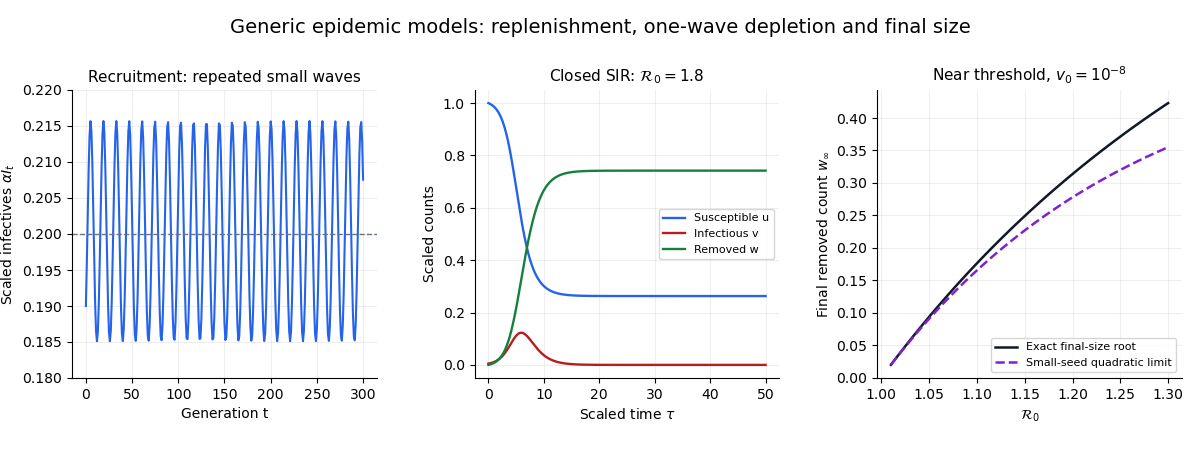
Normalize the closed SIR model by its initial susceptible count, writing , , and . Then , and the SIR susceptible-recovered identity becomes . HenceThe positive root of the quadratic approximation isThe displayed small-seed formula requires , and . In particular, a regime is with a much smaller positive seed. Setting the seed exactly to zero produces the disease-free trajectory instead of an outbreak.
Compute adjacent Fibonacci numbers together, starting at and applying . The shared pair avoids repeating the same recursive subproblem and gives additions for . This counts arithmetic operations; exact integers grow with .
For positive integers , the Fibonacci numbers satisfy . The Fibonacci addition formula gives , so mathematical induction on proves the assertion. This explains why every fifth Fibonacci number is divisible by .
The Cesàro means of the Fourier series of a continuous periodic function converge uniformly to that function. The Fejér kernel is nonnegative with total mass one after normalization, and its mass outside every fixed neighborhood of zero tends to zero. Uniform continuity controls the near contribution, while the vanishing tail controls the rest. For an function the same positive-kernel argument gives an contraction, which is useful even when pointwise behavior is unavailable.
Let be Lebesgue measurable functions on a Lebesgue measurable set , converging almost everywhere to , with . The limit has a measurable representative: use off the exceptional null set and zero on it. The completeness of Lebesgue measure makes any alternative values on that null set measurable as well. Fatou's lemma applied to gives the displayed bound, so is finite almost everywhere and Lebesgue integrable. A uniform L1 norm bound alone does not imply convergence in L1 space; the strict inequality in Fatou lemma supplies a shrinking-spike example.
If are random variables bounded above by an integrable function , with all relevant expectations well defined, Fatou's lemma applied to the nonnegative variables gives . In particular, bounded indicator random variables that tend almost surely to zero have probabilities tending to zero.
The membranous component of superficial perineal fascia.
In an alternating-access model a protein binding site faces either side of a membrane; both empty and substrate-bound carriers can switch orientation. Mass-action binding on each side and conformational transition rates give a four-state carrier cycle coupled to two free-substrate pools. Conservation counts all four carrier states as one protein each and counts bound substrate with the free-substrate pools. Equal source and sink fluxes preserve the total substrate while maintaining throughput.
The complexity class of formal languages decidable in deterministic exponential time. It contains NP: enumerate the finitely many choices of a polynomial-length nondeterministic computation and simulate each branch with a polynomial time cutoff. There are at most branches for fixed branching bound and polynomial .
For fixed real , the base is positive for sufficiently large . Applying Taylor's theorem to the natural logarithm at one gives . Continuity of the exponential function then proves the displayed limit. In particular for fixed , a basic source of exponential distribution limits in probability theory.
For a real symmetric positive-definite matrix and nonzero linear-system residual , minimize for . Differentiating with respect to gives , yielding the displayed positive step. Positive definiteness makes it the unique minimum along the line. Applying the same quotient to a nonsymmetric or indefinite matrix is a formal iteration, but this minimization proof and its convergence consequences no longer apply.
For the angular endpoint conditions , take . The Poincaré inequality and give for . At a nonzero continuous angle still has strictly positive energy because for . Thus the straight state remains the unique global minimum at the critical parameter even though the quadratic variation vanishes on the first sine mode.
Along that mode the energy is at criticality. For a sufficiently small first-mode variation lowers energy, so the straight state loses local minimality. Near the first threshold, expansion of the Euler strut equation gives when and . The resulting supercritical pitchfork bifurcation is stabilized by the same positive quartic term. A zero second variation is therefore an inconclusive quadratic test, not proof of failure of minimization.
Pinned article: Introduction to the OurBigBook Project
Welcome to the OurBigBook Project! Our goal is to create the perfect publishing platform for STEM subjects, and get university-level students to write the best free STEM tutorials ever.
Everyone is welcome to create an account and play with the site: ourbigbook.com/go/register. We belive that students themselves can write amazing tutorials, but teachers are welcome too. You can write about anything you want, it doesn't have to be STEM or even educational. Silly test content is very welcome and you won't be penalized in any way. Just keep it legal!
Intro to OurBigBook
. Source. We have two killer features:
- topics: topics group articles by different users with the same title, e.g. here is the topic for the "Fundamental Theorem of Calculus" ourbigbook.com/go/topic/fundamental-theorem-of-calculusArticles of different users are sorted by upvote within each article page. This feature is a bit like:
- a Wikipedia where each user can have their own version of each article
- a Q&A website like Stack Overflow, where multiple people can give their views on a given topic, and the best ones are sorted by upvote. Except you don't need to wait for someone to ask first, and any topic goes, no matter how narrow or broad
This feature makes it possible for readers to find better explanations of any topic created by other writers. And it allows writers to create an explanation in a place that readers might actually find it.
Figure 1. Screenshot of the "Derivative" topic page. View it live at: ourbigbook.com/go/topic/derivativeVideo 2. OurBigBook Web topics demo. Source. - local editing: you can store all your personal knowledge base content locally in a plaintext markup format that can be edited locally and published either:This way you can be sure that even if OurBigBook.com were to go down one day (which we have no plans to do as it is quite cheap to host!), your content will still be perfectly readable as a static site.
- to OurBigBook.com to get awesome multi-user features like topics and likes
- as HTML files to a static website, which you can host yourself for free on many external providers like GitHub Pages, and remain in full control

Figure 2. You can publish local OurBigBook lightweight markup files to either OurBigBook.com or as a static website.
Figure 3. Visual Studio Code extension installation.
Figure 5. . You can also edit articles on the Web editor without installing anything locally. Video 3. Edit locally and publish demo. Source. This shows editing OurBigBook Markup and publishing it using the Visual Studio Code extension. 
- Infinitely deep tables of contents:



All our software is open source and hosted at: github.com/ourbigbook/ourbigbook
Further documentation can be found at: docs.ourbigbook.com
Feel free to reach our to us for any help or suggestions: docs.ourbigbook.com/#contact