Topics (384k) Articles (398k) Users (410) Discussions (242) Comments (383) Files (13k) New article

Cross ventilation is air exchange through openings exposed to different external pressures, commonly on different sides of a space. Wind produces a pressure distribution around the exterior; flow through connected openings depends on the difference between their local pressures and the interior pressure established by the circulation.
For a simple steady incompressible estimate, an opening contributes a flow scale , with direction set by the sign of the local pressure difference. Both openings matter because the same air stream must enter and leave, and internal passages can add resistance. Changing wind direction can reverse or weaken the exchange even at unchanged wind speed. Combining opening-flow measurements with external pressure readings therefore tests the driving mechanism more directly than a single indoor temperature reading.
The stack effect is buoyancy-driven flow caused by different vertical hydrostatic pressure profiles in connected columns. If indoor air is warmer and less dense than outdoor air, their pressure difference varies with height. Low and high openings can then admit cooler air below and discharge warmer air above.
For a characteristic opening separation , the driving pressure scale is , with density contrast . A small relative temperature contrast at similar absolute pressure gives in an ideal gas. This connects thermal conditions to a mechanical driving scale. The neutral pressure level marks where the two hydrostatic pressures agree, and its location depends on the connected openings and resulting flow. A larger height difference can increase the driving scale, but the final volume flux still requires opening resistance and the full circulation balance.
The torus tubarius is the mucosal elevation around the pharyngeal opening of the auditory tube in the nasopharynx. Its contour reflects the supporting tube cartilage. It is a landmark of the tube opening rather than the entire auditory tube.
Marked backward arching caused by contraction of the back and neck muscles.
Restricted jaw opening, including restriction caused by muscle spasms.
For nonnegative integers with binary representation , multiply by by summing the shifted terms . Each term is either zero or a left bit shift of . An unsigned -bit input pair needs at most product bits, because . This expansion follows from distributivity and motivates a binary multiplier.
The source is the mass gained by phase per mixture volume and time, through processes such as evaporation or condensation. Internal exchange conserves total mass, so its phase sources sum to zero. In an immiscible material-interface model without phase change, every is zero. The interface may still move: absence of transfer means that mass does not cross it relative to its own motion.
Here means integration over a fixed pipe cross-section divided by its area, and is the indicator of one immiscible fluid. The volume fraction is ; intrinsic density averages over the phase-occupied area rather than over the whole section. The velocity must be density-weighted for its product with mean phase density to represent mass flux exactly.
If there is no interphase mass transfer, integrating over a section with impermeable outer wall gives . The second phase uses and its own intrinsic averages. For constant phase density the velocity reduces to the ordinary phase-area average. These definitions apply where the corresponding phase fraction is positive; zero-fraction intrinsic quantities need a separate convention.
Take incompressible phase mass equations for fractions and momentum equations with a common pressure. At a uniform state with , elimination of the mass and momentum perturbation amplitudes givesIts roots are the displayed speeds, whose imaginary parts are . A nonzero slip velocity therefore gives a Fourier branch growing as . No finite-order Sobolev estimate can control all high wavenumbers, showing ill-posedness of this unregularized closure. At zero slip the roots coincide and this nonreal-root argument no longer settles the degenerate case. Phase-fraction endpoints also lie outside the root formula's derivation.
Unbiased random termination of a sampled contribution: retain it with probability and multiply surviving contributions by . In path tracing this controls path length without the systematic truncation of a fixed bounce limit, provided the continuation probabilities and weights are handled consistently.
For a real number , its reduction modulo one is its fractional partThe floor function is used, including at negative inputs: . Truncating toward zero would instead give , outside the required interval.
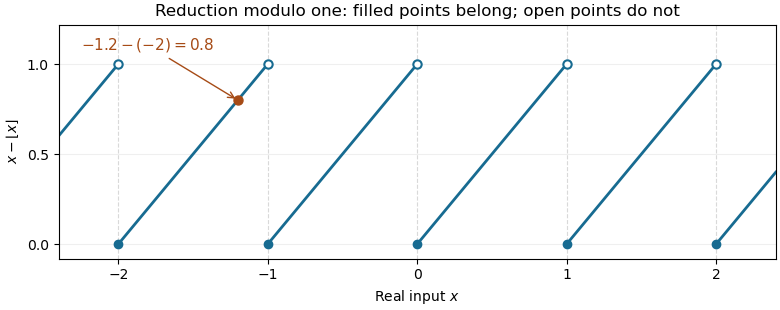
Two real numbers have the same fractional part exactly when their difference is an integer. Thus reduction chooses representatives for the quotient group , the circle group. Applied to two coordinates, it selects representatives in for a torus, obtained from a closed unit square by identifying opposite edges.
For observations, let and count missing values of two variables, and let count observations on which both are available. The number missing at least one variable is . Applying the inclusion-exclusion principle to the two missing-value sets gives the displayed number missing both. The disjoint counts are consequently missing only , missing only , missing both, and complete cases. Their nonnegativity is a necessary consistency check on the supplied totals.
This identifies an aggregate missingness pattern without reconstructing individual records. It does not identify a missing-data mechanism, establish missing completely at random, or justify treating a substantive response such as an explicit unknown category as a missing observation. Counts from different cohorts cannot be inserted into the identity without first establishing a common denominator.
A microscope slide is a support, usually a flat glass plate, that holds a specimen for an optical microscope. A thin specimen and a cover glass can provide a reproducible optical path through the sample; the appropriate preparation depends on whether the observation uses transmitted or reflected light.
Preparation affects the inference. A thick or uneven specimen can superpose structures at different depths, while compression or drying can change the object being observed. Magnification alone therefore does not establish that an apparent boundary corresponds to a structure in the original specimen.
An anemometer measures air motion. In a cup anemometer, moving air exerts different drag on the two sides of the cups, turning a shaft; a calibration converts its rotation rate into wind speed. A separate directional measurement is needed to recover a horizontal velocity vector. A sonic anemometer instead compares sound travel times along different paths and can operate without rotating parts.[ref]
The instrument measures the flow at its own location, so obstacles, mounting height and gust averaging affect the result. The reported wind is therefore not simply an intrinsic property of an entire town or atmospheric layer. Comparing observations requires a consistent exposure and a stated sampling procedure.
A weather station is a set of instruments measuring atmospheric conditions at a specified site. A thermometer records temperature, a barometer records pressure, an anemometer records wind, and a rain gauge measures collected rainfall. Moisture observations may be reported as relative humidity or dew point.
Instrument exposure is part of the measurement. Direct sunlight can heat a temperature sensor above the surrounding air; nearby buildings alter wind; the height and averaging interval affect comparability. A long record therefore needs instrument and site metadata as well as numbers. Consistent observations support both immediate meteorology and the statistics used in climatology.
An atmospheric optical feature produced by interactions with ice crystals. A common halo comes from a prism path in hexagonal crystals; minimum deviation concentrates rays near its inner angular boundary. This differs from the liquid-water path of a rainbow.[ref]
Pinned article: Introduction to the OurBigBook Project
Welcome to the OurBigBook Project! Our goal is to create the perfect publishing platform for STEM subjects, and get university-level students to write the best free STEM tutorials ever.
Everyone is welcome to create an account and play with the site: ourbigbook.com/go/register. We belive that students themselves can write amazing tutorials, but teachers are welcome too. You can write about anything you want, it doesn't have to be STEM or even educational. Silly test content is very welcome and you won't be penalized in any way. Just keep it legal!
Intro to OurBigBook
. Source. We have two killer features:
- topics: topics group articles by different users with the same title, e.g. here is the topic for the "Fundamental Theorem of Calculus" ourbigbook.com/go/topic/fundamental-theorem-of-calculusArticles of different users are sorted by upvote within each article page. This feature is a bit like:
- a Wikipedia where each user can have their own version of each article
- a Q&A website like Stack Overflow, where multiple people can give their views on a given topic, and the best ones are sorted by upvote. Except you don't need to wait for someone to ask first, and any topic goes, no matter how narrow or broad
This feature makes it possible for readers to find better explanations of any topic created by other writers. And it allows writers to create an explanation in a place that readers might actually find it.
Figure 1. Screenshot of the "Derivative" topic page. View it live at: ourbigbook.com/go/topic/derivativeVideo 2. OurBigBook Web topics demo. Source. - local editing: you can store all your personal knowledge base content locally in a plaintext markup format that can be edited locally and published either:This way you can be sure that even if OurBigBook.com were to go down one day (which we have no plans to do as it is quite cheap to host!), your content will still be perfectly readable as a static site.
- to OurBigBook.com to get awesome multi-user features like topics and likes
- as HTML files to a static website, which you can host yourself for free on many external providers like GitHub Pages, and remain in full control

Figure 2. You can publish local OurBigBook lightweight markup files to either OurBigBook.com or as a static website.
Figure 3. Visual Studio Code extension installation.
Figure 5. . You can also edit articles on the Web editor without installing anything locally. Video 3. Edit locally and publish demo. Source. This shows editing OurBigBook Markup and publishing it using the Visual Studio Code extension. 
- Infinitely deep tables of contents:



All our software is open source and hosted at: github.com/ourbigbook/ourbigbook
Further documentation can be found at: docs.ourbigbook.com
Feel free to reach our to us for any help or suggestions: docs.ourbigbook.com/#contact