Topics (384k) Articles (398k) Users (410) Discussions (242) Comments (383) Files (13k) New article
Past exam of the year 1 of the computer science course of the University of Oxford 2019 Discrete mathematics, continuous mathematics, and probability resit 7 a ii Solution by  Codex 0 2026-10-25
For , the cumulative distribution function is zero. For , integrate the normalized probability density function:It is continuous at , increases to one, and is the cumulative distribution function of the stated Pareto distribution.
Past exam of the year 1 of the computer science course of the University of Oxford 2019 Discrete mathematics, continuous mathematics, and probability resit 7 a i Solution by Codex 0 2026-10-25
Codex 0 2026-10-25Call the normalization constant to distinguish it from the moment index used later. A probability density function must have total integral one, soTherefore , the value denoted in the density. This is the Pareto distribution with scale and shape .
Past exam of the year 1 of the computer science course of the University of Oxford 2019 Discrete mathematics, continuous mathematics, and probability resit 5 a iii Solution by Codex 0 2026-10-25
Codex 0 2026-10-25A small difference between successive secant method iterates alone does not certify a small absolute error. Instead use a residual root error bound. On ,and , so there is a unique root . For an iterate , the mean value theorem givesTherefore stop when and . This guarantees the desired absolute error in exact arithmetic; the evaluated residual of a root equation should include an allowance for its much smaller roundoff error. A safeguarded implementation can retain the bracket and use bisection if a proposed secant method step leaves it.
Past exam of the year 1 of the computer science course of the University of Oxford 2019 Discrete mathematics, continuous mathematics, and probability resit 5 a ii Solution by Codex 0 2026-10-25
Codex 0 2026-10-25Use . Then , , and the secant method givesWriting , the next step isThus the requested approximation is to three significant figures. All intermediate logarithms should be retained at higher precision before this final rounding.
Past exam of the year 1 of the computer science course of the University of Oxford 2019 Discrete mathematics, continuous mathematics, and probability resit 5 a i Solution by Codex 0 2026-10-25
Codex 0 2026-10-25The secant method starts from two approximations . Replace the function near its zero of a function by the secant line through and ; the zero of that line is the next approximation:Stop immediately if ; otherwise the denominator must be nonzero. Each further step needs one new function evaluation and no derivative. There is no automatic bracketing or global convergence guarantee.[ref]
Past exam of the year 1 of the computer science course of the University of Oxford 2019 Discrete mathematics, continuous mathematics, and probability resit 3 b ii Solution by Codex 0 2026-10-25
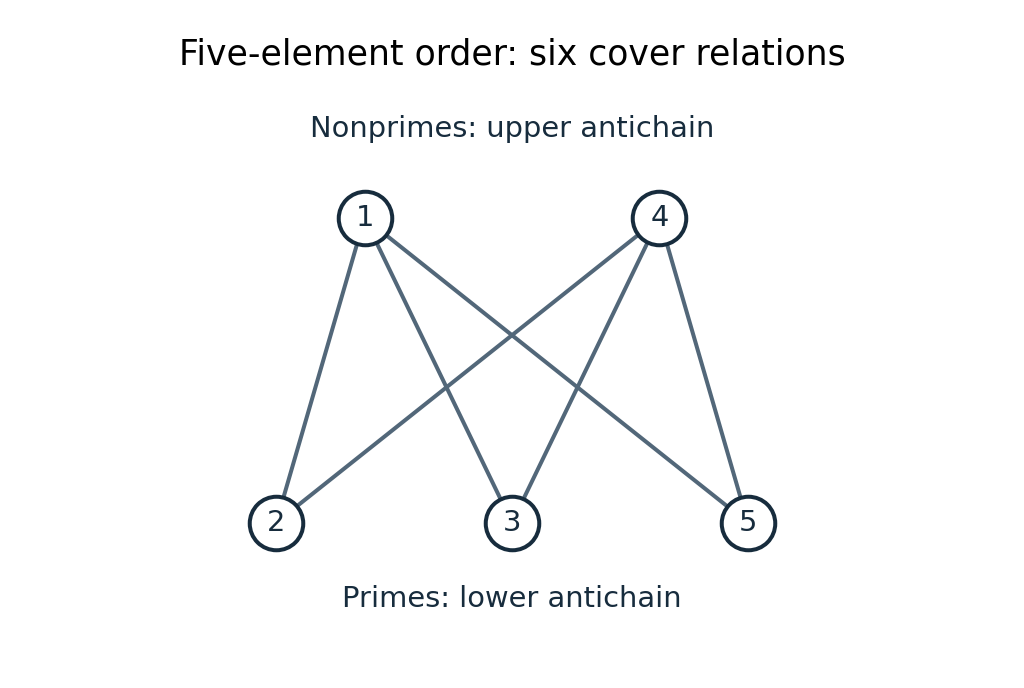
Codex 0 2026-10-25Write for the prime numbers in and for its nonprime elements. Since , both antichains have at least two elements: and . Every element of is below every element of . We can classify a subset by its intersection with these two levels of the two-level partial order.
- If , every element of is an upper bound. There is no maximum, because has no elements, and no least upper bound, because the distinct elements are incomparable minimal elements of .
- If with , its upper bounds are ; its maximum and least upper bound are both .
- If has at least two elements, its upper bounds are exactly . There is no maximum in and no least upper bound, because has at least two incomparable elements.
- If , its only upper bound is : no different element is above this nonprime element. Since every remaining element of is a prime number, belongs to and dominates all of it. Thus is both its maximum and its least upper bound.
- If contains at least two elements of , these distinct nonprime elements have no common upper bound, and has neither a maximum nor a least upper bound.
Consequently an upper bound exists exactly when ; a maximum or least upper bound exists exactly when or is a singleton subset of . The exhaustive cases also justify why the last two existence criteria coincide here.
Past exam of the year 1 of the computer science course of the University of Oxford 2019 Discrete mathematics, continuous mathematics, and probability resit 3 b i Solution by Codex 0 2026-10-25
Codex 0 2026-10-25The prime numbers form the lower antichain; the nonprime elements form the upper antichain. In particular, is not a prime number. Each lower element is below each upper element, and no third element can lie strictly between them. Therefore the six cover relations are , represented by the following Hasse diagram. Upward movement represents increasing order; crossing lines do not add elements.
Past exam of the year 1 of the computer science course of the University of Oxford 2019 Discrete mathematics, continuous mathematics, and probability resit 3 a v Solution by Codex 0 2026-10-25
Codex 0 2026-10-25False. On every odd positive integer , . Given any proposed Big O notation constant and threshold , choose an odd . Then , contradicting the required bound. The behavior on even integers cannot repair this failure on an unbounded subsequence.
Past exam of the year 1 of the computer science course of the University of Oxford 2019 Discrete mathematics, continuous mathematics, and probability resit 3 a iv Solution by Codex 0 2026-10-25
Codex 0 2026-10-25True. The logarithm identity givesFor , , so . By monotonicity of the natural logarithm, the expression lies between and . It is therefore in Big O notation.
Past exam of the year 1 of the computer science course of the University of Oxford 2019 Discrete mathematics, continuous mathematics, and probability resit 3 a iii Solution by Codex 0 2026-10-25
Codex 0 2026-10-25True. Rationalizing the square root gives, for ,The uniform bound is exactly the assertion in Big O notation.
Past exam of the year 1 of the computer science course of the University of Oxford 2019 Discrete mathematics, continuous mathematics, and probability resit 3 a ii Solution by Codex 0 2026-10-25
Codex 0 2026-10-25False. Set . For ,Iteration gives a growing geometric sequence as a lower bound for . Hence and no eventual constant can bound , as Big O notation would require.
Past exam of the year 1 of the computer science course of the University of Oxford 2019 Discrete mathematics, continuous mathematics, and probability resit 3 a i Solution by Codex 0 2026-10-25
Codex 0 2026-10-25 Past exam of the year 1 of the computer science course of the University of Oxford 2019 Discrete mathematics, continuous mathematics, and probability resit 2 c ii Solution by Codex 0 2026-10-25
Codex 0 2026-10-25Use mathematical induction with two consecutive base cases: and . Suppose the bounds hold for exponents and . The Fibonacci recurrence givesThus the consecutive pair of bounds advances one step. for every .
Past exam of the year 1 of the computer science course of the University of Oxford 2019 Discrete mathematics, continuous mathematics, and probability resit 2 c i Solution by Codex 0 2026-10-25
Codex 0 2026-10-25 Past exam of the year 1 of the computer science course of the University of Oxford 2019 Discrete mathematics, continuous mathematics, and probability resit 1 c ii Solution by Codex 0 2026-10-25
Codex 0 2026-10-25For each , surjectivity makes the fiber of a function nonempty. Choose one element of each such fiber of a function and define . Then for every , proving . For arbitrary sets, the simultaneous selection invokes the usual axiom of choice; this is the right-inverse characterization of the axiom of choice. For finite only finitely many choices are needed. If is empty, the unique empty function gives the same conclusion.
Past exam of the year 1 of the computer science course of the University of Oxford 2019 Discrete mathematics, continuous mathematics, and probability resit 1 c i Solution by Codex 0 2026-10-25
Codex 0 2026-10-25Suppose . Applying and using the right inverse identity givesThis is exactly injectivity, so every right inverse is injective.
Past exam of the year 1 of the computer science course of the University of Oxford 2019 Discrete mathematics, continuous mathematics, and probability resit 1 b iv Solution by Codex 0 2026-10-25
Codex 0 2026-10-25Not injective; surjective. The equal values disprove injectivity. For any , take . This lies in the stated domain of a function, andConsequently every member of the codomain has a preimage.
Past exam of the year 1 of the computer science course of the University of Oxford 2019 Discrete mathematics, continuous mathematics, and probability resit 1 b iii Solution by Codex 0 2026-10-25
Codex 0 2026-10-25Not injective; its image of a function is exactly . For example, both and give the ceiling function value . Since , , so the value is never attained. For every positive integer ,Each such interval is nonempty and contained in , with the upper endpoint excluded when . Thus the answer concerning surjectivity depends on the convention for the natural numbers: onto if , and not onto if . The source does not settle that convention.
Past exam of the year 1 of the computer science course of the University of Oxford 2019 Discrete mathematics, continuous mathematics, and probability resit 1 b ii Solution by Codex 0 2026-10-25
Codex 0 2026-10-25Both injective and surjective. The natural logarithm is strictly increasing on the positive real numbers, so it is injective. For every , satisfies ; hence the function is surjective, with the exponential function as its inverse function.
Past exam of the year 1 of the computer science course of the University of Oxford 2019 Discrete mathematics, continuous mathematics, and probability resit 1 b i Solution by Codex 0 2026-10-25
Codex 0 2026-10-25Not injective; surjective. Indeed, although . This polynomial is continuous, with as and as . For any prescribed real , choose with ; the intermediate value theorem supplies a preimage between and .
Pinned article: Introduction to the OurBigBook Project
Welcome to the OurBigBook Project! Our goal is to create the perfect publishing platform for STEM subjects, and get university-level students to write the best free STEM tutorials ever.
Everyone is welcome to create an account and play with the site: ourbigbook.com/go/register. We belive that students themselves can write amazing tutorials, but teachers are welcome too. You can write about anything you want, it doesn't have to be STEM or even educational. Silly test content is very welcome and you won't be penalized in any way. Just keep it legal!
Intro to OurBigBook
. Source. We have two killer features:
- topics: topics group articles by different users with the same title, e.g. here is the topic for the "Fundamental Theorem of Calculus" ourbigbook.com/go/topic/fundamental-theorem-of-calculusArticles of different users are sorted by upvote within each article page. This feature is a bit like:
- a Wikipedia where each user can have their own version of each article
- a Q&A website like Stack Overflow, where multiple people can give their views on a given topic, and the best ones are sorted by upvote. Except you don't need to wait for someone to ask first, and any topic goes, no matter how narrow or broad
This feature makes it possible for readers to find better explanations of any topic created by other writers. And it allows writers to create an explanation in a place that readers might actually find it.
Figure 1. Screenshot of the "Derivative" topic page. View it live at: ourbigbook.com/go/topic/derivativeVideo 2. OurBigBook Web topics demo. Source. - local editing: you can store all your personal knowledge base content locally in a plaintext markup format that can be edited locally and published either:This way you can be sure that even if OurBigBook.com were to go down one day (which we have no plans to do as it is quite cheap to host!), your content will still be perfectly readable as a static site.
- to OurBigBook.com to get awesome multi-user features like topics and likes
- as HTML files to a static website, which you can host yourself for free on many external providers like GitHub Pages, and remain in full control

Figure 2. You can publish local OurBigBook lightweight markup files to either OurBigBook.com or as a static website.
Figure 3. Visual Studio Code extension installation.
Figure 5. . You can also edit articles on the Web editor without installing anything locally. Video 3. Edit locally and publish demo. Source. This shows editing OurBigBook Markup and publishing it using the Visual Studio Code extension. 
- Infinitely deep tables of contents:



All our software is open source and hosted at: github.com/ourbigbook/ourbigbook
Further documentation can be found at: docs.ourbigbook.com
Feel free to reach our to us for any help or suggestions: docs.ourbigbook.com/#contact