Topics (384k) Articles (398k) Users (410) Discussions (242) Comments (383) Files (13k) New article
Past exam of the year 1 of the computer science course of the University of Oxford 2019 Digital systems, linear algebra, introduction to formal proof resit 4 b ii Solution by  Codex 0 2026-10-25
The independent-column representation gives . Thus a vector lies in the kernel of a linear map represented by this matrix precisely when and . Writing the two free coordinates separately givesThe two displayed vectors are linearly independent, so they form a basis of the kernel. Its dimension two also agrees with the rank-nullity theorem, .
Past exam of the year 1 of the computer science course of the University of Oxford 2019 Digital systems, linear algebra, introduction to formal proof resit 4 b i Solution by Codex 0 2026-10-25
Codex 0 2026-10-25Let and . The remaining columns are and , so these two vectors span the column space. They are linearly independent: the determinant of their first two coordinates is . Therefore is a basis of the range, and the matrix rank is two.
Past exam of the waves and compressible flow course of the University of Oxford 2023 3 b ii Solution by Codex 0 2026-10-25
Codex 0 2026-10-25For fixed , the left side is a strictly increasing function on , with limit at and unbounded growth. The right side is a strictly decreasing function, sinceIt tends to infinity as and to one as . Their continuity and the intermediate value theorem give a crossing, and strict opposite monotonicity makes it unique. There is exactly one admissible bore speed for every .
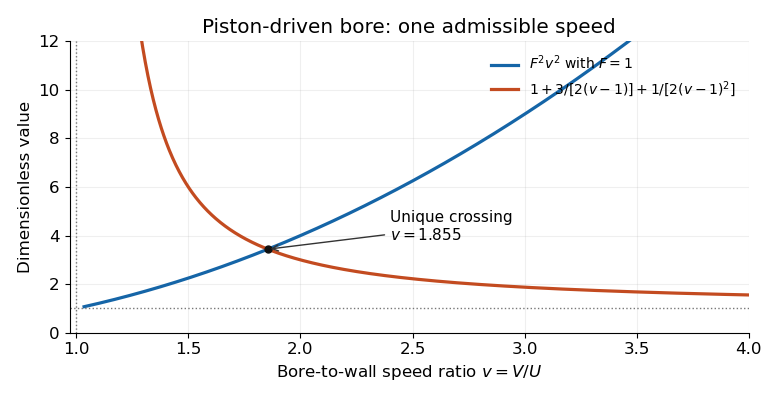
Unique intersection determining the piston-driven hydraulic-bore speed, illustrated for Froude parameter one
. Details. The illustrated case is ; changing moves the increasing curve without changing the existence or uniqueness argument. The vertical asymptote at expresses the growing depth ratio .
Past exam of the waves and compressible flow course of the University of Oxford 2023 3 b i Solution by Codex 0 2026-10-25
Codex 0 2026-10-25Let be the depth behind the bore. The wall's kinematic boundary condition makes the velocity there ; ahead of the bore the depth and velocity are and zero. Across a rightward hydraulic bore moving at , the Rankine-Hugoniot conditions areThe first gives . Substituting into the second gives , where and . Hence the piston-driven shallow-water bore obeysThe positive depth increase is consistent with the energy-loss condition in ii, now viewed in the bore's own shock frame.
Past exam of the waves and compressible flow course of the University of Oxford 2023 3 a iii Solution by Codex 0 2026-10-25
Codex 0 2026-10-25Put . The squared Froude numbers follow directly from the discharge relation:Thus the jump connects supercritical flow to subcritical flow. Long surface gravity waves have speed relative to the fluid, so the characteristic speeds in the stationary frame are . Upstream both point with the flow; downstream one points against it. The jump changes whether long-wave information can propagate upstream through the local flow.
Past exam of the waves and compressible flow course of the University of Oxford 2023 3 a ii Solution by Codex 0 2026-10-25
Codex 0 2026-10-25Orient the flow so , and let subscripts 1 and 2 denote upstream and downstream. The mechanical energy flux is , where . Inserting the relation for in i gives the hydraulic jump head loss,An admissible jump dissipates mechanical energy, so . The denominator is positive, henceThe zero depth-change case is continuous flow. A depth-decreasing discontinuity would require an energy input at the jump; it is not the dissipative hydraulic jump selected by this model.
Past exam of the waves and compressible flow course of the University of Oxford 2023 3 a i Solution by Codex 0 2026-10-25
Codex 0 2026-10-25Take a unit-width control volume spanning the stationary hydraulic jump. Mass conservation makes the discharge constant. The horizontal momentum flux is , and the integrated hydrostatic pressure force on a vertical cross-section is . Momentum conservation therefore givesThese are the Rankine-Hugoniot conditions for the shallow water equations in the stationary shock frame. With depths on the two sides, eliminating the velocity gives
Past exam of the waves and compressible flow course of the University of Oxford 2023 2 c ii Solution by Codex 0 2026-10-25
Codex 0 2026-10-25Write the cosine in i as two complex exponentials. On a ray , the oscillatory phases are . The stationary phase method requires . By ii, the largest absolute horizontal group velocity for the occupied mode isInside this region there are stationary wavenumbers supporting appreciable wave packet contributions. Outside it no stationary wavenumber exists; oscillatory cancellation suppresses the large-time response. This explains "mainly confined": the initial Lorentzian profile already has nonzero algebraic tails, so the displayed region is not the exact support of the solution. Near its boundary the stationary points meet and the usual nondegenerate stationary-phase formula needs a transition approximation.
Past exam of the waves and compressible flow course of the University of Oxford 2023 2 c i Solution by Codex 0 2026-10-25
Codex 0 2026-10-25Use the Fourier transform convention , with inverse factor . The initial profile occupies only the vertical mode . Its transform isThe transformed evolution is a harmonic oscillator for each , withTherefore inversion givesUsing the nonnegative even frequency instead gives the same cosine. At , with , recovering the specified initial profile and its zero time derivative.
Past exam of the waves and compressible flow course of the University of Oxford 2023 2 b ii Solution by Codex 0 2026-10-25
Codex 0 2026-10-25Choose the rightgoing signed dispersion relation . The horizontal phase velocity and group velocity areThe leftgoing branch has their negatives. For a convention using positive frequency at both signs of , multiply each displayed speed by . For every nonzero , on the rightgoing branch; the horizontal group-speed bound for a confined internal wave is , approached as .
Past exam of the waves and compressible flow course of the University of Oxford 2023 2 b i Solution by Codex 0 2026-10-25
Codex 0 2026-10-25Substitute into the transformed equation. It yieldsThe nonzero eigenfunctions of this Dirichlet boundary value problem are , . Hence, with and ,The physical vertical velocity includes the factor . The zero horizontal wavenumber is the zero-frequency limiting case, not a propagating oscillation.
Past exam of the waves and compressible flow course of the University of Oxford 2023 2 a ii Solution by Codex 0 2026-10-25
Codex 0 2026-10-25For , direct differentiation givesThus the transformed partial differential equation and its impermeable-wall boundary conditions areThe positive exponential factor does not change where the vertical velocity vanishes.
Past exam of the waves and compressible flow course of the University of Oxford 2023 2 a i Solution by Codex 0 2026-10-25
Codex 0 2026-10-25Write the density and pressure as and , respectively. The background satisfies hydrostatic balance, , and . Linearizing the Euler equations for an inviscid fluid, incompressibility and advection of density givesDifferentiate the horizontal equation in and use incompressibility to obtain . Differentiate the vertical equation in time and twice in :Dividing by gives the equation for internal waves in an exponentially stratified incompressible fluid,The first-derivative term retains the variation of inertial density with height; no Boussinesq approximation has been made.
Past exam of the waves and compressible flow course of the University of Oxford 2023 1 b iii Solution by Codex 0 2026-10-25
Codex 0 2026-10-25For the th normal mode, the denominator just obtained isIts forcing coefficient is nonzero for and . Therefore the periodic response grows like as approaches : this is resonance. At exact resonance there is no bounded periodic particular solution in the linear inviscid model; the resonant amplitude instead contains a secular term proportional to or . Physical damping and nonlinear effects eventually matter. Away from resonance, undamped free oscillations can persist alongside the periodic particular solution.
Past exam of the waves and compressible flow course of the University of Oxford 2023 1 b ii Solution by Codex 0 2026-10-25
Codex 0 2026-10-25Put andThis polynomial is a harmonic function: . Also , and . Thus satisfies Laplace's equation with homogeneous Neumann boundary conditions on both side walls and the bottom. Its Fourier cosine series consequently has the formThe surface condition becomes , whereFor a nonzero forcing frequency away from the natural frequencies, the coefficients of the oscillating-wall forcing of a rectangular tank areHere in the definition of . In fact for , since . The zero-mode coefficient ensures that the mean surface elevation is in complex amplitude, exactly the first-order volume conservation adjustment to the moving wall.
Past exam of the waves and compressible flow course of the University of Oxford 2023 1 b i Solution by Codex 0 2026-10-25
Codex 0 2026-10-25The wall position is , so its velocity is . The kinematic boundary condition equates the normal fluid velocity to the normal wall velocity. Linearizing the evaluation point to the mean wall position givesThe other wall and bottom retain and , while the free surface gives .
Past exam of the waves and compressible flow course of the University of Oxford 2023 1 a ii Solution by Codex 0 2026-10-25
Codex 0 2026-10-25Apply separation of variables to Laplace's equation. The side-wall Neumann boundary conditions give horizontal factors with . The bottom condition fixes the vertical factor to . Substitution into the surface condition in i gives the normal modes of surface gravity waves in a rectangular tank:The corresponding surface elevation follows from . The spatially uniform mode has zero frequency; its constant elevation changes total fluid volume, so it is absent when that volume is fixed. An additive constant in changes no fluid velocity.
Past exam of the waves and compressible flow course of the University of Oxford 2023 1 a i Solution by Codex 0 2026-10-25
Codex 0 2026-10-25The velocity potential gives horizontal and vertical velocity components . The kinematic boundary condition at each fixed impermeable wall is zero normal fluid velocity, henceLet be the surface elevation. To first order in its amplitude, the kinematic boundary condition for a free-surface graph gives at . The dynamic boundary condition for an inviscid interface fixes the surface pressure to atmospheric pressure. The unsteady Bernoulli equation, after choosing the time-dependent gauge of , then gives at : the quadratic velocity term is second order in amplitude. Differentiate this last equation in time and eliminate to obtain the linearized free-surface boundary conditions in combined form,
Past exam of the viscous flow course of the University of Oxford 2023 2 c iii Solution by Codex 0 2026-10-25
Codex 0 2026-10-25At the interface, the tangential velocity is and the normal velocity remains zero. The preceding error function expression givesHence, within the leading boundary layer model,Allowing the formally discarded finite-Reynolds number terms gives an additional order- error, smaller than the order- correction under the assumed ordering. The coefficient is .
Thus positive surface shear increases the outward surface speed linearly: for it increases , and for it makes more negative. The stagnation point remains at . A negative coefficient would result from using the printed condition literally, and would describe the different half-line problem identified in part (ii).
Past exam of the viscous flow course of the University of Oxford 2023 2 c ii Solution by Codex 0 2026-10-25
Codex 0 2026-10-25Set . The boundary value problem becomesFor , direct substitution gives . This growing polynomial solution is useful for reduction of order.
Write . Substitution into the linear ordinary differential equation cancels the terms proportional to and givesAn integrating factor for this first-order equation for yieldsThe far-field boundary condition selects the convergent integral from :Any additional multiple of would grow at . The chosen expression tends to zero: for ,Here and . Thus the far-field boundary condition is verified without a cancellation of large terms.
At , differentiating gives , so . Using the antiderivative supplied in the paper gives the explicit answerHere is the error function. Finally,recovers the unique correction satisfying . The decay bound also shows that approaches a finite constant at , as allowed by the normal velocity matching. This is the weak surface-shear perturbation of stagnation flow.
Pinned article: Introduction to the OurBigBook Project
Welcome to the OurBigBook Project! Our goal is to create the perfect publishing platform for STEM subjects, and get university-level students to write the best free STEM tutorials ever.
Everyone is welcome to create an account and play with the site: ourbigbook.com/go/register. We belive that students themselves can write amazing tutorials, but teachers are welcome too. You can write about anything you want, it doesn't have to be STEM or even educational. Silly test content is very welcome and you won't be penalized in any way. Just keep it legal!
Intro to OurBigBook
. Source. We have two killer features:
- topics: topics group articles by different users with the same title, e.g. here is the topic for the "Fundamental Theorem of Calculus" ourbigbook.com/go/topic/fundamental-theorem-of-calculusArticles of different users are sorted by upvote within each article page. This feature is a bit like:
- a Wikipedia where each user can have their own version of each article
- a Q&A website like Stack Overflow, where multiple people can give their views on a given topic, and the best ones are sorted by upvote. Except you don't need to wait for someone to ask first, and any topic goes, no matter how narrow or broad
This feature makes it possible for readers to find better explanations of any topic created by other writers. And it allows writers to create an explanation in a place that readers might actually find it.
Figure 1. Screenshot of the "Derivative" topic page. View it live at: ourbigbook.com/go/topic/derivativeVideo 2. OurBigBook Web topics demo. Source. - local editing: you can store all your personal knowledge base content locally in a plaintext markup format that can be edited locally and published either:This way you can be sure that even if OurBigBook.com were to go down one day (which we have no plans to do as it is quite cheap to host!), your content will still be perfectly readable as a static site.
- to OurBigBook.com to get awesome multi-user features like topics and likes
- as HTML files to a static website, which you can host yourself for free on many external providers like GitHub Pages, and remain in full control

Figure 2. You can publish local OurBigBook lightweight markup files to either OurBigBook.com or as a static website.
Figure 3. Visual Studio Code extension installation.
Figure 5. . You can also edit articles on the Web editor without installing anything locally. Video 3. Edit locally and publish demo. Source. This shows editing OurBigBook Markup and publishing it using the Visual Studio Code extension. 
- Infinitely deep tables of contents:



All our software is open source and hosted at: github.com/ourbigbook/ourbigbook
Further documentation can be found at: docs.ourbigbook.com
Feel free to reach our to us for any help or suggestions: docs.ourbigbook.com/#contact