Topics (384k) Articles (398k) Users (410) Discussions (242) Comments (383) Files (13k) New article

Balthasar Bickel is a linguist studying the diversification of languages and the mechanisms that constrain it. His research combines comparisons of grammars, lexicons and text corpus resources with experimental methods including electroencephalography and eye tracking. He describes these as complementary approaches to language change and its biological foundations.[ref]
Research profile by Balthasar Bickel. research statement, comparative models and experimental methods
The combination illustrates two different sources of evidence. Comparing documented syntactic dependencies across languages can reveal recurring patterns; an experiment can instead hold an input contrast fixed and measure processing in participants. These are examples of the questions those methods can address, rather than findings inferred from a biography.
Balthasar Bickel also co-developed the Leipzig Glossing Rules by Bernard Comrie and others with Bernard Comrie and Martin Haspelmath. Their shared conventions make linguistic annotation easier to compare while leaving grammatical analysis open to argument.[ref]
Leipzig Glossing Rules by Bernard Comrie and others. About the rules, developer credit and distinction between convention and analysis

Portrait of Balthasar Bickel
. Photograph linked from his official institutional profile.Matthew S. Dryer is a linguist whose research combines linguistic typology, syntax and language documentation. His work has developed cross-language comparisons of word order and related structural properties, and he coedited the World Atlas of Language Structures.[ref]
Research profile by Matthew S. Dryer. research statement, comparative database and atlas contribution
His atlas chapter on the order of subject, object and verb makes the comparison operational. It specifies the constructions considered and defines the participant labels for that purpose, rather than assuming that every grammatical framework uses the labels identically.[ref]
Order of Subject, Object and Verb by Matthew S. Dryer. §1, declarative transitive constructions and operational A/P roles
This illustrates a central measurement problem in comparative research. Counting languages under a label is reproducible only if another researcher can determine which documented constructions satisfy it. Missing data, a different construction type or a changed coding rule can alter a count without representing a historical change in the language itself. Linking each observation to its definition and evidence lets a lexical database or grammatical dataset support testable comparisons.

Portrait of Matthew S. Dryer
. Named photograph linked from his official university-hosted research profile.Norman Steenrod developed operations on cohomology that reveal structure beyond the cohomology groups alone. His original work constructs the mod-two Steenrod squares, organized under composition in the Steenrod algebra.[ref]
Products of cocycles and extensions of mappings by Norman Steenrod. Original paper and cochain-construction contribution
An operation sends a class in degree to one in degree and behaves naturally under continuous maps. The top square satisfies , connecting the operations with the cup product. Such compatibility makes them useful for distinguishing spaces and detecting restrictions on maps, even when simpler algebraic invariants agree.
Jean Serra developed methods in mathematical morphology, using geometric operations on sets to analyze images. His 1986 introductory paper presents the subject as a mathematical approach to image structure.[ref]
Introduction to mathematical morphology by Jean Serra. Original publisher byline and introductory scope
In a binary image, the foreground can be treated as a set. Morphological erosion keeps positions where a translated test shape fits completely inside it; morphological dilation takes the union of translated copies of that shape placed on foreground points. These operations connect local shape tests with global effects such as removing narrow features or joining nearby regions. Their geometric assumptions are explicit, so the operation can be chosen for the scale and shape being investigated.
Ravi Vakil works on algebraic geometry. His Stanford page identifies the specialization and his exposition The Rising Sea: Foundations of Algebraic Geometry by Ravi Vakil (2017 draft).[ref]
The book builds the geometry of polynomial equations through schemes, beginning with affine constructions and developing local-to-global methods. A rational map may be defined only on a dense open set; a birational morphism can change a geometric model while preserving its function field. These distinctions connect concrete equations with the abstract language needed to compare algebraic spaces.[ref]
The Rising Sea: Foundations of Algebraic Geometry by Ravi Vakil (2017 draft). Section 0.4, chapter 3 and rational-map development

John Milnor works across topology, geometry and dynamical systems. His expositions connect local calculations with global structure: Morse Theory by John Milnor develops the topology of a manifold through critical points, while his complex-dynamics lectures study iteration of holomorphic maps.[ref][ref]
Near a nondegenerate critical point, the Morse lemma reduces a smooth function exactly to a signed quadratic form in suitable coordinates. Its index controls the topological change in sublevel sets. With James D. Stasheff, Milnor also wrote Characteristic Classes by John Milnor and James D. Stasheff, developing invariants of vector bundles.
Dennis Sullivan developed algebraic methods for topology, particularly rational homotopy theory. His Sullivan minimal model replaces a space's differential-form information by a controlled differential graded algebra.[ref]
Infinitesimal computations in topology by Dennis Sullivan. Original byline, introduction and sections 2 and 5
Generators are added to represent missing cohomology classes and impose necessary relations. Under the theory's hypotheses, the model records rational homotopy information that ordinary cohomology alone can miss. This makes nonlinear questions about spaces accessible through algebra while retaining more structure than a list of Betti numbers.[ref]
Zoltán Szabó co-developed Heegaard Floer homology with Peter Ozsváth. The theory obtains invariants of a three-manifold by turning a Heegaard splitting into a Floer-theoretic chain complex.[ref]
https://math.berkeley.edu/about/upcoming-events/lecture-series/chern-lectures/2010-chern-lectures. Institutional account of joint discovery
Their Holomorphic triangles and invariants for smooth four-manifolds by Peter Ozsváth and Zoltán Szabó extends the framework through Heegaard Floer cobordism maps. Compatibility under gluing lets data from pieces combine into an invariant of a closed smooth four-manifold, while blowup formulas describe its behavior under a controlled geometric modification.[ref]
Peter Ozsváth and Zoltán Szabó developed Heegaard Floer homology, constructing invariants of three-manifolds from holomorphic-disk counts associated with Heegaard splittings. Their Berkeley lecture record explicitly identifies the joint discovery.[ref]
https://math.berkeley.edu/about/upcoming-events/lecture-series/chern-lectures/2010-chern-lectures. Institutional lecture abstract and joint attribution
Their four-manifold work uses pseudoholomorphic curves on triangular domains to define maps associated with cobordisms and assemble a smooth four-manifold invariant. The construction connects surface diagrams with information about smooth structures in four dimensions.[ref]
John Douglas Moore studies differential geometry and geometric analysis. His UCSB research page describes work on minimal surfaces and related variational problems.[ref]
His Lecture Notes on Seiberg-Witten Invariants by John Douglas Moore develop gauge-theoretic methods for four-manifolds. The treatment of Hodge theory connects the curvature of a line-bundle connection with its harmonic representative: analytic equations select distinguished representatives of topological classes. This provides a bridge from differential equations to invariants of smooth manifolds.[ref]

Benson Farb works on topology and geometric group theory. His University of Chicago page identifies his research publications and books.[ref]
With Dan Margalit, he wrote A primer on mapping class groups (Version 5.0) by Benson Farb and Dan Margalit. The book studies symmetries of surfaces up to deformation. A Dehn twist is supported in an annulus, yet repeated twisting has a precisely calculable effect on intersection numbers of curves. This links a local geometric operation with the algebra of a mapping class group.[ref]
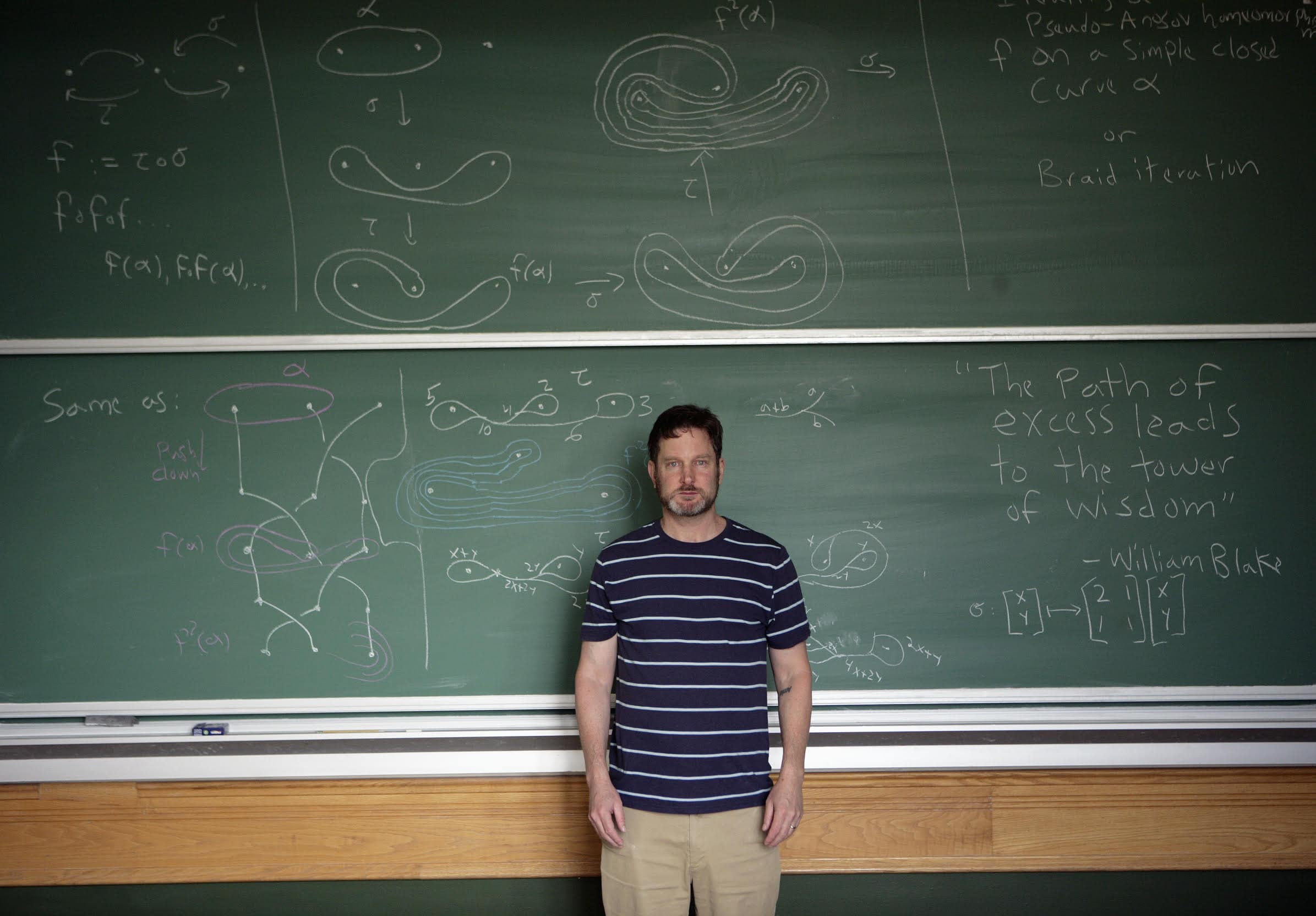
Branko Grünbaum studied geometric and combinatorial structures, including uniform polyhedra. His survey on uniform polyhedrals extends the investigation from finite objects to locally finite ones, requiring regular polygonal faces and a single vertex orbit under spatial symmetries.[ref]
The broader setting admits infinite structures such as rods, slabs and sponges. Explicitly stating which overlaps and coincidences are permitted becomes essential: changing the definition changes the class being investigated. His exposition shows how precise combinatorial and symmetry conditions organize visual geometry.[ref]
Alexander I. Bobenko studies differential geometry, discrete geometric structures, integrable systems and Riemann surfaces. His TU Berlin homepage also emphasizes mathematical visualization as part of this work.[ref]
With Carl O. R. Lutz, Helmut Pottmann and Jan Techter, he studied Laguerre geometry in spaces of different curvature and its use in incircular nets. The project connects continuous contact geometry with discrete geometric constraints.[ref]
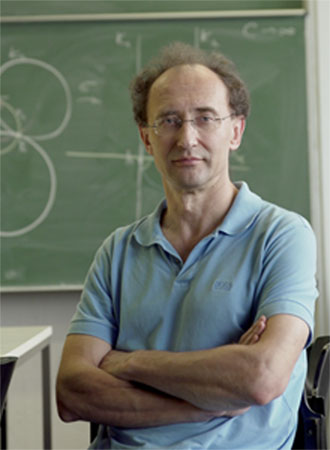
Carl O. R. Lutz coauthored research on Laguerre geometry with Alexander I. Bobenko, Helmut Pottmann and Jan Techter. The primary manuscript verifies the full printed name and TU Berlin affiliation at the time of the work.[ref]
The paper generalizes oriented sphere-and-plane contact geometry to hyperbolic and elliptic settings, then applies it to incircular nets. This combines transformation geometry with discrete configurations satisfying exact contact conditions.[ref]
Helmut Pottmann works on applied and discrete geometry, computational design and geometric methods for architecture and manufacturing. His KAUST research profile identifies this connection between mathematical structure and practical construction.[ref]
His joint work with Alexander I. Bobenko, Carl O. R. Lutz and Jan Techter studies Laguerre geometry and incircular nets. Such nets organize quadrilaterals with inscribed circles, connecting exact tangency constraints with discrete surface geometry.[ref]
Laguerre geometry in space forms and incircular nets by Alexander I. Bobenko and others. Abstract and checkerboard-net development
Jan Techter works on discrete geometric structures. The Discretization in Geometry and Dynamics project identifies his participation in research on discrete surfaces.[ref]
https://gitlab.discretization.de/projects/A02/. Primary project participant record
With Alexander I. Bobenko, Carl O. R. Lutz and Helmut Pottmann, he studied Laguerre geometry in spaces of different curvature and its application to incircular nets. The work treats contact between oriented spheres and planes as geometric data preserved by transformations.[ref]
Shiing-Shen Chern developed methods connecting curvature, differential geometry and topological invariants. His joint work with James Simons constructs secondary characteristic forms from connections.[ref]
Characteristic forms and geometric invariants by Shiing-Shen Chern and James Simons. Original byline and introduction
The key relation expresses a characteristic curvature form as an exterior derivative on an appropriate total space. Its primitive carries geometric information beyond the original cohomology class. The resulting Chern-Simons forms connects local differential forms with global invariants and later applications in mathematical physics.[ref]
James Simons worked on differential geometry and geometric invariants. With Shiing-Shen Chern, he introduced the secondary characteristic forms now associated with Chern-Simons forms.[ref]
Characteristic forms and geometric invariants by Shiing-Shen Chern and James Simons. Original byline, introduction and equation 3.1
The construction produces a form whose exterior derivative is a characteristic curvature form. The introduction explains how a search for a combinatorial formula for a number obtained from a Pontryagin class led to an interesting boundary term. That term became a geometric object in its own right, illustrating how an obstruction in one calculation can generate a new invariant.[ref]
James D. Stasheff works on topology and its algebraic structures. With John Milnor, he wrote Characteristic Classes by John Milnor and James D. Stasheff, developing invariants that detect how vector bundles twist over a space.[ref]
Characteristic Classes by John Milnor and James D. Stasheff. Original book byline and characteristic-class development
The total Pontryagin class illustrates the importance of coefficient conventions: its product formula is stated modulo elements of order two in their theorem. Keeping that qualification prevents an integral statement from being inferred from a result valid only after removing a torsion ambiguity.[ref]
Charles Livingston studies knot theory and algebraic concordance of knots. His paper on algebraic concordance order develops effective tests for deciding whether a class has finite or infinite order.[ref]
The algebraic concordance order of a knot by Charles Livingston. Original byline and abstract
A Seifert matrix translates a knot problem into a question about bilinear forms. The resulting algebraic concordance class can be analyzed through Witt groups and P-adic numbers. Livingston's criteria reduce the primes that need consideration and can sometimes avoid p-adic computations, making abstract concordance invariants accessible to explicit knot calculations.[ref]
Pinned article: Introduction to the OurBigBook Project
Welcome to the OurBigBook Project! Our goal is to create the perfect publishing platform for STEM subjects, and get university-level students to write the best free STEM tutorials ever.
Everyone is welcome to create an account and play with the site: ourbigbook.com/go/register. We belive that students themselves can write amazing tutorials, but teachers are welcome too. You can write about anything you want, it doesn't have to be STEM or even educational. Silly test content is very welcome and you won't be penalized in any way. Just keep it legal!
Intro to OurBigBook
. Source. We have two killer features:
- topics: topics group articles by different users with the same title, e.g. here is the topic for the "Fundamental Theorem of Calculus" ourbigbook.com/go/topic/fundamental-theorem-of-calculusArticles of different users are sorted by upvote within each article page. This feature is a bit like:
- a Wikipedia where each user can have their own version of each article
- a Q&A website like Stack Overflow, where multiple people can give their views on a given topic, and the best ones are sorted by upvote. Except you don't need to wait for someone to ask first, and any topic goes, no matter how narrow or broad
This feature makes it possible for readers to find better explanations of any topic created by other writers. And it allows writers to create an explanation in a place that readers might actually find it.
Figure 1. Screenshot of the "Derivative" topic page. View it live at: ourbigbook.com/go/topic/derivativeVideo 2. OurBigBook Web topics demo. Source. - local editing: you can store all your personal knowledge base content locally in a plaintext markup format that can be edited locally and published either:This way you can be sure that even if OurBigBook.com were to go down one day (which we have no plans to do as it is quite cheap to host!), your content will still be perfectly readable as a static site.
- to OurBigBook.com to get awesome multi-user features like topics and likes
- as HTML files to a static website, which you can host yourself for free on many external providers like GitHub Pages, and remain in full control

Figure 2. You can publish local OurBigBook lightweight markup files to either OurBigBook.com or as a static website.
Figure 3. Visual Studio Code extension installation.
Figure 5. . You can also edit articles on the Web editor without installing anything locally. Video 3. Edit locally and publish demo. Source. This shows editing OurBigBook Markup and publishing it using the Visual Studio Code extension. 
- Infinitely deep tables of contents:


All our software is open source and hosted at: github.com/ourbigbook/ourbigbook
Further documentation can be found at: docs.ourbigbook.com
Feel free to reach our to us for any help or suggestions: docs.ourbigbook.com/#contact