Topics (384k) Articles (398k) Users (410) Discussions (242) Comments (383) Files (13k) New article

S. Kim (knot theory) coauthored lectures on fundamental groups and knot groups with V. O. Manturov. The primary title page identifies the author only as S. Kim; a fuller personal identity is not inferred from those initials.[ref]
Lecture 3. Fundamental groups and knot groups by S. Kim and V. O. Manturov. Title page, 19 May 2022
The lectures explain the van Kampen theorem and derive diagrammatic group presentations. A Dehn presentation of a knot group assigns generators to regions and a relation at each crossing, converting topological gluing into algebra. This supplies a reusable route from knot diagrams to invariants of their complements.[ref]
Lecture 3. Fundamental groups and knot groups by S. Kim and V. O. Manturov. Slides 12–21, especially the region/crossing figure
V. O. Manturov works on knot theory. With S. Kim (knot theory), he authored lectures connecting fundamental groups with diagrams of knots. The displayed title page verifies both sets of initials.[ref]
Lecture 3. Fundamental groups and knot groups by S. Kim and V. O. Manturov. Title page, 19 May 2022
Their presentation of knot groups explains how loops in a knot complement can be encoded by generators and relations. Wirtinger presentations use arcs, whereas a Dehn presentation of a knot group uses regions and crossing relations. The two constructions show how a picture supplies algebraic information about an otherwise difficult three-dimensional complement.[ref]
E. C. Zeeman developed constructions in geometric topology. His paper on twist-spun knots studies higher-dimensional knots obtained by rotating a classical knot while adding twists.[ref]
Twisting spun knots by E. C. Zeeman. Original byline and introduction
The construction makes knot complements accessible through fiber bundles over a circle. A striking consequence is that the one-twist spin is unknotted, even when the original classical knot is nontrivial. The theorem connects an explicit motion of a diagram with the global topology of its complement.[ref]
Louis H. Kauffman studies knot theory and its connections with statistical mechanics, quantum theory and combinatorics. His University of Illinois at Chicago research page identifies these connections.[ref]
His Kauffman bracket computes a polynomial by resolving each crossing into simpler diagrams and combining the resulting states. A correction using the diagram's writhe produces the Jones polynomial. The construction explains how a local crossing rule can yield a global invariant of a knot and gives applications to reduced alternating diagrams.[ref]
State models and the Jones polynomial by Louis H. Kauffman. Introduction and section 2, Definition 2.1 and writhe normalization
Robion Kirby developed tools for low-dimensional topology, including Kirby calculus. His 1978 paper describes three-manifolds by surgery on framed links in the three-sphere.[ref]
A calculus for framed links in S3 by Robion Kirby. Original byline and section 1
Different link diagrams can describe the same manifold. Kirby's theorem identifies moves—handle slides and the addition or removal of an isolated appropriately framed unknot—that relate such descriptions. This turns an equivalence problem about manifolds into controlled operations on diagrams, while also connecting the diagrams to four-dimensional handle attachments.[ref]
Vladimir Turaev develops invariants in low-dimensional topology. His work on Reidemeister torsion refines invariants using Euler structures and relates them to Seiberg-Witten invariant of a three-manifold of three-manifolds.[ref]
A formula for Dehn surgery describes how an invariant changes when a manifold is assembled by filling boundary tori. Tracking the coefficient system and the extra geometric structures is essential: the same underlying filling can have different invariant data. His paper supplies formulas in this refined setting.[ref]
Emily B. Dryden studies spectral geometry: the relationship between geometric spaces and spectra of differential operators. Her Bucknell profile identifies this research specialization.[ref]
https://www.bucknell.edu/fac-staff/emily-dryden. Institutional research profile
With Alexander Strohmaier, she proved an orbisurface version of Huber's theorem. For compact orientable hyperbolic orbisurfaces, the Laplacian spectrum determines both closed-geodesic lengths and singular-point orders with multiplicities; the corresponding geometric data also determine the spectrum. Thus spectral information records some singular geometry as well as ordinary closed paths.[ref]
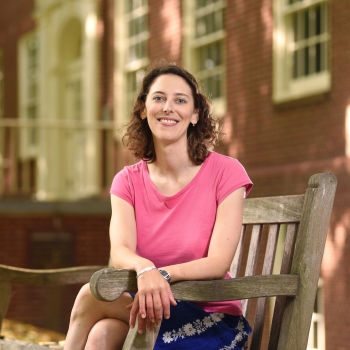
Alexander Strohmaier studies global analysis, spectral geometry and quantum field theory in curved spacetime. His Hannover research page connects spectra of geometric differential operators with classical dynamics.[ref]
With Emily B. Dryden, he extended Huber's theorem to compact orientable hyperbolic orbisurfaces: the Laplacian spectrum determines the lengths of closed geodesics and the number of singular points of each order, with a converse. The result uses a Selberg trace formula to relate spectral and geometric terms.[ref]
Juan Pablo Rossetti works on geometry and spectral questions. With Peter G. Doyle, he proved that closed hyperbolic surfaces with the same Laplacian spectrum have matching closed geodesics, separately counting orientation-preserving and orientation-reversing ones at each length.[ref]
The orientation distinction matters on nonorientable surfaces: different types of closed geodesic contribute differently to a trace formula. Their result explains exactly which geometric data can be recovered from the spectrum, extending the orientable setting of Huber's theorem.[ref]
Frédéric Haglund works on geometric group theory and cubical geometry. His joint work with Daniel T. Wise introduced special cube complexes and related them to Right-angled Artin groups.[ref]
Special cube complexes by Frédéric Haglund and Daniel T. Wise. Original byline and introduction
The key conditions control how hyperplanes embed, whether they are two-sided and how they meet. A local isometry to a standard cubical model then yields an embedding of the fundamental group. This is a concrete mechanism for obtaining algebraic information from the internal geometry of a complex.[ref]
Special cube complexes by Frédéric Haglund and Daniel T. Wise. Theorem 1.1 and definition of specialness
Daniel T. Wise studies geometric group theory through cubical geometry. With Frédéric Haglund, he introduced and studied special cube complexes, whose hyperplanes satisfy restrictions preventing certain self-interactions.[ref]
Special cube complexes by Frédéric Haglund and Daniel T. Wise. Original byline, introduction and Theorem 1.1
A compact nonpositively curved cube complex satisfying their criterion admits a local isometry into the standard complex of a Right-angled Artin group. Consequently its fundamental group embeds in a linear group. The contribution connects visible geometric conditions on hyperplanes with algebraic properties of the fundamental group.[ref]
Indira Chatterji studies geometric group theory. Her joint work with Graham Niblo develops a route from actions on a wallspace to actions on a CAT(0) cube complex.[ref]
From wall spaces to CAT(0) cube complexes by Indira Chatterji and Graham Niblo. Original byline and abstract
The distinction between a distance and a pseudometric matters here: different points can be separated by no walls. Counting walls still records enough separation information to support a cubical construction and transfer proper-action properties under the paper's hypotheses.[ref]
From wall spaces to CAT(0) cube complexes by Indira Chatterji and Graham Niblo. Section 1 and main construction
Graham Niblo works on geometric group theory. With Indira Chatterji, he explained a construction taking a group action on a wallspace to an action on a CAT(0) cube complex.[ref]
From wall spaces to CAT(0) cube complexes by Indira Chatterji and Graham Niblo. Original byline and abstract
Walls separate pairs of points; counting the separating walls gives a pseudometric. Consistent choices of sides become vertices of a cubical space. This transforms separation data into a geometric object on which the group acts, making combinatorial information available to nonpositive-curvature methods.[ref]
From wall spaces to CAT(0) cube complexes by Indira Chatterji and Graham Niblo. Section 1, pp. 2–3, and construction
Daniel Ray coauthored the 1971 analytic torsion paper with Isadore Singer. The original prints D. B. Ray; the author-hosted account by Singer's former student John Lott explicitly identifies him as Daniel Ray.[ref]
https://math.berkeley.edu/~lott/torsion.pdf. Introduction, p. 17, identifies Daniel Ray and Isadore Singer
Their construction extracts a geometric invariant from spectra of Laplacians on differential forms. A spectral zeta function makes it possible to define a regularized determinant, which contributes to analytic torsion. Their paper establishes metric-independence under its hypotheses and motivates comparison with a combinatorial invariant.[ref]
R-torsion and the Laplacian on Riemannian manifolds by Daniel Ray and Isadore Singer. Introduction, Definition 1.6 and section 2
Isadore Singer connected analysis, topology and differential geometry. With Michael Atiyah, he proved the Atiyah-Singer index theorem, linking the analytic index of an elliptic operator to topological data.[ref]
https://www.maths.ox.ac.uk/node/31190. Institutional mathematical account of the joint index theorem
With Daniel Ray, he introduced analytic torsion using spectral information from Laplacians on differential forms. Their construction uses derivatives of spectral zeta functions to regularize otherwise divergent products of eigenvalues. The original paper proved invariance results and proposed equality with combinatorial torsion; that equality was a conjectural step in their paper.[ref]
R-torsion and the Laplacian on Riemannian manifolds by Daniel Ray and Isadore Singer. Introduction, Definition 1.6 and section 2
Mark Powell studies the topology of manifolds, especially in dimensions three and four, together with homological algebra. His Glasgow profile verifies this research specialization.[ref]
https://www.gla.ac.uk/schools/mathematicsstatistics/staff/markpowell/. Institutional research statement
His Introduction to Differential Geometry by Mark Powell connects the local geometry of curves and surfaces with global invariants. Curvature and torsion of a curve describe how a curve bends in space, whereas the Gauss-Bonnet theorem turns integrated surface curvature and boundary terms into an Euler characteristic. These examples show how local differential measurements can constrain a whole geometric object.[ref]
Michael Atiyah connected topology, geometry and analysis. With Isadore Singer, he proved the Atiyah-Singer index theorem, relating an analytic index of an elliptic operator to topological data. Oxford's mathematical memorial explains its connection with Riemann-Roch theorem and Gauss-Bonnet theorem formulas.[ref]
https://www.maths.ox.ac.uk/node/31190. Institutional mathematical account of the index theorem
His work with Raoul Bott provides another local-to-global bridge: a holomorphic Lefschetz fixed-point formula expresses a global alternating trace in terms of contributions at fixed points. Such results make local geometric calculations determine invariants of global spaces of solutions.[ref]
Raoul Bott made fundamental contributions to topology and differential geometry, with applications to Lie groups and differential operators. Harvard's departmental memorial documents this range of work.[ref]
https://people.math.harvard.edu/history/bott/index.html. Institutional memorial and research description
With Michael Atiyah, he developed a holomorphic Lefschetz fixed-point formula for elliptic complexes. In the holomorphic setting, global traces on cohomology become a sum of local contributions from nondegenerate fixed points. This connects a map's behavior at isolated points with its action on global solution spaces.[ref]
Jean-Pierre Demailly developed analytic methods in complex geometry and algebraic geometry. His author bibliography includes extensive treatments of Hodge theory, positivity and the analysis of complex manifolds.[ref]
His Complex Analytic and Differential Geometry by Jean-Pierre Demailly connects local analytic tools with global geometric objects: Cauchy integral formulas and the Dolbeault operator lead into sheaf cohomology, divisors and line bundles. His geometric lectures also derive the Ricci form from the logarithmic determinant of a Kähler metric, making curvature computable in complex coordinates.[ref][ref]
Christian Schnell studies Hodge theory and the geometry and topology of complex algebraic varieties. His Stony Brook research page emphasizes applications of mixed Hodge modules to algebraic geometry.[ref]
His lecture on the Appell–Humbert theorem describes holomorphic line bundles on a complex torus using a Hermitian form and compatible lattice data. Tensor product becomes addition of the forms and multiplication of the accompanying characters. The classification turns an abstract Picard group into explicit data that also help decide when a torus is projective.[ref]
Pinned article: Introduction to the OurBigBook Project
Welcome to the OurBigBook Project! Our goal is to create the perfect publishing platform for STEM subjects, and get university-level students to write the best free STEM tutorials ever.
Everyone is welcome to create an account and play with the site: ourbigbook.com/go/register. We belive that students themselves can write amazing tutorials, but teachers are welcome too. You can write about anything you want, it doesn't have to be STEM or even educational. Silly test content is very welcome and you won't be penalized in any way. Just keep it legal!
Intro to OurBigBook
. Source. We have two killer features:
- topics: topics group articles by different users with the same title, e.g. here is the topic for the "Fundamental Theorem of Calculus" ourbigbook.com/go/topic/fundamental-theorem-of-calculusArticles of different users are sorted by upvote within each article page. This feature is a bit like:
- a Wikipedia where each user can have their own version of each article
- a Q&A website like Stack Overflow, where multiple people can give their views on a given topic, and the best ones are sorted by upvote. Except you don't need to wait for someone to ask first, and any topic goes, no matter how narrow or broad
This feature makes it possible for readers to find better explanations of any topic created by other writers. And it allows writers to create an explanation in a place that readers might actually find it.
Figure 1. Screenshot of the "Derivative" topic page. View it live at: ourbigbook.com/go/topic/derivativeVideo 2. OurBigBook Web topics demo. Source. - local editing: you can store all your personal knowledge base content locally in a plaintext markup format that can be edited locally and published either:This way you can be sure that even if OurBigBook.com were to go down one day (which we have no plans to do as it is quite cheap to host!), your content will still be perfectly readable as a static site.
- to OurBigBook.com to get awesome multi-user features like topics and likes
- as HTML files to a static website, which you can host yourself for free on many external providers like GitHub Pages, and remain in full control

Figure 2. You can publish local OurBigBook lightweight markup files to either OurBigBook.com or as a static website.
Figure 3. Visual Studio Code extension installation.
Figure 5. . You can also edit articles on the Web editor without installing anything locally. Video 3. Edit locally and publish demo. Source. This shows editing OurBigBook Markup and publishing it using the Visual Studio Code extension. 
- Infinitely deep tables of contents:


All our software is open source and hosted at: github.com/ourbigbook/ourbigbook
Further documentation can be found at: docs.ourbigbook.com
Feel free to reach our to us for any help or suggestions: docs.ourbigbook.com/#contact