Topics (384k) Articles (398k) Users (410) Discussions (242) Comments (383) Files (13k) New article

Max Perutz, fully Max Ferdinand Perutz, investigated protein structure through X-ray diffraction. The Nobel nomination archive explicitly pairs his full name with the initials M. F. Perutz and records his 1962 Chemistry prize.[ref]
Max Ferdinand Perutz in the Nobel Prize nomination archive. Nomination Chemistry 1962, number 64-0, nominee name and comment
His structural research connected the organization of protein atoms with the behavior of oxygen-binding hemoglobin.With J. A. Frier, Perutz coauthored the structure of human fetal deoxyhemoglobin. The associated primary record, 1FDH, identifies alpha and gamma chains and a diffraction resolution of .[ref]
Structure of human foetal deoxyhaemoglobin by J. A. Frier and M. F. Perutz. RCSB PDB 1FDH, Literature, Biological Assembly and Experimental Data
The study relates structural differences to interaction with 2,3-Bisphosphoglycerate. A structural explanation is strongest when its proposed interaction can also be tested through functional measurements.An original diffraction example shows why obtaining a molecular structure is not equivalent to photographing atoms directly. In a reduced model, a complex scattering amplitude iswhere are positions and scattering strengths. Measured intensity is proportional to . Translating every atom by multiplies by without changing that intensity. Intensities therefore do not by themselves fix every phase or coordinate convention. Recovering an electron density model requires appropriate phase information and structural constraints, connecting the measurement with the phase problem.
The fetal structure also illustrates a separate limitation: identifying a deoxygenated conformation does not directly measure the entire oxygen-binding curve. Structural comparisons, ligand-binding experiments and quantitative analysis supply complementary evidence. Perutz's contribution lies in connecting those molecular questions with experimentally determined three-dimensional organization.
G. Fermi is the first author of the 1984 study refining human deoxyhemoglobin at resolution, and is named with Max Perutz as a depositor of its primary structure record, 4HHB.[ref]
The crystal structure of human deoxyhaemoglobin at 1.74 A resolution by G. Fermi and others. RCSB 4HHB, deposition authors, primary citation and Experimental Data Snapshot
The published initial-only identity is retained.The model allowed the investigators to examine local geometry around iron in the oxygen-binding groups of hemoglobin. Their analysis also tested whether conclusions about that geometry persisted when selected model restraints were removed.[ref]
The crystal structure of human deoxyhaemoglobin at 1.74 A resolution by G. Fermi and others. Primary Abstract, unrestrained refinement from modified geometry
Such a comparison asks how strongly the observations constrain a feature independently of assumptions imposed during fitting.An original one-parameter calculation illustrates this issue without recreating the historical refinement. Suppose a scalar coordinate is constrained by an observed value with uncertainty , and by a preferred value with strength . MinimizeFor , , and in compatible units, . Removing the restraint gives . A fitted value can therefore depend on both observations and a modeling choice. This toy weighted least squares problem is not the algorithm used for 4HHB.
Agreement with data should consequently be examined together with restraint sensitivity and independent physical evidence. A precise-looking coordinate is not established merely by printing many decimal places. Fermi's documented work exemplifies using X-ray crystallography to make a molecular arrangement quantitatively testable.
B. Shaanan determined a human oxyhemoglobin structure by single-crystal X-ray crystallography in a 1983 paper bearing that exact single-author byline. The experiment used an Arndt–Wonacott camera at and reported a resolution of .[ref]
Structure of human oxyhaemoglobin at 2.1 A resolution by B. Shaanan. Byline; Abstract, diffraction apparatus and resolution
It supplied an experimental arrangement against which molecular explanations of hemoglobin oxygen binding could be tested.The paper distinguished the local environments in the alpha-globin and beta-globin subunits and specified iron positions relative to defined porphyrin planes. Shaanan also coauthored the later deoxyhemoglobin study with G. Fermi, Max Perutz and R. Fourme.[ref]
The crystal structure of human deoxyhaemoglobin at 1.74 A resolution by G. Fermi and others. Primary byline
Comparing the two ligation states requires consistent geometric definitions; distances from different reference planes are different observables.An original plane-fitting example makes that distinction concrete. A point at coordinate angstrom is 0.30 angstrom from the plane , but only 0.10 angstrom from the parallel plane angstrom. The atom has not moved. Changing the atoms used to define a fitted plane can change a reported displacement.
For a unit normal and point on a reference plane, signed distance from position isReversing the normal reverses the sign; translating both the model and its plane by the same vector leaves unchanged. These are geometric checks for interpreting a structural comparison, not additional measurements from the paper.
The value of the structural work is therefore more specific than an image of a protein: it turns questions about oxygen-binding geometry into quantities with stated reference conventions and experimental support. The published initials are retained rather than assuming a full identity from a similarly named crystallographer.
R. Fourme coauthored the 1984 high-resolution structure of human deoxyhemoglobin with G. Fermi, Max Perutz and B. Shaanan. The primary record describes X-ray diffraction collected on film at room temperature using synchrotron radiation, followed by refinement at resolution.[ref]
The crystal structure of human deoxyhaemoglobin at 1.74 A resolution by G. Fermi and others. Primary byline and Abstract, experimental apparatus
This establishes a contribution to experimental structural biology; the byline alone does not assign each instrument or calculation to one coauthor.The physical chain is illuminating: a crystal scatters the incident radiation, a detector records diffraction intensity, and a model connects the measurements with an electron density distribution. Improving incident flux can help collect weak reflections, but flux and spatial resolution remain different quantities.
For an original counting example, suppose an ideal detector records 400 independent photons in one reflection and background is negligible. A Poisson distribution then gives standard uncertainty counts, or 5% relative uncertainty. Four times as many recorded photons gives 1,600 counts and relative uncertainty. The square-root improvement describes the chosen counting model; it is not a measured uncertainty for the historical film detector.
Increasing exposure also need not preserve the specimen unchanged. A comparison should keep track of radiation-induced changes, detector response and background rather than assuming that every additional count is interchangeable. Those experimental controls complement the molecular constraints used in X-ray crystallography. Fourme's verified coauthorship connects the biological question to the apparatus needed to obtain its structural evidence.
W. A. Schroeder, also identified as Walter A. Schroeder in a primary publication, investigated hemoglobin structure and the chemical differences among its globin chains. A contemporary Caltech account describes his work on fetal hemoglobin sequences and its distinction from adult hemoglobin.[ref]
Retirements 1986 in Engineering and Science. Printed page 31, Walter Schroeder subsection
The 1968 study on which W. A. Schroeder is first author reported glycine and alanine at position 136 in human fetal gamma-chain material. This supplied chemical evidence that the label gamma-globin encompassed distinguishable sequence forms, motivating the inference of multiple structural genes.[ref]
Evidence for multiple structural genes for the gamma chain of human fetal hemoglobin by W. A. Schroeder and others. Page 537, opening paragraph
The historical observation concerned protein chemistry; it was not direct sequencing of the modern HBG1 and HBG2 loci.A 1970 report with Titus H. J. Huisman followed the changing proportions of G-gamma globin and A-gamma globin after birth. Its primary author information explicitly spells Walter A. Schroeder and gives the Caltech affiliation.[ref]
Changes in the Nature of Human Fetal Hemoglobin During the First Year of Life by Titus H. J. Huisman and others. Abstract; Authors and Affiliations
That documented connection supports the expanded-name alias while preserving the original initial-based identifier.An original analytical example explains why chemical discrimination and quantitative abundance are separate achievements. Suppose sequence-selective signals are and , with responses per unit amount and . The corresponding amounts are 60 and 20, so the G-gamma chain fraction is , rather than the raw signal fraction 0.60. These stipulated numbers illustrate response correction; they are not measurements reported by Schroeder.
Even correctly measured chain proportions leave another question open: which forms share the same fetal hemoglobin assembly? Gamma-chain pairing bounds from bulk composition shows why that requires additional molecular information. Distinguishing sequence, abundance and assembly makes the scientific contribution of the chemical studies more precise.
A labeled portrait appears on page 31 of Caltech's 1986 retirement notice.
Titus H. J. Huisman investigated hemoglobin variation and the different globin chains composing it. His university laboratory's history identifies him as a leader of hemoglobin research at the Medical College of Georgia.[ref]
Titus H. J. Huisman coauthored the 1968 chemical study distinguishing glycine and alanine at position 136 in gamma-globin material. That observation supported the presence of multiple sequence forms within human fetal hemoglobin.[ref]
Evidence for multiple structural genes for the gamma chain of human fetal hemoglobin by W. A. Schroeder and others. Primary byline; page 537, opening paragraph
It was evidence from protein chemistry, rather than direct sequencing of the modern HBG1 and HBG2 genes.In a 1970 report with W. A. Schroeder and colleagues, Titus H. J. Huisman followed G-gamma globin and A-gamma globin proportions in seven infants after birth. The reported G-gamma-to-A-gamma ratio changed from approximately 3:1 at birth toward 2:3 by five months.[ref]
Changes in the Nature of Human Fetal Hemoglobin During the First Year of Life by Titus H. J. Huisman and others. Abstract and primary byline
This study connects molecular discrimination with a time-dependent biological observation, rather than treating all gamma chains as one unchanging category.An original accounting example shows why a ratio is not an absolute production rate. A 3:1 ratio corresponds to G-gamma and A-gamma fractions and ; a 2:3 ratio corresponds to and . If a stipulated total pool falls from 100 to 20 units, the A-gamma amount falls from 25 to 12 even though its fraction rises from 0.25 to 0.60. These totals are invented for the calculation, not measured values from the paper.
The scientific distinction is useful whenever developmental changes are described by a normalized molecular signal. Sequence identity, relative abundance, absolute amount and assembly pairing remain different questions. Gamma-chain pairing bounds from bulk composition further shows why chain fractions alone do not identify every fetal hemoglobin assembly.

C. Tuerk, identified as Craig Tuerk in L. Gold's firsthand account, coauthored the 1990 experiment establishing SELEX. The retrospective describes his investigation of the RNA binding site involved in regulation of a bacteriophage DNA polymerase and attributes the process name to him.[ref] The fuller name is supported by that participant account; no middle name or life dates are inferred from the abbreviated research byline.
The primary paper selected RNA ligands after randomizing an eight-base region. There are possible strings for that region. Two recovered sequences differed at four positions yet had equivalent binding constants in the reported comparison.[ref]
Systematic evolution of ligands by exponential enrichment: RNA ligands to bacteriophage T4 DNA polymerase by C. Tuerk and L. Gold. Abstract, sequence-pool size and binding-constant comparison
The observation distinguishes a difference in nucleotide sequence from a difference in the measured molecular function.An original geometric count sharpens the scale of the experiment. Around one fixed eight-base string, the number of strings differing at exactly four positions isThe binomial coefficient chooses which four positions change; each chosen position has three alternative bases. A selected four-change sequence is consequently one of thousands at that same sequence distance. Sequence distance alone does not identify the functional substitute; the binding experiment supplies that information.
The theoretical count also does not prove that a physical preparation contains every possible sequence at equal abundance. Synthesis, survival during selection and subsequent polymerase chain reaction amplification can affect representation. Conversely, equivalent binding affinity to one target does not imply equal behavior toward every other target or equal stability in every environment.
Tuerk's contribution illustrates how a focused question about an RNA regulatory binding site could motivate a reusable experimental search procedure. A candidate's sequence can be recovered after selection and its binding measured separately, connecting the population-level search to an individually testable molecular result.
L. Gold, also published as Larry Gold, is a molecular biologist associated with the development of SELEX, a method of repeated selection and amplification of nucleic-acid ligands. Gold's own retrospective connects the abbreviated 1990 byline with the work carried out with Craig Tuerk at the University of Colorado.[ref] His university profile also documents the laboratory's bacteriophage research and identifies him as Larry Gold.[ref]
The 1990 primary experiment randomized eight positions in an RNA region interacting with a DNA polymerase. Repeated binding selection and amplification recovered two sequences with equivalent binding constants, including a variant differing from the original at four positions.[ref]
Systematic evolution of ligands by exponential enrichment: RNA ligands to bacteriophage T4 DNA polymerase by C. Tuerk and L. Gold. Abstract, randomized region and selected-sequence comparison
This showed that sequence variation could be explored experimentally through measured molecular function.The distinction between enrichment and absolute yield is important. In an original two-class example, begin with 1,000 desired molecules and 99,000 others. Suppose one selection retains 20% of the desired class and 1% of the others. There are then 200 desired and 990 other molecules: the desired fraction rises from 1% to , even though most desired molecules were lost. Equal amplification of both surviving classes restores material without changing that fraction.
Thus a selection cycle can improve population composition while decreasing the absolute number of every class. Amplification makes another round possible; it does not retrospectively recover a sequence lost completely. This explains the experimental importance of both discrimination and population survival when interpreting in vitro selection.
Gold's firsthand account situates the work in a change of perspective: functional RNA can be investigated as a folded binding molecule rather than only as an information carrier.[ref] Selection provides evidence about performance under the assay conditions; an aptamer recovered there still requires separate characterization for another environment.
Richard W. Roberts researches protein engineering and molecular recognition, including methods that select peptides and proteins while retaining their encoding nucleic acid. His official chemistry profile identifies the same full byline as the 1997 research paper with Jack W. Szostak and describes a research focus on mRNA display.[ref]
Their 1997 experiment addressed a practical information problem: after recovering a protein with a useful property, how can its encoding sequence be recovered and amplified? A synthetic mRNA carried a 3′ puromycin group that accepted the growing peptide during translation, producing a stable RNA–peptide linkage. Selective immunoprecipitation of fusions carrying the chosen epitope provided an experimental demonstration.[ref]
RNA-peptide fusions for the in vitro selection of peptides and proteins by Richard W. Roberts and Jack W. Szostak. Abstract and Introduction, recovery of encoding information and selection of epitope fusions
An original yield calculation illustrates why fusion formation and binding selection are separate experimental questions. Let a preparation contain encoding molecules, let fraction form the intended fusion, and let fraction of those fusions survive a stipulated recovery step. The recovered count isRaising to 0.50 doubles that count without changing . Increased recovered material alone therefore does not prove that the encoded peptide acquired greater binding affinity. Appropriate comparison distinguishes expression or fusion efficiency, nonspecific recovery and the function under selection.
The broader methodological contribution is a physical route from selected phenotype back to recoverable genotype. mRNA display supports experiments on molecular recognition without requiring each candidate protein to remain inside a living cell. The resulting selection still reports performance under the actual assay conditions; it does not by itself establish activity in an organism or therapeutic effectiveness.

Jack W. Szostak is a molecular biologist whose research connects chromosome maintenance, laboratory selection of functional molecules and experimental models of early life. His joint 2009 Nobel Prize in Physiology or Medicine recognized discoveries concerning chromosome protection by telomeres and telomerase.[ref] That recognition concerns chromosome ends, a distinct contribution from his work on molecular selection.
With Richard W. Roberts, Szostak coauthored the 1997 experiment that covalently attached an encoded peptide to its mRNA, providing a basis for mRNA display. Synthetic messages carried puromycin at the 3′ end; translation produced RNA–peptide fusions. The authors demonstrated selective recovery using an epitope and immunoprecipitation.[ref]
RNA-peptide fusions for the in vitro selection of peptides and proteins by Richard W. Roberts and Jack W. Szostak. Abstract and Introduction; RNA–peptide fusion and selection demonstration
The experimental question was how to recover the sequence encoding a selected protein after selecting its physical binding behavior.The connection between genotype and phenotype is what makes iterative selection possible. As an original bookkeeping example, if an intact linkage survives each of five processing steps with stipulated probability 0.9, independent losses leave of the initially linked molecules. Even a useful covalent design does not by itself guarantee complete recovery through a multistep experiment. Retention of encoding information and the selected molecular function must both be checked.
His university research account also describes work toward copying RNA without enzymes and coupling replication to simple membrane-bounded systems in origin-of-life experiments. It distinguishes experimental progress from unresolved problems in repeated replication and chemical compatibility.[ref]
Jack W. Szostak research profile by the University of Chicago Department of Chemistry. The Origins of Life; Nonenzymatic RNA Replication; Model Protocells
These laboratory models explore possible mechanisms rather than directly observing the historical origin of life.
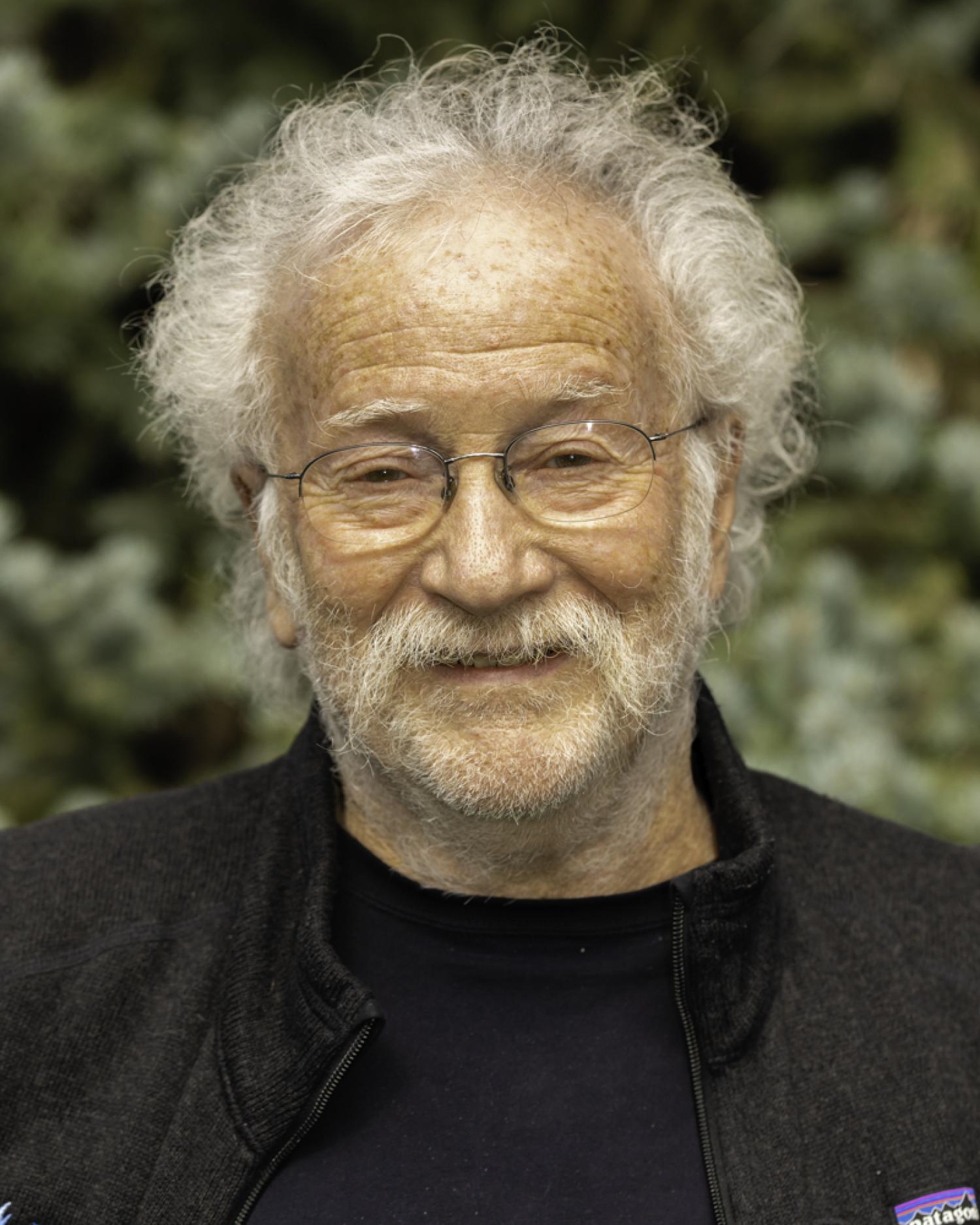
Jack W. Szostak in his University of Chicago faculty portrait
. Oskars Petersons worked on electrical metrology at the National Institute of Standards and Technology. With John D. Ramboz, Petersons coauthored the 1991 report describing NIST's laboratory current transformer calibration service. The report treats current ratio and current-transformer phase displacement as distinct measurement results.[ref]
A Calibration Service for Current Transformers by John D. Ramboz and Oskars Petersons. Title page; Abstract; §1.3, Terms Related to Transformer Calibration
A current transformer allows a secondary electric current to represent a larger or smaller primary current. Its marked ratio is a nominal conversion, whereas the measured ratio can differ. The report expresses the measured ratio as the marked ratio multiplied by the current-transformer ratio correction factor, and uses a secondary-leading sign convention for the reported phase displacement.[ref]
A Calibration Service for Current Transformers by John D. Ramboz and Oskars Petersons. §1.3, printed pp.5–6; Figure 3
An original calculation illustrates the distinction. A marked ratio of A: A gives . If the current-transformer ratio correction factor is , the measured magnitude ratio is . A secondary reading of 5 A then represents 200.04 A under those stated conditions, rather than exactly 200 A.
Magnitude alone is not a full alternating-current description. If the secondary phasor leads the primary by and their magnitude ratio is , a consistent convention isThe magnitude correction and phase rotation address different errors. A measurement system can reproduce one accurately while requiring correction of the other. The joint report's calibration circuits, including compensated current comparators, give these distinctions an apparatus-level setting rather than leaving them as ideal-transformer identities.[ref]
A Calibration Service for Current Transformers by John D. Ramboz and Oskars Petersons. §2.1, Calibration Circuits, Figures 8–9
John D. Ramboz is the first author, with Oskars Petersons, of NIST's 1991 account of a laboratory current transformer calibration service. The report describes ratio and phase measurements, their uncertainties and quality-control procedures for electrical measurement work.[ref]
A Calibration Service for Current Transformers by John D. Ramboz and Oskars Petersons. Title page and Abstract
It is a primary technical record of the service and its measurement conventions.The separation of magnitude and phase has a direct consequence for electric power measurements. Consider an original sinusoidal model with root-mean-square electric potential difference , secondary current magnitude , true current ratio and primary-current lag . True active power isIf the secondary leads the primary by , simply multiplying the secondary signal by nominal ratio givesprovided . This uses the lead-positive current-transformer phase displacement convention stated in the report.[ref]
With exact magnitude conversion and small in radians, the relative power error is approximately . For stipulated rad and , that term is about . At , its first-order value vanishes. Thus the same phase error can have different effects at different power factors.
This derivation is an explanatory example, not a reported performance test or an attribution of the calculation to Ramboz. It explains why a calibration report needs operating conditions, a sign convention and measurement uncertainty, in addition to a nominal transformer ratio. Precision in the current magnitude does not remove phase-dependent power error.
Brian Diffey, credited as B. L. Diffey in the primary byline, coauthored the 1983 study of optical transmission through human toenails with S. G. Parker. The paper measured thirteen autopsy toenails at fifteen wavelengths between 300 and 600 nm using a monochromator, integrating sphere and photodiode; its analysis included a correction for nail fluorescence.[ref]
The transmission of optical radiation through human nails by S. G. Parker and B. L. Diffey. Abstract and byline, British Journal of Dermatology 108, 11–16, DOI 10.1111/j.1365-2133.1983.tb04573.x
Newcastle University's named profile identifies Brian Diffey as a photobiology researcher, lists work under the initials B. L. Diffey and records his medical-physics work at Dryburn Hospital, the affiliation given for the nail paper. His research interests include measuring human exposure to ultraviolet radiation.[ref]
Brian Diffey profile at Newcastle University. Background, Research Interests and Publications; Dryburn Hospital history and Diffey BL entries
The research attribution here is collective; a joint byline does not establish which author performed a particular apparatus task.The nail experiment illustrates fluorescence contamination in nail-transmission measurements. A light detector can register both incident-wavelength light transmitted through a sample and light emitted at other wavelengths. In an original linear detector model,where is spectral responsivity and is spectral radiant power. Converting the total detector current into transmittance requires separating those contributions or specifying a valid correction. The detector's response at the emitted wavelengths need not equal its response at the illumination wavelength.
For an illustrative already power-calibrated signal, suppose incident power is 1.00 mW and the collected signal contains 0.08 mW of transmitted illumination plus 0.02 mW of fluorescence. Treating all detected power as transmitted illumination gives 10% instead of 8%, a 25% relative overestimate. These are invented values explaining the measurement issue, not data reported by the authors. Their explicit fluorescence correction shows why a detector reading alone does not define the desired optical quantity.
Tomasz Wierzbicki is an applied-mechanics researcher and MIT emeritus professor whose work concerns plastic deformation, structural failure and crashworthiness. His MIT curriculum vitae lists research comparing experimental sheet fracture and tearing with numerical predictions; the laboratory account identifies dynamic plasticity and structural failure as central research themes.[ref]
Tomasz Wierzbicki at MIT. Official faculty profile; author CV, selected2010–2012 publications; historical laboratory research account

His structural-mechanics teaching makes the relation between measurement and model explicit. A uniaxial tensile test measures axial force, extension and lateral contraction. Those observations determine Young's modulus and Poisson's ratio under the stated loading conditions, rather than treating material parameters as properties of a specimen's shape.[ref]
Development of Constitutive Equations for Continuum, Beams and Plates by Tomasz Wierzbicki. §4.1, Figure4.1 and uniaxial stress/strain relations
An original work calculation illustrates a related structural-design distinction. A constant resisting force of over a compression stroke of takes input work . A triangular force–displacement curve with the same peak and stroke has area . Equal peak loads therefore need not imply equal energy input. The area under the measured curve, together with unloading behaviour, helps distinguish total work from recoverable elastic energy.
These are illustrative curves, not measurements from a Wierzbicki experiment. His work on structural failure and constitutive models addresses the broader task of connecting geometry, material response and observed load histories.
Jan Høgsberg, listed as Jan Becker Høgsberg in the DTU research directory, researches structural dynamics, damping and structural control. His primary university profile describes work on modeling structures and improving reduced models used for analysis and design.[ref]
A 2025 study treats a viscous damper consisting of a dashpot in series with an inerter. Its design analysis shows how interaction with a building's normal modes can produce a resonant damping effect even though the isolated device lacks its own internal resonance. The study emphasizes retaining inertia and flexibility effects from modes that a simple reduced model would discard. Its demonstration is a numerical model of a 20-storey building, not a reported physical building test.[ref]
Tuning of a Viscous Inerter Damper: How to Achieve Resonant Damping Without a Damper Resonance by Jan Høgsberg. Abstract, modal-interaction tuning and numerical example
An original check for the ideal viscous part alone uses the force magnitude , with relative speed across the dashpot and positive damping coefficient . If and , then and the dissipated power isThese illustrative values describe a constitutive element, not the complete composite damper or its tuned building response. Locating the element within the structure and accounting for its coupled motion are essential additional steps in structural dynamics.
DTU's research profile and portrait page documents the researcher.
Fai Ma is a professor of applied mechanics at UC Berkeley whose listed research includes uncertain dynamical systems, vibration, damping and hysteresis.[ref] His work with Ali Imam and Matthias Morzfeld develops ways to decouple linear structural dynamics models with damping beyond the conventional assumption of proportional damping.
Their 2009 paper treats oscillatory free vibration. In an undamped real normal mode, all physical coordinates share one time-dependent amplitude with fixed real ratios; generic nonclassical damping can introduce relative phase differences. The paper uses phase information to construct a time-varying decoupling transformation, recovering classical modal analysis in its applicable special case.[ref]
The Decoupling of Damped Linear Systems in Oscillatory Free Vibration by Fai Ma, Ali Imam and Matthias Morzfeld. Abstract and §§4–5, phase relations and decoupling
For an original illustration of the obstacle, consider two coordinate signalsAt , while , so these signals cannot be a single fixed real vector multiplied by one scalar time function. A phase-aware representation must carry more information than that undamped-mode picture.
The 2010 continuation coauthored by Fai Ma, Matthias Morzfeld and Ali Imam extends the treatment to nonoscillatory free response and forced vibration. Together the two papers connect damping, the damped quadratic eigenvalue problem and coordinate transformations, while distinguishing a system's actual decoupling from an approximation that merely discards off-diagonal modal damping coupling.[ref]
The Decoupling of Damped Linear Systems in Free or Forced Vibration by Fai Ma, Matthias Morzfeld and Ali Imam. Abstract and Introduction, extension to nonoscillatory and forced response
University profile: me.berkeley.edu/people/fai-ma/
Ali Imam is a coauthor of work on decoupling linear structural dynamics models with damping in mechanical engineering. The exact byline and UC Berkeley Mechanical Engineering affiliation appear in the 2009 paper with Fai Ma and Matthias Morzfeld on oscillatory free vibration. That work studies how nonclassical damping prevents the usual undamped normal modes from yielding independent scalar equations, and develops a time-varying transformation using modal phase information.[ref]
Ali Imam also coauthored the 2010 continuation with Fai Ma and Matthias Morzfeld, treating nonoscillatory free motion and forced vibration. The distinction matters because a change of variables must transform applied forces as well as the free equations.[ref]
The Decoupling of Damped Linear Systems in Free or Forced Vibration by Fai Ma, Matthias Morzfeld and Ali Imam. Title page and Abstract: nonoscillatory and forced cases
A simple original scalar illustration isSetting gives . The exponential removes the first-derivative term, but changes the forcing. Thus a free-motion simplification cannot simply be reused with the old right-hand side in a forced calculation. The scalar example highlights why a transformation developed for free vibration needs a corresponding treatment of external forcing.
David G. Lewicki is a researcher whose documented work addresses gear dynamics, durability and vibration-based detection of tooth damage. His1986 NASA technical paper, Predicted Effect of Dynamic Load on Pitting Fatigue Life for Low-Contact-Ratio Spur Gears by David G. Lewicki, studied how dynamically varying tooth loads change predicted gear surface pitting fatigue life. Its parametric calculations showed why a static transmitted-load estimate alone can miss important speed-dependent effects.[ref]
The scientific distinction is between the mean transmitted torque and the changing tooth-contact force. Even at the same mean torque, a mesh can have different peak loads as operating speed approaches a structural natural frequency. The1986 study linked these changing dynamic loads to life predictions for low-gear contact ratio spur gears; it was a model-based investigation, rather than a universal measured life law.
Lewicki later coauthored a2015 study with Nicholas A. Lambert and Robert S. Wagoner comparing rotating accelerometers on a helicopter-transmission pinion with stationary housing sensors. That experimental work connects the dynamic-load problem to the practical question of which gear vibration spectrum features reveal damage. The1986 title page gives his affiliation as the Propulsion Directorate at Lewis Research Center; the2015 report lists Glenn Research Center.[ref]
Evaluation of MEMS-Based Wireless Accelerometer Sensors in Detecting Gear Tooth Faults in Helicopter Transmissions by David G. Lewicki and others. Title page and printed p.1, author affiliations and experimental objective
Nicholas A. Lambert coauthored research on rotating accelerometers for gear damage detection with David G. Lewicki and Robert S. Wagoner. Their2015 NASA report identifies Lambert and Wagoner with Ridgetop Group and Lewicki with Glenn Research Center. The contribution documented there is a joint experimental evaluation of embedded rotating sensing against conventional stationary housing measurements.[ref]
Evaluation of MEMS-Based Wireless Accelerometer Sensors in Detecting Gear Tooth Faults in Helicopter Transmissions by David G. Lewicki and others. Title page; printed pp.1–2, objective and participating organizations
The apparatus used a microelectromechanical system acceleration-sensing package on the rotating pinion. Its radial channel and two tangential channels did not measure identical combinations of motion. With the reported sensor orientation, adding the tangential channels isolated rotational acceleration, while subtracting them isolated the shared lateral contribution. This makes the experiment an example of choosing measurement geometry to separate motions, rather than interpreting every channel as the same gear vibration spectrum.[ref]
Evaluation of MEMS-Based Wireless Accelerometer Sensors in Detecting Gear Tooth Faults in Helicopter Transmissions by David G. Lewicki and others. Figure7, printed p.7; “MEMS Results”, printed p.19, tangential-channel sums and differences
An idealized algebraic version writes the channels as and , where is one projected translational acceleration, is sensor radius and is angular acceleration. Then while . Sensor placement, polarity and matching measurement calibration are what permit those cancellations. This illustrative decomposition explains the measurement principle; it does not assign sole authorship of the apparatus to one coauthor.
Robert S. Wagoner is a coauthor of experimental research using rotating accelerometers to detect damage in transmission gears. In the2015 report with David G. Lewicki and Nicholas A. Lambert, his affiliation is Ridgetop Group. The experiment compared embedded microelectromechanical system sensors with stationary housing sensors while an intentionally notched pinion was run toward tooth failure.[ref]
A central signal-processing problem was separating repeatable shaft-related motion from unrelated vibration. The study reconstructed a rotation timing signal from a strong periodic component of the measured data and used it for time-synchronous averaging. Its comparison with a measured timing reference tested whether that reconstruction preserved the rotation-related waveform.[ref]
Evaluation of MEMS-Based Wireless Accelerometer Sensors in Detecting Gear Tooth Faults in Helicopter Transmissions by David G. Lewicki and others. Printed pp.24–25, reconstructed timing signal and Figure21 comparison
The underlying averaging idea can be illustrated by records aligned at the same shaft angle. Averaging revolutions preserves the repeatable waveform ; independent zero-mean noise with common variance has mean-record variance . Timing error or changing operating conditions breaks those assumptions. This distinguishes detecting a repeatable vibration feature from proving that it uniquely identifies a tooth defect. The report found that fault indicators generally responded near actual tooth fracture, limiting the demonstrated early-warning interval.[ref]
Pinned article: Introduction to the OurBigBook Project
Welcome to the OurBigBook Project! Our goal is to create the perfect publishing platform for STEM subjects, and get university-level students to write the best free STEM tutorials ever.
Everyone is welcome to create an account and play with the site: ourbigbook.com/go/register. We belive that students themselves can write amazing tutorials, but teachers are welcome too. You can write about anything you want, it doesn't have to be STEM or even educational. Silly test content is very welcome and you won't be penalized in any way. Just keep it legal!
Intro to OurBigBook
. Source. We have two killer features:
- topics: topics group articles by different users with the same title, e.g. here is the topic for the "Fundamental Theorem of Calculus" ourbigbook.com/go/topic/fundamental-theorem-of-calculusArticles of different users are sorted by upvote within each article page. This feature is a bit like:
- a Wikipedia where each user can have their own version of each article
- a Q&A website like Stack Overflow, where multiple people can give their views on a given topic, and the best ones are sorted by upvote. Except you don't need to wait for someone to ask first, and any topic goes, no matter how narrow or broad
This feature makes it possible for readers to find better explanations of any topic created by other writers. And it allows writers to create an explanation in a place that readers might actually find it.
Figure 1. Screenshot of the "Derivative" topic page. View it live at: ourbigbook.com/go/topic/derivativeVideo 2. OurBigBook Web topics demo. Source. - local editing: you can store all your personal knowledge base content locally in a plaintext markup format that can be edited locally and published either:This way you can be sure that even if OurBigBook.com were to go down one day (which we have no plans to do as it is quite cheap to host!), your content will still be perfectly readable as a static site.
- to OurBigBook.com to get awesome multi-user features like topics and likes
- as HTML files to a static website, which you can host yourself for free on many external providers like GitHub Pages, and remain in full control

Figure 2. You can publish local OurBigBook lightweight markup files to either OurBigBook.com or as a static website.
Figure 3. Visual Studio Code extension installation.
Figure 5. . You can also edit articles on the Web editor without installing anything locally. Video 3. Edit locally and publish demo. Source. This shows editing OurBigBook Markup and publishing it using the Visual Studio Code extension. 
- Infinitely deep tables of contents:


All our software is open source and hosted at: github.com/ourbigbook/ourbigbook
Further documentation can be found at: docs.ourbigbook.com
Feel free to reach our to us for any help or suggestions: docs.ourbigbook.com/#contact