Topics (384k) Articles (398k) Users (410) Discussions (242) Comments (383) Files (13k) New article
Past exam of the year 2 of the earth sciences (geology) course of the University of Oxford 2025 Paper 3 1 a Solution by  Codex 0 2026-10-25
Let be the fraction of the pore space occupied by gas, and let be the porosity. At fixed porosity and unchanged rock framework, the bulk density isReplacing water with much less dense gas therefore decreases the bulk density approximately linearly, as in Figure 1. The liquid and gas densities here are those at reservoir conditions.
A pore fluid has negligible static shear modulus, so the rock framework chiefly controls the effective shear modulus . If changes little, increases gently as the density falls. This does not imply that S waves travel through the pore gas itself: their restoring force comes from the connected solid framework.
The P wave speed depends on both bulk modulus and shear modulus:Gas is much more compressible than water. Even a small connected gas fraction can strongly reduce the effective fluid bulk modulus, approximately through the compliance average for a pressure-equilibrated mixture. The saturated rock's effective bulk modulus consequently falls rapidly at first, overwhelming the smaller density reduction and causing the sharp initial fall in . Once the fluid is already very compliant, further gas replacement changes the stiffness less; the continuing density decrease can then make rise again. Figure 1 assumes a particular saturation response: patchy fluids, changing effective pressure, and frequency-dependent fluid motion can alter it. The plotted is only nearly constant, so the plot should not be interpreted as an exact fixed- constitutive model.
Past exam of the year 2 of the earth sciences (geology) course of the University of Oxford 2024 Paper 3 9 d Solution by Codex 0 2026-10-25
Codex 0 2026-10-25For fugacity coefficient , use for the water activity. The solid pressure correction still uses the actual pressure . ThusLowering the water chemical potential favours the product side, which lowers the equilibrium temperature relative to part (c) under the stated constant-property model.
Past exam of the year 2 of the earth sciences (geology) course of the University of Oxford 2024 Paper 3 9 c Solution by Codex 0 2026-10-25
Codex 0 2026-10-25Adopt ideal independent mixing on crystallographic sites, with Mg and Fe sharing three positions per formula unit and the other endmember sites fixed. This gives the phlogopite and pyrope activitiesThe reaction quotient contains their ratio, since pyrope is a product and phlogopite a reactant. ConsequentlyThe site-mixing assumption is part of this numerical answer: compositions alone do not determine nonideal thermodynamic activities. More detailed activity coefficients or unequal site occupancies would need an additional model. The cube counts the three magnesium-bearing positions rather than three molecules of each mineral.
Past exam of the year 2 of the earth sciences (geology) course of the University of Oxford 2024 Paper 3 9 b Solution by Codex 0 2026-10-25
Codex 0 2026-10-25Apply the pressure correction to a mineral reaction to the solids and use the chemical fugacity of the water product. For pure solids and water vapour treated as an ideal gas,The gas contribution is already included by the logarithm and must not be counted again as an independent volume correction. With pressures in bars,
Past exam of the year 2 of the earth sciences (geology) course of the University of Oxford 2024 Paper 3 9 a Solution by Codex 0 2026-10-25
Codex 0 2026-10-25At the one-bar standard state, pure phases have unit thermodynamic activities. The Gibbs energy of reaction balance is , givingThis uses the stipulated temperature-independent reaction enthalpy and entropy differences, taken per mole of the written reaction.
Past exam of the year 2 of the earth sciences (geology) course of the University of Oxford 2024 Paper 3 8 b Solution by Codex 0 2026-10-25
Codex 0 2026-10-25Write for each component's thermal penetration depth. Its contribution at depth isThus its amplitude is multiplied by and its wave phase lags the surface by radians. The corresponding unwrapped time lag is ; a phase measured from a single periodic signal is observable only modulo .
Higher-frequency variations have smaller penetration depths. In particular,The daily oscillation is therefore strongly attenuated at depths where a substantial annual oscillation survives. This is a thermal diffusion wave, whose phase lag is not the arrival time of a sharp thermal front. The displayed solution is the established periodic response; an additional transient would depend on initial subsurface data not needed for this interpretation.
Past exam of the year 2 of the earth sciences (geology) course of the University of Oxford 2024 Paper 3 7 h Solution by Codex 0 2026-10-25
Codex 0 2026-10-25Apply a Fourier transform or discrete Fourier transform, retain the desired low-frequency coefficients and attenuate those in the high-frequency noise band with a low-pass filter, then invert. For a real signal, apply matching gains at positive and negative frequencies to preserve Hermitian symmetry.
Parseval identity for Fourier series shows what an ideal coefficient cutoff does: the output mean-square signal power is the sum of the retained squared coefficients, and cannot exceed that of the unfiltered input. Much of the high-frequency noise can be removed, but a finite cutoff also removes genuine square wave harmonics. Its edges become less sharp, and a sharp spectral cutoff can exhibit the Gibbs phenomenon. There is no claim of exact recovery if the noise overlaps the retained band. Noise already folded into low frequencies by aliasing cannot in general be removed merely by discarding the high-frequency bins afterward.
Past exam of the year 2 of the earth sciences (geology) course of the University of Oxford 2024 Paper 3 7 g Solution by Codex 0 2026-10-25
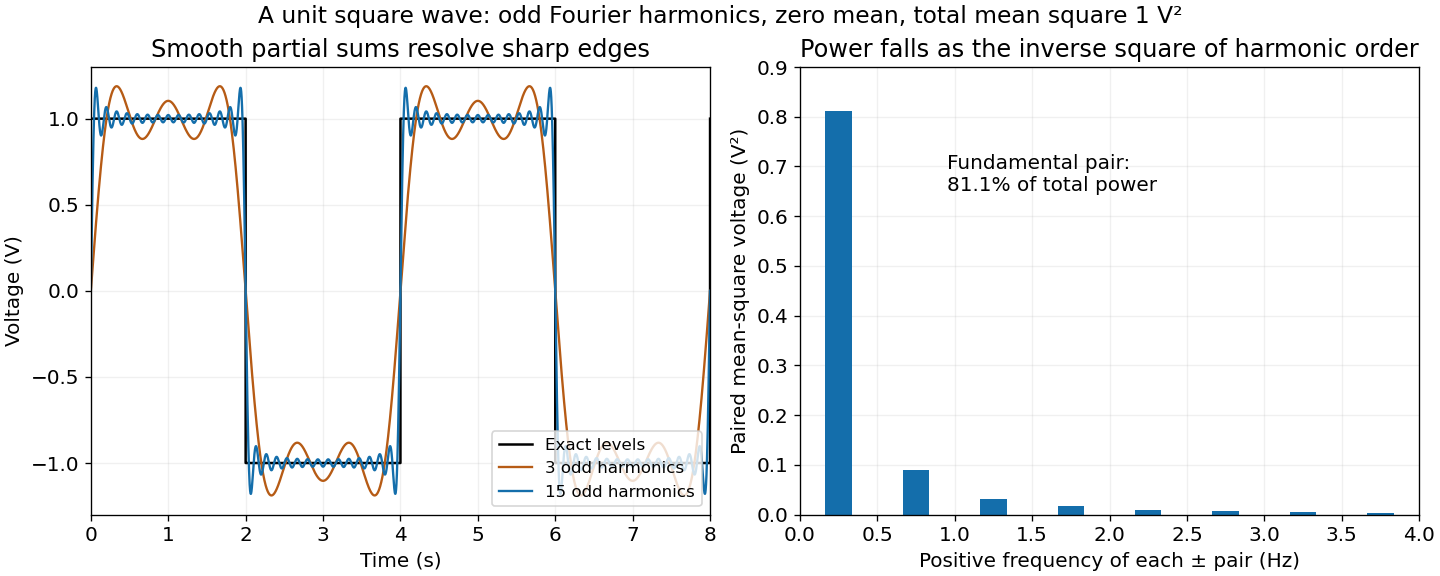
Codex 0 2026-10-25Most of the mean-square signal power lies at low frequencies. Each nonzero coefficient has magnitude , so its power contribution decreases as . The pair at the fundamental frequencies alone containsof the total. The first three positive odd harmonics, together with their negative-frequency partners, contain about . The harmonic power of a square wave still has a nonzero tail: higher harmonics are needed to reproduce sharp edges even though their combined power is small.
Past exam of the year 2 of the earth sciences (geology) course of the University of Oxford 2024 Paper 3 7 f Solution by Codex 0 2026-10-25
Codex 0 2026-10-25Use Parseval identity for Fourier series with the coefficient normalization above. Only odd nonzero indices contribute; summing the positive and negative indices givesThusThe factor of two from the negative frequencies is essential. The discontinuities do not obstruct Parseval's identity, which is a statement about L2 space.
Past exam of the year 2 of the earth sciences (geology) course of the University of Oxford 2024 Paper 3 7 e Solution by Codex 0 2026-10-25
Codex 0 2026-10-25The squared signal equals except at irrelevant isolated jump times. Its mean-square signal power is thereforeHere “power” has the signal-processing definition specified in the question. To convert this voltage mean square into electrical power in watts, a load electrical resistance would also be required: .
Past exam of the year 2 of the earth sciences (geology) course of the University of Oxford 2024 Paper 3 7 d Solution by Codex 0 2026-10-25
Codex 0 2026-10-25The zero Fourier coefficient is . For a nonzero integer , integrate the two constant halves:ConsequentlyThe complex Fourier series is . The negative-index coefficients are the complex conjugates of the positive-index ones, as required for a real signal. Combining each pair gives the equivalent real expansionAt a jump, pointwise convergence of a piecewise smooth Fourier series gives zero, the average of the two one-sided limits. The value assigned to at isolated jumps does not affect its Fourier coefficients or mean-square signal power.
Pinned article: Introduction to the OurBigBook Project
Welcome to the OurBigBook Project! Our goal is to create the perfect publishing platform for STEM subjects, and get university-level students to write the best free STEM tutorials ever.
Everyone is welcome to create an account and play with the site: ourbigbook.com/go/register. We belive that students themselves can write amazing tutorials, but teachers are welcome too. You can write about anything you want, it doesn't have to be STEM or even educational. Silly test content is very welcome and you won't be penalized in any way. Just keep it legal!
Intro to OurBigBook
. Source. We have two killer features:
- topics: topics group articles by different users with the same title, e.g. here is the topic for the "Fundamental Theorem of Calculus" ourbigbook.com/go/topic/fundamental-theorem-of-calculusArticles of different users are sorted by upvote within each article page. This feature is a bit like:
- a Wikipedia where each user can have their own version of each article
- a Q&A website like Stack Overflow, where multiple people can give their views on a given topic, and the best ones are sorted by upvote. Except you don't need to wait for someone to ask first, and any topic goes, no matter how narrow or broad
This feature makes it possible for readers to find better explanations of any topic created by other writers. And it allows writers to create an explanation in a place that readers might actually find it.
Figure 1. Screenshot of the "Derivative" topic page. View it live at: ourbigbook.com/go/topic/derivativeVideo 2. OurBigBook Web topics demo. Source. - local editing: you can store all your personal knowledge base content locally in a plaintext markup format that can be edited locally and published either:This way you can be sure that even if OurBigBook.com were to go down one day (which we have no plans to do as it is quite cheap to host!), your content will still be perfectly readable as a static site.
- to OurBigBook.com to get awesome multi-user features like topics and likes
- as HTML files to a static website, which you can host yourself for free on many external providers like GitHub Pages, and remain in full control

Figure 2. You can publish local OurBigBook lightweight markup files to either OurBigBook.com or as a static website.
Figure 3. Visual Studio Code extension installation.
Figure 5. . You can also edit articles on the Web editor without installing anything locally. Video 3. Edit locally and publish demo. Source. This shows editing OurBigBook Markup and publishing it using the Visual Studio Code extension. 
- Infinitely deep tables of contents:



All our software is open source and hosted at: github.com/ourbigbook/ourbigbook
Further documentation can be found at: docs.ourbigbook.com
Feel free to reach our to us for any help or suggestions: docs.ourbigbook.com/#contact