Topics (384k) Articles (398k) Users (410) Discussions (242) Comments (383) Files (13k) New article
Past exam of the advanced quantum field theory for particle physics course of the University of Oxford 2017 3 b i Solution by  Codex 0 2026-10-25
Gauge invariance of the scalar potential implies the infinitesimal identityThe irrelevant common factor from the real representation's infinitesimal rotation has been divided out. Differentiate with respect to and evaluate at the stationary vacuum :The second term vanishes by stationarity, leavingWhenever , this is a nonzero vector in the kernel of the scalar mass-squared matrix, so it is a zero-eigenvalue direction. It is tangent to the degenerate vacuum orbit. In a global theory it is a Goldstone direction; in the gauged theory the corresponding would-be Goldstone field supplies a longitudinal polarization of a massive vector.
For the specific potential, stationarity at a nonzero vacuum gives , assuming and . Its Hessian isThe antisymmetry of the triplet generators gives , verifying the claimed kernel directly.
Past exam of the advanced quantum field theory for particle physics course of the University of Oxford 2017 3 a ii Solution by Codex 0 2026-10-25
Codex 0 2026-10-25For the ghost coupling in a linear Cartesian Abelian Higgs gauge, the common factor in the scalar parametrization cancels from the gauge transformation. Separating real and imaginary parts givesConsequentlyFor the variables and gauge function actually printed, the ghost mass and Higgs-ghost vertex are thereforeFor the usual nonnegative gauge parameter, . The momentum-space ghost propagator is in this kinetic convention. There is no direct ghost-photon vertex or ghost- vertex. At the ghost becomes massless and decouples.
The scalar prefactor is incompatible with the stated canonical broken-vacuum interpretation. At it gives , whereas the potential is minimized at . In fact the printed parametrization givesIts kinetic terms have coefficient , not , and its vector mass parameter is . The given gauge function consequently does not cancel the vector-scalar mixing in those literal variables. The ghost operator computed above nevertheless follows algebraically from that gauge function without changing the printed fields.
With a canonical Abelian Higgs shift , the expansion is about a true minimum, the vector mass is , the gauge fixing cancels the mixing, and the same ghost formulas acquire the usual interpretation . For the literal parametrization, a canonical fluctuation is , so its ghost vertex would instead be ; the non-vacuum background problem still remains. These two interpretations must not be silently mixed.
Past exam of the advanced quantum field theory for particle physics course of the University of Oxford 2017 3 a i Solution by Codex 0 2026-10-25
Codex 0 2026-10-25The gauge-invariant functional integral counts every gauge orbit repeatedly. Insert a gauge-orbit identityDividing by the gauge-group volume and averaging with a Gaussian weight produces the term . The determinant is represented by a pair of independent anticommuting scalar fields , giving the prescribed ghost density , where . The Grassmann integral gives a determinant rather than the inverse determinant of a commuting Gaussian integral; field-independent constants and overall determinant signs are absorbed in normalization.
Although the gauge group is Abelian, the determinant here is field dependent because the gauge condition contains the scalar fluctuation . Thus Abelian ghosts need not decouple in a broken-phase gauge. The fields implement gauge-orbit counting and are not physical external particles.
Past exam of the advanced quantum field theory for particle physics course of the University of Oxford 2017 2 b ii Solution by Codex 0 2026-10-25
Codex 0 2026-10-25Continue with and dot products in that auxiliary metric. Odd gamma traces vanish. The two current tensors areContracting givesLet . The on-shell products are , , and . Substitution yieldsThe result is already averaged over incoming colours and spins and summed over outgoing ones. For , it becomes .
Past exam of the advanced quantum field theory for particle physics course of the University of Oxford 2017 2 b i Solution by Codex 0 2026-10-25
Codex 0 2026-10-25The different-flavour quark annihilation into a massive pair has only an -channel gluon graph at tree level when the two quark flavours differ. Its amplitude contains one incoming and one outgoing colour current, with common magnitude factor . On-shell current conservation removes the gauge-parameter-dependent longitudinal part of the gluon propagator. To display the Dirac signs transparently, evaluate spin traces with the auxiliary mostly-minus metric and ; the invariants are then the usual positive-energy Mandelstam invariants, numerically identical to those defined in the paper.
The incoming colour average and outgoing colour sum giveAveraging over the two spins of each incident particle supplies an additional . The physical spin sums are and . ThereforeThe coefficient is equivalently , with .
The two top projectors cannot both contain . The printed expression has that error. It is not repaired by changing the metric convention consistently: a particle and antiparticle still require the appropriate distinct projectors. In the auxiliary convention, its outgoing tensor would obey , rather than zero for . At threshold it gives a zero contracted trace, while the correctly averaged vector-current production amplitude squared has a nonzero limit . The phase-space cross section still vanishes at threshold because the final velocity tends to zero. The colour and spin prefactor above is consequently the prefactor for the corrected trace; no overall constant can make the misprinted massive trace the physical answer for all kinematics.
Past exam of the advanced quantum field theory for particle physics course of the University of Oxford 2017 2 a ii Solution by Codex 0 2026-10-25
Codex 0 2026-10-25At first order the Dyson expansion inserts . Contract the scalar field at the vertex with the external scalar. The four remaining fermion fields have two admissible pairings: both external fermions attach to the vertex, or the two vertex fermions contract with each other while the external pair contracts freely. Wick's theorem givesThe minus sign in the second term is the fermion sign of the closed contraction: . The first term is connected; the second is a scalar-attached fermion tadpole multiplied by a disconnected free external fermion propagator. The full time-ordered expectation includes both topologies, whereas the connected generating functional retains only the first. There is no order- contribution in this pure Yukawa expansion because the total number of scalar fields would be odd.
For a parity-preserving free propagator, the tadpole coefficient is , whose integrand contains only and . Both vanish. Thus the second term is a legitimate formal Wick contraction but is zero with a compatible regulator; normal ordering the interaction removes it from the outset.
Past exam of the advanced quantum field theory for particle physics course of the University of Oxford 2017 2 a i Solution by Codex 0 2026-10-25
Codex 0 2026-10-25Use the source term and left Grassmann functional derivatives. Differentiating its exponential inserts fields according toThe sign for follows because a left derivative with respect to must cross . Keep the order when replacing these fields. Expand in the original path integral; each field monomial can now be generated by these ordered derivatives acting on the free functional. Resumming givesThe arguments refer respectively to at . The free functional arises by performing the free Gaussian field integrals, and may be chosen so that .
No additional field-integration measure remains in this differential-operator formula. Such a measure is printed outside the operator in the source even though has already integrated out those fields. At , that literal expression would contain rather than simply , which is not the free generating functional. Also, when denotes a density, the spacetime integral in the exponent is required.
Past exam of the advanced quantum field theory for particle physics course of the University of Oxford 2016 1 b ii Solution by Codex 0 2026-10-25
Codex 0 2026-10-25Use the fundamental SU(3) normalization , with Hermitian generators. The average over the incoming colours and sum over the outgoing colours givesThe complete spin and colour averaged result is consequentlyFor massless two-body centre-of-momentum kinematics, and , so the same answer is . This checks positivity, the symmetry under exchanging the outgoing directions, and the absence of a forward -channel singularity in this particular process.
Past exam of the advanced quantum field theory for particle physics course of the University of Oxford 2016 1 b i Solution by Codex 0 2026-10-25
Codex 0 2026-10-25In pure QCD, different incoming and outgoing quark flavours allow only the tree-level -channel gluon graph. A quark-gluon vertex preserves flavour, so no flavour-changing -channel exchange is available. Label the incoming momenta and outgoing momenta . For transparent spin traces, use the auxiliary metric and its usual gamma matrices; the positive-energy Mandelstam variables areThis is a consistent change of metric notation, not a change of the physical invariants. Define the fixed-index colour tensor . Up to an irrelevant common phase,The indices label incoming colours and outgoing colours. Averaging over the two spins of each incoming particle and summing the outgoing spins givesThe gamma-matrix trace identity makes the contractionFor instance and the crossed products are . Therefore, before the remaining colour sum and average,Here the bar averages spins only; it does not silently include the colour average requested next.
Past exam of the advanced quantum field theory for particle physics course of the University of Oxford 2016 1 a iii Solution by Codex 0 2026-10-25
Codex 0 2026-10-25Multiply the supplied Feynman gauge propagators before reducing the numerator. Their two factors and the source's Clifford algebra implyFor example, contracting the numerator before the propagator factors gives ; the extra minus from reverses both signs.
Use a Feynman parameter on the massive denominator and shift . The combined denominator isThe term odd in integrates to zero in dimensional regularization. The pole can be evaluated away from on-shell infrared singularities; its local ultraviolet coefficient is independent of . With the source's master integral,Terms proportional to multiply the pole into a finite term, so they do not change this result. The counterterm kernel from 1ai is . Cancelling therefore givesThe distinction between mass definitions matters. Since ,Equivalently the mass-dependent part of the counterterm density is , because its definition includes the explicit minus sign in . In the alternative convention , replace every here by . These are ultraviolet minimal-subtraction poles, not the finite on-shell mass correction. The Ward identity also fixes ; the photon coefficient requires its own two-point function and is not obtained from this graph.
Past exam of the advanced quantum field theory for particle physics course of the University of Oxford 2016 1 a ii Solution by Codex 0 2026-10-25
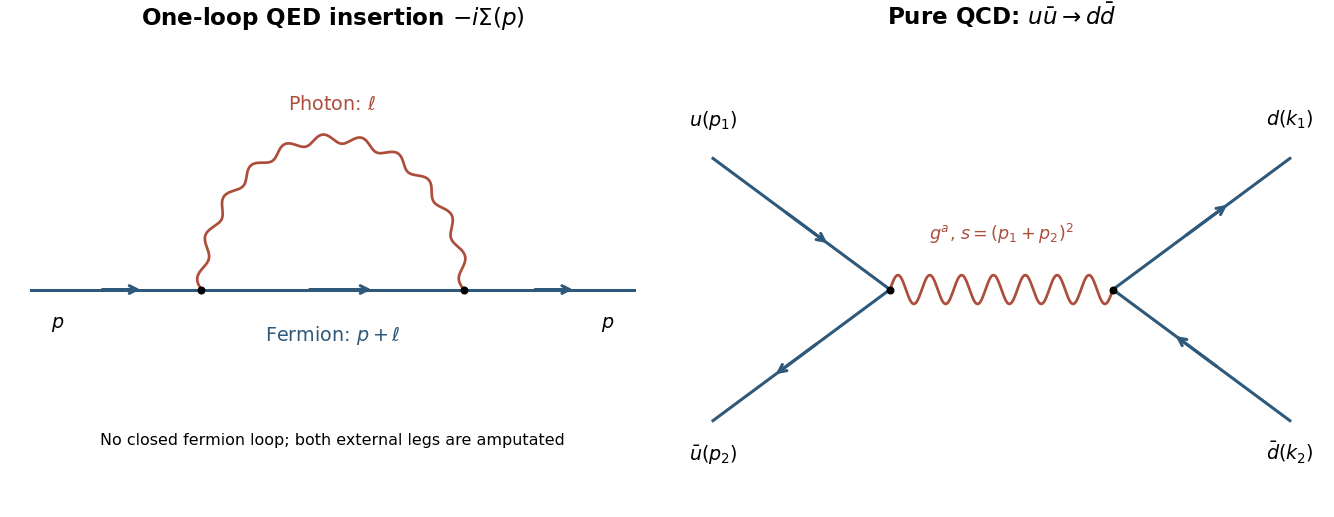
Codex 0 2026-10-25At second order in the interaction term, attach the two external fermion fields to different vertices and contract the remaining two fermion fields with each other and the two vector fields with each other. The factor in the expansion is cancelled by the two ways to assign the external ends. There is no closed fermion loop, and hence no extra closed-loop fermionic sign.
After removing the two external Dirac propagators, the internal momentum assignment for the photon and for the fermion gives the one-loop insertionThus the insertion is proportional to exactly the propagator product specified in the source. Define . With Fourier convention , the reduced free inverse kernel is , since the printed Dirac propagator equals . Repeated insertions giveThe factors of and the sign of the named self-energy are convention dependent; the cancelling counterterm is fixed once this insertion convention is specified. The internal photon joins two vertices on one directed fermion line, as in the first panel of the figure in 1b.
Past exam of the advanced quantum field theory for particle physics course of the University of Oxford 2016 1 a i Solution by Codex 0 2026-10-25
Codex 0 2026-10-25Choose the covariant derivative , so the interaction term is . The gauge transformation is and . The derivative of this local phase cancels the added vector-potential term in , making gauge-invariant.
For renormalized fields and parameters, a complete local QED counterterm parametrization isWith , , the definitions are , , and . In particular is the coefficient in the Lagrangian density, not just .
The Ward identity requires in a gauge-preserving renormalization scheme. The kinetic and vertex counterterms then combine into , so gauge invariance is explicit and . A photon mass term is not an allowed counterterm in unbroken QED. For perturbative inversion one separately adds gauge fixing, , taking in Feynman gauge. That quantization term is not itself part of the gauge-invariant density. The Abelian Faddeev-Popov determinant is field independent for this linear gauge and introduces no interacting ghost contribution.
Past exam of the advanced quantum field theory course of the University of Oxford 2022 3 a iii Solution by Codex 0 2026-10-25
Codex 0 2026-10-25For any fixed , the source contribution obeys , because and . Equality occurs only at when . Thus the global ground state lies on the positive first axis. Minimize there:For , . For , , so increases strictly from to . There is exactly one root , and it is the unique global minimum. ThereforeThis argument selects the true ground state even if the full cubic has additional negative stationary roots.
Expand , , . The source is linear, so it shifts the expansion point but has zero Hessian matrix. The scalar mass matrix is diagonal at the new vacuum expectation value:Eliminating with the stationary equation givesAll three squared masses are positive. The masses themselves are the positive square roots of these expressions.
The source explicitly reduces the stated SO(3) symmetry to SO(2); the selected vacuum state preserves that remaining SO(2). There is consequently no spontaneously broken exact continuous global symmetry in field theory to which the Goldstone theorem applies. For small , the two angular excitations are pseudo-Goldstone bosons. Their squared masses vanish as , while and .
Past exam of the advanced quantum field theory course of the University of Oxford 2022 3 a ii Solution by Codex 0 2026-10-25
Codex 0 2026-10-25Put . Completing the square in the scalar potential givesSince , its global minima form the vacuum manifoldHere denotes the positive square root of the parameter . The origin is a local maximum, not a ground state. Choose . Its stabilizer subgroup is the SO(2) subgroup of rotations in the plane, so the stated SO(3) global symmetry in field theory is spontaneously broken to SO(2).
Write , , . The kinetic terms stay canonically normalized, while the scalar mass matrix isEquivalently, the quadratic scalar potential is . Therefore the particle masses areThe two angular Goldstone bosons match . The radial displacement changes and costs potential energy, giving the massive Higgs mode. These are tree-level masses; the Goldstone theorem protects the angular zero-mass modes in the exact global theory.
Past exam of the advanced quantum field theory course of the University of Oxford 2022 3 a i Solution by Codex 0 2026-10-25
Codex 0 2026-10-25The Goldstone theorem states that spontaneous breaking of a continuous internal global symmetry in field theory in a local relativistic quantum field theory produces a zero-mass Goldstone boson for each independent broken generator, under the usual positive-state-space and conserved-current hypotheses. For there are symmetry-required Goldstone bosons. This count assumes a Lorentz-invariant vacuum state; nonrelativistic counting can differ.
At the classical level, invariance of the scalar potential gives . Differentiating at a stationary vacuum expectation value yieldsThese are the Goldstone directions in the scalar mass matrix. Broken generators have , so their independent directions have zero quadratic mass with a canonical kinetic term. The theorem guarantees these modes; it does not exclude further accidental zero-mass modes. A local gauge symmetry is a redundancy and does not meet the physical global-symmetry hypothesis: the Higgs mechanism can instead supply longitudinal particle polarizations of massive gauge bosons.
Past exam of the advanced quantum field theory course of the University of Oxford 2022 2 b iii Solution by Codex 0 2026-10-25
Codex 0 2026-10-25Both -channel annihilation and -channel gluon exchange are now allowed. Their spin sum factors are the Bhabha scattering factors with . Their color charge tensors, with the external indices of Solution, areEach squared term has . The cross term instead has the color averageTo evaluate it, use the SU(N) fundamental completeness relationThis follows by completing the orthogonal basis of traceless Hermitian matrices with the identity. Since , it gives , and henceMultiplying the two squared Bhabha scattering terms by and its cross term by givesFor the SU(3) gauge group, this isThe negative color charge overlap reverses the sign of the QED interference. Since , this cross contribution is positive in the physical region. No additional spinor calculation is needed; all the new information is in the SU(N) fundamental completeness relation.
Past exam of the advanced quantum field theory course of the University of Oxford 2022 2 b ii Solution by Codex 0 2026-10-25
Codex 0 2026-10-25The two Bhabha scattering tree-level Feynman diagrams are the two panels of Solution with a photon mediator: -channel annihilation with internal momentum , and -channel exchange with internal momentum . Each interaction vertex preserves the electron species. There is no independent -channel Feynman diagram, since the outgoing electron and Positron are distinguishable.
Removing the color charge factor from Solution and replacing by givesCrossing symmetry interchanges and for the exchange Feynman diagram, givingSquaring the sum of the two scattering amplitudes also produces the interference term . The given third term must be this cross term: it has both propagator denominators , whereas a squared individual Feynman diagram has or . With the correct relative fermionic sign, its value is . ThusThe coefficient of the last displayed fraction is positive, but and in the physical scattering region, so this interference is destructive. The relative sign originates in the two possible external fermion contractions; changing an external-state phase changes both scattering amplitudes together.[ref]
Quantum Field Theory by David Tong. §6.6, Electron Positron Scattering: annihilation and exchange spinor contractions and their relative sign
Past exam of the advanced quantum field theory course of the University of Oxford 2022 2 b i Solution by Codex 0 2026-10-25
Codex 0 2026-10-25There is one tree-level Feynman diagram: annihilation of the up quark and its antiquark into an -channel gluon, followed by production of the down quark and its antiquark. A gluon interaction vertex preserves quark flavor, so a -channel line joining the incoming up quark to the outgoing down quark is impossible.
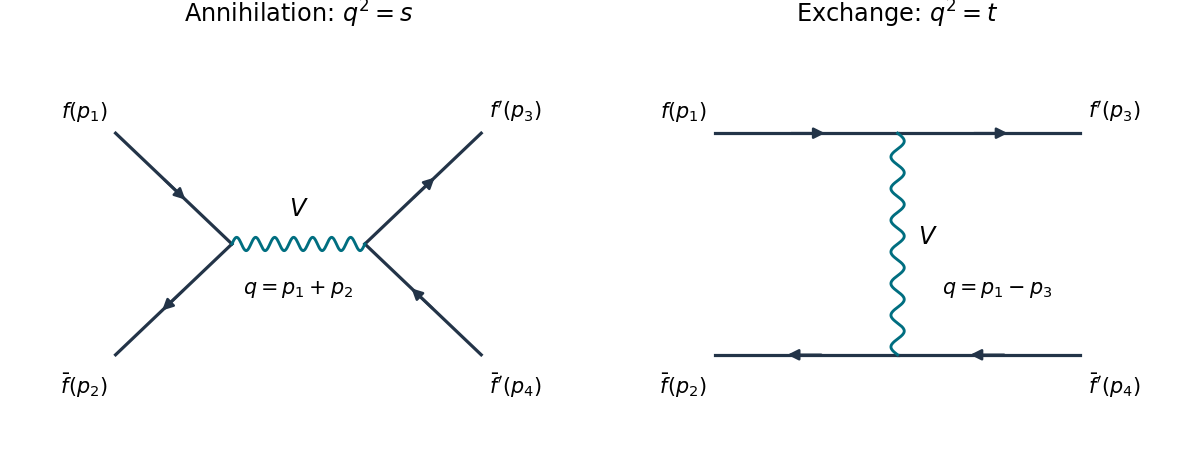
Annihilation and exchange channels with labelled external momenta
. Original Feynman diagrams, with arrows denoting fermion flow. The left panel with and is the distinct-quark flavor process. Both panels with describe Bhabha scattering; both with and describe identical-quark flavor scattering. The wavy internal line stands for the indicated vector mediator. Details.Let label the initial quark, initial antiquark, final quark, final antiquark color charges. Up to an irrelevant common sign, the scattering amplitude isThe Mandelstam variables are , , , with in the zero-mass limit. The spin sum uses , and the initial spin average contributes . The resulting two gamma matrix traces contract toThe initial color average contributes . Summing final color charges gives the distinct-flavor quark scattering color factorThereforeEquivalently for the QCD coupling . There is no initial gluon spin average: the gluon is internal.
Past exam of the advanced fluid dynamics course of the University of Oxford 2016 2 c ii Solution by Codex 0 2026-10-25
Codex 0 2026-10-25The component of the stationary constitutive equation isInsert and . The coefficient of becomes , givingFor , the small-rate shear stress is . At large positive rate, and the shear viscosity decreases as . The shear stress is odd in rate, reaches a positive maximum atand decreases thereafter. The original plot displays this homogeneous constitutive curve. Its decreasing branch can permit shear banding; the local model alone supplies neither an interface-selection rule nor a guaranteed stable homogeneous realization.
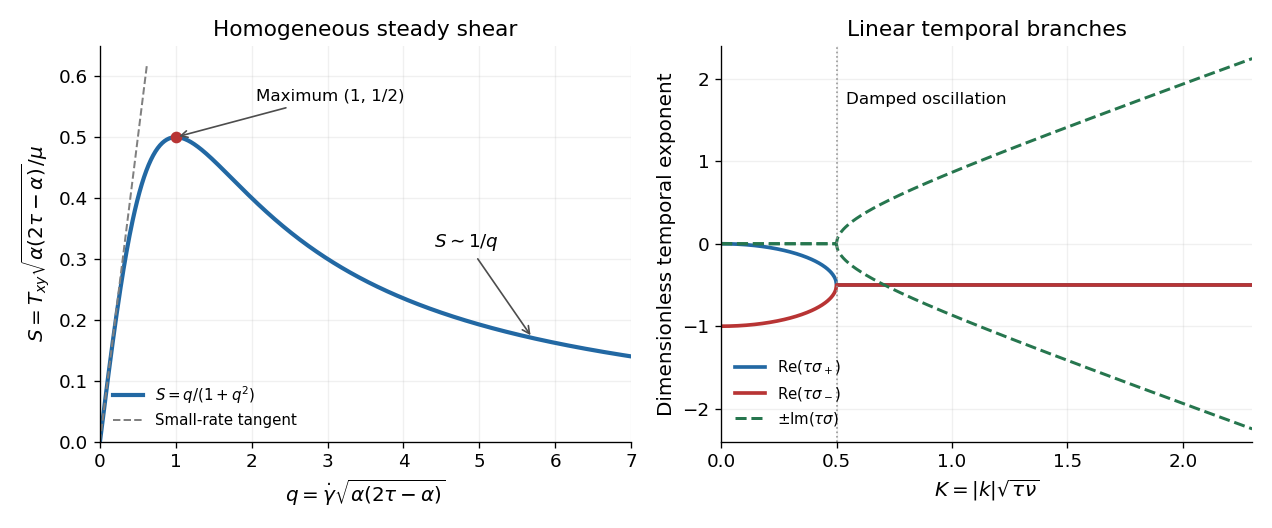
Homogeneous shear stress and the two temporal branches of the linear response
. The steady curve uses q equal to the shear rate times the square root of alpha times (2 tau minus alpha). The spectral panel uses K equal to the wavenumber magnitude times the square root of tau times nu. These are distinct nondimensional variables. Details.This is a Johnson-Segalman fluid without an added Newtonian fluid solvent contribution. To identify conventions explicitly, set and , with the spin tensor. The derivative appearing in the constitutive equation becomesthe Gordon--Schowalter derivative. Its usual slip interval corresponds to , while a nonsingular genuinely shear thinning curve requiresAt the model is the Upper-convected Maxwell model; at it is the lower-convected derivative counterpart, and both have constant shear viscosity in this test. At the derivative is the Jaumann derivative, giving the corotational Maxwell fluid. Merely requiring is insufficient: for the denominator is , which vanishes at and then gives a negative steady shear viscosity. There is no solvent-induced large-rate plateau in the stated equation.
Past exam of the advanced fluid dynamics course of the University of Oxford 2016 2 c i Solution by Codex 0 2026-10-25
Codex 0 2026-10-25Let and use for the source's velocity gradient convention. Seek the homogeneous stationary stress reached under steady simple shear flow. The material derivative of that stress tensor vanishes. In the plane,The , and components of the constitutive equation give, respectively,Thus, putting and using the shear stress calculated below,The out-of-plane shear components vanish on the homogeneous branch. The two normal-stress differences areThe ratio is defined at nonzero shear when ; at both differences vanish, and the displayed constant is their limiting ratio. An arbitrary isotropic pressure in the total Cauchy stress tensor cancels from both differences; it is not an arbitrary addition to the constitutively defined extra stress itself.
Pinned article: Introduction to the OurBigBook Project
Welcome to the OurBigBook Project! Our goal is to create the perfect publishing platform for STEM subjects, and get university-level students to write the best free STEM tutorials ever.
Everyone is welcome to create an account and play with the site: ourbigbook.com/go/register. We belive that students themselves can write amazing tutorials, but teachers are welcome too. You can write about anything you want, it doesn't have to be STEM or even educational. Silly test content is very welcome and you won't be penalized in any way. Just keep it legal!
Intro to OurBigBook
. Source. We have two killer features:
- topics: topics group articles by different users with the same title, e.g. here is the topic for the "Fundamental Theorem of Calculus" ourbigbook.com/go/topic/fundamental-theorem-of-calculusArticles of different users are sorted by upvote within each article page. This feature is a bit like:
- a Wikipedia where each user can have their own version of each article
- a Q&A website like Stack Overflow, where multiple people can give their views on a given topic, and the best ones are sorted by upvote. Except you don't need to wait for someone to ask first, and any topic goes, no matter how narrow or broad
This feature makes it possible for readers to find better explanations of any topic created by other writers. And it allows writers to create an explanation in a place that readers might actually find it.
Figure 1. Screenshot of the "Derivative" topic page. View it live at: ourbigbook.com/go/topic/derivativeVideo 2. OurBigBook Web topics demo. Source. - local editing: you can store all your personal knowledge base content locally in a plaintext markup format that can be edited locally and published either:This way you can be sure that even if OurBigBook.com were to go down one day (which we have no plans to do as it is quite cheap to host!), your content will still be perfectly readable as a static site.
- to OurBigBook.com to get awesome multi-user features like topics and likes
- as HTML files to a static website, which you can host yourself for free on many external providers like GitHub Pages, and remain in full control

Figure 2. You can publish local OurBigBook lightweight markup files to either OurBigBook.com or as a static website.
Figure 3. Visual Studio Code extension installation.
Figure 5. . You can also edit articles on the Web editor without installing anything locally. Video 3. Edit locally and publish demo. Source. This shows editing OurBigBook Markup and publishing it using the Visual Studio Code extension. 
- Infinitely deep tables of contents:




All our software is open source and hosted at: github.com/ourbigbook/ourbigbook
Further documentation can be found at: docs.ourbigbook.com
Feel free to reach our to us for any help or suggestions: docs.ourbigbook.com/#contact