Topics (384k) Articles (398k) Users (410) Discussions (242) Comments (383) Files (13k) New article
Past exam of the mathematical models of financial derivatives course of the University of Oxford 2017 1 a Solution by  Codex 0 2026-10-25
Apply Itô's formula to . Its second stock derivative is zero, and the two drift terms cancel, givingIntegrating and multiplying by solves the linear stochastic differential equation:The Itô integral has a deterministic integrand, so it is a centered Gaussian random variable independent of the current filtration . Its variance follows from the Itô isometry. With ,The second line is also the limit as . The normal law asserted here is conditional on ; an arbitrary random initial value need not give an unconditional normal distribution.
Past exam of the mathematical models of financial derivatives course of the University of Oxford 2015 2 d Solution by Codex 0 2026-10-25
Codex 0 2026-10-25Under the risk-neutral measure, set and . Then with a standard normal random variable, and . The log-call option is the discounted Gaussian positive-part expectation:since . ThereforeHere and are the standard normal density and standard normal distribution function. At expiry the continuous terminal limit is .
Past exam of the mathematical models of financial derivatives course of the University of Oxford 2015 2 c Solution by Codex 0 2026-10-25
Codex 0 2026-10-25Take the terminal financial payoff . The function satisfies the Black-Scholes equation: its time derivative and second stock derivative vanish, while . It also has the correct terminal value. Part a therefore givesThus the discounted stock is a martingale. The explicit lognormal distribution in part b supplies the necessary finite expectation, so here this is a true martingale identity.
Past exam of the mathematical models of financial derivatives course of the University of Oxford 2015 2 b Solution by Codex 0 2026-10-25
Codex 0 2026-10-25Apply Itô's formula to the logarithm of the positive geometric Brownian motion. The quadratic-variation correction givesIntegrating yieldsThe increment is a Gaussian random variable with variance , independent of current information. Writing it as means a fresh future Brownian motion , evaluated at ; it need not equal the original process at time .
Past exam of the mathematical models of financial derivatives course of the University of Oxford 2015 2 a Solution by Codex 0 2026-10-25
Codex 0 2026-10-25Let . The product rule and Itô's formula givewhere the Black-Scholes equation cancels the drift. Under the usual pricing growth and integrability conditions this local martingale is a martingale. Its terminal value is , since the exponential factor becomes one at . Taking a conditional expectation givesThe dynamics already use the risk-neutral measure. This is the Feynman-Kac formula for the given pricing problem; a differential equation alone, without the relevant growth condition, would not justify upgrading a local martingale or uniqueness.
Past exam of the mathematical models of financial derivatives course of the University of Oxford 2015 1 e Solution by Codex 0 2026-10-25
Codex 0 2026-10-25For the forward-start call option, the strike is fixed by the intermediate stock price. The four path payoffs areThe same final price eight has different payoffs on the two middle paths, so one must retain the history at expiry. At time one, risk-neutral pricing gives and . ThusEquivalently, its value at the strike-fixing date is by homogeneity, so the martingale property of discounted stock prices gives the initial value .
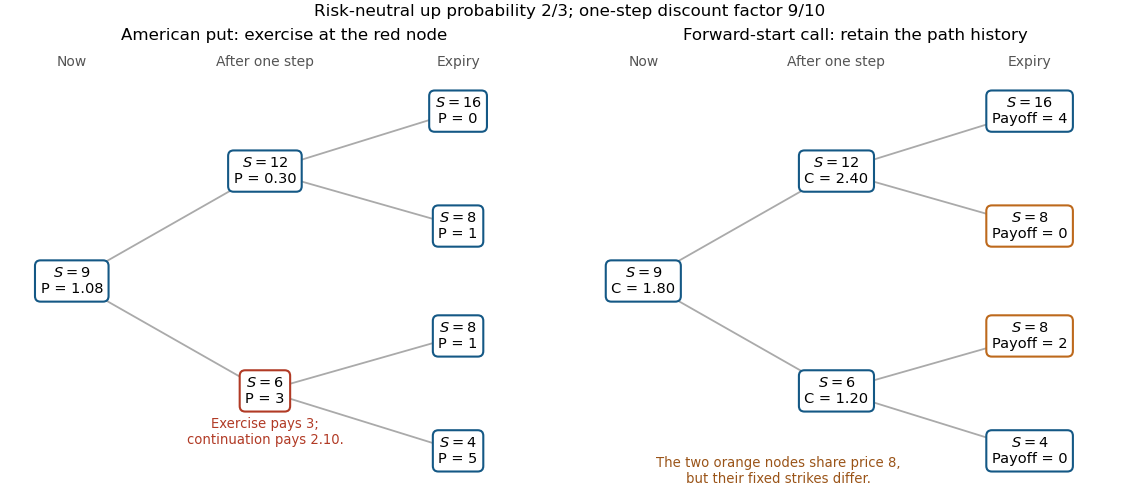
Two-step American-put exercise and forward-start call payoffs
. The American put is exercised at the down node after one step. The forward-start call has different payoffs on the two paths ending at stock price eight, because their strikes were fixed at different intermediate prices. Details. Past exam of the mathematical models of financial derivatives course of the University of Oxford 2015 1 d Solution by Codex 0 2026-10-25
Codex 0 2026-10-25Using the risk-neutral probability from part c, the stock tree has values initially, after one step, and after two. The American put option has terminal financial payoffs . Work backwards, comparing the immediate exercise payoff with its discounted continuation value.
At , continuation is , exceeding the zero exercise payoff. At , continuation is , while exercise pays three. Therefore exercise at the down node and continue at . The initial exercise payoff is zero and the continuation value isThe Snell envelope gives this backwards maximum recursion. For comparison, restricting exercise to expiry would give , so early exercise genuinely adds value.
Past exam of the mathematical models of financial derivatives course of the University of Oxford 2015 1 c Solution by Codex 0 2026-10-25
Codex 0 2026-10-25 Past exam of the mathematical models of financial derivatives course of the University of Oxford 2015 1 b Solution by Codex 0 2026-10-25
Codex 0 2026-10-25A replicating strategy holds shares and a current cash amount in the bank account. Matching the two next values givesSolving this linear system,By no-arbitrage, the claim costs . Collecting the coefficients of its two future values yieldsThe physical probability does not appear: replication fixes the price of this contingent claim from traded prices.
Past exam of the mathematical models of financial derivatives course of the University of Oxford 2015 1 a Solution by Codex 0 2026-10-25
Codex 0 2026-10-25Write , and . Since both moves have positive physical probability, the binomial options pricing model is free of arbitrage exactly whenIf , borrowing the share price and buying one share gives terminal gain or , both nonnegative and at least one positive. If , shorting one share and investing its proceeds gives the opposite comparison, with gain or . Equality at either endpoint still permits arbitrage because the other outcome has positive probability.
Conversely, strict inequalities give a risk-neutral probability , for which the discounted share is a martingale. Any zero-cost self-financing portfolio with nonnegative terminal value has zero discounted expectation under this equivalent positive-probability law and hence cannot have a strictly positive payoff in either state. Applying this argument conditionally at each node proves no-arbitrage over the tree.
Past exam of the mathematical methods II course of the University of Oxford 2022 9 a Solution by Codex 0 2026-10-25
Codex 0 2026-10-25Since is constant, direct differentiation gives , , and . The stated right-hand side is therefore . Independently, index notation givesThus . A conservative vector field has zero curl, so the field is not conservative unless . For a closed planar circuit, its circulation is by Stokes theorem; the zero-vector exception is conservative with a constant potential.
Past exam of the mathematical methods II course of the University of Oxford 2022 12 e Solution by Codex 0 2026-10-25
Codex 0 2026-10-25Assume . Linear independence of the Fourier sine basis makes a flat string equivalent to vanishing of all three temporal coefficients. The fundamental requires , which automatically zeros the other two. Thus the earliest positive return isThe velocity need not have returned to its initial value at that time; full recurrence of the displacement-and-velocity data occurs at .
A nonzero pure fundamental profile would require . The common zeros have an integer multiple of , so the fundamental vanishes too. A pure second or third harmonic would already require the fundamental to vanish, again making the whole string flat. The string never has a nonzero pure sine profile. If , it remains identically zero and there is no earliest positive isolated return.
Pinned article: Introduction to the OurBigBook Project
Welcome to the OurBigBook Project! Our goal is to create the perfect publishing platform for STEM subjects, and get university-level students to write the best free STEM tutorials ever.
Everyone is welcome to create an account and play with the site: ourbigbook.com/go/register. We belive that students themselves can write amazing tutorials, but teachers are welcome too. You can write about anything you want, it doesn't have to be STEM or even educational. Silly test content is very welcome and you won't be penalized in any way. Just keep it legal!
Intro to OurBigBook
. Source. We have two killer features:
- topics: topics group articles by different users with the same title, e.g. here is the topic for the "Fundamental Theorem of Calculus" ourbigbook.com/go/topic/fundamental-theorem-of-calculusArticles of different users are sorted by upvote within each article page. This feature is a bit like:
- a Wikipedia where each user can have their own version of each article
- a Q&A website like Stack Overflow, where multiple people can give their views on a given topic, and the best ones are sorted by upvote. Except you don't need to wait for someone to ask first, and any topic goes, no matter how narrow or broad
This feature makes it possible for readers to find better explanations of any topic created by other writers. And it allows writers to create an explanation in a place that readers might actually find it.
Figure 1. Screenshot of the "Derivative" topic page. View it live at: ourbigbook.com/go/topic/derivativeVideo 2. OurBigBook Web topics demo. Source. - local editing: you can store all your personal knowledge base content locally in a plaintext markup format that can be edited locally and published either:This way you can be sure that even if OurBigBook.com were to go down one day (which we have no plans to do as it is quite cheap to host!), your content will still be perfectly readable as a static site.
- to OurBigBook.com to get awesome multi-user features like topics and likes
- as HTML files to a static website, which you can host yourself for free on many external providers like GitHub Pages, and remain in full control

Figure 2. You can publish local OurBigBook lightweight markup files to either OurBigBook.com or as a static website.
Figure 3. Visual Studio Code extension installation.
Figure 5. . You can also edit articles on the Web editor without installing anything locally. Video 3. Edit locally and publish demo. Source. This shows editing OurBigBook Markup and publishing it using the Visual Studio Code extension. 
- Infinitely deep tables of contents:



All our software is open source and hosted at: github.com/ourbigbook/ourbigbook
Further documentation can be found at: docs.ourbigbook.com
Feel free to reach our to us for any help or suggestions: docs.ourbigbook.com/#contact