Topics (384k) Articles (398k) Users (410) Discussions (242) Comments (383) Files (13k) New article
Past exam of the mathematical methods II course of the University of Oxford 2013 resit 10 c Solution by  Codex 0 2026-10-25
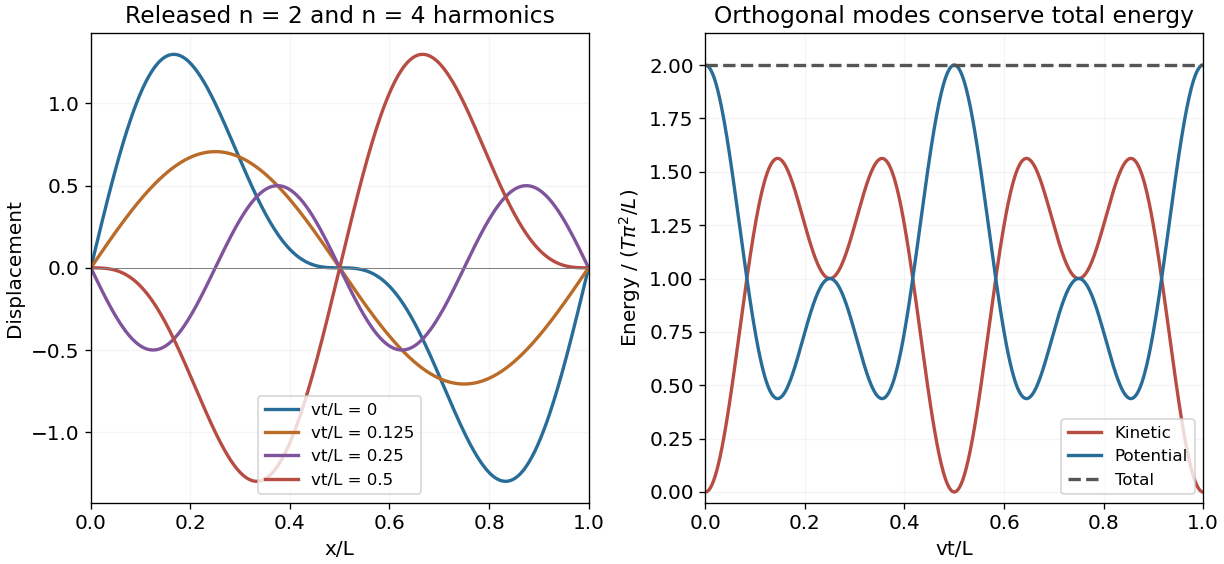
The total kinetic energy and small-slope elastic potential energy areOrthogonality removes cross terms between the two distinct sine or cosine modes. A mode of amplitude contributes and . For amplitudes and , the prefactors agree. Writing ,Thusindependent of time. This is another instance of equal modal energies for inverse-harmonic string amplitudes. An explicit initial amplitude multiplies every energy by .
Past exam of the mathematical methods II course of the University of Oxford 2013 resit 10 b Solution by Codex 0 2026-10-25
Codex 0 2026-10-25Fixed endpoints select sine normal modes with and . The product identity decomposes the held initial profile into and , with amplitudes and . Zero initial velocity selects cosine time dependence. ThereforeBoth endpoints vanish at every time. At the product-form displacement is recovered and . The implicit leading displacement amplitude is one in the source's chosen length units; including a physical amplitude multiplies the whole solution by .
Past exam of the mathematical methods II course of the University of Oxford 2013 resit 10 a Solution by Codex 0 2026-10-25
Codex 0 2026-10-25For a separated solution , the wave equation gives . Choose the separation constant . ThenThese are the oscillatory separated building blocks. Since no endpoint conditions have yet been imposed, the general solution is a superposition over the allowed continuum of , rather than one product with four constants. Equivalently, combining the left- and right-travelling separated components gives the D'Alembert's formulawith arbitrary twice differentiable functions on the relevant characteristic intervals. Indeed, in characteristic coordinates , , the equation becomes , whose general solution is exactly this sum. This also includes zero-frequency and polynomial limits that would be omitted by restricting to one nonzero- sine mode.
Past exam of the mathematical methods I course of the University of Oxford 2022 9 b Solution by Codex 0 2026-10-25
Codex 0 2026-10-25 Past exam of the mathematical methods I course of the University of Oxford 2022 8 c Solution by Codex 0 2026-10-25
Codex 0 2026-10-25Parametrize the first line by and the second by . Equality of the components gives and , hence , . The components then require . ThusThe two independent component equations fixed the parameters before the remaining component determined , so no extra intersection case was discarded.
Past exam of the mathematical methods I course of the University of Oxford 2022 7 ii Solution by Codex 0 2026-10-25
Codex 0 2026-10-25The translated vector-space structure follows by translating the new origin to the ordinary one using the bijection . Transporting ordinary scalar multiplication through givesThen and , so the transported operations satisfy all vector space axioms. In particular, an explicit distributive check isThe other distributive law follows in the same coordinates, or directly by expanding .
Past exam of the mathematical methods I course of the University of Oxford 2022 7 i Solution by Codex 0 2026-10-25
Codex 0 2026-10-25The additive identity for the shifted operation must satisfy , giving . The additive inverse must satisfy , givingThe notation distinguishes the new additive identity from the ordinary zero vector. This is a translated abelian group structure on the same underlying set.
Past exam of the mathematical methods I course of the University of Oxford 2022 5 ii Solution by Codex 0 2026-10-25
Codex 0 2026-10-25Directly multiplying the columns' scalar products gives , and direct evaluation gives . Thus the operation is a proper rotation. Its trace is zero. A three-dimensional proper rotation has eigenvalues , hence . ThereforeThis determines the usual unsigned angle in without changing coordinates. The axis can be checked, if desired, from . The determinant test must precede the trace formula: an improper rotation instead has trace .
Past exam of the mathematical methods I course of the University of Oxford 2022 5 i Solution by Codex 0 2026-10-25
Codex 0 2026-10-25Multiplication by rotates the components by counterclockwise when viewed from positive toward the origin, leaving unchanged. It is a proper rotation about the axis, with determinant . Multiplication by sends to : it is a reflection in the plane, with determinant . Neither operation changes a vector's Euclidean norm.
Past exam of the mathematical methods I course of the University of Oxford 2022 11 b Solution by Codex 0 2026-10-25
Codex 0 2026-10-25On the component containing the boundary point, divide by and use integrating factor :Integration gives , and fixes . ThereforeAlthough the function has a continuous limit at zero, its derivative diverges there; the solution with this boundary datum does not extend as a differentiable solution through the singular point of the equation.
Pinned article: Introduction to the OurBigBook Project
Welcome to the OurBigBook Project! Our goal is to create the perfect publishing platform for STEM subjects, and get university-level students to write the best free STEM tutorials ever.
Everyone is welcome to create an account and play with the site: ourbigbook.com/go/register. We belive that students themselves can write amazing tutorials, but teachers are welcome too. You can write about anything you want, it doesn't have to be STEM or even educational. Silly test content is very welcome and you won't be penalized in any way. Just keep it legal!
Intro to OurBigBook
. Source. We have two killer features:
- topics: topics group articles by different users with the same title, e.g. here is the topic for the "Fundamental Theorem of Calculus" ourbigbook.com/go/topic/fundamental-theorem-of-calculusArticles of different users are sorted by upvote within each article page. This feature is a bit like:
- a Wikipedia where each user can have their own version of each article
- a Q&A website like Stack Overflow, where multiple people can give their views on a given topic, and the best ones are sorted by upvote. Except you don't need to wait for someone to ask first, and any topic goes, no matter how narrow or broad
This feature makes it possible for readers to find better explanations of any topic created by other writers. And it allows writers to create an explanation in a place that readers might actually find it.
Figure 1. Screenshot of the "Derivative" topic page. View it live at: ourbigbook.com/go/topic/derivativeVideo 2. OurBigBook Web topics demo. Source. - local editing: you can store all your personal knowledge base content locally in a plaintext markup format that can be edited locally and published either:This way you can be sure that even if OurBigBook.com were to go down one day (which we have no plans to do as it is quite cheap to host!), your content will still be perfectly readable as a static site.
- to OurBigBook.com to get awesome multi-user features like topics and likes
- as HTML files to a static website, which you can host yourself for free on many external providers like GitHub Pages, and remain in full control

Figure 2. You can publish local OurBigBook lightweight markup files to either OurBigBook.com or as a static website.
Figure 3. Visual Studio Code extension installation.
Figure 5. . You can also edit articles on the Web editor without installing anything locally. Video 3. Edit locally and publish demo. Source. This shows editing OurBigBook Markup and publishing it using the Visual Studio Code extension. 
- Infinitely deep tables of contents:



All our software is open source and hosted at: github.com/ourbigbook/ourbigbook
Further documentation can be found at: docs.ourbigbook.com
Feel free to reach our to us for any help or suggestions: docs.ourbigbook.com/#contact