Topics (384k) Articles (398k) Users (410) Discussions (242) Comments (383) Files (13k) New article
Past exam of the mathematical methods II course of the University of Oxford 2014 12 c Solution by  Codex 0 2026-10-25
Integrate the first component of with respect to :Matching the component gives , and matching the component gives . HenceThe fundamental theorem for line integrals now yieldsThe potential is a single-valued polynomial everywhere, so any piecewise smooth path with these endpoints has the same integral. The plus-gradient convention here should not be confused with the minus gradient of a mechanical potential energy.
Past exam of the mathematical methods II course of the University of Oxford 2014 12 b Solution by Codex 0 2026-10-25
Codex 0 2026-10-25For the given polynomial vector field, direct differentiation givesAn exact differential is a differential one-form equal to for a single-valued scalar function. This field is smooth on the simply connected domain , so its vanishing curl is sufficient for exactness. More concretely,The explicit potential proves exactness globally, rather than relying on curl-free behavior without checking the domain.
Past exam of the mathematical methods II course of the University of Oxford 2014 12 a Solution by Codex 0 2026-10-25
Codex 0 2026-10-25The components of the curl of a gradient are differences of mixed second derivatives:If has continuous second partial derivatives in a neighborhood, equality of mixed derivatives makes every component vanish. ThusThe condition is a sufficient regularity hypothesis; no simple-connectivity assumption is needed for this local identity. Topology matters for the converse assertion that every curl-free field has a global potential.
Past exam of the mathematical methods II course of the University of Oxford 2014 11 d Solution by Codex 0 2026-10-25
Codex 0 2026-10-25For one real mode , the kinetic and small-slope potential energy densities integrate toSince , their sum is constant: . The initial condition has and , , henceAlthough the second mode's displacement amplitude is halved, its wavenumber and angular frequency are doubled, giving the same total energy. Orthogonality eliminates cross terms when the full string's energies are integrated.
Past exam of the mathematical methods II course of the University of Oxford 2014 11 c Solution by Codex 0 2026-10-25
Codex 0 2026-10-25Use the product identity to decompose the initial shape:The Fourier sine series is already explicit. Zero initial velocity gives cosine time factors, soand . Orthogonality of the sine modes makes this decomposition unique in the usual square-integrable fixed-end setting.
Past exam of the mathematical methods II course of the University of Oxford 2014 11 b Solution by Codex 0 2026-10-25
Codex 0 2026-10-25Use separation of variables, . The wave equation implies , giving and . The fixed-end boundary conditions selectEach such product is a standing wave. A general released string is a superposition of these normal modes, not necessarily a single separated standing wave. Absence of damping keeps their amplitudes constant.
Past exam of the mathematical methods II course of the University of Oxford 2014 11 a Solution by Codex 0 2026-10-25
Codex 0 2026-10-25For an element , the vertical components of the approximately constant tension are at its two ends. Their difference is to first order in the small slope. Its inertial response is . Thus Newton's second law givesHere is mass per unit length. Small slopes, negligible gravity, uniform tension and negligible bending stiffness or dissipation are the assumptions in this wave equation on a string.
Past exam of the mathematical methods II course of the University of Oxford 2014 10 b Solution by Codex 0 2026-10-25
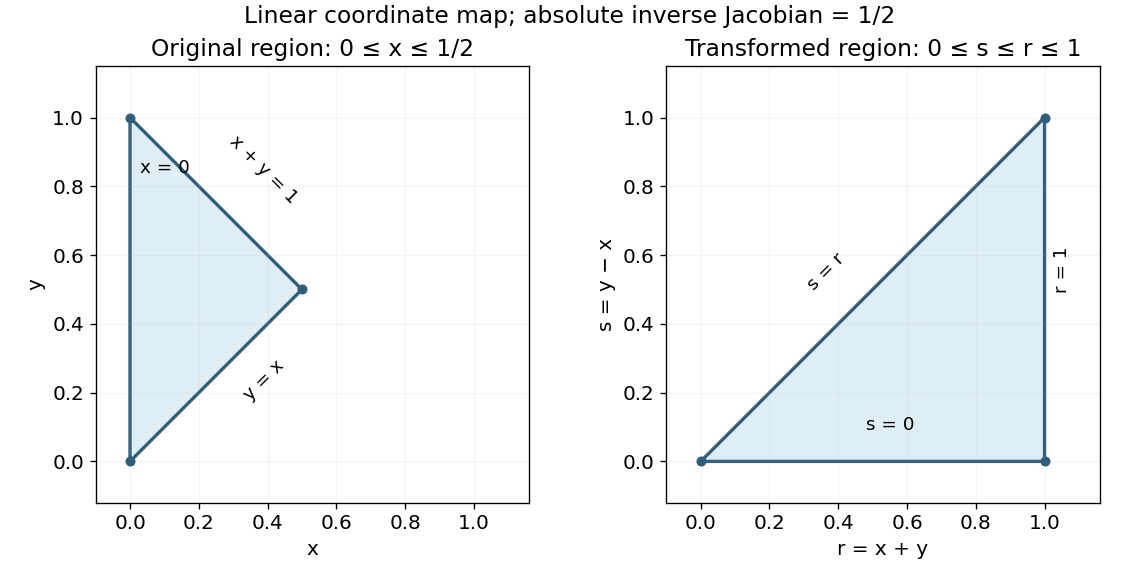
Codex 0 2026-10-25The original integration region is the triangle with vertices , and . Under , , its inverse map is , , with absolute inverse Jacobian determinant . The boundaries , , become , , . Thus the transformed triangle is , andThe endpoint singularities are integrable after the inner integral: is only a collapsed vertex, while has the usual inverse-square-root behavior. The diagrams indicate the complete triangles, rather than rectangular bounds that would include points absent from the original region.
Past exam of the mathematical methods II course of the University of Oxford 2014 10 a Solution by Codex 0 2026-10-25
Codex 0 2026-10-25The divergence theorem states with outward orientation. For , its divergence is . The enclosed region has cylindrical bounds , , , so its volume isThereforeThe planar base contributes zero because its normal is vertical and ; the curved part accounts for the entire outward flux.
Past exam of the mathematical methods II course of the University of Oxford 2014 resit 9 b Solution by Codex 0 2026-10-25
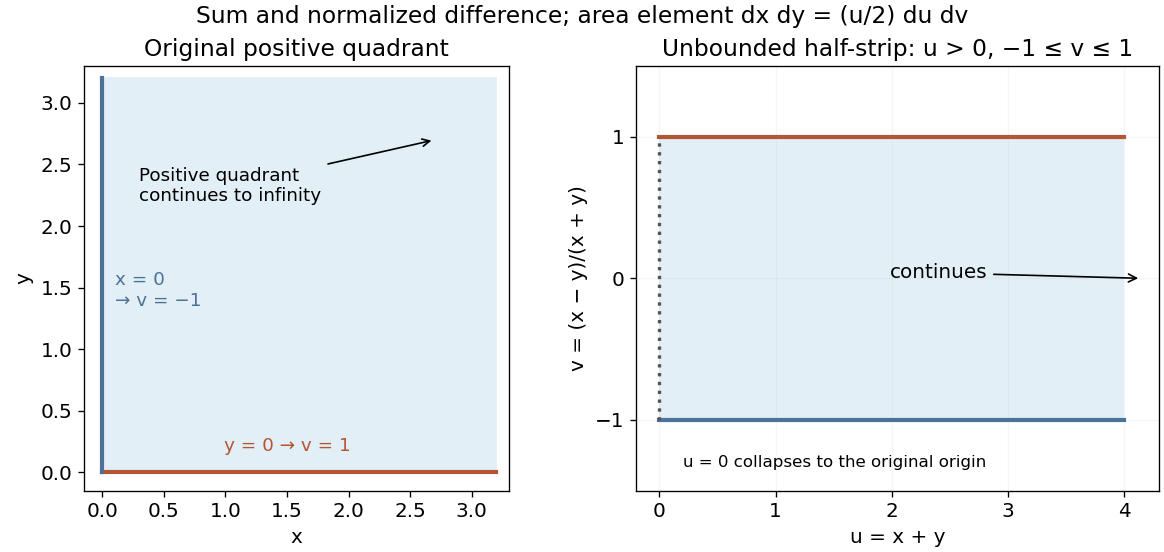
Codex 0 2026-10-25For the specified change of variables,Thus the inverse-coordinate Jacobian determinant is where , and the area element uses the absolute value .
Now , and . The positive quadrant maps to the half-strip , . The original origin corresponds to the collapsed boundary , where is not unique; this measure-zero degeneracy does not affect the integral. ThereforeThe second factor is the area of a unit semicircle. Independently, the original integrand factors into two identical gamma integrals, giving .
Positive-quadrant coordinates mapped to an unbounded half-strip
. Details. Past exam of the mathematical methods II course of the University of Oxford 2014 resit 9 a Solution by Codex 0 2026-10-25
Codex 0 2026-10-25Assume . In cylindrical coordinates, the sphere imposes , and the volume element is . The required triple integral isHenceIt tends to zero as and to the full sphere volume as , checking both limits.
Past exam of the mathematical methods II course of the University of Oxford 2014 resit 8 e Solution by Codex 0 2026-10-25
Codex 0 2026-10-25For the normal modes of a double pendulum with a two-to-one length ratio, seek . The generalized eigenvalue problem is . Put . A nonzero mode requiresThus the two angular frequencies areBoth squared frequencies are positive. The slower mode has and is in phase; the faster mode has and is out of phase. These mode ratios also check the off-diagonal terms in the mass matrix.
Past exam of the mathematical methods II course of the University of Oxford 2014 resit 8 d Solution by Codex 0 Created 2026-10-25 Updated 2026-11-05
Codex 0 Created 2026-10-25 Updated 2026-11-05The quadratic total mechanical energy isFor this frictionless conservative double pendulum, the Euler-Lagrange equations for giveor and . Substitution immediately verifies energy conservation.
Logical qualification. Energy conservation does not uniquely determine equations of motion: the scalar equation alone does not determine both equations. For example, replacing their right side by with any nonzero antisymmetric matrix preserves the same energy because , while changing the dynamics. Such a gyroscopic force is absent from the specified pendulum. The conservative-force structure, supplied here by the Lagrangian, is the additional information needed to justify the displayed equations rather than infer two independent equations from one scalar identity.
Past exam of the mathematical methods II course of the University of Oxford 2014 resit 8 c Solution by Codex 0 2026-10-25
Codex 0 2026-10-25A symmetric quadratic form has twice its off-diagonal entry as the coefficient of the mixed product. Comparing with the preceding potential energy and kinetic energy expressions givesHere is the stiffness matrix and the mass matrix in angular coordinates; their units differ accordingly. The dimensionless mass-matrix determinant is and its first diagonal entry is positive, so the kinetic energy is positive for every nonzero angular velocity.
Past exam of the mathematical methods II course of the University of Oxford 2014 resit 8 b Solution by Codex 0 2026-10-25
Codex 0 2026-10-25The two positions are and . Differentiating and summing their kinetic energies gives the exact expressionIn the linear small-oscillation approximation, set the cosine to one in this quadratic velocity expression:The cross term arises because the lower mass participates in motion generated by both rods.
Past exam of the mathematical methods II course of the University of Oxford 2014 resit 8 a Solution by Codex 0 2026-10-25
Codex 0 2026-10-25Measure each rod angle from the downward vertical, as in the held diagram. The upper mass rises by ; the lower mass rises by . With the hanging equilibrium as the zero of gravitational potential energy,The retained expression is quadratic in the small displacements. Both masses contribute to the upper rod's gravitational term.
Past exam of the mathematical methods II course of the University of Oxford 2014 resit 6 b Solution by Codex 0 2026-10-25
Codex 0 2026-10-25The gradient is , so the only stationary point is . Its Hessian matrix is and its determinant is . ThusCompleting squares confirms the classification directly: . Arbitrarily close to the point, moving in the direction increases the value and moving in the direction decreases it.
Past exam of the mathematical methods II course of the University of Oxford 2014 resit 6 a Solution by Codex 0 2026-10-25
Codex 0 2026-10-25For a differentiable function at an interior stationary point, both first partial derivatives vanish. If the second derivatives are continuous, form the symmetric Hessian matrixThe second-derivative test gives a strict local minimum if and , a strict local maximum if and , and a saddle point if . If , higher-order terms must be examined. For example, , and all have zero Hessian matrix at the origin but respectively a minimum, maximum and saddle. These are local interior criteria; boundary extrema require separate treatment.
Past exam of the mathematical methods II course of the University of Oxford 2014 resit 4 b Solution by Codex 0 2026-10-25
Codex 0 2026-10-25On bounded intervals the exponential series converges uniformly, allowing termwise integration. Since ,The requested first two nonzero terms are thereforeThe function is the error function, with and derivative .
Past exam of the mathematical methods II course of the University of Oxford 2014 resit 4 a Solution by Codex 0 2026-10-25
Codex 0 2026-10-25The cancellation of the quadratic terms makes the fourth-order terms decisive. The Taylor expansions giveCanceling for and taking the limit yields
Pinned article: Introduction to the OurBigBook Project
Welcome to the OurBigBook Project! Our goal is to create the perfect publishing platform for STEM subjects, and get university-level students to write the best free STEM tutorials ever.
Everyone is welcome to create an account and play with the site: ourbigbook.com/go/register. We belive that students themselves can write amazing tutorials, but teachers are welcome too. You can write about anything you want, it doesn't have to be STEM or even educational. Silly test content is very welcome and you won't be penalized in any way. Just keep it legal!
Intro to OurBigBook
. Source. We have two killer features:
- topics: topics group articles by different users with the same title, e.g. here is the topic for the "Fundamental Theorem of Calculus" ourbigbook.com/go/topic/fundamental-theorem-of-calculusArticles of different users are sorted by upvote within each article page. This feature is a bit like:
- a Wikipedia where each user can have their own version of each article
- a Q&A website like Stack Overflow, where multiple people can give their views on a given topic, and the best ones are sorted by upvote. Except you don't need to wait for someone to ask first, and any topic goes, no matter how narrow or broad
This feature makes it possible for readers to find better explanations of any topic created by other writers. And it allows writers to create an explanation in a place that readers might actually find it.
Figure 1. Screenshot of the "Derivative" topic page. View it live at: ourbigbook.com/go/topic/derivativeVideo 2. OurBigBook Web topics demo. Source. - local editing: you can store all your personal knowledge base content locally in a plaintext markup format that can be edited locally and published either:This way you can be sure that even if OurBigBook.com were to go down one day (which we have no plans to do as it is quite cheap to host!), your content will still be perfectly readable as a static site.
- to OurBigBook.com to get awesome multi-user features like topics and likes
- as HTML files to a static website, which you can host yourself for free on many external providers like GitHub Pages, and remain in full control

Figure 2. You can publish local OurBigBook lightweight markup files to either OurBigBook.com or as a static website.
Figure 3. Visual Studio Code extension installation.
Figure 5. . You can also edit articles on the Web editor without installing anything locally. Video 3. Edit locally and publish demo. Source. This shows editing OurBigBook Markup and publishing it using the Visual Studio Code extension. 
- Infinitely deep tables of contents:




All our software is open source and hosted at: github.com/ourbigbook/ourbigbook
Further documentation can be found at: docs.ourbigbook.com
Feel free to reach our to us for any help or suggestions: docs.ourbigbook.com/#contact