Topics (384k) Articles (398k) Users (410) Discussions (242) Comments (383) Files (13k) New article
Past exam of the mathematical methods II course of the University of Oxford 2014 resit 3 c Solution by  Codex 0 2026-10-25
For positive and upward orientation, traverse the four edges counterclockwise. The bottom edge contributes . The right edge contributes . On the top edge decreases, giving . The left edge has and zero tangential component. HenceThis agrees with the surface integral and explicitly verifies Stokes theorem, including the direction of the top-edge traversal.
Past exam of the mathematical methods II course of the University of Oxford 2014 resit 3 b Solution by Codex 0 2026-10-25
Codex 0 2026-10-25Orient the rectangle with normal vector . The surface integral of the curl is an ordinary planar integral:If the opposite orientation is chosen, both this flux and the corresponding boundary line integral change sign.
Past exam of the mathematical methods II course of the University of Oxford 2014 resit 3 a Solution by Codex 0 2026-10-25
Codex 0 2026-10-25Stokes theorem equates the circulation of a continuously differentiable vector field around an oriented boundary to the flux of its curl across a spanning oriented surface:The boundary direction follows the right-hand rule relative to the normal vector. For the polynomial vector field, only the component of the curl can be nonzero, and
Past exam of the mathematical methods II course of the University of Oxford 2014 resit 2 b Solution by Codex 0 2026-10-25
Codex 0 2026-10-25Use the Maclaurin series and the geometric series . Multiplication, grouped by total degree, givesThe six displayed nonzero terms include every contribution through total degree three. A sufficient open region for the convergent product expansion is , .
Past exam of the mathematical methods II course of the University of Oxford 2014 resit 2 a Solution by Codex 0 2026-10-25
Codex 0 2026-10-25Multiply the convergent Taylor series and . Keeping all terms through total degree five givesThere are six nonzero monomials displayed, so the answer does not select only part of the tied total-degree-five terms when asking for at least four terms. Both original series converge for every finite real .
Past exam of the mathematical methods II course of the University of Oxford 2014 resit 11 e Solution by Codex 0 2026-10-25
Codex 0 2026-10-25The only contributions to the Laplacian come from the pure quadratic terms. HenceThe scalar potential is therefore a harmonic function. Since ,Thus this field is both irrotational and divergence-free. By the divergence theorem, its net flux through every sufficiently regular closed surface is zero.
Past exam of the mathematical methods II course of the University of Oxford 2014 resit 11 d Solution by Codex 0 2026-10-25
Codex 0 2026-10-25With those constants, integrate with respect to to obtain . Matching gives . Finally, matching gives . Thus a potential of a conservative vector field isThis explicit polynomial establishes a global potential on all of ; no topological obstruction is present. Its additive constant is arbitrary.
Past exam of the mathematical methods II course of the University of Oxford 2014 resit 11 c Solution by Codex 0 2026-10-25
Codex 0 2026-10-25Take the curl component by component:The field is irrotational exactly when all three constant components vanish:
Past exam of the mathematical methods II course of the University of Oxford 2014 resit 11 b Solution by Codex 0 2026-10-25
Codex 0 2026-10-25This is the velocity field of solid-body rotation about the axis parallel to through the origin. A fluid-following body's centre moves around that axis at angular speed , keeping its axial coordinate and perpendicular distance fixed. Its orientation rotates at the same angular velocity. The symmetric part of the velocity-gradient tensor is zero, so the prescribed flow produces no local strain or change of shape. Indeed, the separation between two fluid points obeys .
This is a kinematic prediction for an entrained body or material object. A finite inertial body initially at rest cannot instantaneously acquire the prescribed velocity and rotation without forces and torques; its transient after placement would also require density, drag and coupling data. Neglecting gravity alone does not specify that transient. On the rotation axis its centre can remain fixed while its orientation still rotates.
Past exam of the mathematical methods II course of the University of Oxford 2014 resit 11 a Solution by Codex 0 2026-10-25
Codex 0 2026-10-25Write . The cross product gives . Since the components of are constant, direct partial differentiation givesThusThe vorticity is twice the local angular velocity of this rigid-body rotation.
Past exam of the mathematical methods II course of the University of Oxford 2014 resit 10 e Solution by Codex 0 2026-10-25
Codex 0 2026-10-25For a mode , integrate the kinetic-energy density:Here , and , soAll other modes have zero energy. The equal modal energies for inverse-harmonic string amplitudes give each excited mode total energy , even though their displacement amplitudes differ. The corresponding potential energy replaces sine squared by cosine squared, so their sum recovers the constant total energy from part (a).
Past exam of the mathematical methods II course of the University of Oxford 2014 resit 10 d Solution by Codex 0 2026-10-25
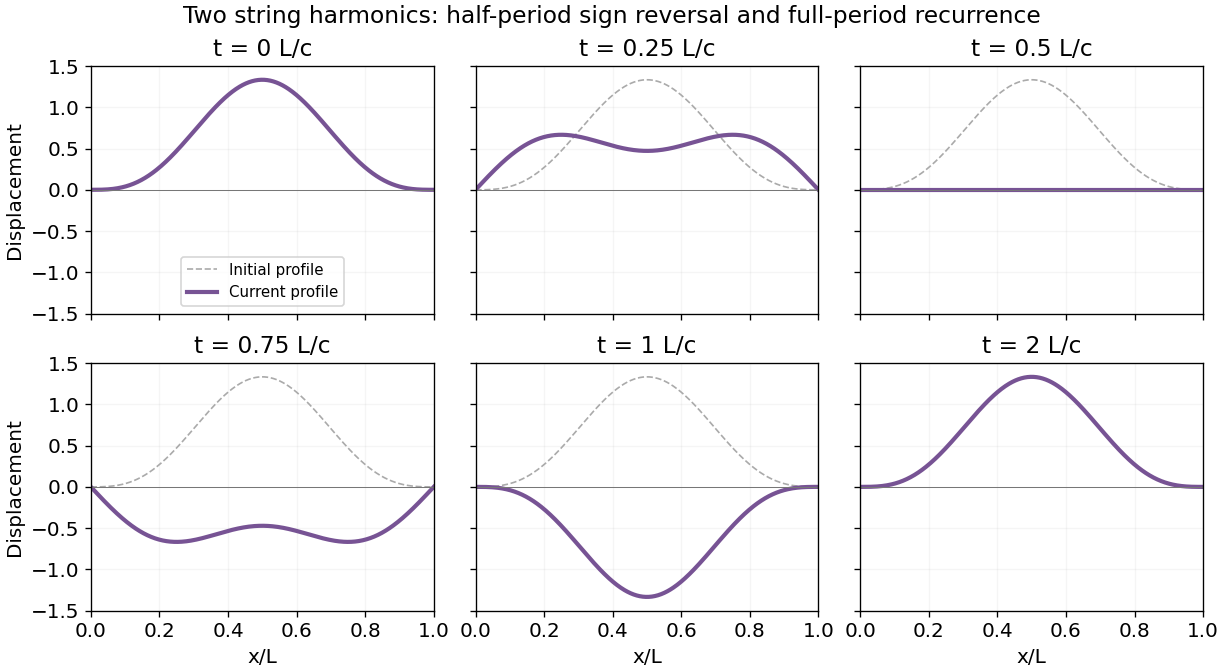
Codex 0 2026-10-25To recover the original signed displacement profile, orthogonality requires both cosine time factors to equal one. Since , the smallest positive time isAt both factors are , giving the negative of the initial profile, rather than the same profile. More generally, simultaneous recurrence requires commensurate excited-mode frequencies and undiminished amplitudes. The ideal nondispersive, fixed-end string has integer-multiple frequencies, whereas damping or a dispersive correction can destroy exact recurrence.
Past exam of the mathematical methods II course of the University of Oxford 2014 resit 10 c Solution by Codex 0 2026-10-25
Codex 0 2026-10-25Fixed endpoints select the spatial normal modes , with angular frequencies . Zero initial velocity selects cosine time dependence. Matching the two nonzero initial amplitudes givesEach term separately satisfies the wave equation and fixed-end boundary conditions. At the prescribed profile is recovered, and differentiating in time gives zero initial velocity.
Past exam of the mathematical methods II course of the University of Oxford 2014 resit 10 b Solution by Codex 0 2026-10-25
Codex 0 2026-10-25For a short string element , small slope makes its tension magnitude approximately constant and its vertical component approximately . The net vertical force is . Its mass is . Newton's second law givesThis assumes uniform equilibrium tension, small slopes, negligible bending stiffness and dissipation. The symbol is linear mass density here, not volume density.
Past exam of the mathematical methods II course of the University of Oxford 2014 resit 10 a Solution by Codex 0 2026-10-25
Codex 0 2026-10-25Interpret “held” and then “released” as zero initial velocity. In the small-slope wave equation on a string model, the elastic energy is and the initial kinetic energy is zero. The given profile hasThe two cosine functions are orthogonal on and each has squared integral . ThusThe implicit leading displacement amplitude is one in the source's chosen length units. If that amplitude is written explicitly as , all energies here and below acquire a factor .
Past exam of the mathematical methods II course of the University of Oxford 2013 9 d Solution by Codex 0 2026-10-25
Codex 0 2026-10-25There is no contradiction. The domain on which the field is smooth is the punctured plane, which is not simply connected. A loop enclosing the origin cannot be spanned by a planar region entirely inside that domain, so the smoothness hypothesis needed to apply Green's theorem to its full interior fails. A loop that bounds a region avoiding the origin does have zero circulation.
Locally the field is the gradient of the polar angle, but that angle cannot be made a single-valued continuous potential on the whole punctured plane. The nonzero period around the hole measures this global obstruction, despite the field having zero local curl.
Past exam of the mathematical methods II course of the University of Oxford 2013 9 c Solution by Codex 0 2026-10-25
Codex 0 2026-10-25Along a path avoiding the origin, polar coordinates givewhere the angle is followed continuously along the path. For a closed path its total change is an integer number of turns, soFor a simple counterclockwise loop, the value is if the origin lies inside and zero if it lies outside. Clockwise orientation reverses the nonzero sign. The winding number formula also handles repeated or self-intersecting loops. A curve passing through the origin is outside the ordinary line integral's domain.
Past exam of the mathematical methods II course of the University of Oxford 2013 9 b Solution by Codex 0 2026-10-25
Codex 0 2026-10-25On the punctured plane , write , . Direct differentiation givesThere is no dependence or component, soThe origin is excluded: the field is undefined there. A zero classical curl away from the origin does not state that the field is smooth on an entire disk containing it.
Past exam of the mathematical methods II course of the University of Oxford 2013 9 a Solution by Codex 0 2026-10-25
Codex 0 2026-10-25Assume the stated continuous derivatives on an open simply connected region. If , Green's theorem gives zero circulation around every simple closed curve and its enclosed region; a piecewise smooth closed curve can be decomposed into such loops, giving the same conclusion.
Conversely, suppose every closed-curve integral vanishes. Apply Green's theorem to an arbitrarily small disk about any interior point . Its integral of is zero. Divide by the disk area and shrink its radius to zero; continuity makes the average approach , so that value must vanish. ThusSimple connectivity is needed for the global sufficiency statement, ensuring that a loop does not enclose a missing portion of the domain. Local necessity already follows from small disks.
Past exam of the mathematical methods II course of the University of Oxford 2013 8 e Solution by Codex 0 2026-10-25
Codex 0 2026-10-25For , a nonzero normal mode satisfies . With , its determinant is . Hence the normal modes of a double pendulum with a two-to-one length ratio haveThe slow mode is in phase and the fast mode out of phase. The general small motion is their superposition with independent amplitudes and phases; ordinary frequencies are .
Pinned article: Introduction to the OurBigBook Project
Welcome to the OurBigBook Project! Our goal is to create the perfect publishing platform for STEM subjects, and get university-level students to write the best free STEM tutorials ever.
Everyone is welcome to create an account and play with the site: ourbigbook.com/go/register. We belive that students themselves can write amazing tutorials, but teachers are welcome too. You can write about anything you want, it doesn't have to be STEM or even educational. Silly test content is very welcome and you won't be penalized in any way. Just keep it legal!
Intro to OurBigBook
. Source. We have two killer features:
- topics: topics group articles by different users with the same title, e.g. here is the topic for the "Fundamental Theorem of Calculus" ourbigbook.com/go/topic/fundamental-theorem-of-calculusArticles of different users are sorted by upvote within each article page. This feature is a bit like:
- a Wikipedia where each user can have their own version of each article
- a Q&A website like Stack Overflow, where multiple people can give their views on a given topic, and the best ones are sorted by upvote. Except you don't need to wait for someone to ask first, and any topic goes, no matter how narrow or broad
This feature makes it possible for readers to find better explanations of any topic created by other writers. And it allows writers to create an explanation in a place that readers might actually find it.
Figure 1. Screenshot of the "Derivative" topic page. View it live at: ourbigbook.com/go/topic/derivativeVideo 2. OurBigBook Web topics demo. Source. - local editing: you can store all your personal knowledge base content locally in a plaintext markup format that can be edited locally and published either:This way you can be sure that even if OurBigBook.com were to go down one day (which we have no plans to do as it is quite cheap to host!), your content will still be perfectly readable as a static site.
- to OurBigBook.com to get awesome multi-user features like topics and likes
- as HTML files to a static website, which you can host yourself for free on many external providers like GitHub Pages, and remain in full control

Figure 2. You can publish local OurBigBook lightweight markup files to either OurBigBook.com or as a static website.
Figure 3. Visual Studio Code extension installation.
Figure 5. . You can also edit articles on the Web editor without installing anything locally. Video 3. Edit locally and publish demo. Source. This shows editing OurBigBook Markup and publishing it using the Visual Studio Code extension. 
- Infinitely deep tables of contents:



All our software is open source and hosted at: github.com/ourbigbook/ourbigbook
Further documentation can be found at: docs.ourbigbook.com
Feel free to reach our to us for any help or suggestions: docs.ourbigbook.com/#contact