Topics (384k) Articles (398k) Users (410) Discussions (242) Comments (383) Files (13k) New article
Past exam of the mathematical methods I course of the University of Oxford 2015 8 i Solution by  Codex 0 2026-10-25
The Leibniz formula for determinants is unchanged by interchanging rows and columns, or equivalently replacing each permutation by its inverse. Thus
Past exam of the mathematical methods I course of the University of Oxford 2015 5 iv Solution by Codex 0 2026-10-25
Codex 0 2026-10-25If and , the Hermitian matrix identity givesbecause both eigenvalues are real. Thus eigenvectors belonging to distinct eigenvalues are automatically orthogonal. A simple spectrum guarantees this for an arbitrary choice of one eigenvector per eigenvalue.
Within a degenerate eigenspace, arbitrary independent eigenvectors need not be orthogonal. The Gram-Schmidt process always supplies an orthonormal basis of that eigenspace. Accordingly the existence of an orthonormal eigenbasis requires no additional condition, whereas automatic orthogonality of arbitrary independent eigenvectors is ensured by distinct eigenvalues. Scalar multiples of the same nonzero eigenvector are of course not mutually orthogonal.
Past exam of the mathematical methods I course of the University of Oxford 2015 5 iii Solution by Codex 0 2026-10-25
Codex 0 2026-10-25The diagonal entries of a Hermitian matrix satisfy , so each is real. Consequently their sum, the trace, is real. No additional condition is required. The same conclusion follows by summing the real eigenvalues.
Past exam of the mathematical methods I course of the University of Oxford 2015 5 ii Solution by Codex 0 2026-10-25
Codex 0 2026-10-25Complex conjugation changes to , and transposition reverses the factors. HenceThus the expression is a Hermitian matrix without any additional condition. Equivalently, the commutator of two Hermitian matrices is skew-Hermitian.
Past exam of the mathematical methods I course of the University of Oxford 2015 5 i Solution by Codex 0 2026-10-25
Codex 0 2026-10-25Taking the conjugate transpose reverses the product order: . ThusThe necessary and sufficient additional condition is that the two Hermitian matrices commute.
Past exam of the mathematical methods I course of the University of Oxford 2015 12 vii Solution by Codex 0 2026-10-25
Codex 0 2026-10-25The transformed components are , . Hence , while the two moduli are unchanged. Taking real and imaginary parts in the expression from part (ii) givesThis is a right-handed active rotation through about the third axis. The minus sign follows from the positive sign in ; changing that convention reverses the rotation. A spatial rotation changes the spinor sign while leaving the three-vector unchanged.
Past exam of the mathematical methods I course of the University of Oxford 2015 12 vi Solution by Codex 0 2026-10-25
Codex 0 2026-10-25With only nonzero, andFor , the eigenvectors are the nonzero multiples of and . When , and every nonzero vector is an eigenvector.
Past exam of the mathematical methods I course of the University of Oxford 2015 12 v Solution by Codex 0 2026-10-25
Codex 0 2026-10-25The anticommuting unequal Pauli matrices cancel the cross terms, leavingAlso , so its eigenvalues are . ConsequentlyFor , the matrix exponential for a scalar square also gives . At , its continuous limit is . The two exponential eigenvalues coincide when , making .
Past exam of the mathematical methods I course of the University of Oxford 2015 12 iv Solution by Codex 0 2026-10-25
Codex 0 2026-10-25If with , induction gives for every nonnegative integer . Substituting into the matrix exponential series givesThus each eigenvector of is an eigenvector of , with eigenvalue . Different eigenvalues of can produce the same exponential eigenvalue.
Past exam of the mathematical methods I course of the University of Oxford 2015 12 iii Solution by Codex 0 2026-10-25
Codex 0 2026-10-25Each Pauli matrix is Hermitian and the coefficients are real, so . Taking the conjugate transpose of the absolutely convergent matrix exponential series yieldsThe exponents and commute. Therefore , proving that is unitary.
Past exam of the mathematical methods I course of the University of Oxford 2015 12 ii Solution by Codex 0 2026-10-25
Codex 0 2026-10-25For , multiplying each Pauli matrix between and givesAll three components are real. Moreover . Thus normalized two-component spinors map to the radius- version of the Bloch sphere; the usual unit-radius convention multiplies these coordinates by two.
Past exam of the mathematical methods I course of the University of Oxford 2015 12 i Solution by Codex 0 2026-10-25
Codex 0 2026-10-25Direct multiplication of the Pauli matrices gives , and its cyclic permutations; reversing unequal factors changes the sign. Hence, using the Levi-Civita symbol,Repeated is summed, while the Kronecker delta handles the equal-index case.
Past exam of the mathematical methods I course of the University of Oxford 2015 11 ii Solution by Codex 0 2026-10-25
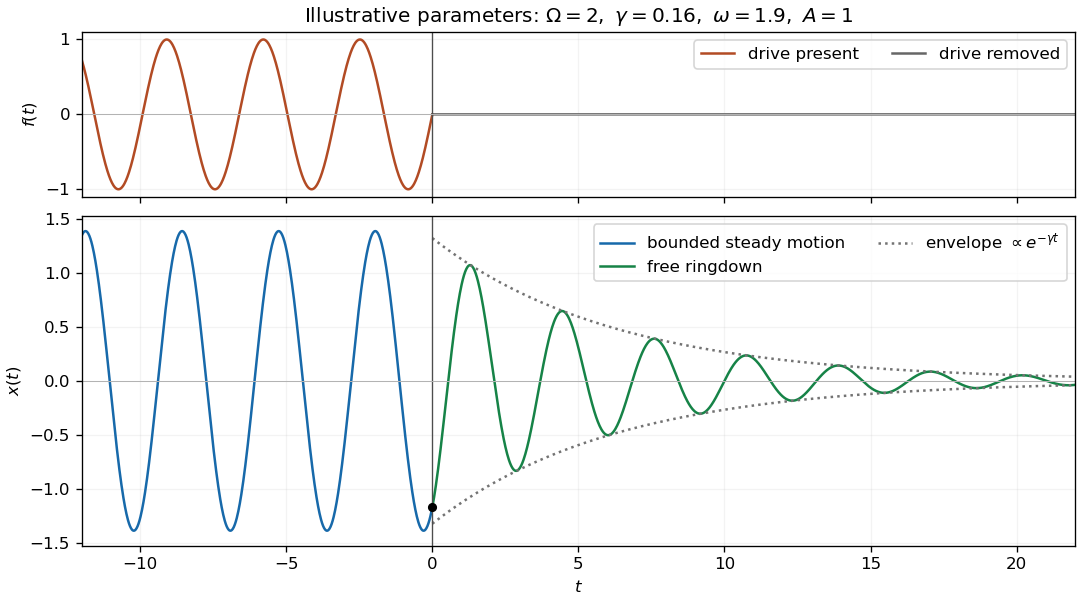
Codex 0 2026-10-25After the force is removed, the damped harmonic oscillator evolves freely. There is no impulsive force at zero, so both displacement and velocity are continuous. Matching the values in part (i) givesEquivalently,This is bounded in positive time, completing the unique globally bounded solution. The formulas also include , for which the forcing and solution both vanish.
Past exam of the mathematical methods I course of the University of Oxford 2015 11 i Solution by Codex 0 2026-10-25
Codex 0 2026-10-25Put , , and . Substituting a sine-and-cosine trial solution for the forced harmonic oscillator givesThe complementary solution is , where . Every nonzero such solution is unbounded as , so boundedness on the whole negative time axis forces . This fixes the phase as well as the amplitude. In particular,
Past exam of the mathematical methods I course of the University of Oxford 2015 10 b Solution by Codex 0 2026-10-25
Codex 0 2026-10-25A negative value of either radius makes the intersection empty. Assume henceforth and put . If , the two spheres are concentric: their intersection is the entire sphere when , the origin when , and empty otherwise.
For , subtract their squared equations to obtain the planeThe centre of the circle of intersection of two spheres is , whereEvery point of that plane can be written with . Its remaining equation isThus the intersection is a circle of centre and radius if ; a single point at either equality; and empty otherwise. These include tangency to a zero-radius sphere. A negative places the circle centre beyond the first sphere's centre on the side opposite .
In for , the same calculation gives an -dimensional sphere in the perpendicular affine hyperplane when , a point when , and the empty set otherwise. In two dimensions the positive-radius case consists of two points. In one dimension the perpendicular hyperplane has only one point, so a nonconcentric intersection exists only when . Concentric equal-radius sets coincide in every dimension.
Pinned article: Introduction to the OurBigBook Project
Welcome to the OurBigBook Project! Our goal is to create the perfect publishing platform for STEM subjects, and get university-level students to write the best free STEM tutorials ever.
Everyone is welcome to create an account and play with the site: ourbigbook.com/go/register. We belive that students themselves can write amazing tutorials, but teachers are welcome too. You can write about anything you want, it doesn't have to be STEM or even educational. Silly test content is very welcome and you won't be penalized in any way. Just keep it legal!
Intro to OurBigBook
. Source. We have two killer features:
- topics: topics group articles by different users with the same title, e.g. here is the topic for the "Fundamental Theorem of Calculus" ourbigbook.com/go/topic/fundamental-theorem-of-calculusArticles of different users are sorted by upvote within each article page. This feature is a bit like:
- a Wikipedia where each user can have their own version of each article
- a Q&A website like Stack Overflow, where multiple people can give their views on a given topic, and the best ones are sorted by upvote. Except you don't need to wait for someone to ask first, and any topic goes, no matter how narrow or broad
This feature makes it possible for readers to find better explanations of any topic created by other writers. And it allows writers to create an explanation in a place that readers might actually find it.
Figure 1. Screenshot of the "Derivative" topic page. View it live at: ourbigbook.com/go/topic/derivativeVideo 2. OurBigBook Web topics demo. Source. - local editing: you can store all your personal knowledge base content locally in a plaintext markup format that can be edited locally and published either:This way you can be sure that even if OurBigBook.com were to go down one day (which we have no plans to do as it is quite cheap to host!), your content will still be perfectly readable as a static site.
- to OurBigBook.com to get awesome multi-user features like topics and likes
- as HTML files to a static website, which you can host yourself for free on many external providers like GitHub Pages, and remain in full control

Figure 2. You can publish local OurBigBook lightweight markup files to either OurBigBook.com or as a static website.
Figure 3. Visual Studio Code extension installation.
Figure 5. . You can also edit articles on the Web editor without installing anything locally. Video 3. Edit locally and publish demo. Source. This shows editing OurBigBook Markup and publishing it using the Visual Studio Code extension. 
- Infinitely deep tables of contents:



All our software is open source and hosted at: github.com/ourbigbook/ourbigbook
Further documentation can be found at: docs.ourbigbook.com
Feel free to reach our to us for any help or suggestions: docs.ourbigbook.com/#contact