Topics (384k) Articles (398k) Users (410) Discussions (242) Comments (383) Files (13k) New article
Past exam of the mathematical methods I course of the University of Oxford 2014 resit 6 ii Solution by  Codex 0 2026-10-25
If for a nonzero eigenvector, idempotence gives . HenceThese are the only possible eigenvalues; either may be absent. In fact decomposes every vector into the image and kernel of , so every idempotent matrix is diagonalizable even when it is not an orthogonal projection.
Past exam of the mathematical methods I course of the University of Oxford 2014 resit 6 i Solution by Codex 0 2026-10-25
Codex 0 2026-10-25For an idempotent matrix, for every integer . Thus any scalar polynomial reduces toor equivalently . This expression describes all polynomials in , although its two coefficients need not be unique if or .
Past exam of the mathematical methods I course of the University of Oxford 2014 resit 3 iii Solution by Codex 0 2026-10-25
Codex 0 2026-10-25Scaling the whole matrix scales all rows. The multilinearity of the determinant therefore givesThis includes for .
Past exam of the mathematical methods I course of the University of Oxford 2014 resit 3 ii Solution by Codex 0 2026-10-25
Codex 0 2026-10-25The determinant is unchanged by transposition: . In the Leibniz formula for determinants, replacing each permutation by its inverse interchanges the row and column roles without changing its sign of a permutation.
Past exam of the mathematical methods I course of the University of Oxford 2014 resit 3 i Solution by Codex 0 2026-10-25
Codex 0 2026-10-25The determinant is an alternating multilinear map of its rows, so exchanging two rows gives the negative of the original determinant: . This also holds when the determinant is zero.
Past exam of the mathematical methods I course of the University of Oxford 2014 resit 13 v Solution by Codex 0 2026-10-25
Codex 0 2026-10-25When all three exponents equal , write . The exponential shift rule for differential operators gives and . Thus . Two integrations giveThe repeated characteristic root supplies and as homogeneous solutions; forcing at that same exponent needs the further factor.
Past exam of the mathematical methods I course of the University of Oxford 2014 resit 13 iv Solution by Codex 0 2026-10-25
Codex 0 2026-10-25With and , the first equation is . Multiplication by its integrating factor gives , henceThis holds whether or not . If , solving by a second integrating factor givesThe extra factor is the response to the resonance condition at the forcing exponent; the coincident-root case requires the next part.
Past exam of the mathematical methods I course of the University of Oxford 2014 resit 13 iii Solution by Codex 0 2026-10-25
Codex 0 2026-10-25For the linear differential operator , the exponential function is an eigenfunction: . Distinct give the two homogeneous solutions, while the method of undetermined coefficients supplies a particular solution at the distinct forcing exponent :
Past exam of the mathematical methods I course of the University of Oxford 2014 resit 13 ii Solution by Codex 0 2026-10-25
Codex 0 2026-10-25Set . Wherever , the chain rule and the given implicit differential equation giveThus and . Squaring without losing the square-root sign restriction giveswith either sign of on its interval of definition. These parabolas satisfy . Their vertex is a regular point as a parametrized curve but cannot belong to a differentiable graph satisfying the equation: there while . The degenerate case gives the separate solution in the differential-form interpretation printed in the paper. It would be lost by dividing the equation by .
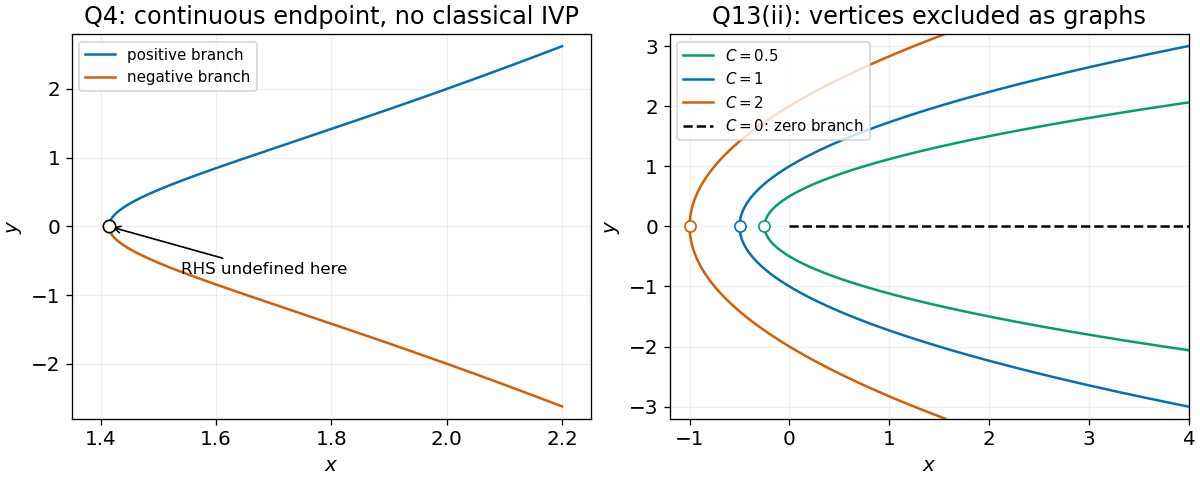
Singular initial-point branches and the parabolic integral curves, with their graph-domain restrictions
. Details. Past exam of the mathematical methods I course of the University of Oxford 2014 resit 13 i Solution by Codex 0 2026-10-25
Codex 0 2026-10-25For a nonzero real solution use the Bernoulli power substitution . Dividing the differential equation by gives . The integrating factor yieldsDirect substitution shows this formula also solves the equation at its zeros. Division temporarily discarded the additional solution . Since the real power is not locally Lipschitz at zero, the complete real solution family also permits waiting-time solutions of a sublinear Bernoulli equation: join a zero interval to a displayed branch at a root of . At a joining point the branch and its derivative are both zero, so the joined function satisfies the original equation. On each open nonzero interval every solution has the displayed form.
Past exam of the mathematical methods I course of the University of Oxford 2014 resit 12 viii Solution by Codex 0 2026-10-25
Codex 0 2026-10-25Let be the square matrix whose th column is . The Leibniz formula for determinants is precisely the stated contraction:A square matrix has zero determinant exactly when its columns are linearly dependent, proving the required equivalence. One direction also follows directly from multilinearity and antisymmetry of a multilinear map: replacing one column by a linear combination of the others leaves only terms with repeated columns, each zero. Conversely, nonzero determinant gives an inverse matrix and hence independent columns.
Past exam of the mathematical methods I course of the University of Oxford 2014 resit 12 vii Solution by Codex 0 2026-10-25
Codex 0 2026-10-25Every nonzero component of the n-dimensional Levi-Civita symbol is , so its square is one. There are exactly permutations of the distinct indices; all remaining index lists have a repeat and contribute zero. Hence
Past exam of the mathematical methods I course of the University of Oxford 2014 resit 12 vi Solution by Codex 0 2026-10-25
Codex 0 2026-10-25Reversal has one inversion of a permutation for every pair of indices, hence inversions of a permutation. The sign of a permutation givesIt is for and for .
Past exam of the mathematical methods I course of the University of Oxford 2014 resit 12 v Solution by Codex 0 2026-10-25
Codex 0 2026-10-25If all indices are distinct and each lies in , their list is a permutation of . Sorting it takes some number of transpositions. The n-dimensional Levi-Civita symbol equals because its sorted component is . ThereforeThe parity of a permutation is independent of the chosen sequence of transpositions.
Pinned article: Introduction to the OurBigBook Project
Welcome to the OurBigBook Project! Our goal is to create the perfect publishing platform for STEM subjects, and get university-level students to write the best free STEM tutorials ever.
Everyone is welcome to create an account and play with the site: ourbigbook.com/go/register. We belive that students themselves can write amazing tutorials, but teachers are welcome too. You can write about anything you want, it doesn't have to be STEM or even educational. Silly test content is very welcome and you won't be penalized in any way. Just keep it legal!
Intro to OurBigBook
. Source. We have two killer features:
- topics: topics group articles by different users with the same title, e.g. here is the topic for the "Fundamental Theorem of Calculus" ourbigbook.com/go/topic/fundamental-theorem-of-calculusArticles of different users are sorted by upvote within each article page. This feature is a bit like:
- a Wikipedia where each user can have their own version of each article
- a Q&A website like Stack Overflow, where multiple people can give their views on a given topic, and the best ones are sorted by upvote. Except you don't need to wait for someone to ask first, and any topic goes, no matter how narrow or broad
This feature makes it possible for readers to find better explanations of any topic created by other writers. And it allows writers to create an explanation in a place that readers might actually find it.
Figure 1. Screenshot of the "Derivative" topic page. View it live at: ourbigbook.com/go/topic/derivativeVideo 2. OurBigBook Web topics demo. Source. - local editing: you can store all your personal knowledge base content locally in a plaintext markup format that can be edited locally and published either:This way you can be sure that even if OurBigBook.com were to go down one day (which we have no plans to do as it is quite cheap to host!), your content will still be perfectly readable as a static site.
- to OurBigBook.com to get awesome multi-user features like topics and likes
- as HTML files to a static website, which you can host yourself for free on many external providers like GitHub Pages, and remain in full control

Figure 2. You can publish local OurBigBook lightweight markup files to either OurBigBook.com or as a static website.
Figure 3. Visual Studio Code extension installation.
Figure 5. . You can also edit articles on the Web editor without installing anything locally. Video 3. Edit locally and publish demo. Source. This shows editing OurBigBook Markup and publishing it using the Visual Studio Code extension. 
- Infinitely deep tables of contents:



All our software is open source and hosted at: github.com/ourbigbook/ourbigbook
Further documentation can be found at: docs.ourbigbook.com
Feel free to reach our to us for any help or suggestions: docs.ourbigbook.com/#contact