Topics (384k) Articles (398k) Users (410) Discussions (242) Comments (383) Files (13k) New article
Past exam of the mathematical methods I course of the University of Oxford 2017 resit 4 ii Solution by  Codex 0 2026-10-25
For a two-dimensional complex orthogonal matrix, let . Since , comparison with the two-by-two matrix inverse formula forces the second row to be if the first is . Thus the complete family isConversely direct multiplication gives and , proving sufficiency. The two parameters obey a bilinear constraint, not ; replacing squares by absolute squares would incorrectly impose unitarity.
Past exam of the mathematical methods I course of the University of Oxford 2017 resit 4 i Solution by Codex 0 2026-10-25
Codex 0 2026-10-25An orthogonal matrix satisfies . Taking determinants and using gives , soThis calculation remains valid over the complex numbers: orthogonality uses the transpose, whereas a unitary matrix uses the conjugate transpose.
Past exam of the mathematical methods I course of the University of Oxford 2017 resit 10 b Solution by Codex 0 2026-10-25
Codex 0 2026-10-25The quadratic form has symmetric matrixNormalized eigenvectors for and are and . They form the columns of the rotation matrixThus the new axis is rotated counterclockwise by , withThe opposite signs of the eigenvalues classify each positive level as a hyperbola. For the original level six its standard equation is ; for the final level one it is . The printed change of level therefore changes the scale, but not the principal axes or asymptotes.
Past exam of the mathematical methods I course of the University of Oxford 2017 resit 1 c Solution by Codex 0 2026-10-25
Codex 0 2026-10-25Factor out the same half-angle phase from the numerator and denominator:Here Euler's formula converts the bracketed sums to cosine and sine. Both sides require ; at the excluded angles the original denominator vanishes.
Past exam of the mathematical methods I course of the University of Oxford 2017 resit 1 b Solution by Codex 0 2026-10-25
Codex 0 2026-10-25A root of unity satisfies , hence has modulus one. Writing , its argument satisfies for some integer . The three distinct complex roots are thereforeThey are equally spaced on the unit circle. Taking exhausts them, since adding three to repeats a root and a nonzero polynomial of degree three has at most three distinct roots.
Past exam of the mathematical methods I course of the University of Oxford 2017 resit 1 a Solution by Codex 0 2026-10-25
Codex 0 2026-10-25By De Moivre's theorem, . Expanding the cube and equating its real part givesThe last form uses ; comparing the imaginary parts similarly gives the corresponding sine identity.
Past exam of the mathematical methods I course of the University of Oxford 2016 9 d Solution by Codex 0 2026-10-25
Codex 0 2026-10-25 Past exam of the mathematical methods I course of the University of Oxford 2016 9 c Solution by Codex 0 2026-10-25
Codex 0 2026-10-25The characteristic equation of the homogeneous ordinary differential equation is , with roots . Therefore . For the forcing term, try the particular solution . Substitution gives , , so , . The two initial conditions give and . ConsequentlyBoth the value and the first derivative vanish at zero; direct differentiation verifies the inhomogeneous equation.
Past exam of the mathematical methods I course of the University of Oxford 2016 9 b Solution by Codex 0 2026-10-25
Codex 0 2026-10-25The initial point lies in , where division by is valid. The first-order linear differential equationhas integrating factor . HenceThe condition at sets , soThe solution cannot be continued regularly through : its numerator tends to while the denominator tends to zero. The real logarithm also requires .
Past exam of the mathematical methods I course of the University of Oxford 2016 9 a Solution by Codex 0 2026-10-25
Codex 0 2026-10-25For , the integrating factor for can be taken as on either half-line. Thus , givingThe arbitrary constant may differ on the disconnected domains and .
Past exam of the mathematical methods I course of the University of Oxford 2016 11 b Solution by Codex 0 2026-10-25
Codex 0 2026-10-25At the power series gives . Equate the coefficient of after differentiating the series and substituting into the linear system of ordinary differential equations:Mathematical induction yields . Summing gives the matrix exponential solution .
For the specified diagonal Hermitian matrix, its powers and exponential act separately on the two components. ThusThis unitary matrix preserves : the two components acquire opposite phases of unit modulus. The coefficient recurrence applies to any constant finite square matrix ; unitarity here additionally uses its Hermitian property.
Past exam of the mathematical methods I course of the University of Oxford 2016 1 ii Solution by Codex 0 2026-10-25
Codex 0 2026-10-25For any value of the complex logarithm, up to adding an integer multiple of . Its real part therefore satisfiesThe locus is the circle centred at the origin with radius . Different logarithm values change only the imaginary part. If a particular analytic branch of the complex logarithm with a cut is imposed, restrict the circle to that branch's domain; the modulus equation itself is branch independent.
Past exam of the mathematical methods I course of the University of Oxford 2016 1 i Solution by Codex 0 2026-10-25
Codex 0 2026-10-25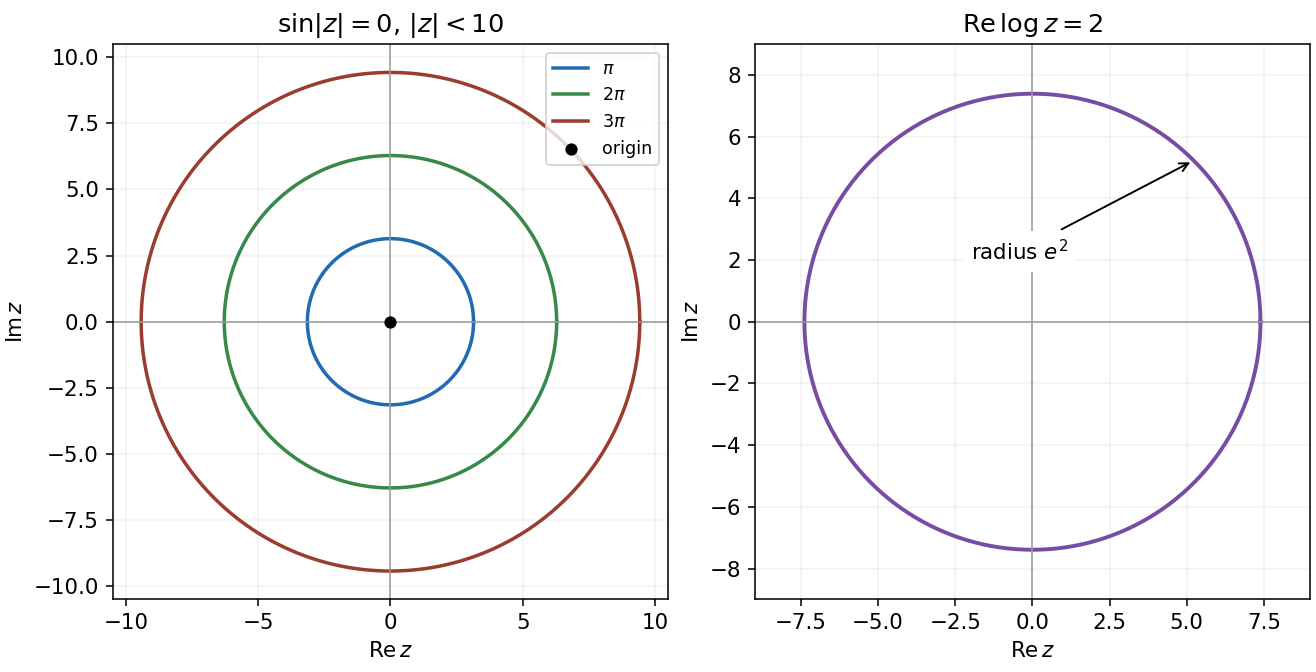
Past exam of the mathematical methods I course of the University of Oxford 2016 resit 9 v Solution by Codex 0 2026-10-25
Codex 0 2026-10-25For , the centre and constant remain and . Its eigenvalues are , so rotated coordinates put the surface in the form . This is a one-sheet hyperboloid. Since , the nearest centre-to-surface distance is at least one, attained in the eigen-direction with eigenvalue three. The coordinate is unbounded, because arbitrarily large can be balanced by or . Thus the nearest distance is one, and there is no maximum value of .
For the printed nonsymmetric , use the symmetric part of a matrix:The skew-symmetric part contributes zero to this scalar. The same centre solves , and again . Sylvester's positive principal minors are , so this surface is an ellipsoid.
Let be the largest eigenvalue of . Its characteristic equation is , and the Rayleigh quotient givesFor the maximum , the support function of a centred ellipsoid gives the bound below. Equivalently, apply the Cauchy-Schwarz inequality in the -weighted inner product: . The inverse entry is , and equality is attained for a centred vector proportional to . Thus
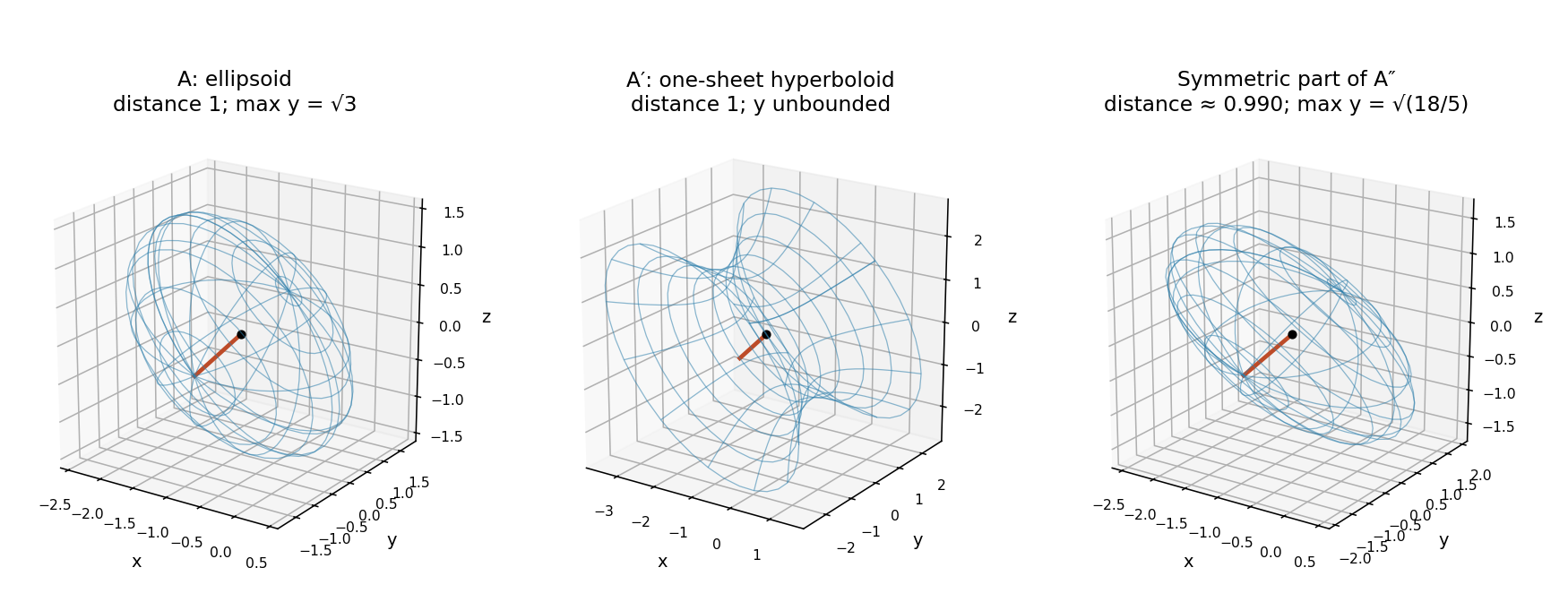
Using the eigenvalues of the raw nonsymmetric would be incorrect: it is its symmetric part that determines the surface and its Euclidean geometry.
Pinned article: Introduction to the OurBigBook Project
Welcome to the OurBigBook Project! Our goal is to create the perfect publishing platform for STEM subjects, and get university-level students to write the best free STEM tutorials ever.
Everyone is welcome to create an account and play with the site: ourbigbook.com/go/register. We belive that students themselves can write amazing tutorials, but teachers are welcome too. You can write about anything you want, it doesn't have to be STEM or even educational. Silly test content is very welcome and you won't be penalized in any way. Just keep it legal!
Intro to OurBigBook
. Source. We have two killer features:
- topics: topics group articles by different users with the same title, e.g. here is the topic for the "Fundamental Theorem of Calculus" ourbigbook.com/go/topic/fundamental-theorem-of-calculusArticles of different users are sorted by upvote within each article page. This feature is a bit like:
- a Wikipedia where each user can have their own version of each article
- a Q&A website like Stack Overflow, where multiple people can give their views on a given topic, and the best ones are sorted by upvote. Except you don't need to wait for someone to ask first, and any topic goes, no matter how narrow or broad
This feature makes it possible for readers to find better explanations of any topic created by other writers. And it allows writers to create an explanation in a place that readers might actually find it.
Figure 1. Screenshot of the "Derivative" topic page. View it live at: ourbigbook.com/go/topic/derivativeVideo 2. OurBigBook Web topics demo. Source. - local editing: you can store all your personal knowledge base content locally in a plaintext markup format that can be edited locally and published either:This way you can be sure that even if OurBigBook.com were to go down one day (which we have no plans to do as it is quite cheap to host!), your content will still be perfectly readable as a static site.
- to OurBigBook.com to get awesome multi-user features like topics and likes
- as HTML files to a static website, which you can host yourself for free on many external providers like GitHub Pages, and remain in full control

Figure 2. You can publish local OurBigBook lightweight markup files to either OurBigBook.com or as a static website.
Figure 3. Visual Studio Code extension installation.
Figure 5. . You can also edit articles on the Web editor without installing anything locally. Video 3. Edit locally and publish demo. Source. This shows editing OurBigBook Markup and publishing it using the Visual Studio Code extension. 
- Infinitely deep tables of contents:




All our software is open source and hosted at: github.com/ourbigbook/ourbigbook
Further documentation can be found at: docs.ourbigbook.com
Feel free to reach our to us for any help or suggestions: docs.ourbigbook.com/#contact