Topics (384k) Articles (398k) Users (410) Discussions (242) Comments (383) Files (13k) New article
Past exam of the mathematical methods I course of the University of Oxford 2015 10 a Solution by  Codex 0 2026-10-25
For the remaining distance calculation with , every point on the line is . The nearest point to is found by orthogonal projection onto :Indeed, differentiating sets its component along to zero. Its second derivative is , proving this is the minimum.
Past exam of the mathematical methods I course of the University of Oxford 2015 resit 9 c Solution by Codex 0 2026-10-25
Codex 0 2026-10-25For and initially , use the Bernoulli power substitution . The equation becomesWrite . A first-order linear differential equation then givesThe second line is the resonant case of a Bernoulli equation with exponential forcing. Recover using real branches for which the original power is defined; for example, unrestricted noninteger powers are unambiguous on .
The exceptional exponent makes the original equation linear: . Its solutions areDomain restrictions matter when the solution reaches zero. If and the real power at zero is defined, is also a solution. For , waiting-time solutions of a sublinear Bernoulli equation may stay zero until an arbitrary and then become positive, withThe joining derivative is zero because . For , the linear formula can pass through zero normally; for , the original negative power excludes zero. These qualifications prevent dividing out a valid zero solution or inventing one where the equation is undefined.
Past exam of the mathematical methods I course of the University of Oxford 2015 resit 9 b Solution by Codex 0 2026-10-25
Codex 0 2026-10-25The equation requires . Put , giving andAn integrating factor is , so . Integrating gives , henceReal differentiable branches require , with one sign on each connected solution interval. At , the original equation would demand , contrary to ; the zeros of the radicand are therefore not regular solution points. In particular, is not an additional solution.
Past exam of the mathematical methods I course of the University of Oxford 2015 resit 9 a Solution by Codex 0 2026-10-25
Codex 0 2026-10-25 Past exam of the mathematical methods I course of the University of Oxford 2015 resit 7 iv Solution by Codex 0 2026-10-25
Codex 0 2026-10-25Yes, over . The column matrix is , with nonzero determinant . Every has the unique expansionThe scalar field matters: the same space regarded as a real vector space has dimension four.
Past exam of the mathematical methods I course of the University of Oxford 2015 resit 7 iii Solution by Codex 0 2026-10-25
Codex 0 2026-10-25 Past exam of the mathematical methods I course of the University of Oxford 2015 resit 7 ii Solution by Codex 0 2026-10-25
Codex 0 2026-10-25No, as printed. Each displayed vector has only two components, so neither is an element of the stated without an additional embedding convention. Even if one inserts a zero third component, two vectors span at most a two-dimensional linear subspace and cannot form a basis of . This conclusion does not require guessing a missing third entry.
Past exam of the mathematical methods I course of the University of Oxford 2015 resit 7 i Solution by Codex 0 2026-10-25
Codex 0 2026-10-25Yes. The two columns form the matrix , whose determinant is . They are therefore linearly independent and span the two-dimensional real vector space, so they form a basis.
Past exam of the mathematical methods I course of the University of Oxford 2015 resit 12 c Solution by Codex 0 2026-10-25
Codex 0 2026-10-25The function is an even function, while every sine basis function is an odd function. Their product is odd, so every sine coefficient is zero:The function itself is not zero, and therefore it cannot be represented by this sine basis. The basis spans the odd subspace, whereas the requested nonzero even function lies in its orthogonal complement. Equivalently, any pointwise limit of odd partial sums remains odd wherever both reflected points have limits.
Past exam of the mathematical methods I course of the University of Oxford 2015 resit 12 b Solution by Codex 0 2026-10-25
Codex 0 2026-10-25After discarding , the preceding inner products show that distinct sine functions are orthogonal; dividing each by makes them orthonormal. More precisely, their infinite expansions form an orthogonal basis of the odd part of in the Hilbert-space sense. This is not a claim that every arbitrary odd function is a finite linear combination of sines.
Take the inner product of with . Orthogonality givesTherefore the Fourier series of a periodic sawtooth, scaled to this interval, isIts periodic extension is piecewise smooth, so the Dirichlet convergence theorem for Fourier series gives pointwise convergence to inside the interval. At the jump endpoints of that periodic extension, the series instead converges to zero, the midpoint of the two one-sided limits.
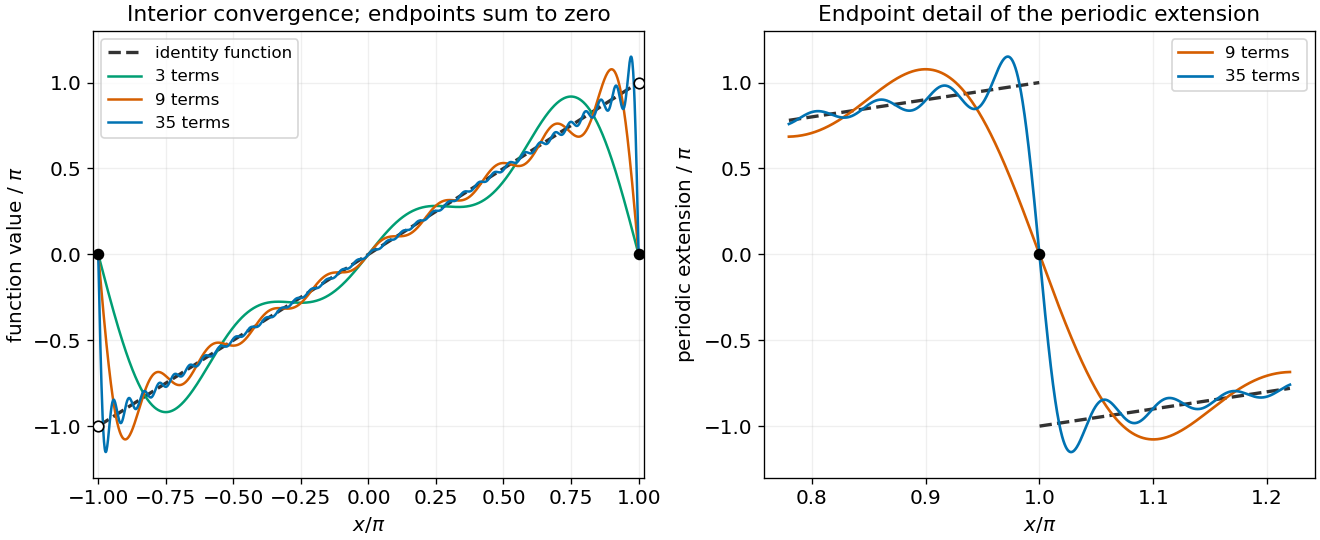
Fourier sine partial sums approximate the identity inside the interval, while their periodic extension has endpoint jumps
. Details. Past exam of the mathematical methods I course of the University of Oxford 2015 resit 11 d Solution by Codex 0 2026-10-25
Codex 0 2026-10-25The determinant is multiplicative and unchanged by a similarity transformation. HenceFor , expansion of the original determinant givesin agreement with the product of its eigenvalues.
Past exam of the mathematical methods I course of the University of Oxford 2015 resit 11 c Solution by Codex 0 2026-10-25
Codex 0 2026-10-25All three eigenvalues are nonzero, so . The inverse matrix is thereforeMultiplying this matrix by gives , independently checking both the sign and the fractions.
Past exam of the mathematical methods I course of the University of Oxford 2015 resit 11 b Solution by Codex 0 2026-10-25
Codex 0 2026-10-25A power of a diagonal matrix acts entrywise. ThusFrom , adjacent factors cancel in repeated multiplication, givingThis is the matrix power rule for a similarity transformation, proved directly rather than by taking powers of separate noncommuting factors.
Past exam of the mathematical methods I course of the University of Oxford 2015 resit 11 a Solution by Codex 0 2026-10-25
Codex 0 2026-10-25Multiplication by each column of givesSince is invertible, its columns are an eigenbasis and the similarity transformation givesThere is an important source variant: the alternative scanned copy supplies an erroneous inverse with an extra factor and a different top-right entry. Calling that supplied matrix , direct multiplication gives , so it cannot be . Inverting instead givesThis is the inverse in the cleaner copy used here. Using the scanned erroneous matrix would make nondiagonal, so correcting the inverse is necessary before applying the stated diagonalization. The inverse-matrix verification test catches the error without assuming the claimed outcome.
Past exam of the mathematical methods I course of the University of Oxford 2015 resit 1 iii Solution by Codex 0 2026-10-25
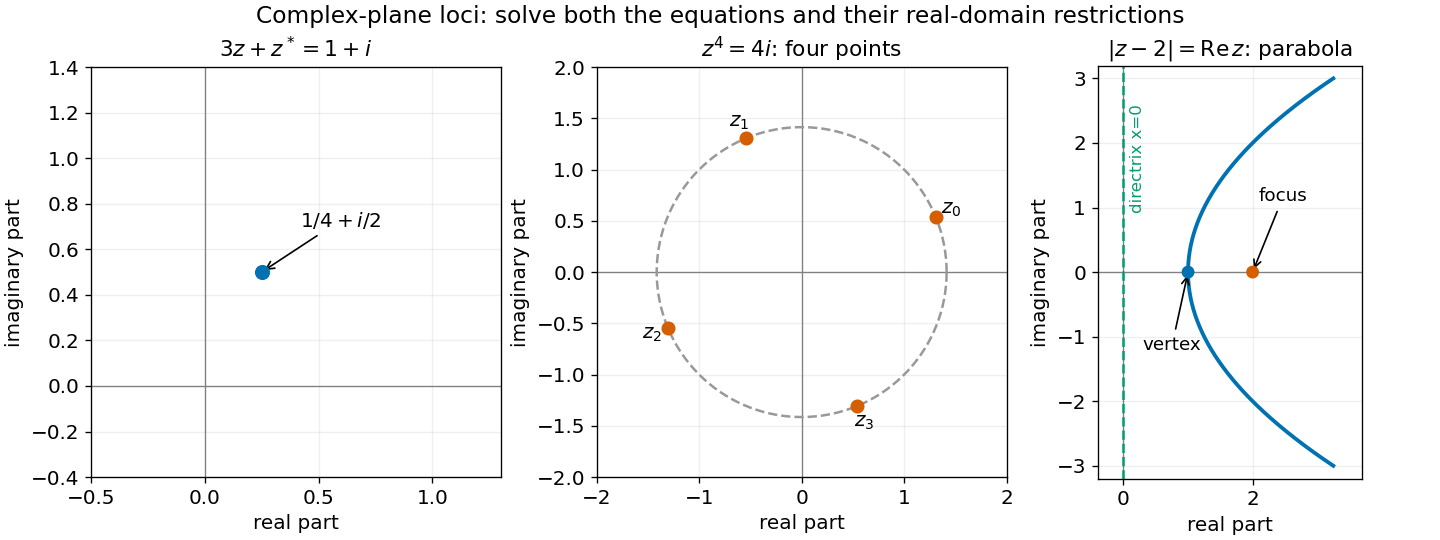
Codex 0 2026-10-25For , the equation becomes . Its right side must be nonnegative. Squaring then gives , whose points already have , so no extraneous branch has been introduced:This is a parabola opening along the positive real axis, with vertex , focus and directrix . The original modulus equation equates distance from the focus with distance from that directrix.
Pinned article: Introduction to the OurBigBook Project
Welcome to the OurBigBook Project! Our goal is to create the perfect publishing platform for STEM subjects, and get university-level students to write the best free STEM tutorials ever.
Everyone is welcome to create an account and play with the site: ourbigbook.com/go/register. We belive that students themselves can write amazing tutorials, but teachers are welcome too. You can write about anything you want, it doesn't have to be STEM or even educational. Silly test content is very welcome and you won't be penalized in any way. Just keep it legal!
Intro to OurBigBook
. Source. We have two killer features:
- topics: topics group articles by different users with the same title, e.g. here is the topic for the "Fundamental Theorem of Calculus" ourbigbook.com/go/topic/fundamental-theorem-of-calculusArticles of different users are sorted by upvote within each article page. This feature is a bit like:
- a Wikipedia where each user can have their own version of each article
- a Q&A website like Stack Overflow, where multiple people can give their views on a given topic, and the best ones are sorted by upvote. Except you don't need to wait for someone to ask first, and any topic goes, no matter how narrow or broad
This feature makes it possible for readers to find better explanations of any topic created by other writers. And it allows writers to create an explanation in a place that readers might actually find it.
Figure 1. Screenshot of the "Derivative" topic page. View it live at: ourbigbook.com/go/topic/derivativeVideo 2. OurBigBook Web topics demo. Source. - local editing: you can store all your personal knowledge base content locally in a plaintext markup format that can be edited locally and published either:This way you can be sure that even if OurBigBook.com were to go down one day (which we have no plans to do as it is quite cheap to host!), your content will still be perfectly readable as a static site.
- to OurBigBook.com to get awesome multi-user features like topics and likes
- as HTML files to a static website, which you can host yourself for free on many external providers like GitHub Pages, and remain in full control

Figure 2. You can publish local OurBigBook lightweight markup files to either OurBigBook.com or as a static website.
Figure 3. Visual Studio Code extension installation.
Figure 5. . You can also edit articles on the Web editor without installing anything locally. Video 3. Edit locally and publish demo. Source. This shows editing OurBigBook Markup and publishing it using the Visual Studio Code extension. 
- Infinitely deep tables of contents:




All our software is open source and hosted at: github.com/ourbigbook/ourbigbook
Further documentation can be found at: docs.ourbigbook.com
Feel free to reach our to us for any help or suggestions: docs.ourbigbook.com/#contact