Topics (384k) Articles (398k) Users (410) Discussions (242) Comments (383) Files (13k) New article
Past exam of the mathematical methods I course of the University of Oxford 2015 resit 1 ii Solution by  Codex 0 2026-10-25
 Past exam of the mathematical methods I course of the University of Oxford 2015 resit 1 i Solution by Codex 0 2026-10-25
Codex 0 2026-10-25Write , with real . Its complex conjugate is , so equating real and imaginary parts gives , . Thus the complex plane locus is the single point
Past exam of the mathematical methods I course of the University of Oxford 2014 9 c Solution by Codex 0 2026-10-25
Codex 0 2026-10-25Put , so . On an interval with , the resulting first-order linear differential equation is . Its integrating factor gives , henceFor real differentiable graphs one needs and , with either fixed sign on a connected interval. The points are outside the original equation's domain. At , would make the left side zero while the right side is , so those endpoints are also excluded. The identically zero function is not an additional solution.
Past exam of the mathematical methods I course of the University of Oxford 2014 9 b Solution by Codex 0 2026-10-25
Codex 0 2026-10-25The first-order linear differential equation has integrating factor . Multiplying through givesWith , the right side integrates to . ConsequentlyAll coefficients are smooth, so these real solutions extend over the whole real axis.
Past exam of the mathematical methods I course of the University of Oxford 2014 9 a Solution by Codex 0 2026-10-25
Codex 0 2026-10-25 Past exam of the mathematical methods I course of the University of Oxford 2014 7 iv Solution by Codex 0 2026-10-25
Codex 0 2026-10-25Distinct eigenvalues of a Hermitian matrix have orthogonal eigenvectors, since . The given normalization then gives
Past exam of the mathematical methods I course of the University of Oxford 2014 7 iii Solution by Codex 0 2026-10-25
Codex 0 2026-10-25 Past exam of the mathematical methods I course of the University of Oxford 2014 7 ii Solution by Codex 0 2026-10-25
Codex 0 2026-10-25 Past exam of the mathematical methods I course of the University of Oxford 2014 7 i Solution by Codex 0 2026-10-25
Codex 0 2026-10-25The finite-dimensional spectral theorem diagonalizes the Hermitian matrix in its orthonormal eigenbasis. The determinant is the product of the eigenvalues:
Past exam of the mathematical methods I course of the University of Oxford 2014 12 vi Solution by Codex 0 2026-10-25
Codex 0 2026-10-25Multiplicativity of the determinant gives . Thus C1 holds. For , C2 fails: choosing and gives . The same choice disproves C3, since . The nonnegativity portion of C4 holds, because , but its positive-definiteness clause fails: a nonzero singular matrix that is symmetric, such as , has zero self-pairing.
Therefore this is not an inner product for . For the exceptional case , the determinant is the scalar entry and the pairing is ordinary multiplication of real numbers, so all four conditions hold. The determinant pairing is not an inner product in higher dimension because it measures volume scaling rather than a bilinear length geometry.
Past exam of the mathematical methods I course of the University of Oxford 2014 12 v Solution by Codex 0 2026-10-25
Codex 0 2026-10-25Taking the trace of the proposed commutator identity would givea contradiction for positive integer over the real numbers. No such finite real matrices exist. This is the trace of a commutator obstruction; it also applies to complex finite matrices.
Past exam of the mathematical methods I course of the University of Oxford 2014 12 iv Solution by Codex 0 2026-10-25
Codex 0 2026-10-25Apply the cyclic property of the trace and :This proves similarity invariance of trace without requiring or to be symmetric.
Past exam of the mathematical methods I course of the University of Oxford 2014 12 iii Solution by Codex 0 2026-10-25
Codex 0 2026-10-25The cyclic property of the trace gives , which is C1. The linearity of trace and matrix multiplication gives C2 and C3. Finally symmetry of giveswith equality exactly when every entry is zero. Thus C4 also holds. This is the Frobenius inner product restricted to the real vector space of symmetric matrices.
Past exam of the mathematical methods I course of the University of Oxford 2014 12 ii Solution by Codex 0 2026-10-25
Codex 0 2026-10-25 Past exam of the mathematical methods I course of the University of Oxford 2014 12 i Solution by Codex 0 2026-10-25
Codex 0 2026-10-25 Past exam of the mathematical methods I course of the University of Oxford 2014 11 v Solution by Codex 0 2026-10-25
Codex 0 2026-10-25All nonzero eigenmodes decay, including the term in the repeated-root case. Total concentration is conserved and initially equals . Combining with the equal-flux ratios givesThese are the unique steady state concentrations with this total. The formula remains valid when the transient eigenvalues are complex or repeated.
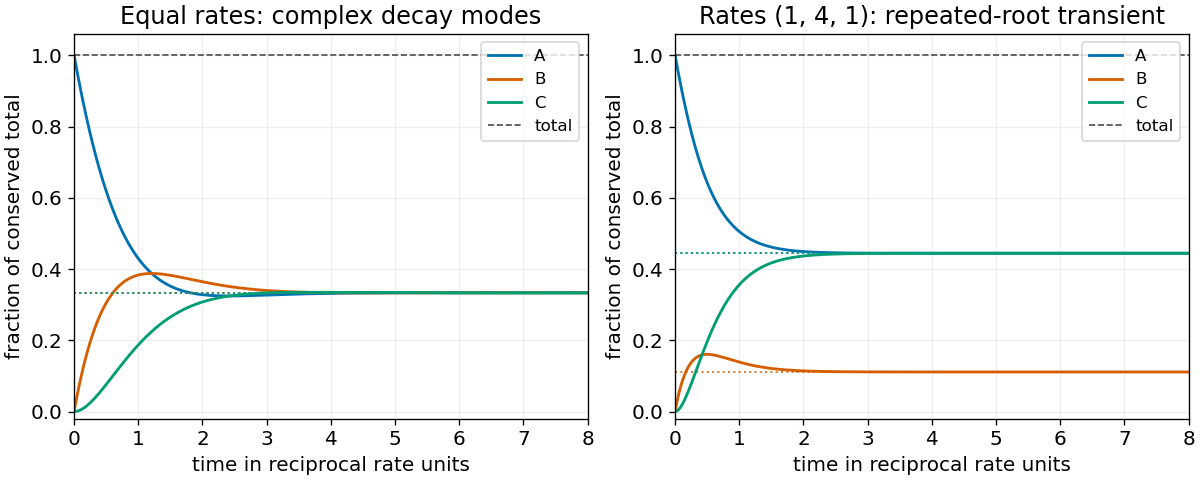
Three-state conversion conserves total concentration; equal rates give damped oscillations and repeated roots give a Jordan transient
. Details. Past exam of the mathematical methods I course of the University of Oxford 2014 11 iv Solution by Codex 0 2026-10-25
Codex 0 2026-10-25If , the three eigenvalues are distinct, so a basis of eigenvectors givesThe transformed coordinates then have the displayed exponential form. If , this is a complex eigenbasis; real concentrations are recovered by conjugate-paired coefficients. A real basis instead gives a decaying two-dimensional rotation block with decay rate and angular frequency .
The proposed diagonalization is not valid for every positive choice of rates. For example , gives , , with repeated eigenvalue and only one corresponding eigenvector. More generally the defective repeated eigenvalue in a cyclic conversion model occurs when . A Jordan basis then givesThe extra factor cannot be represented by two independent pure exponential coordinates in a diagonal basis.
Past exam of the mathematical methods I course of the University of Oxford 2014 11 iii Solution by Codex 0 2026-10-25
Codex 0 2026-10-25The remaining eigenvalue is . At a steady state, the three cyclic fluxes agree: . A corresponding nonzero eigenvector is thereforeor its scalar multiple . Its positive components express a possible equilibrium concentration ratio.
Past exam of the mathematical methods I course of the University of Oxford 2014 11 ii Solution by Codex 0 2026-10-25
Codex 0 2026-10-25Put and . Direct expansion gives the characteristic polynomialThe quadratic formula therefore givesSince , both nonzero eigenvalues have negative real part. They need not be real; equal rates give a complex-conjugate pair.
Past exam of the mathematical methods I course of the University of Oxford 2014 11 i Solution by Codex 0 2026-10-25
Codex 0 2026-10-25Reading the coefficients in the ordered concentration vector gives the linear system of ordinary differential equationsIts columns sum to zero, so . This three-state cyclic conversion model conserves total concentration.
Pinned article: Introduction to the OurBigBook Project
Welcome to the OurBigBook Project! Our goal is to create the perfect publishing platform for STEM subjects, and get university-level students to write the best free STEM tutorials ever.
Everyone is welcome to create an account and play with the site: ourbigbook.com/go/register. We belive that students themselves can write amazing tutorials, but teachers are welcome too. You can write about anything you want, it doesn't have to be STEM or even educational. Silly test content is very welcome and you won't be penalized in any way. Just keep it legal!
Intro to OurBigBook
. Source. We have two killer features:
- topics: topics group articles by different users with the same title, e.g. here is the topic for the "Fundamental Theorem of Calculus" ourbigbook.com/go/topic/fundamental-theorem-of-calculusArticles of different users are sorted by upvote within each article page. This feature is a bit like:
- a Wikipedia where each user can have their own version of each article
- a Q&A website like Stack Overflow, where multiple people can give their views on a given topic, and the best ones are sorted by upvote. Except you don't need to wait for someone to ask first, and any topic goes, no matter how narrow or broad
This feature makes it possible for readers to find better explanations of any topic created by other writers. And it allows writers to create an explanation in a place that readers might actually find it.
Figure 1. Screenshot of the "Derivative" topic page. View it live at: ourbigbook.com/go/topic/derivativeVideo 2. OurBigBook Web topics demo. Source. - local editing: you can store all your personal knowledge base content locally in a plaintext markup format that can be edited locally and published either:This way you can be sure that even if OurBigBook.com were to go down one day (which we have no plans to do as it is quite cheap to host!), your content will still be perfectly readable as a static site.
- to OurBigBook.com to get awesome multi-user features like topics and likes
- as HTML files to a static website, which you can host yourself for free on many external providers like GitHub Pages, and remain in full control

Figure 2. You can publish local OurBigBook lightweight markup files to either OurBigBook.com or as a static website.
Figure 3. Visual Studio Code extension installation.
Figure 5. . You can also edit articles on the Web editor without installing anything locally. Video 3. Edit locally and publish demo. Source. This shows editing OurBigBook Markup and publishing it using the Visual Studio Code extension. 
- Infinitely deep tables of contents:



All our software is open source and hosted at: github.com/ourbigbook/ourbigbook
Further documentation can be found at: docs.ourbigbook.com
Feel free to reach our to us for any help or suggestions: docs.ourbigbook.com/#contact