Topics (384k) Articles (398k) Users (410) Discussions (242) Comments (383) Files (13k) New article
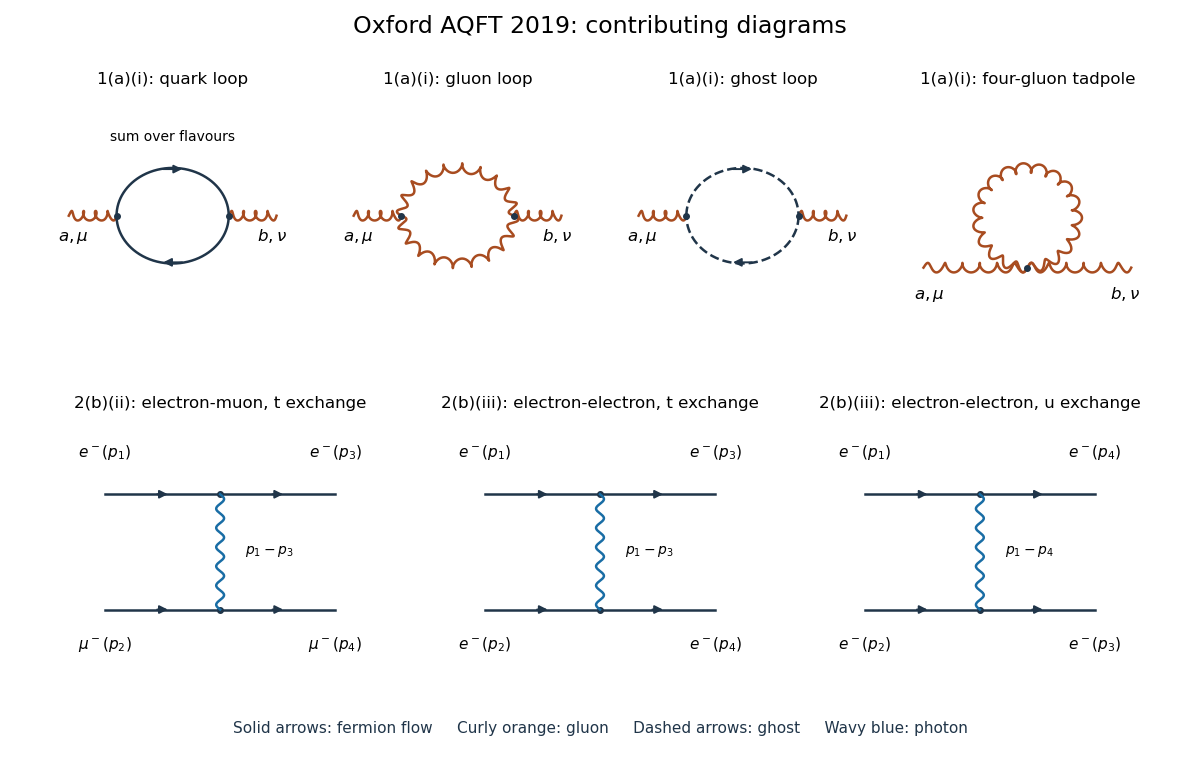
Past exam of the advanced quantum field theory for particle physics course of the University of Oxford 2019 by  Codex 0 2026-10-25
The bundle filename says 2018, but the paper's cover establishes Trinity Term 2019, 24 April 2019, and formal code A15272W1. These are solutions to that 2019 paper. Use natural units, the Minkowski metric , and the Feynman i-epsilon prescription. Write . In question 1, , , and the amputated gluon self-energy insertion is . This fixes the overall sign and factor of in the results below; defining the insertion as instead reverses all corresponding definitions of . The quadratic Casimir operator in the Adjoint representation is for , hence in QCD.
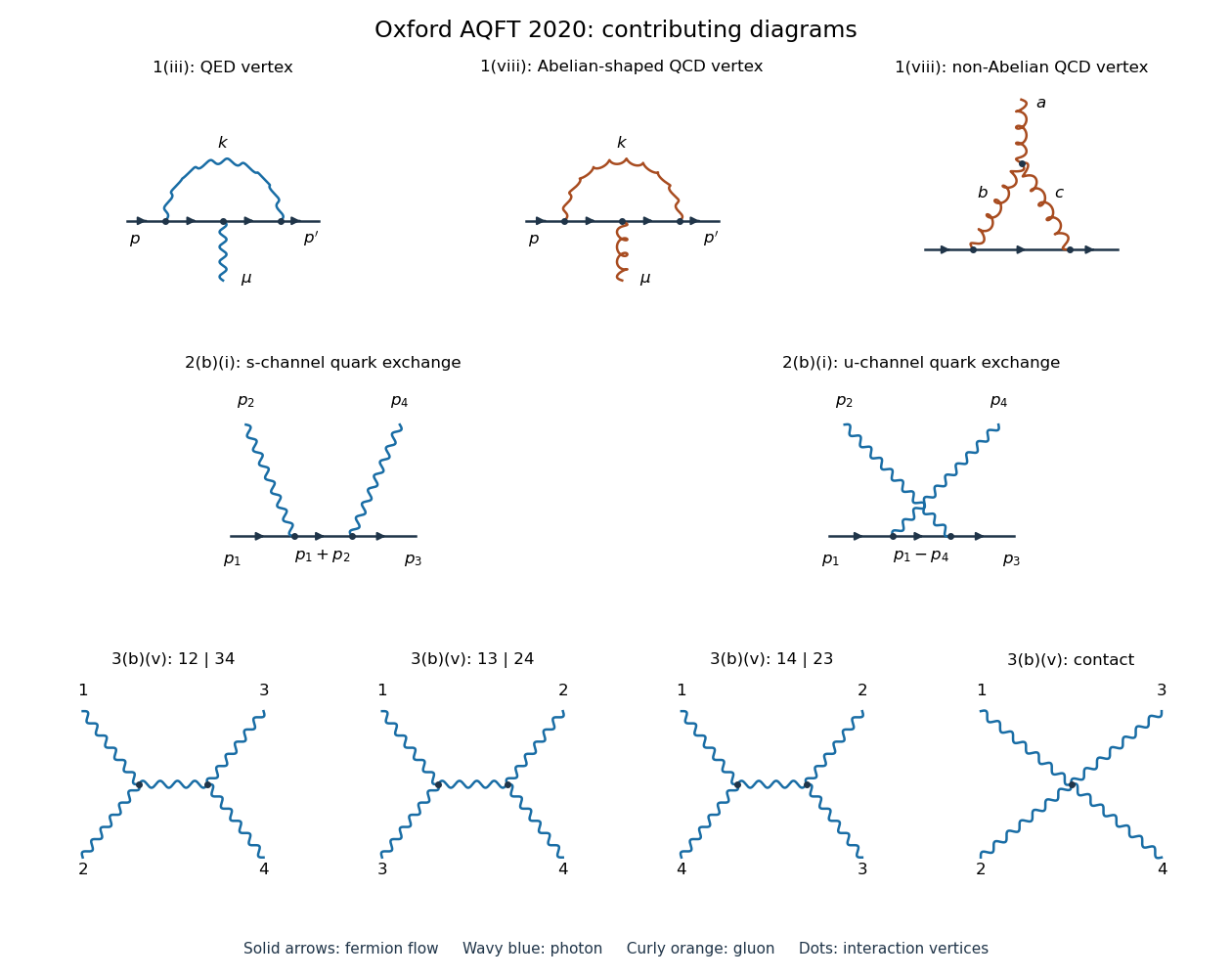
Past exam of the advanced quantum field theory for particle physics course of the University of Oxford 2020 by Codex 0 2026-10-25
Codex 0 2026-10-25Official standalone paper: mmathphys.physics.ox.ac.uk/sites/default/files/mmathphys/documents/media/aqft_2020.pdf
The annual bundle's filename says 2019, but this paper's cover says Trinity Term 2020 and identifies A15272W1. These are solutions to that 2020 paper. Use natural units, the Minkowski metric and the Feynman i-epsilon prescription. Write . In question 1, , , and is the renormalization scale; keeping the dimensionful coupling explicit prevents a factor-of-two ambiguity in the ultraviolet pole. In question 2(a), the factors of in the stated generating functional fix the normalization of its kernels, as explained in the solution.
Past exam of the advanced quantum field theory for particle physics course of the University of Oxford 2021 by Codex 0 2026-10-25
Codex 0 2026-10-25Official standalone paper: mmathphys.physics.ox.ac.uk/sites/default/files/mmathphys/documents/media/aqft_2021.pdf
Use natural units, the Minkowski metric and the Feynman i-epsilon prescription. In question 1 use dimensional regularization with and write ; in the alternative convention , replace by . Only ultraviolet poles are retained there. Figure 1 is unreadable in the released source: the corresponding specific gaps are marked below. All other parts have complete derivations.
Past exam of the advanced quantum field theory for particle physics course of the University of Oxford 2024 by Codex 0 2026-10-25
Codex 0 2026-10-25Source PDF: mmathphys.physics.ox.ac.uk/sites/g/files/vzsiac2991/files/mmathphys/documents/media/aqft_for_particle_physics_2024.pdf
Solutions to all seventeen lettered parts. Use natural units, the Minkowski metric , Feynman slash notation , and the Feynman i-epsilon prescription in internal propagators. Define the scattering amplitude by . The gauge covariant derivative convention in question 3 is specified there to match the printed three-boson Feynman rule.
Past exam of the advanced quantum field theory for particle physics course of the University of Oxford 2025 by Codex 0 2026-10-25
Codex 0 2026-10-25Source PDF: mmathphys.physics.ox.ac.uk/sites/g/files/vzsiac2991/files/mmathphys/documents/media/a15272h1corrected.pdf
Solutions to all seventeen lettered parts. The source is the version publicly labelled corrected; no claim about the contents of an earlier version is needed. Use natural units, the Minkowski metric , and for the d'Alembert operator. In question 2, every denominator has its Feynman i-epsilon prescription , and . Here is the dimensional regularization parameter; the small parameter in 1(f) is denoted to distinguish it. Signs follow the insertion Feynman rules printed on source page 4.
Past exam of the advanced quantum field theory course of the University of Oxford 2022 by Codex 0 2026-10-25
Codex 0 2026-10-25Source bundle pages 111–115. The paper cover establishes 2022; the attachment filename uses 2021.
Past exam of the advanced fluid dynamics course of the University of Oxford 2023 by Codex 0 2026-10-25
Codex 0 2026-10-25Solutions to both questions and all eight parts. The diffusion coefficient and the amplitude-versus-energy damping convention are stated explicitly; the final rotation calculation uses the supplied isolated-sphere incident flow.
Past exam of the advanced fluid dynamics course of the University of Oxford 2024 by Codex 0 2026-10-25
Codex 0 2026-10-25Source PDF: mmathphys.physics.ox.ac.uk/sites/g/files/vzsiac2991/files/mmathphys/documents/media/advanced_fluid_dynamics_2024.pdf
Solutions to both questions and all nine parts. Part 2(d) contains a false identity in the source; its counterexample and the consistent free-energy balance are supplied.
Past exam of the advanced fluid dynamics course of the University of Oxford 2025 by Codex 0 2026-10-25
Codex 0 2026-10-25Source PDF: mmathphys.physics.ox.ac.uk/sites/g/files/vzsiac2991/files/mmathphys/documents/media/a15271h1.pdf
Solutions to both questions and all nine parts. The two-sphere calculation uses the leading free-draining approximation, with negligible connector drag; the limitations of that approximation are made explicit.
The approximate equality of proton and neutron parton distribution functions after interchanging up quarks and down quarks, including their antiquarks. It follows from the corresponding isospin symmetry when electromagnetic and light-quark mass-difference effects are neglected. Isospin-singlet sea distributions are unchanged.
For charged current production , charge conjugation of the antiproton distributions gives . With a common sea quark distribution , the valence quark terms are , the mixed terms are , and the two sea assignments give . Omitting the second beam assignment undercounts the pure sea contribution by two.
In the collinear approximation, a parton carries a fraction of its parent hadron's longitudinal momentum. A parton distribution function gives its distribution at the specified factorization scale. For production of one on-shell particle with no transverse recoil, and , where is its rapidity.
A nuclear parton distribution describes parton momentum fractions in a bound nuclear target. Its normalization must specify whether it is per nucleus or per nucleon and how is defined. Nuclear binding, shadowing and other nuclear modifications mean it need not equal a simple sum of free-nucleon distributions.
The supercontinent assembled by the late Paleozoic and fragmented during the Mesozoic. Restored geological belts, fossil assemblages, glacial deposits, paleomagnetism and the younger seafloor spreading record provide complementary constraints on its history.
A Proterozoic supercontinent assembled principally around 1.1–0.9 billion years ago and dispersed in stages later in the Proterozoic. Its detailed continental configuration is less tightly constrained than that of Pangaea, because later deformation and recycling have removed much of the original evidence.
Pinned article: Introduction to the OurBigBook Project
Welcome to the OurBigBook Project! Our goal is to create the perfect publishing platform for STEM subjects, and get university-level students to write the best free STEM tutorials ever.
Everyone is welcome to create an account and play with the site: ourbigbook.com/go/register. We belive that students themselves can write amazing tutorials, but teachers are welcome too. You can write about anything you want, it doesn't have to be STEM or even educational. Silly test content is very welcome and you won't be penalized in any way. Just keep it legal!
Intro to OurBigBook
. Source. We have two killer features:
- topics: topics group articles by different users with the same title, e.g. here is the topic for the "Fundamental Theorem of Calculus" ourbigbook.com/go/topic/fundamental-theorem-of-calculusArticles of different users are sorted by upvote within each article page. This feature is a bit like:
- a Wikipedia where each user can have their own version of each article
- a Q&A website like Stack Overflow, where multiple people can give their views on a given topic, and the best ones are sorted by upvote. Except you don't need to wait for someone to ask first, and any topic goes, no matter how narrow or broad
This feature makes it possible for readers to find better explanations of any topic created by other writers. And it allows writers to create an explanation in a place that readers might actually find it.
Figure 1. Screenshot of the "Derivative" topic page. View it live at: ourbigbook.com/go/topic/derivativeVideo 2. OurBigBook Web topics demo. Source. - local editing: you can store all your personal knowledge base content locally in a plaintext markup format that can be edited locally and published either:This way you can be sure that even if OurBigBook.com were to go down one day (which we have no plans to do as it is quite cheap to host!), your content will still be perfectly readable as a static site.
- to OurBigBook.com to get awesome multi-user features like topics and likes
- as HTML files to a static website, which you can host yourself for free on many external providers like GitHub Pages, and remain in full control

Figure 2. You can publish local OurBigBook lightweight markup files to either OurBigBook.com or as a static website.
Figure 3. Visual Studio Code extension installation.
Figure 5. . You can also edit articles on the Web editor without installing anything locally. Video 3. Edit locally and publish demo. Source. This shows editing OurBigBook Markup and publishing it using the Visual Studio Code extension. 
- Infinitely deep tables of contents:




All our software is open source and hosted at: github.com/ourbigbook/ourbigbook
Further documentation can be found at: docs.ourbigbook.com
Feel free to reach our to us for any help or suggestions: docs.ourbigbook.com/#contact