Official standalone paper: mmathphys.physics.ox.ac.uk/sites/default/files/mmathphys/documents/media/aqft_2021.pdf
Use natural units, the Minkowski metric and the Feynman i-epsilon prescription. In question 1 use dimensional regularization with and write ; in the alternative convention , replace by . Only ultraviolet poles are retained there. Figure 1 is unreadable in the released source: the corresponding specific gaps are marked below. All other parts have complete derivations.
The superficial degree of divergence of this scalar electrodynamics three-point vertex is one. Its ultraviolet pole is consequently a local expression at most linear in the external four-momenta. The allowed counterterm Lagrangian, with the charge-conjugation and Hermiticity properties of scalar electrodynamics, contains a single one-derivative scalar electrodynamics three-point vertex:Thus the coefficient is independent of the chosen external four-momenta. Setting leaves , so a nonzero generic still determines that coefficient. It does not determine the full finite scattering amplitude at other four-momenta.
Keep and generic off shell while extracting the ultraviolet pole. These choices avoid spurious infrared divergences; setting all scales to zero would instead produce scaleless integrals that can conceal the ultraviolet pole.
TODO (source gap): Figure 1(a), including its internal connections and four-momentum labels, is absent from the recoverable source. The local PDF renderer reports missing image objects, and the matching official PDF's figure could not be retrieved for visual inspection. Therefore the individual Feynman diagram called (a) cannot be assigned an integrand and its separate independence of cannot be verified from the available diagram. A guessed replacement drawing would not resolve this gap.
An independent determination of the complete ultraviolet pole, given in part (iv), remains possible from the scalar QED Ward identity. Together with the textually supplied integral in part (iv), it fixes the sum of the contributions outside that integral to in the stated scalar electrodynamics three-point vertex convention. That sum alone does not identify the contents of panel (a).
TODO (source gap): Figure 1(c) and its four-momentum labels are unreadable. The assertion about this individual Feynman diagram therefore cannot be checked against its actual integrand. In particular, one must not identify the missing panel with a convenient vanishing seagull vertex graph by inference.
A useful criterion, once the drawing is recovered, is that dimensional regularization annihilates a vector integral of the formby the change of variables . This would prove vanishing for every if all remaining factors were functions of ; a denominator involving must first be checked rather than discarded. Whether this criterion applies to panel (c) is precisely the unavailable information.
The integral printed in the text can be evaluated without reconstructing Figure 1. Put and , and let denote that integral without its factor . The numerator contraction responsible for its covariant gauge dependence isWith the scalar electrodynamics three-point vertex , three such vertices, two scalar propagators and one photon propagator have overall factor . Thus the supplied integrand gives .
First isolate the numerator term . Its contribution isUnder the two denominators exchange and the numerator changes sign. A shift-invariant dimensional regularization therefore gives , including the finite part.
For the remaining numerator , only its term contributes to the ultraviolet pole. Corrections from expanding the denominators, and the numerator , are ultraviolet finite by power counting. Use auxiliary-mass extraction of ultraviolet poles with any rather than literally integrating a massless scaleless integral. Lorentz covariance then givesTODO (source gap): The algebra of the supplied expression is complete, but its graphical identification with Figure 1(b), including the routing at each internal vertex, cannot be visually verified from the unreadable panel.
The complete renormalization constant can nevertheless be obtained independently. Here is a short scalar QED wave-function pole calculation, to avoid assuming either missing panel's value. For an external four-momentum , the exchange contribution to the scalar self-energy has numeratorIts denominator is . The necessary ultraviolet poles, with the measure , are respectivelyThe first two follow by a Feynman parameter and a shift of ; the third is a tadpole integral; the last follows by the same large- extraction used above. The seagull vertex contributes only a photon tadpole integral, which is a scaleless integral, and in any case cannot affect the coefficient of . Multiplication by the exchange graph's factor gives the scalar self-energy insertionThe kinetic counterterm therefore requires . The scalar QED Ward identity sets , soIndeed the full unrenormalized scalar electrodynamics three-point vertex has ultraviolet pole , which is cancelled by . Subtracting the supplied contribution gives the gauge-independent sum stated in part (ii), without assigning either unreadable panel an integrand.
The scalar QED Ward identity equates the vertex renormalization and wave-function renormalization constants. Consequently, using part (iv),The renormalization constants describe gauge-dependent fields and off shell vertices, so their dependence on is permitted. A physical scattering amplitude includes all Feynman diagrams, the counterterms, and the external-state factors from LSZ reduction. The Ward identities ensure that the dependence on cancels for physical external states. Infrared-sensitive probabilities also require the usual inclusive treatment of unobserved soft photons. Thus no dependence on is implied for consistently calculated physical observables.
Use the Mandelstam variables , and . The external on shell relations are and . Expanding the three Mandelstam variables and using four-momentum conservation, , gives
Let , , and . The single tree-level Feynman diagram is annihilation through a virtual photon. Up to an irrelevant common phase, its scattering amplitude isThere are two initial spin angular momentum states for each particle, so the spin average is . The final color charge sum gives . There is no additional photon polarization average for a virtual photon and no separate polarization label beyond the Dirac spinor spin sums.
The spin sums and the gamma-matrix trace identities giveHere . Contracting givesSince and , this is the massive vector-current annihilation kernelThus the absolutely normalized result isAfter taking out the displayed prefactor, . Because the source uses a proportionality sign, only their ratio is fixed until that prefactor is specified. Equivalently, after taking out just , their values are . No mass has been neglected. At and , the bracket yields the finite isotropic threshold value of the scattering amplitude; the vanishing threshold scattering cross-section comes from relativistic two-body phase space.
The exchanged particle is now a gluon, and the incoming up quark mass replaces . DefineThe Dirac trace and spin average are unchanged. Normalize the fundamental gauge generators by . Averaging over the initial color charge choices and summing the final color charge choices givesReplace the factor from part (ii) by . ThereforeKeeping is allowed; if the usual negligible up quark mass approximation is wanted, simply set . The factor is essential: initial quark color charge states are averaged, whereas final ones are summed.
There are two tree-level Feynman diagrams, with intermediate photon and gluon respectively. Their color charge tensors are and . The pure photon factor isTheir interference vanishes after the color charge sum because of photon-gluon colour orthogonality:Thus there is no term proportional to , and with the of part (iii),Here . The absence of interference concerns the specified averaged and summed result; a fixed choice of external color charge need not have zero interference.
There are exactly four tree-level Feynman diagrams: one four-photon contact graph and one exchange graph for each of the three partitions , and of the external legs. The exchange graphs contain two cubic Feynman vertices. A fermion loop or a closed Faddeev-Popov ghost line has positive loop order, so neither enters here.
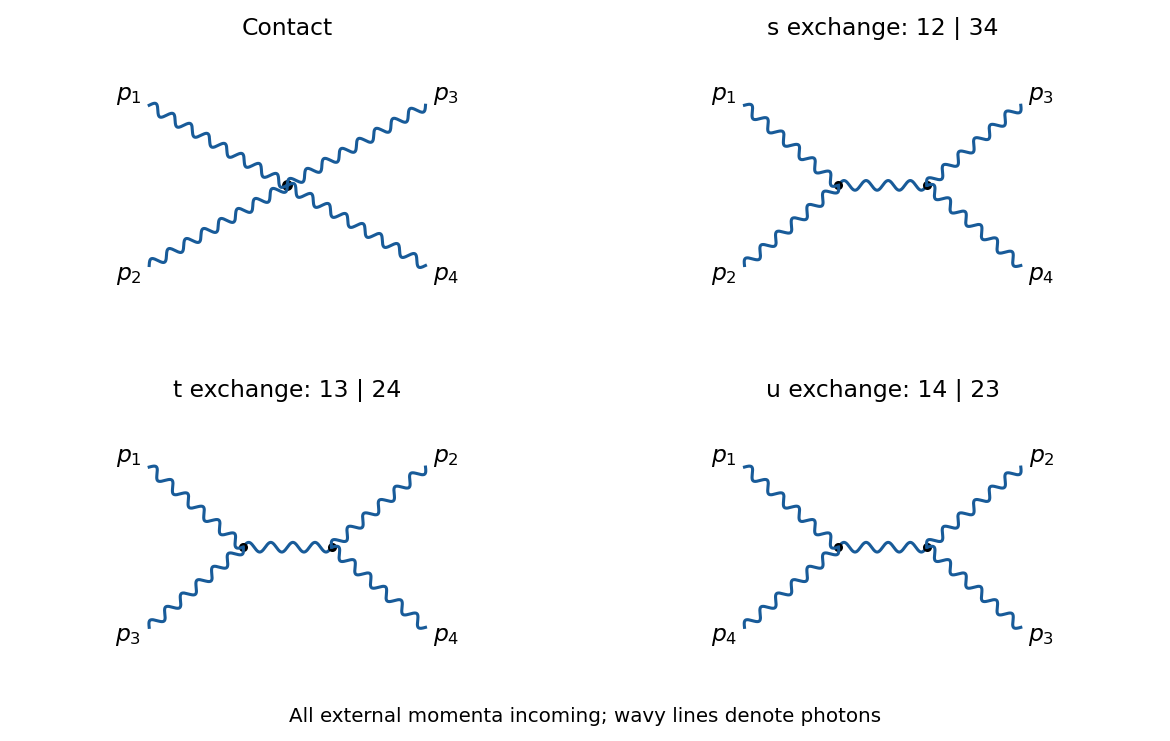
The contact graph and three exchange graphs for physical photon scattering in the nonlinear gauge; all external momenta are incoming
. Details. 
Write and take physical photon polarization vectors with and . At the cubic Feynman vertex attached to legs , the two terms containing or vanish. If flows into the internal line, the remaining factor at that end isAt the other end the internal incoming four-momentum is rather than , giving . Multiplication by the photon propagator givesThe cancellation holds first at generic nonzero channel Mandelstam invariants and then by continuation at degenerate kinematics. Summing the three exchange graphs produces , whereThe quartic Feynman vertex contributes . ThereforeThis is a cancellation for physical on shell photon polarization vectors. The off shell four-photon correlation function need not vanish. Physical light-by-light scattering first occurs through charged-particle loop Feynman diagrams.
Put . The potential has its minimum atChoose the vacuum expectation value . Since the weak hypercharge is zero, on this real scalar triplet, and . Neither nor annihilates . The stabilizer subgroup is consequentlyIn particular, spontaneous symmetry breaking has not reduced the two neutral gauge generators to a single one: annihilates every component and remains unbroken independently of .
The scalar mass matrix isWith canonical kinetic normalization , the radial Higgs boson therefore hasThe two tangential zero eigenvalues are Goldstone modes, absorbed by the two massive gauge bosons through the Higgs mechanism.
Let and be the two gauge couplings. In unitary gauge, and the weak hypercharge term in the gauge covariant derivative vanishes. Using , the kinetic term becomesThus, in the basis , the gauge-boson mass matrix and its eigenvalues areHere . The two massless neutral gauge bosons may be rotated to any orthonormal basis; no neutral mass term selects a unique mixing angle.
Expanding the same kinetic term to first order in givesFunctional differentiation gives the Feynman rulesand, in the real basis, for . All such three-point Feynman vertices involving or vanish. The factor two in the real basis comes from the two identical gauge boson fields; in the charged basis it is already explicit in .
This cannot be the sole symmetry-breaking sector of the Standard Model. Its gauge-boson mass matrix has two zero eigenvalues, so besides the electromagnetic photon it predicts an extra massless neutral gauge boson. Every linear combination of and , including the combination normally called , is massless. The observed massive Z boson is a concrete contradiction. Choosing differently cannot change these two zero eigenvalues.
A real scalar triplet can occur as an additional sector, but a further vacuum expectation value, for example that of a Higgs doublet, is then necessary to obtain the observed neutral gauge boson mass pattern. This does not rescue the triplet-only model posed here.
Normalize the generating functional by its value with all sources zero, and take the connected part of the time-ordered correlation function. Source differentiation of the interaction exponential is equivalent to the Dyson series followed by Wick's theorem. Write and temporarily, so that every contraction has an unambiguous meaning.
The second-order Dyson series contributesThere are two connected external scalar field attachments:They become equal after exchanging the integration variables , cancelling . The connected fermion contractions have the closed fermion loop sign:The minus sign can also be checked directly: the pairing of the first with the fourth field and the second with the third has positive pairing parity, but . Multiplying it by leaves a positive result:A contraction of the two external fields with each other times a vacuum bubble cancels against the normalization. Separate fermion tadpole integrals at and belong to a product of one-point functions, removed by taking the connected part.
To match the source's generating functional convention, distinguish its displayed kernels from contractions. The positive exponent gives . With the source insertion order in equation (5), the positive exponent similarly gives . The two scalar propagators and two Dirac propagators supply a total phase . Thus, writing as in the requested formula,The matrix trace closes the spinor indices; no extra factor of two or additional symmetry factor remains for a Dirac field with this Yukawa interaction.
For commuting real scalar fields, remove the closed fermion loop sign and replace the Dirac propagators by scalar propagators. There are no spinor indices, hence no matrix trace. With two independent real scalar fields and interaction , the same normalization givesThe overall sign has reversed relative to part (i) because is now unaccompanied by a closed fermion loop sign. The same formula holds in the source's kernel convention, since there are again four propagators.
There is an additional convention to specify if the two symbols are intended to denote the same real scalar field. For the literal interaction , there are two identical connected Wick contractions between and , so the coefficient becomes . If the conventional interaction is instead , each vertex is and the loop has symmetry factor , giving coefficient . In both interpretations the closed fermion loop sign and spinor matrix trace disappear; the differing numerical factor comes from the interaction normalization and field identity.
Articles by others on the same topic
There are currently no matching articles.