The bundle filename says 2018, but the paper's cover establishes Trinity Term 2019, 24 April 2019, and formal code A15272W1. These are solutions to that 2019 paper. Use natural units, the Minkowski metric , and the Feynman i-epsilon prescription. Write . In question 1, , , and the amputated gluon self-energy insertion is . This fixes the overall sign and factor of in the results below; defining the insertion as instead reverses all corresponding definitions of . The quadratic Casimir operator in the Adjoint representation is for , hence in QCD.
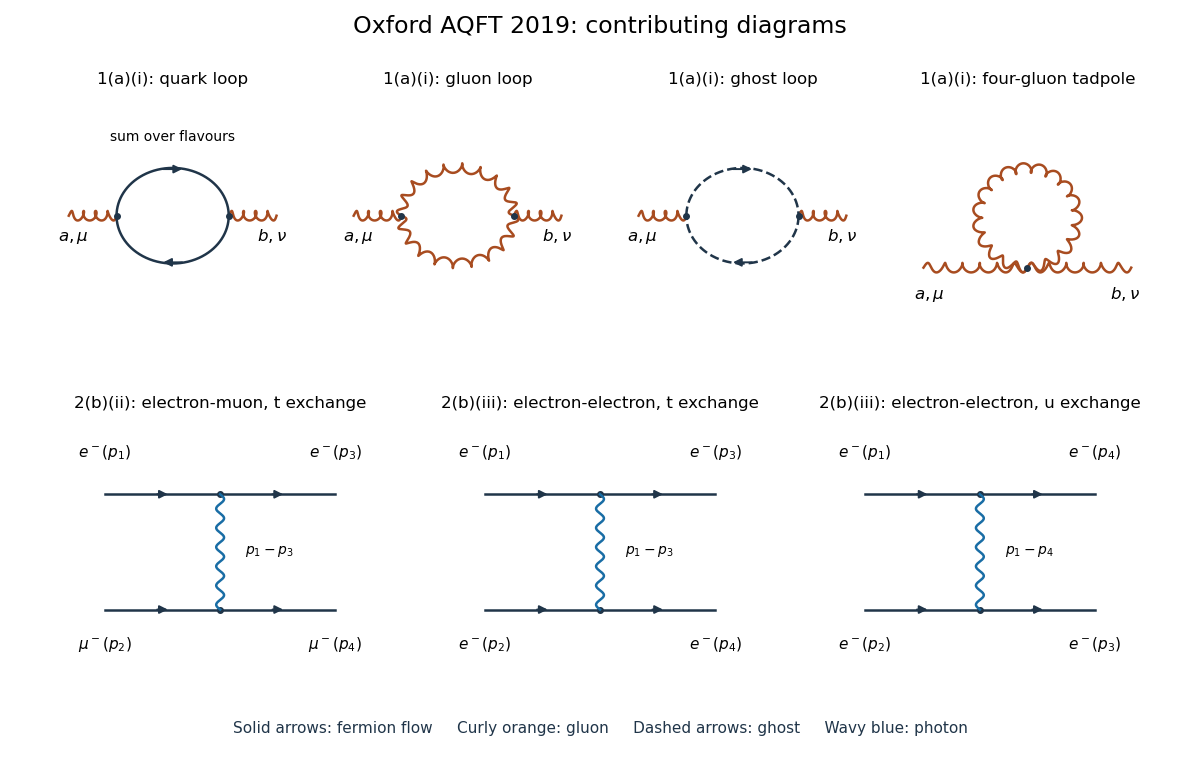

There are four topologies for the one-loop gluon self-energy, shown in the upper row of the figure:
- A closed quark loop with the two external gluons attached through quark-gluon Feynman vertices, summed over active quark flavors.
- A loop of two internal gluons joining two three-gluon Feynman vertices, each carrying one external gluon.
- A closed Faddeev-Popov ghost field loop with two ghost-gluon Feynman vertices.
- A single four-gluon Feynman vertex with two external gluons and its remaining two legs contracted into a tadpole diagram.
The two internal-gluon graphs have symmetry factor . The directed quark and ghost loops have symmetry factor one and a minus sign for a closed anticommuting loop. The four-gluon tadpole diagram must be included in the list even though its massless Feynman integral vanishes in dimensional regularization. Local counterterms are excluded here.
Route a directed ghost loop so that its internal four-momenta are and . At the external gluon with indices , let the incoming ghost carry colour and the outgoing ghost carry colour ; the other Feynman vertex has the reverse order. The stated ghost-gluon Feynman rules supply . Their colour factor isThe two ghost propagators supply , while the closed ghost loop supplies another . Thus, with the insertion convention stated above,This establishes every prefactor before integration. To isolate its ultraviolet pole, take generic off shell , initially , so the massless integral has no overlapping infrared divergence. Introduce a Feynman parameter, shift , and set . Odd powers of vanish, givingThe needed dimensional regularization integrals follow from the supplied gamma function formula. In ,Here , rather than . Using and , obtainTherefore the ghost-loop pole of the gluon self-energy isThe factor in affects only finite terms at this order. The isolated ghost loop is not transverse: contracting this result gives . Transversality is a condition on the complete gluon self-energy, including the other loop graphs.
There is one four-gluon tadpole diagram. Temporarily replace its internal gluon propagator by . Contract the supplied four-gluon Feynman vertex with . Its first colour factor vanishes because . Each of the other two terms contributes , soInclude the symmetry factor and the factor from the internal gluon propagator:The exact regulated tadpole integral isIn particular,The entire expression is proportional to and vanishes as the auxiliary mass tends to zero near four dimensions. Equivalently, its expanded terms are proportional to , and , all of which disappear when the regulator is removed. HenceThis is the massless scaleless integral result obtained directly in dimensional regularization. The artificial mass is only an intermediate device for this graph; retaining it in the full theory would modify the gauge symmetry and cannot be used when applying the massless transversality identity in part (iv).
The Slavnov-Taylor identity implies transversality of the full perturbative gluon self-energy:The quark loop is separately transverse. This follows without evaluating its Feynman integral: contract its vector Feynman vertex with and use between its two Dirac propagators. One obtains a difference of two loop integrals that cancel after a shift of in dimensional regularization. The colour factor is proportional to and does not obstruct this argument.
The four-gluon tadpole diagram vanishes after removal of . Thus the nontransverse parts of the two-three-gluon-vertex loop and the ghost loop must cancel. Contracting the preceding ghost-loop pole of the gluon self-energy givesFor QCD, set . No evaluation of the remaining three-gluon Feynman diagram is required. Its uncontracted transverse part is not fixed by this identity.
For the one-loop renormalization-group beta function, write . Separating variables givesThis expression resums the leading logarithms of the one-loop running coupling, while omitting higher-order terms in the renormalization-group beta function. Assume a positive initial coupling.
For , increasing the renormalization scale decreases the running coupling; the zero-coupling renormalization-group fixed point is attractive in the ultraviolet. This is asymptotic freedom. Toward lower scales the one-loop expression has a formal pole at . The strong-coupling neighborhood of that pole lies outside perturbative control. QCD provides the main example; the minimal Standard Model coupling is also asymptotically free at one loop.
For , the running coupling grows with the renormalization scale and formally diverges at the ultraviolet Landau pole . Toward the infrared it decreases to zero within this approximation. The Standard Model weak hypercharge coupling has this sign, as does QED in a fixed charged-particle regime. A perturbative Landau pole marks failure of the approximation, rather than proving that the exact theory has that divergence.
For , the running coupling is constant at this order; higher-loop terms decide whether it runs. Vanishing of the leading coefficient alone does not establish exact scale invariance.
For a concrete common convention, define with in its usual, non-unified weak hypercharge normalization. In the minimal Standard Model with three generations and one Higgs doublet, above its particle thresholds,Thus the question's is , with the sign regimes just described. Crossing a mass threshold changes the active field content and requires the appropriate piecewise renormalization-group beta function.
For a real local parameter , the Dirac adjoint varies as . The matter kinetic term varies byThe QED interaction varies by , since the phases in cancel. These two variations cancel pointwise. The mass term is invariant for the same reason, and .
Only the gauge fixing term varies. Put ; then , givingFor arbitrary local , the gauge-fixed action is therefore not invariant under this transformation of its dynamical fields. The restricted parameters satisfying give a residual invariance of the displayed density.
Let here be a constant infinitesimal transformation parameter, unrelated to the dimensional regularization parameter in question 1. The matter and Maxwell terms undergo an ordinary infinitesimal gauge transformation with , and their variations cancel as before. The gauge fixing contribution isThe extra real scalar field kinetic term varies byAdding the two gives a total derivative:The last equality uses vanishing boundary contributions, for example sufficiently fast decay of the fields. No field equations were used. This gauge-scalar global symmetry of covariantly fixed QED leaves the action invariant even though the density need not be invariant pointwise; the scalar's variation supplies exactly the missing boundary-term cancellation.
First derive the contracted gamma matrices identities from the Clifford algebra in four dimensions. Moving the outer gamma matrix through two factors givesMoving it through three factors, and using this two-factor result, givesConsequently and . Apply these in succession:The final step uses . This is a genuinely four-dimensional instance of the gamma matrix trace identities; using it unchanged inside a -dimensional loop calculation would require separate justification.
Label the four-momenta as . There is one tree-level Feynman diagram, the -channel photon exchange shown in the lower-left panel. The two lepton species are distinct, so there is no exchanged-final-lepton diagram. With , and , the Feynman rules giveThe massless fermion spin sum is . Averaging the two initial spins of each lepton supplies , soThe gamma matrix trace identities imply, for arbitrary null external four-momenta,To see the contraction, each trace is ; the terms proportional to cancel in four dimensions, leaving the displayed two products. Here and . ThereforeThe requested proportionality constant is , where is the fine-structure constant. Both numerator terms are required by the spin sum; no final-state statistical factor enters a squared scattering amplitude for distinct leptons.
For Møller scattering, both the -channel and -channel photon exchange tree-level Feynman diagrams contribute, as shown in the two remaining lower panels. Exchanging the identical final electrons reverses the sign of the scattering amplitude, so the fermionic sign fixesThe two direct squares follow from the preceding distinct-lepton calculation:The interference cannot be discarded because the final particles are identical. Summing their spins joins all four external Dirac spinors into a single trace:The result from part (i) was used with relabelled contracted indices. Its negative sign combines with the explicit subtraction of the two exchange scattering amplitudes, so the interference contribution to the averaged square is positive:ThusThis is symmetric under , as required by the identical final electrons. There is no additional in the squared scattering amplitude. Such a factor is used when integrating the cross section over a final-state region that counts both orderings of the identical pair; alternatively one integrates over one representative half of that region.
After integration by parts, the quadratic Proca action with an external source isSince , this kernel is invertible with the Feynman i-epsilon prescription; the massless gauge redundancy is absent in this unitary gauge quadratic action. Complete the square by in the Gaussian functional integral. Its source-independent determinant cancels in the normalized generating functional:In Fourier space, the kernel isFor , use the transverse projector of a vector field and the longitudinal projector of a vector field . Their mixed-index products obey , soThe last expression also extends to ; that point only obstructs the intermediate projector decomposition. Two source functional derivatives yield the gauge-boson propagator :The pole residue is the physical massive-vector massive vector polarization sum. The longitudinal term is essential for inverting the quadratic kernel, and makes the naive limit of this unitary gauge Proca propagator singular.
Expand the matrix trace explicitly:Write and collect the real fields into a vector . ThenBoth quadratic forms are preserved by every constant orthogonal matrix , acting as . Thus the full linear internal symmetry contains , with connected special orthogonal group as requested. The enlargement beyond unitary transformations is possible because the real and imaginary components have identical kinetic and mass terms and no interactions distinguishing them.
For a Hermitian matrix , there are real diagonal entries and independent complex off-diagonal entries, hence real fields. Choose an orthonormal basis of Hermitian matrices for the trace inner product, , and put . The same calculation giveswhere these are the connected rotation groups; their full orthogonal extensions are and . A purely quadratic theory with would have an unstable scalar potential, but this algebraic symmetry statement still holds.
Let . Under the global transformation of the chiral matrix scalar model,The phase and cancel, and . The cyclic property of the trace impliesTherefore each of the three terms in the scalar potential is invariant separately. Since are constant, , giving invariance of the kinetic matrix trace by the same argument. Henceis a global symmetry group of the Lagrangian density. Its action has a finite central kernel, which does not affect its Lie algebra or the broken-generator counting below. For special parameter choices the symmetry can be larger; the displayed group is a symmetry for the stated potential without such extra assumptions.
It is useful first to establish the global minimum, rather than only a stationary point. The positive semidefinite matrix has nonnegative eigenvalues . For fixed , the Cauchy-Schwarz inequality gives , with equality exactly when all are equal. Since ,For and , this lower bound has its minimum atThe bound is attained, so every minimum has , or with a unitary matrix. A global transformation removes by decomposing it into an overall phase and an matrix. Thus is a valid representative of the vacuum manifold.
Preservation of this chosen vacuum expectation value requiresInfinitesimally, with traceless Hermitian generators , this reads . Taking the trace forces , and then . The surviving continuous transformations are consequentlyAll other independent continuous directions change the chosen vacuum expectation value. Thus the number of broken generators isGlobally, taking the determinant of the stabilizer equation permits the discrete phases , paired with . They induce the same conjugation action on . The faithful unbroken conjugation group is ; for example, at , acts exactly like . Thus the question's description by is correct as a parametrization and at the Lie algebra level, with this central redundancy understood. It leaves the number of broken generators unchanged.
Write and , both Hermitian matrices. Through quadratic order around the chosen vacuum expectation value,The trace of a commutator vanishes. The needed matrix traces are thereforeUsing , all linear terms cancel. The quadratic scalar potential reduces towith no term. The kinetic term issince its mixed term is the trace of a commutator. A Hermitian matrix has independent real components, so describes exactly massless scalar modes.
To determine the other masses, take and traceless Hermitian with , and expand . These are canonically normalized real scalar fields. The scalar mass matrix is diagonal in this basis:Thus contains one massive singlet and a degenerate multiplet of massive fields in the Adjoint representation of the unbroken diagonal . Both squared masses are strictly positive for the specified parameters. The fields are the Goldstone bosons associated with the broken generators: traceless relative left-right rotations and one overall phase rotation.
Goldstone's theorem guarantees those massless directions. It does not alone forbid additional accidental massless modes; the positive scalar mass matrix computed here supplies the further conclusion that every component is massive. The fields describe a global symmetry, so these Goldstone bosons are physical rather than being absorbed into massive gauge bosons.
Articles by others on the same topic
There are currently no matching articles.