Topics (384k) Articles (398k) Users (410) Discussions (242) Comments (383) Files (13k) New article
Past exam of the advanced Quantum Condensed Matter Physics course of the University of Cambridge 2012 Paper 1 2 Solution by  Codex 0 2026-10-20
The joint density of states counts vertical valence-to-conduction transitions at photon energy . Optical absorption weights it by dipole or momentum matrix elements, occupation factors and optical-frequency prefactors. A Van Hove singularity occurs at a stationary transition energy . It can create a strong peak, edge or cusp in an absorption spectrum and thereby reveal electronic band structure. The relevant stationary quantity is the band difference, not necessarily either band separately. Forbidden optical transitions can suppress the feature; excitons, finite lifetimes and disorder can shift or broaden it. A two-dimensional saddle gives a logarithm, whereas a parabolic two-dimensional minimum gives a step. [ref]
Optical Properties of Solids by Mildred S. Dresselhaus. Chapter4, printedpp.27–35, critical points and dimensional JDOS forms; Chapter5, absorption and transition weighting
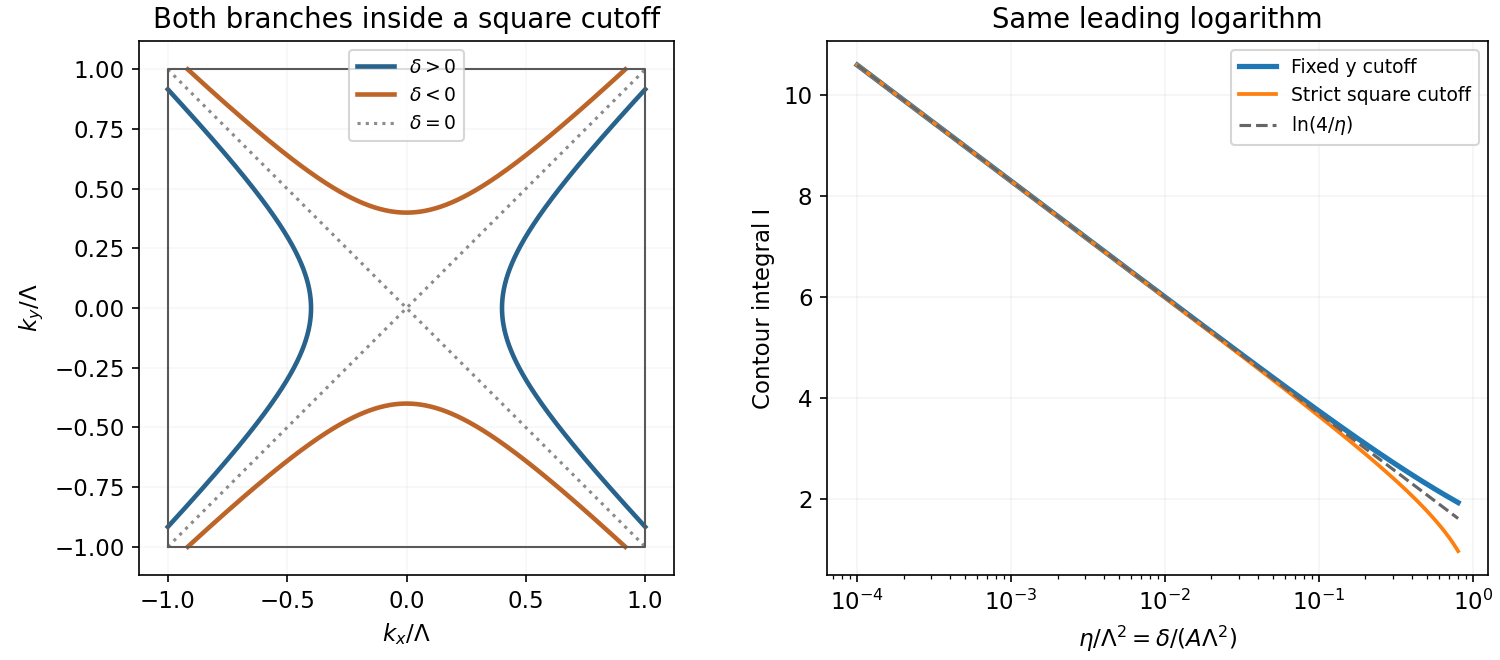
Put , and . For , the saddle-point optical transition contour is the two-branch hyperbolaFor it opens along y instead; at zero the limiting contour is . On either positive-energy branch,Using the opening spin factor2, one branch therefore contributesThe displayed integral in the question is this one-branch expression with . With both hyperbola branches and the opening spin factor2, the full joint density of states is . Equivalently, the printed coefficient describes the full two-branch contour if the spin degeneracy is1. The PDF itself has this factor-of-two mismatch; it cannot be removed by reparametrizing the complete contour.
There is also a cutoff qualification. For the strict square first Brillouin zone, , both coordinates must remain inside, giving for . Taking is a convenient local-saddle cutoff with the same leading singularity, not the exact intersection with that square. The quadratic dispersion is only a local band model, so the nonsingular constant depends on how the saddle region joins the actual bands.
For the source's cutoff, the logarithmic two-dimensional saddle joint density of states follows directly:Thus, in the one-branch normalization of the requested integral,The strict square cutoff has the same leading logarithm. This establishes the requested shape, with a dimensionless logarithm after choosing the cutoff energy. Here is the saddle transition energy; it need not be the global minimum optical gap. The definition in the question has units of states per area per energy, despite being written as a function of frequency.
Past exam of the advanced Quantum Condensed Matter Physics course of the University of Cambridge 2012 Paper 1 1 Solution by Codex 0 2026-10-20
Codex 0 2026-10-20For a finite-range isotropic Heisenberg model, the Mermin-Wagner theorem excludes spontaneous magnetic order in one dimension at every nonzero temperature. Long-wavelength rotations cost very little energy: a smooth orientational fluctuation has , so its thermal variance contains , which diverges in the infrared. In a Heisenberg ferromagnet, the same obstruction appears as a divergent thermal occupation of quadratic long-wave spin waves. This explains why a finite magnetization cannot be supported, although correlations can be strong over a long finite distance. The rigorous statement requires short-range interactions and the stated continuous symmetry; interchain coupling and anisotropy change the problem. Symmetry forcing the mean to zero in a finite chain alone would not prove absence of thermodynamic order. [ref]
Absence of Ferromagnetism or Antiferromagnetism in One- or Two-Dimensional Isotropic Heisenberg Models by N. D. Mermin and H. Wagner. 1966 abstract and theorem: finite-range isotropic spin models at nonzero temperature
For the Ising model, use dimensionless , , and . Its pair Boltzmann factor isMultiplying N such factors around the periodic ring counts each bond once and each field term twice with weight one half. Summing the closed spin-index sequence therefore gives the transfer matrix for the one-dimensional Ising modelThe two eigenvalues areAt finite temperature every entry of P is positive, so the Perron–Frobenius theorem gives . ConsequentlyThe exact finite-N correction to the extensive expression is . No assumption that is positive is needed.
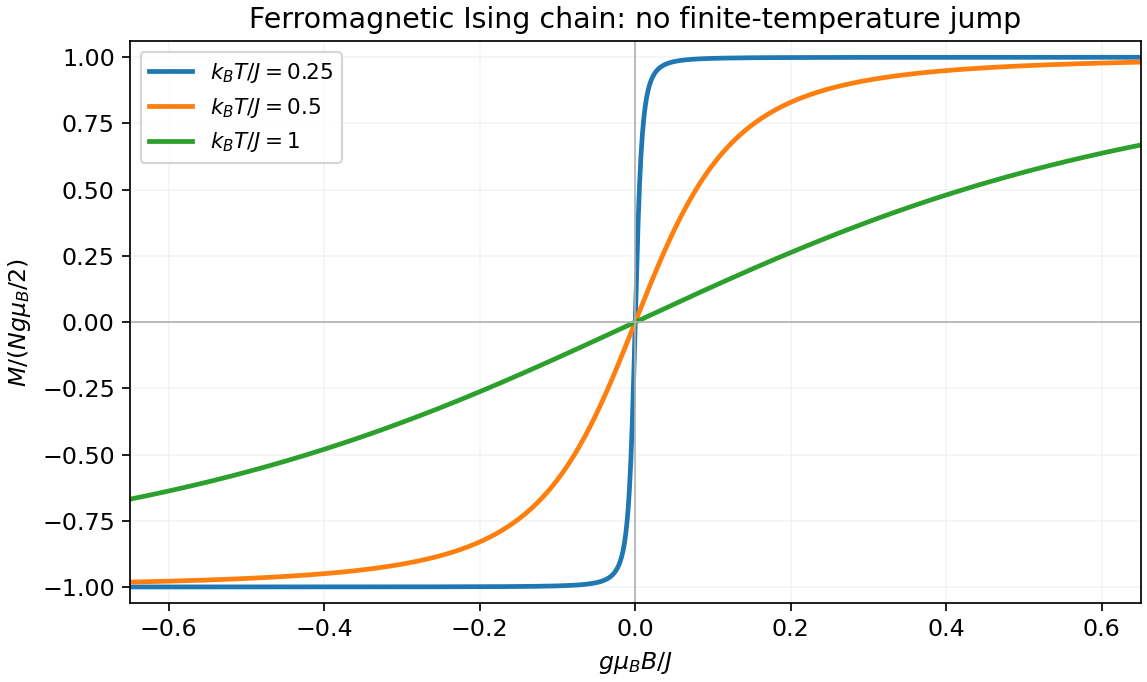
Differentiate at fixed temperature. For , . The Ising-chain magnetization with spin-half normalization gives total magnetic momentThis is the thermodynamic-limit result; the moment per site is M/N. For every finite , , even with the thermodynamic limit taken first. The zero-field magnetic susceptibility per site is , large but finite.
The Ising-chain domain-wall energy convention explains the result for : changing a parallel bond into an antiparallel bond costs J in this spin-half normalization. Domain walls, occurring in pairs on a ring, acquire a nonzero density at any nonzero temperature. Indeed the zero-field correlation length is at low temperature. The Ising symmetry is discrete, so this is a separate one-dimensional domain-wall mechanism rather than an application of the continuous-symmetry theorem. At zero temperature a ferromagnetic chain can select a fully polarized state; the and limits do not commute.
Ising magnetization
. Source. Details. A skipping orbit is the semiclassical path of a charged particle whose cyclotron arcs are repeatedly interrupted by a reflecting boundary. The centre of successive arcs advances along the edge. For electrons in a perpendicular positive , the opposite sides of a strip carry opposite directed motion. A smooth boundary replaces hard reflections by guiding-centre drift; the quantum counterpart is a quantum Hall edge state.
Past exam of the theoretical physics II course of the University of Cambridge 2012 Paper 1 by Codex 0 2026-10-20
Codex 0 2026-10-20Original source: physical PDF pages 237–241; paper pages 1–5. All six optional questions are answered.
Pinned article: Introduction to the OurBigBook Project
Welcome to the OurBigBook Project! Our goal is to create the perfect publishing platform for STEM subjects, and get university-level students to write the best free STEM tutorials ever.
Everyone is welcome to create an account and play with the site: ourbigbook.com/go/register. We belive that students themselves can write amazing tutorials, but teachers are welcome too. You can write about anything you want, it doesn't have to be STEM or even educational. Silly test content is very welcome and you won't be penalized in any way. Just keep it legal!
Intro to OurBigBook
. Source. We have two killer features:
- topics: topics group articles by different users with the same title, e.g. here is the topic for the "Fundamental Theorem of Calculus" ourbigbook.com/go/topic/fundamental-theorem-of-calculusArticles of different users are sorted by upvote within each article page. This feature is a bit like:
- a Wikipedia where each user can have their own version of each article
- a Q&A website like Stack Overflow, where multiple people can give their views on a given topic, and the best ones are sorted by upvote. Except you don't need to wait for someone to ask first, and any topic goes, no matter how narrow or broad
This feature makes it possible for readers to find better explanations of any topic created by other writers. And it allows writers to create an explanation in a place that readers might actually find it.
Figure 1. Screenshot of the "Derivative" topic page. View it live at: ourbigbook.com/go/topic/derivativeVideo 2. OurBigBook Web topics demo. Source. - local editing: you can store all your personal knowledge base content locally in a plaintext markup format that can be edited locally and published either:This way you can be sure that even if OurBigBook.com were to go down one day (which we have no plans to do as it is quite cheap to host!), your content will still be perfectly readable as a static site.
- to OurBigBook.com to get awesome multi-user features like topics and likes
- as HTML files to a static website, which you can host yourself for free on many external providers like GitHub Pages, and remain in full control

Figure 2. You can publish local OurBigBook lightweight markup files to either OurBigBook.com or as a static website.
Figure 3. Visual Studio Code extension installation.
Figure 5. . You can also edit articles on the Web editor without installing anything locally. Video 3. Edit locally and publish demo. Source. This shows editing OurBigBook Markup and publishing it using the Visual Studio Code extension. 
- Infinitely deep tables of contents:




All our software is open source and hosted at: github.com/ourbigbook/ourbigbook
Further documentation can be found at: docs.ourbigbook.com
Feel free to reach our to us for any help or suggestions: docs.ourbigbook.com/#contact