Topics (384k) Articles (398k) Users (410) Discussions (242) Comments (383) Files (13k) New article
Past exam of the chemistry A course of the University of Cambridge 2023 Paper 2 A10 a i Solution by  Codex 0 2026-10-20
The density of states counts available one-electron states: is the number with energies in . It describes the spectrum, irrespective of whether those states contain electrons.
The density of occupied states additionally weights each state by the Fermi-Dirac distribution:Thus is the mean number of electrons in that energy interval, and . State and electron densities must use the same normalization, including whether they are extensive or per volume and whether already includes spin degeneracy. The symbol here denotes occupied density, not a canonical partition function.
Past exam of the chemistry A course of the University of Cambridge 2023 Paper 1 A5 b iv Solution by Codex 0 2026-10-20
Codex 0 2026-10-20The six electrons give the Hückel method energyThe appropriate localized reference contains two C=N bonds and one C=C bond. Three C=C bonds would incorrectly replace the nitrogen one-centre parameters. For one isolated C=N pair, the dimensionless matrix iswhose eigenvalues are . Since , the occupied bonding molecular orbital has energy . Two doubly occupied C=N bonds and one doubly occupied C=C bond consequently giveTherefore the signed delocalization energy isThe positive stabilization is , smaller than the benzene value in the stated model but still stabilizing.
Pyrazine is aromatic: its planar cyclic conjugated system contains six electrons and has a filled set of three bonding molecular orbitals. Each ring nitrogen contributes one electron; its in-plane lone pair is outside this system. The heteroatoms change orbital energies and coefficients without interrupting cyclic conjugation or the count. Aromaticity does not require the stabilization to equal benzene's.
Past exam of the chemistry A course of the University of Cambridge 2023 Paper 1 A5 b iii Solution by Codex 0 2026-10-20
Codex 0 2026-10-20Work with . Its nearest-neighbour ring entries are , and its diagonal entries are on the nitrogen sites and on the carbon sites. Because commutes with each molecular symmetry operation, it only mixes symmetry-adapted linear combinations with the same irreducible representation.
In the bases and , the two nontrivial matrix blocks areTheir characteristic polynomials are and . The remaining single-function blocks are and . Thus, ordered from lowest to highest physical energy because , the molecular orbitals areAll six levels are nondegenerate in this parametrization. The right-hand ladder of the diagram in part (ii) shows these levels and occupations. The occupied level is the highest occupied molecular orbital, and the unoccupied level immediately above it is the lowest unoccupied molecular orbital.
Past exam of the chemistry A course of the University of Cambridge 2023 Paper 1 A5 b ii Solution by Codex 0 2026-10-20
Codex 0 2026-10-20The nitrogen pair and the four-carbon set are separately invariant under the D2h point group. Construct symmetry-adapted linear combinations within these two sets; mixing equivalent representations across the sets is left for the Hückel method calculation.
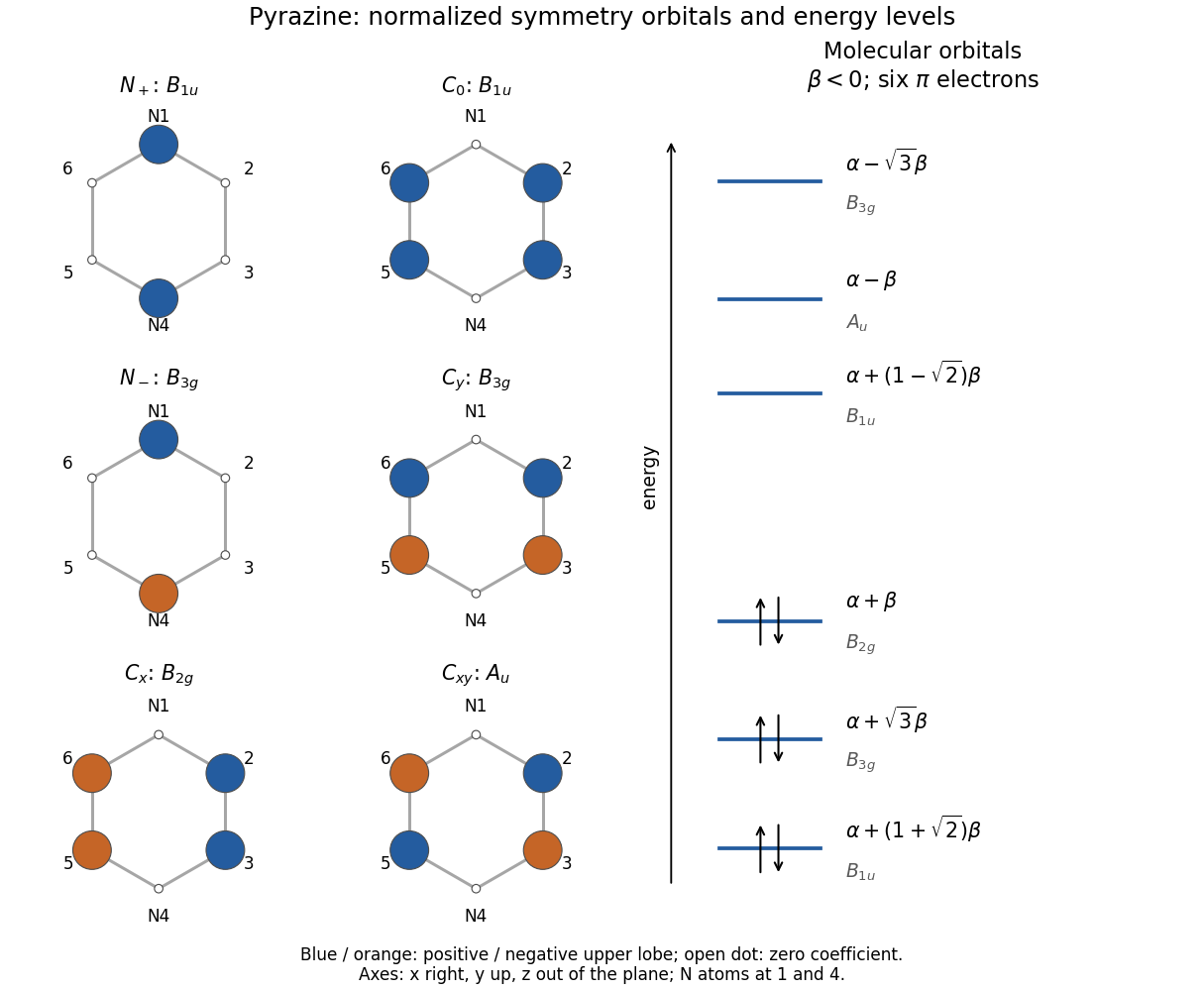
For the nitrogen atomic orbitals, normalized combinations areFor the carbon atomic orbitals, takeThese six functions are orthonormal under the zero-overlap assumption. The suffixes describe coefficient patterns across the carbon sites; the sign acquired by each underlying function must also be included when assigning an irreducible representation. In particular, reflection through the molecular plane changes the sign of every function, while inversion sends to . Ignoring that orbital sign would give incorrect labels.
The complete group representation is thereforeThe diagram shows all six ring symmetry-adapted linear combinations and the resulting energy ordering used in part (iii).
Past exam of the chemistry A course of the University of Cambridge 2023 Paper 1 A5 b i Solution by Codex 0 2026-10-20
Codex 0 2026-10-20Pyrazine belongs to , the D2h point group. With the printed axes, its three twofold axes are ; it also has an inversion centre and the three coordinate mirror planes. The nitrogen atoms occupy sites 1 and 4 on the axis. Interchanging carbon and nitrogen is not a molecular symmetry operation, so the sixfold benzene symmetry is lost.
Past exam of the chemistry A course of the University of Cambridge 2023 Paper 1 A5 a ii Solution by Codex 0 2026-10-20
Codex 0 2026-10-20Filling the three bonding molecular orbitals with two electrons each givesThree isolated ethene-like bonds, evaluated with the same Hückel method parameters, have . Thus the signed delocalization energy isEquivalently, the positive stabilization is .
Benzene has a planar cyclic conjugated system with six electrons, satisfying the count with . All three bonding molecular orbitals are filled and the antibonding levels are empty, giving the closed-shell stabilization associated with aromaticity. The conclusion uses the continuous cyclic overlap as well as the electron count.
Past exam of the chemistry A course of the University of Cambridge 2023 Paper 1 A5 a i Solution by Codex 0 2026-10-20
Codex 0 2026-10-20Use the printed numbering: site 1 is at the top on , sites 2 and 3 are on the right, site 4 is at the bottom, and sites 5 and 6 are on the left; is perpendicular to the ring. Let be consistently phased, orthonormal atomic orbitals at those sites.
In the Hückel method, and , including the 6–1 bond. Set , with the usual . The cyclic nearest-neighbour matrix has eigenvalues . One real, normalized orthonormal eigenbasis isEach row means . The three lowest molecular orbitals hold the six electrons. Any real orthogonal mixing within either degenerate pair is an equally valid choice of molecular orbitals; the coefficient vectors specify exactly which sketches are used here.
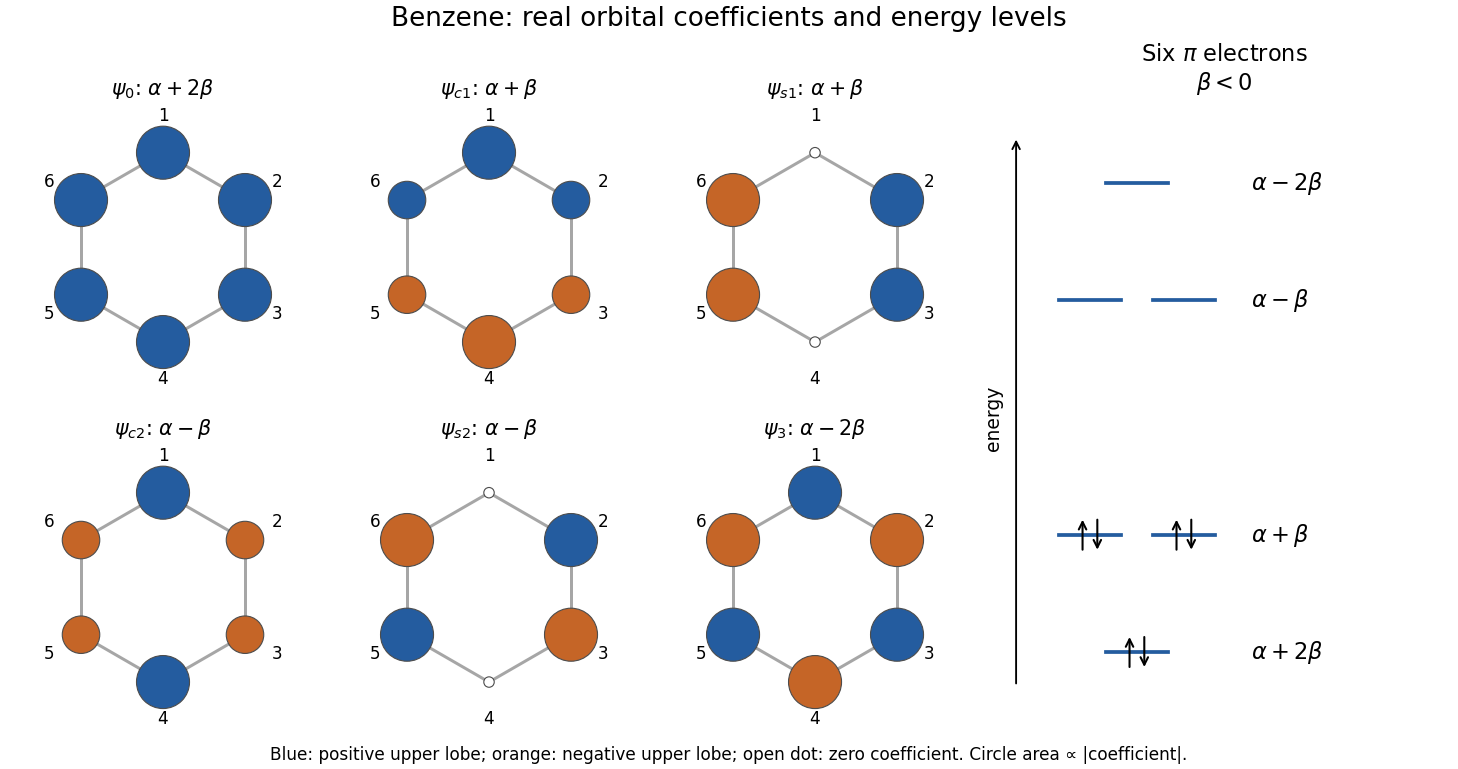
Original benzene pi-orbital energy diagram and six real orbital phase sketches in the printed atom numbering
. Details. The coloured circles show the signs and relative magnitudes of the lobes above the molecular plane. The lobes below it have the opposite signs; colours are quantum phases, not electric charges.
Past exam of the chemistry A course of the University of Cambridge 2023 Paper 1 A4 b iii Solution by Codex 0 2026-10-20
Codex 0 2026-10-20The nine-atom nonlinear ion has vibrational degrees of freedom. To construct its displacement group representation, only atoms left in place by an operation contribute to the character. Each such atom contributes the trace of the operation on :For example, reflection in the square's molecular plane fixes all nine atoms and has trace , giving character ; inversion fixes nickel alone and has trace , giving . Molecular character reduction usesFor the D4h molecular point group, with primed twofold axes along the Ni–C directions, the class order and displacement characters areReducing and removing translations and rotations givesThe vibrational infrared activity belongs to , giving six features. The Raman vibrational activity belongs to , giving seven features. The remaining modes are silent. There are zero shared fundamentals, by infrared and Raman mutual exclusion. Counting dimensions gives IR-active, Raman-active and silent vibrational coordinates, totaling .
For the Td molecular point group, the corresponding calculation starts fromand gives . Subtracting translations and rotations leavesThe fundamentals give four IR features. The fundamentals give eight Raman features, of which four coincide with the IR features. The fundamental is silent. The dimensions are .
Thus the predicted IR/Raman/coincidence counts are for the square and for the tetrahedron. These are numbers of distinct ideal fundamental frequencies: each or multiplet contributes one feature, and different copies of the same irreducible representation generally have different frequencies. Accidental degeneracy, overtones and combination bands are outside this count.
Past exam of the chemistry A course of the University of Cambridge 2023 Paper 1 A4 b ii Solution by Codex 0 2026-10-20
Codex 0 2026-10-20There are four internal C–N stretching coordinates. A stretch length is unchanged in sign when a molecular symmetry operation carries a bond to an equivalent bond, so these coordinates have the same permutation group representation as the four ligand sigma functions.
For the square,Only has vibrational infrared activity. The and stretches have Raman vibrational activity. Thus the ideal square gives one IR feature and two Raman features, with no common fundamental. The two components of have one frequency, not two different lines.
For the tetrahedron,The stretch is IR active, while both and are Raman active. Thus the tetrahedron also gives one IR feature and two Raman features, but one feature, , is shared between the spectra. Its three components likewise describe three independent displacements at one frequency.
The separate line counts alone do not distinguish the geometries. Comparing their frequencies does: the tetrahedral IR C–N feature coincides with one Raman C–N feature, whereas the square has no symmetry-enforced coincidence. This assumes resolved fundamentals and excludes accidental equality of unrelated frequencies.
Past exam of the chemistry A course of the University of Cambridge 2023 Paper 1 A4 b i Solution by Codex 0 2026-10-20
Codex 0 2026-10-20The D4h molecular point group contains an inversion centre, so infrared and Raman mutual exclusion applies. A normal mode of parity can have vibrational infrared activity, whereas the quadratic polarizability tensor components responsible for Raman vibrational activity have parity. No individual fundamental can be active in both spectra.
The Td molecular point group lacks an inversion centre. In particular, normal modes transform both as electric-dipole components and as off-diagonal polarizability tensor components, so they occur in both spectra. Coincident IR and Raman fundamentals therefore favour the tetrahedral structure; symmetry requires no such coincidences for the square. Weak or unresolved features can conceal coincidences experimentally, while accidental equality of different frequencies is not a violation of mutual exclusion.
Past exam of the chemistry A course of the University of Cambridge 2023 Paper 1 A4 a v Solution by Codex 0 2026-10-20
Codex 0 2026-10-20For unpaired electrons, the spin-only magnetic moment iswhere is the Bohr magneton and the second expression uses .
For the square, a large separation of the highest level favours pairing in the lower four molecular orbitals: , , . If the cost of occupying were smaller than the relevant electron pairing energy, a high-spin complex with two unpaired electrons and could instead occur, giving .
For ideal tetrahedral , the occupation is . Hund's rules distribute four electrons over the three degenerate molecular orbitals as one pair and two single occupations. Thus and . Merely increasing the – splitting does not create a conventional paired tetrahedral alternative: four electrons must still occupy .
Past exam of the chemistry A course of the University of Cambridge 2023 Paper 1 A4 a iv Solution by Codex 0 2026-10-20
Codex 0 2026-10-20Each cyanide contributes charge , so the formal nickel oxidation state is and the metal has . The requested diagram retains only the five principally metal- molecular orbitals; the mainly ligand bonding molecular orbitals lie below them and are omitted.
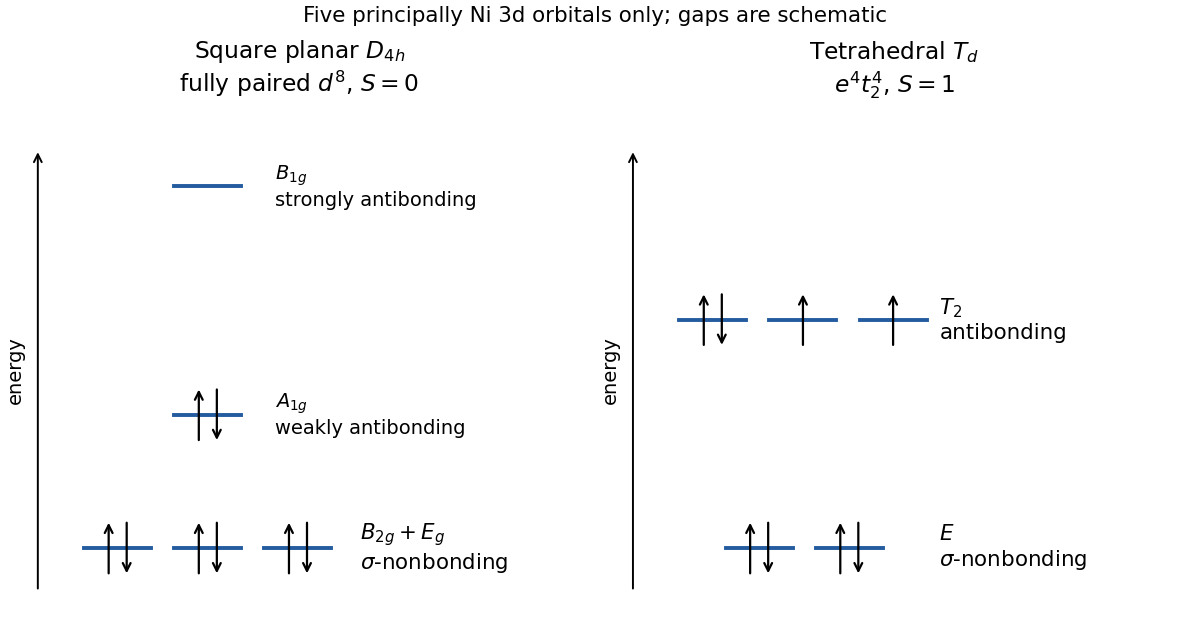
In the square, points directly towards all four ligand donors and gives the highest, strongly antibonding molecular orbital, . The function also has an allowed interaction, but its in-plane overlap is smaller. Including the allowed nickel mixing gives a principally level with relatively weak antibonding character. The and metal functions have no ligand partner in the sigma bond donor basis and are nonbonding in this minimal model. The useful qualitative ordering is thereforeThe three nonbonding functions are shown together because the sigma-only model does not determine their finer splitting. Additional electrostatic and pi backbonding interactions can change the ordering of the lower levels; molecular symmetry alone does not fix these energy gaps.[ref]
Bonding in Molecules by John E. McGrady. 2022 lecture notes, square-planar sigma-only molecular-orbital discussion, printed pp. 60–61
In the tetrahedron, the ligand combinations interact with the metal functions, producing higher -derived antibonding molecular orbitals. The metal pair has no sigma donor partner and remains nonbonding:The diagram fills both arrangements with eight metal electrons; the square is shown in its fully paired state.
Past exam of the chemistry A course of the University of Cambridge 2023 Paper 1 A4 a iii Solution by Codex 0 2026-10-20
Codex 0 2026-10-20Choose the phase of each inward-pointing ligand sigma bond donor lobe consistently. An operation taking one donor to another then acts as a permutation on the four donor functions. For the square, label these functions cyclically along . Normalized symmetry-adapted linear combinations areThus the ligand group representation is . Its irreducible representations allow the first two combinations to mix with the matching nickel atomic orbitals; instead matches nickel .
For the tetrahedron in the vertex order specified above, takeThe three latter functions transform like . Hence . These are four ligand symmetry-adapted linear combinations, rather than the five metal functions of part (ii).
Past exam of the chemistry A course of the University of Cambridge 2023 Paper 1 A4 a ii Solution by Codex 0 2026-10-20
Codex 0 2026-10-20The angular factors of the nickel atomic orbitals transform like quadratic Cartesian functions. In the D4h molecular point group, the assignments areAll five are even under inversion symmetry, hence the suffixes. The pair is mixed by a quarter-turn and spans a two-dimensional irreducible representation.
In the Td molecular point group, the corresponding result isThere is no inversion label because has no inversion centre. In both cases the dimensions add to five.
Past exam of the chemistry A course of the University of Cambridge 2023 Paper 1 A4 a i Solution by Codex 0 2026-10-20
Codex 0 2026-10-20For the ideal tetracyanonickelate(II) geometries, the square planar molecular geometry has , the D4h molecular point group, while the tetrahedral molecular geometry has , the Td molecular point group. Collinearity of each Ni–C–N unit means that including the terminal nitrogen atoms does not lower either point group.
For the square, take the Ni–C directions as and perpendicular to the plane. For the tetrahedron, use the conventional cubic axes with ligand directions proportional to . These choices fix the irreducible representation labels used below.
Past exam of the chemistry A course of the University of Cambridge 2023 Paper 1 A3 c ii Solution by Codex 0 2026-10-20
Codex 0 2026-10-20The combined boron trifluoride series givesUsing with the wavenumber in inverse metres,With integer fluorine mass and ,Using for the observed spacing would incorrectly treat BF as a linear diatomic rotor and overestimate the bond length by .
Past exam of the chemistry A course of the University of Cambridge 2023 Paper 1 A3 c i Solution by Codex 0 2026-10-20
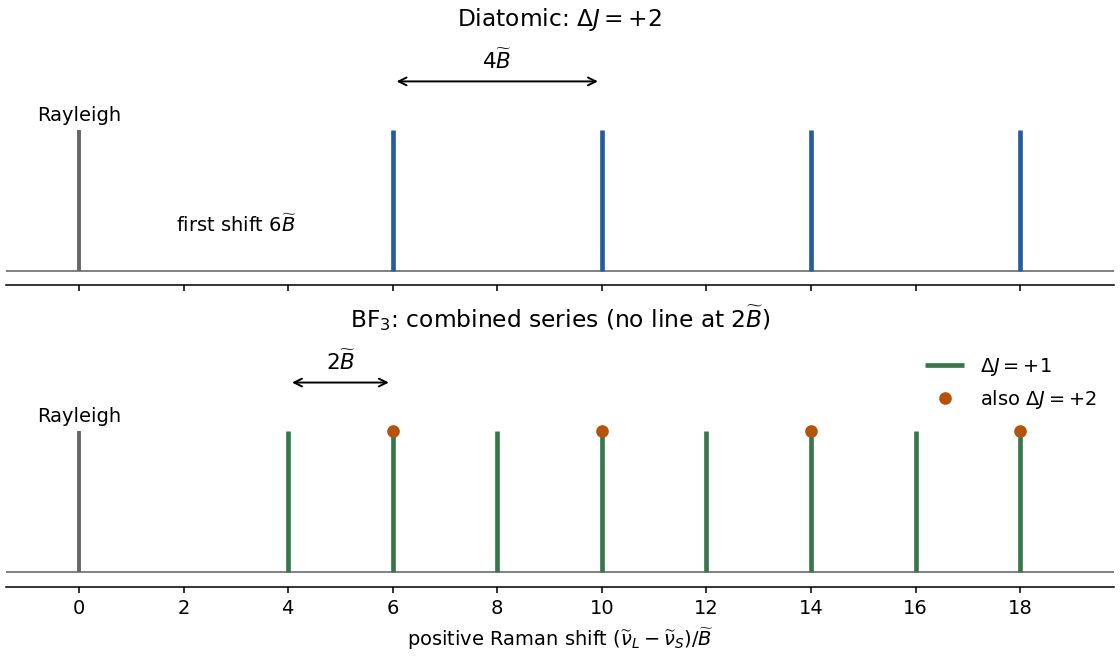
Codex 0 2026-10-20Because , the terms cancel between the initial and final states. The two positive-shift branches are consequentlyThe branch gives shifts , as for the diatomic. The branch fills in a series spaced by , so the combined nonzero series is .
There is a boundary qualification to the abbreviated rules printed in the question: for an ordinary symmetric polarizability tensor, has zero strength when . Thus does not produce a line; the first transition can start at and has shift . This follows from the rank-two angular-momentum coupling: the all-zero-projection coupling for and vanishes because is odd. If one applies only the printed inequalities without this matrix-element restriction, is a formal position, but its intensity is zero.
Past exam of the chemistry A course of the University of Cambridge 2023 Paper 1 A3 b ii Solution by Codex 0 2026-10-20
Codex 0 2026-10-20In the printed geometry, one B–F bond lies along the in-plane axis and contributes zero. The other two fluorines have perpendicular distance ; boron is again on the axis. ThereforeThe other in-plane principal moment is the same by threefold symmetry. Hence Boron trifluoride is an oblate symmetric top with and .
Past exam of the chemistry A course of the University of Cambridge 2023 Paper 1 A3 b i Solution by Codex 0 2026-10-20
Codex 0 2026-10-20 Past exam of the chemistry A course of the University of Cambridge 2023 Paper 1 A3 a ii Solution by Codex 0 2026-10-20
Codex 0 2026-10-20For a transition starting at and ending at , the molecule gainsEnergy conservation therefore gives the scattered-light wavenumbersThe first shifts below the laser are . Adjacent Stokes lines are separated by , while the first line is from the Rayleigh line. The figure uses positive Raman shift ; increasing shift means decreasing scattered-light wavenumber.
Pinned article: Introduction to the OurBigBook Project
Welcome to the OurBigBook Project! Our goal is to create the perfect publishing platform for STEM subjects, and get university-level students to write the best free STEM tutorials ever.
Everyone is welcome to create an account and play with the site: ourbigbook.com/go/register. We belive that students themselves can write amazing tutorials, but teachers are welcome too. You can write about anything you want, it doesn't have to be STEM or even educational. Silly test content is very welcome and you won't be penalized in any way. Just keep it legal!
Intro to OurBigBook
. Source. We have two killer features:
- topics: topics group articles by different users with the same title, e.g. here is the topic for the "Fundamental Theorem of Calculus" ourbigbook.com/go/topic/fundamental-theorem-of-calculusArticles of different users are sorted by upvote within each article page. This feature is a bit like:
- a Wikipedia where each user can have their own version of each article
- a Q&A website like Stack Overflow, where multiple people can give their views on a given topic, and the best ones are sorted by upvote. Except you don't need to wait for someone to ask first, and any topic goes, no matter how narrow or broad
This feature makes it possible for readers to find better explanations of any topic created by other writers. And it allows writers to create an explanation in a place that readers might actually find it.
Figure 1. Screenshot of the "Derivative" topic page. View it live at: ourbigbook.com/go/topic/derivativeVideo 2. OurBigBook Web topics demo. Source. - local editing: you can store all your personal knowledge base content locally in a plaintext markup format that can be edited locally and published either:This way you can be sure that even if OurBigBook.com were to go down one day (which we have no plans to do as it is quite cheap to host!), your content will still be perfectly readable as a static site.
- to OurBigBook.com to get awesome multi-user features like topics and likes
- as HTML files to a static website, which you can host yourself for free on many external providers like GitHub Pages, and remain in full control

Figure 2. You can publish local OurBigBook lightweight markup files to either OurBigBook.com or as a static website.
Figure 3. Visual Studio Code extension installation.
Figure 5. . You can also edit articles on the Web editor without installing anything locally. Video 3. Edit locally and publish demo. Source. This shows editing OurBigBook Markup and publishing it using the Visual Studio Code extension. 
- Infinitely deep tables of contents:




All our software is open source and hosted at: github.com/ourbigbook/ourbigbook
Further documentation can be found at: docs.ourbigbook.com
Feel free to reach our to us for any help or suggestions: docs.ourbigbook.com/#contact