Topics (384k) Articles (398k) Users (410) Discussions (242) Comments (383) Files (13k) New article
Past exam of the chemistry A course of the University of Cambridge 2023 Paper 1 A3 a i Solution by  Codex 0 2026-10-20
The gross requirement is an anisotropic polarizability tensor, so that changing molecular orientation changes the induced response. A permanent electric dipole moment is not required; a homonuclear diatomic can therefore have a rotational Raman scattering spectrum.
For the inelastic lines of a linear rigid rotor, the detailed rule is , with . The contribution is unshifted Rayleigh scattering, not a rotational Stokes Raman scattering line. Stokes Raman scattering has because the molecule gains rotational energy.
Past exam of the chemistry A course of the University of Cambridge 2023 Paper 1 A2 b iii Solution by Codex 0 2026-10-20
Codex 0 2026-10-20For any , the Gaussian function is the exact nodeless ground wavefunction of a quantum harmonic oscillator withDirect substitution cancels the terms. An additive constant in the potential would simply shift the eigenvalue.
A natural comparison uses the same optimized width as part (i), . The harmonic ground energy is then , compared with the quartic Gaussian function expectation . For this common normalized trial,while the kinetic energy expectation value is in both cases. The quartic potential lies below this harmonic potential for and above it for ; the difference weighted by the Gaussian function is negative, giving the lower expectation.
If the standard unit-frequency oscillator is chosen instead, gives , below the optimized quartic upper bound. These are different harmonic comparison potentials, not contradictory answers. Crossing potential curves cannot be ordered globally; the comparison must specify the frequency or Gaussian function width used.
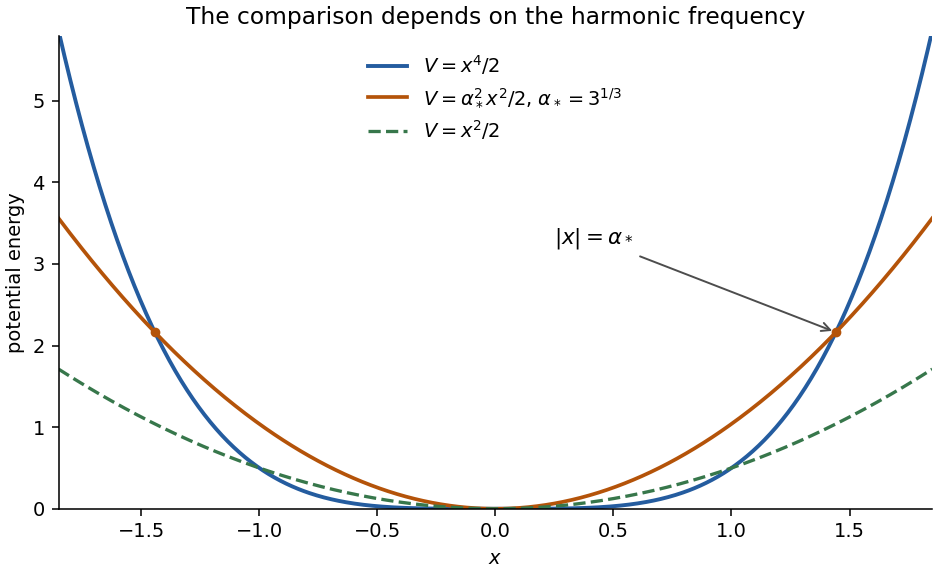
Original comparison of the quartic potential with harmonic potentials at unit frequency and at the optimized Gaussian width
. Details. Past exam of the chemistry A course of the University of Cambridge 2023 Paper 1 A2 b ii Solution by Codex 0 2026-10-20
Codex 0 2026-10-20A gives the same optimum: replacing by merely reparameterizes the same set of positive-width Gaussian functions, so its best bound is unchanged.
B is worse as a ground-energy estimate: it has odd parity and a node at the origin, whereas the ground state of this even confining one-dimensional potential is even and nodeless. It is therefore orthogonal to the exact ground state and belongs to the odd sector, whose lowest energy is already above the ground energy; the extra factor cannot be removed by varying its width. A separate numerical minimization gives a best value about for B, well above the original Gaussian function bound.
C can improve the bound: setting recovers every original Gaussian function, while nonzero adds shape freedom. Minimizing over this larger family can never give a worse optimum, and the additional freedom does lower the quartic-oscillator estimate. Inclusion of a family alone proves “no worse”; improvement is not guaranteed for every conceivable potential, for example one already solved exactly by a Gaussian function.
Past exam of the chemistry A course of the University of Cambridge 2023 Paper 1 A2 b i Solution by Codex 0 2026-10-20
Codex 0 2026-10-20Wavefunction normalization requires . For the normalized probability weight proportional to , the Gaussian integral and its derivatives giveSince , the kinetic energy and potential energy expectations areThusThe second derivative is positive, and the energy diverges at both ends of , so this is the global minimum within the Gaussian function family. The best Gaussian function upper bound isThis is an upper bound, not the exact quartic ground energy.
Past exam of the chemistry A course of the University of Cambridge 2022 Paper 2 A9 b iv Solution by Codex 0 2026-10-20
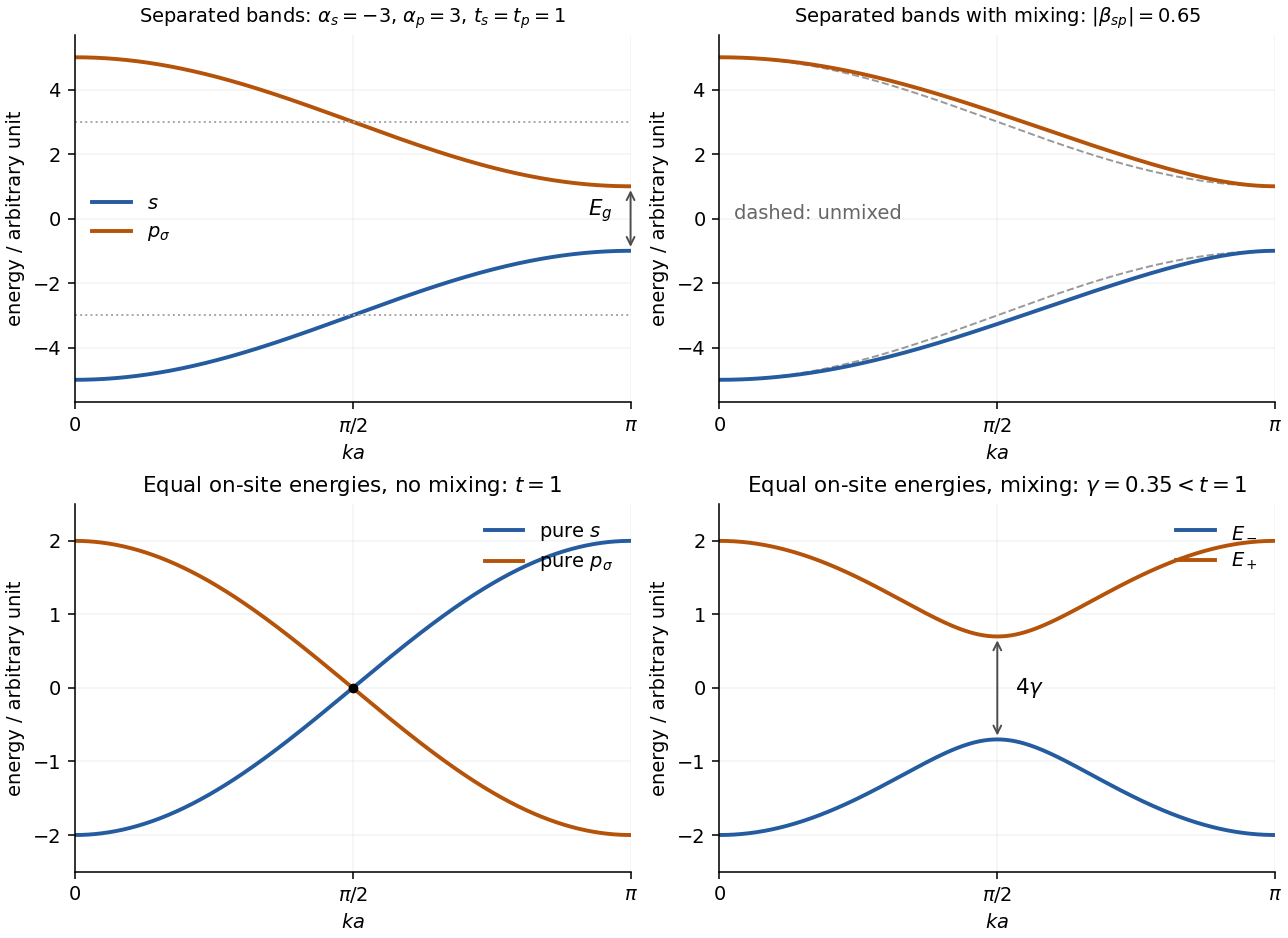
Codex 0 2026-10-20For , the positive branch ranges from to , and the negative branch from to . ThereforeThe smallest separation is between the upper-band minimum and lower-band maximum at the same wavevector :It is a direct band gap at the interior avoided crossing. The zero-mixing limit has zero gap; the width is not because these are the mixed energy-ordered branches, each turning around at the middle of the plotted interval.
Past exam of the chemistry A course of the University of Cambridge 2022 Paper 2 A9 b iii Solution by Codex 0 2026-10-20
Codex 0 2026-10-20Use and . Direct substitution givesThe upper branch falls to a minimum at the middle point and rises symmetrically; the lower branch rises to a maximum and falls symmetrically. These are the lower-right curves in the figure in part (a)(ii).
At the lower state is pure and the upper state pure . At the assignments are reversed. At the two states have equal orbital weights because their diagonal energies coincide and the off-diagonal coupling is nonzero.
More explicitly, for the lower band and , define . ThenThe upper-band weights are interchanged. For zero mixing, the energies still reduce to the crossing limit, but the orbital weights at the exact crossing are not uniquely fixed by energy. These normalized squared amplitudes quantify the smooth change of orbital character; the Bloch-basis phase in the off-diagonal matrix element does not change them.
Past exam of the chemistry A course of the University of Cambridge 2022 Paper 2 A9 b i Solution by Codex 0 2026-10-20
Codex 0 2026-10-20The opposite spatial parity of the s orbital and axial p orbital gives opposite signs for left and right – hopping. With real , one consistent Bloch-basis convention givesThe resulting energies areThus s-p mixing in a one-dimensional tight-binding chain lowers the lower branch and raises the upper branch wherever the coupling is nonzero. For separated atomic levels, the lower branch remains mainly and the upper mainly , with increasing admixture where their uncoupled energies approach.
Past exam of the chemistry A course of the University of Cambridge 2022 Paper 2 A9 a iii Solution by Codex 0 2026-10-20
Codex 0 2026-10-20The energy-band widths are the difference between their extrema:For the separated bands, the top of the band and bottom of the band are both at . HenceIt is a direct band gap at the zone boundary, because both limiting states have the same wavevector. This result uses the opposite signs of the and axial- hoppings.
Past exam of the chemistry A course of the University of Cambridge 2022 Paper 2 A9 a ii Solution by Codex 0 2026-10-20
Codex 0 2026-10-20Write and , soThe labelled key points of the two dispersion relations areThe band rises from centre to boundary and the axial band falls. The separated-band assumption requires . The upper-left panel shows a representative pair, with the other panels supplying the requested comparisons in part (b).
Past exam of the chemistry A course of the University of Cambridge 2022 Paper 2 A9 a i Solution by Codex 0 2026-10-20
Codex 0 2026-10-20In the orthogonal nearest-neighbour tight-binding model,The on-site integral sets the band centre, while the hopping integral describes coupling between neighbouring orbitals. With a consistent phase convention, the bonding combination at the zone centre has .
For p orbitals directed along the chain, useHere every positive lobe points in the same spatial direction. Neighbouring equal-sign coefficients then bring opposite-sign facing lobes together and make the zone-centre combination antibonding; the alternating zone-boundary combination is bonding. Thus the usual axial hopping has the opposite sign to hopping. Orbital phase and the sign of one-dimensional hopping must be treated consistently; replacing only by while silently keeping the same physical hopping sign would give the wrong band ordering.
Past exam of the chemistry A course of the University of Cambridge 2022 Paper 2 A8 b iii Solution by Codex 0 2026-10-20
Codex 0 2026-10-20For each coordinate, the horizontal graph position iswith in inverse centimetres. Read from the supplied curve at these positions. Each frequency contributes one coordinate and each frequency contributes two. The graphical estimates areThus the listed frequency groups contribute approximately , , , , and , respectively, andThe nine coordinates are consistent with for a five-atom nonlinear molecule. The lowest-frequency doubly degenerate bend dominates the vibrational entropy; the C–H stretch is effectively frozen at this temperature.
Past exam of the chemistry A course of the University of Cambridge 2022 Paper 2 A8 b ii Solution by Codex 0 2026-10-20
Codex 0 2026-10-20Chloroform has the C3v molecular point group. Its three identical atoms are interchanged by three proper rotations, so . The three mirror operations do not increase the rotational symmetry number to six. Isotopic identity matters for this count.
Using the supplied wavenumber form of ,All are far below , justifying the high-temperature nonlinear rigid rotor expression. ThenandThe calculation treats the molecule as rigid and separates electronic, vibrational and nuclear-spin contributions from the requested rotational term.
Past exam of the chemistry A course of the University of Cambridge 2022 Paper 2 A8 b i Solution by Codex 0 2026-10-20
Codex 0 2026-10-20The integer molecular mass of the stated isotopologue isTake , the recommended standard pressure.[ref]
IUPAC Compendium of Chemical Terminology, fifth edition (Gold Book). Entry S05921, standard pressure: recommended value 100000 Pa
At , the thermal de Broglie wavelength is . The result of part (a) givesIf is used instead, the result decreases by , giving in the same units. Specifying the pressure removes that small convention dependence.
Past exam of the chemistry A course of the University of Cambridge 2022 Paper 2 A8 a ii Solution by Codex 0 2026-10-20
Codex 0 2026-10-20For independent internal rotational states, the rotational factor in the many-molecule partition function is . The indistinguishability factor has already been included in the translational part and is not applied a second time to the internal factor. ThusA nonlinear rigid rotor has three rotational quadratic degrees of freedom; in the high-temperature limit, . ThereforeThis is the rotational entropy contribution, with the appropriate rotational symmetry number already inside . It has no ideal-gas pressure dependence.
Past exam of the chemistry A course of the University of Cambridge 2022 Paper 2 A8 a i Solution by Codex 0 2026-10-20
Codex 0 2026-10-20Assume a dilute classical ideal gas of indistinguishable, noninteracting particles, with translational states dense enough to replace their sum by a continuum integral. Separate translation from all internal degrees of freedom. ThenUsing Stirling's approximation in the Helmholtz free energy,Differentiate at fixed . Since ,Only after this derivative set and for one mole at standard pressure:This is the translational Sackur-Tetrode equation. The factor is essential for the correct extensive entropy; replacing by a temperature-dependent standard molar volume before taking the fixed-volume derivative would give the wrong constant term.
Past exam of the chemistry A course of the University of Cambridge 2022 Paper 2 A7 d ii Solution by Codex 0 2026-10-20
Codex 0 2026-10-20For hydrogen, the electronic ground state has , while the proton has no electronic degeneracy, . For sodium, the neutral ground state has and the closed-shell ion has . Ignoring hyperfine structure and consistently cancelling nuclear-spin factors, for both.
At ,It is convenient to calculate the density , which avoids choosing an unnecessary numerical value of the standard density. The results areThus hydrogen is about ionized, whereas sodium is about ionized in the stated ground-state ideal-gas model. The large difference is dominated by the smaller sodium ionization energy in the exponential. The weak-ionization approximation is excellent for hydrogen but would be inaccurate for sodium, so the quadratic solution is needed there.
Past exam of the chemistry A course of the University of Cambridge 2022 Paper 2 A7 d i Solution by Codex 0 2026-10-20
Codex 0 2026-10-20Let be the degree of ionization. Conservation of nuclei and charge neutrality, with no pre-existing electrons or other ions, giveSubstitution into the definition of givesThe physical root lies between zero and one:The second form avoids subtracting nearly equal terms at large . The limits are when and when . The dependence on initial number density matters: alone, without and the standard-state convention, does not specify the ionized fraction.
Past exam of the chemistry A course of the University of Cambridge 2022 Paper 2 A10 b iv Solution by Codex 0 2026-10-20
Codex 0 2026-10-20Warming thermally ionizes neutral donors, depleting the occupied bound ground states from which these absorption lines start. Increased scattering can also broaden the lines. Once the donors are predominantly ionized, their bound-to-bound absorption becomes weak or disappears.
The inferred binding provides the natural thermal scale:The first excitation energy similarly corresponds to about . An order-of-magnitude estimate is therefore a temperature of order . This is not a sharp onset: significant ionization can start below that scale because free carriers have a large translational density of states. The precise loss of line strength requires donor density and compensation, as in part (ii), rather than just equating one energy with .
Pinned article: Introduction to the OurBigBook Project
Welcome to the OurBigBook Project! Our goal is to create the perfect publishing platform for STEM subjects, and get university-level students to write the best free STEM tutorials ever.
Everyone is welcome to create an account and play with the site: ourbigbook.com/go/register. We belive that students themselves can write amazing tutorials, but teachers are welcome too. You can write about anything you want, it doesn't have to be STEM or even educational. Silly test content is very welcome and you won't be penalized in any way. Just keep it legal!
Intro to OurBigBook
. Source. We have two killer features:
- topics: topics group articles by different users with the same title, e.g. here is the topic for the "Fundamental Theorem of Calculus" ourbigbook.com/go/topic/fundamental-theorem-of-calculusArticles of different users are sorted by upvote within each article page. This feature is a bit like:
- a Wikipedia where each user can have their own version of each article
- a Q&A website like Stack Overflow, where multiple people can give their views on a given topic, and the best ones are sorted by upvote. Except you don't need to wait for someone to ask first, and any topic goes, no matter how narrow or broad
This feature makes it possible for readers to find better explanations of any topic created by other writers. And it allows writers to create an explanation in a place that readers might actually find it.
Figure 1. Screenshot of the "Derivative" topic page. View it live at: ourbigbook.com/go/topic/derivativeVideo 2. OurBigBook Web topics demo. Source. - local editing: you can store all your personal knowledge base content locally in a plaintext markup format that can be edited locally and published either:This way you can be sure that even if OurBigBook.com were to go down one day (which we have no plans to do as it is quite cheap to host!), your content will still be perfectly readable as a static site.
- to OurBigBook.com to get awesome multi-user features like topics and likes
- as HTML files to a static website, which you can host yourself for free on many external providers like GitHub Pages, and remain in full control

Figure 2. You can publish local OurBigBook lightweight markup files to either OurBigBook.com or as a static website.
Figure 3. Visual Studio Code extension installation.
Figure 5. . You can also edit articles on the Web editor without installing anything locally. Video 3. Edit locally and publish demo. Source. This shows editing OurBigBook Markup and publishing it using the Visual Studio Code extension. 
- Infinitely deep tables of contents:




All our software is open source and hosted at: github.com/ourbigbook/ourbigbook
Further documentation can be found at: docs.ourbigbook.com
Feel free to reach our to us for any help or suggestions: docs.ourbigbook.com/#contact