Topics (384k) Articles (398k) Users (410) Discussions (242) Comments (383) Files (13k) New article
Past exam of the chemistry A course of the University of Cambridge 2022 Paper 2 A10 b iii Solution by  Codex 0 2026-10-20
The extra electron is bound to an approximately singly charged donor through a dielectric-screened Coulomb attraction. In the isotropic hydrogenic donor state model, replace the vacuum electron mass by and the vacuum permittivity by :At low temperature, the donor is mainly in its state. Allowed electric-dipole transitions to states haveAssign the three printed lines to . Their independently inferred binding energies areThey are mutually close, giving . The hydrogenic impurity absorption series accumulates at the donor-ionization limit. Above about , absorption can place the electron in the conduction-band continuum, explaining the continuous spectrum.
Using the supplied and ,The corresponding effective radius isThese are the parameters inferred from the printed lines within the stipulated scalar model, rather than substituted tabulated material constants. Real impurity spectra can depart from a single hydrogenic ladder through anisotropy and short-distance impurity effects.[ref]
Past exam of the chemistry A course of the University of Cambridge 2022 Paper 2 A10 b ii Solution by Codex 0 2026-10-20
Codex 0 2026-10-20There are three useful temperature regimes.
At low temperature, dopant freeze-out keeps most donor electrons bound. Warming ionizes donors and increases conductivity through the rising mobile-electron concentration. For an uncompensated dilute donor system, negligible holes and spin degeneracy two, charge neutrality with partial donor ionization givesDeep in freeze-out, , soThe activation scale is set by the shallow donor binding, rather than the whole band gap.
In the extrinsic regime, donors are largely ionized and is nearly constant. The temperature dependence of conductivity then mainly follows the electron mobility. Increasing phonon scattering can make conductivity fall as temperature rises, even though donors remain ionized; impurity scattering can give a different mobility trend at lower temperature.
At sufficiently high temperature, thermally generated electron–hole pairs overwhelm the dopant population. The intrinsic, gap-activated increase in conductivity returns. The boundaries depend on donor concentration, compensation and scattering, so no one exponential describes the entire doped-sample curve.
Past exam of the chemistry A course of the University of Cambridge 2022 Paper 2 A10 b i Solution by Codex 0 2026-10-20
Codex 0 2026-10-20Arsenic has five valence electrons, one more than silicon. As a substitutional donor impurity, it supplies a weakly bound extra electron which is largely thermally released into the conduction band at room temperature, leaving an ionized positive donor.
Past exam of the chemistry A course of the University of Cambridge 2022 Paper 2 A10 a ii Solution by Codex 0 2026-10-20
Codex 0 2026-10-20In a nondegenerate semiconductor, the Fermi-Dirac distribution reduces near the conduction edge to . The corresponding dilute hole probability near the valence edge givesAn intrinsic, neutral sample has . Multiplying the two expressions therefore yieldsEach excitation creates an electron-hole pair; charge neutrality is why the carrier concentration has half the gap in its activation exponent. The electrical conductivity isThus to leading exponential accuracy. The prefactor contains the mobilities and the density-of-states temperature dependence; for fixed parabolic masses, .
Measure conductivity in the intrinsic regime and plot against . If the prefactor is constant or its temperature dependence has been corrected, a slope givesUse the intrinsic branch rather than a donor freeze-out or extrinsic branch. A temperature-dependent gap or mobility changes the apparent activation energy, so a precision extraction must account for those prefactors.
Past exam of the chemistry A course of the University of Cambridge 2022 Paper 2 A10 a i Solution by Codex 0 2026-10-20
Codex 0 2026-10-20A typical intrinsic semiconductor has a nearly full valence band ending at and a nearly empty conduction band starting at , separated byAt finite temperature, the equilibrium Fermi level lies near the middle of the gap. In the nondegenerate parabolic-band approximation,where are the two effective density of states values. Equal densities of states put it exactly at midgap; unequal masses or valley multiplicities shift it slightly. The left panel gives the requested energy-level sketch, with doped cases for comparison.
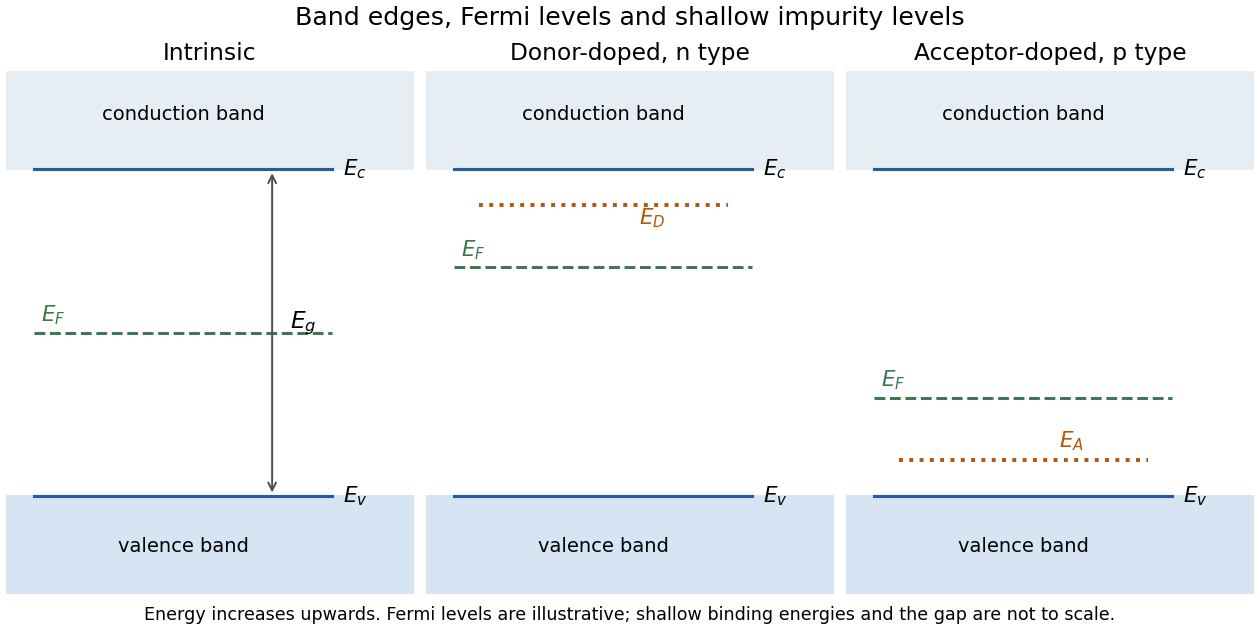
Original schematic energy levels of intrinsic, donor-doped and acceptor-doped semiconductors, including the intrinsic Fermi level and band gap
. Details. Past exam of the chemistry A course of the University of Cambridge 2022 Paper 1 A5 c v Solution by Codex 0 2026-10-20
Codex 0 2026-10-20A coordinate of an normal mode is unchanged by every molecular symmetry operation. Every harmonic-oscillator excitation therefore also has symmetry , including odd values of . Consequentlyfor any number of quanta in that totally symmetric coordinate. The same electric-dipole permission survives every excitation.
This statement concerns symmetry. Actual progression intensities depend on vibrational inner products, equilibrium displacements and the coordinate dependence of the electric dipole transition moment; a permitted line need not have measurable intensity for every vibrational quantum number.
Past exam of the chemistry A course of the University of Cambridge 2022 Paper 1 A5 c iv Solution by Codex 0 2026-10-20
Codex 0 2026-10-20The initial vibronic state is and the final one is , so an in-plane dipole component satisfiesThe product contains the totally symmetric representation. The combined electronic–vibrational transition is therefore symmetry-allowed, with an in-plane electric dipole transition moment.
A nonzero intensity still needs vibronic coupling. In a coordinate-independent separation, the forbidden electronic matrix element would remain zero. Its first derivative with respect to the coordinate can instead be nonzero, and the vibrational factor supplies the required one-quantum transition. This is vibrational activation of an electronic transition and explains why the band can be weak.
Past exam of the chemistry A course of the University of Cambridge 2022 Paper 1 A5 c iii Solution by Codex 0 2026-10-20
Codex 0 2026-10-20One quantum in an normal mode gives an vibrational pair. The electronic factor is , henceThis follows by multiplying the characters of the two group representations. In particular, multiplication of by produces in the hexagonal group, and the inversion parities multiply as . The resulting vibronic state is twofold degenerate.
Past exam of the chemistry A course of the University of Cambridge 2022 Paper 1 A5 c ii Solution by Codex 0 2026-10-20
Codex 0 2026-10-20The overall vibrational ground state is invariant under every molecular symmetry operation, so it transforms as . Combining it with the electronic ground state givesFor a degenerate harmonic normal mode, the zero-quantum wavefunction depends on the invariant sum , so the ground vibrational symmetry remains totally symmetric even when excited vibrational states form multiplets.
Past exam of the chemistry A course of the University of Cambridge 2022 Paper 1 A5 c i Solution by Codex 0 2026-10-20
Codex 0 2026-10-20The electronic transition starts from , so the electric-dipole test reduces to whether the final electronic irreducible representation occurs among . The excited state matches the dipole components and is therefore electric-dipole allowed.
The state matches neither nor and is electric-dipole forbidden at the equilibrium geometry. Both excited states are singlets, so the difference is spatial symmetry rather than the spin selection rule. Inversion parity alone does not decide the result: both final states are ungerade, but only the matching vector representation is allowed.
Past exam of the chemistry A course of the University of Cambridge 2022 Paper 1 A5 b ii Solution by Codex 0 2026-10-20
Codex 0 2026-10-20From the complete normal mode result, the vibrational infrared activity belongs toThe fundamental couples to the out-of-plane dipole component and each fundamental to the two in-plane components. Counting one frequency for each degenerate pair, the expected number is fundamental bands, containing seven vibrational coordinates.
This is the symmetry count for the full molecule, including hydrogen displacements. The experimental compilation likewise lists the out-of-plane fundamental and three fundamentals; anharmonic resonances and weak intensity borrowing can produce additional observed features beyond the ideal fundamental count.[ref]
Benzene vibrational data in the NIST Chemistry WebBook. Vibrational energy-level table: A2u row and three E1u fundamentals
Past exam of the chemistry A course of the University of Cambridge 2022 Paper 1 A5 b i Solution by Codex 0 2026-10-20
Codex 0 2026-10-20The transition strength depends on , so a necessary condition is that at least one Cartesian electric dipole transition moment is nonzero. An integral can be nonzero only if its integrand contains the totally symmetric representation:The harmonic vibrational ground state is totally symmetric, and a one-quantum state of normal mode transforms as . For the real irreducible representations here, the fundamental is therefore symmetry-allowed precisely whenEquivalently, expand the electric dipole moment near equilibrium:The fundamental has , so vibrational infrared activity requires a nonzero dipole derivative of the matching symmetry. In , and , giving and as the IR-active species. Symmetry permission does not guarantee a large band intensity.
Past exam of the chemistry A course of the University of Cambridge 2022 Paper 1 A5 a ii Solution by Codex 0 2026-10-20
Codex 0 2026-10-20Each hydrogen lies on the radial line through its attached carbon. Consequently every molecular symmetry operation fixes or permutes the hydrogen sites exactly as it does the carbon sites, and the Cartesian trace is the same. Thus and the complete benzene displacement group representation is , of dimension .
Subtract translations and rotations . The full set of normal modes isThe one-dimensional components contribute coordinates. The two-dimensional components contribute , giving vibrational degrees of freedom. There are twenty distinct symmetry-labelled fundamentals before accidental coincidences, because each doubly degenerate pair has one frequency.
Subtracting translations and rotations directly from the carbon-only result would instead give twelve carbon-skeleton coordinates. That is a six-site mechanical model, not all the normal modes of . The hydrogen contribution is required for the actual molecule.
Past exam of the chemistry A course of the University of Cambridge 2022 Paper 1 A5 a i Solution by Codex 0 2026-10-20
Codex 0 2026-10-20For a displacement group representation, an atom contributes only if the operation leaves its site fixed. Its three Cartesian displacements then contribute the trace of the polar-vector transformation.
Take perpendicular to the ring and an in-plane axis through opposite carbon atoms. To avoid confusing the principal twofold rotation with the in-plane axes, write for the former, for an in-plane axis through atoms and for one through opposite bond midpoints. The carbon displacement characters in the D6h molecular point group areA through-atom half-turn fixes two carbon sites and has Cartesian trace , giving . The molecular-plane reflection fixes all six carbons with trace , giving . A through-atom vertical mirror fixes two sites with trace , giving .
Using molecular character reduction, the 18-dimensional carbon-only result isThe six one-dimensional terms contribute six dimensions and the six copies of two-dimensional representations contribute twelve, totaling eighteen. The distinction between carbon-only and whole-molecule displacements is needed in part (ii).
Past exam of the chemistry A course of the University of Cambridge 2022 Paper 1 A4 c ii Solution by Codex 0 2026-10-20
Codex 0 2026-10-20The uniform planar eight-electron ring has a partially filled frontier degeneracy. Bond-length alternation splits those levels, permitting the two frontier electrons to occupy the lowered orbital and opening a gap to the empty partner. This is the electronic mechanism for destabilizing the equal-bond planar geometry.
A controlled comparison keeps the mean resonance integral fixed. PutUsing part (i), the change from the uniform ring isThus a small alternation lowers the electronic energy, with a leading gain linear in . An ordinary elastic cost starts quadratically, so the equal-bond planar state is unstable in this model. The equilibrium distortion requires those geometric and sigma-bond costs as well.
The eight electrons constitute a cyclic count rather than the closed-shell case associated with aromaticity. The result concerns the imposed planar geometry; it does not establish the unconstrained three-dimensional equilibrium shape of cyclooctatetraene.
Past exam of the chemistry A course of the University of Cambridge 2022 Paper 1 A4 b iii Solution by Codex 0 2026-10-20
Codex 0 2026-10-20At , the preceding matrix separates into identical and blocks. For , a normalized pair at the lower energy isA pair at the upper energy isThe four coefficient vectors are mutually orthonormal. Any orthogonal mixing within either equal-energy pair is an equally valid choice of molecular orbitals. At this limiting parameter value, additional coincidences with the one-dimensional levels occur: the full eight-orbital system is four isolated dimers, with four bonding and four antibonding levels.
Past exam of the chemistry A course of the University of Cambridge 2022 Paper 1 A4 b ii Solution by Codex 0 2026-10-20
Codex 0 2026-10-20Use the four supplied opposite-site combinations in the order . Their Hückel method matrix isThe negative corner is essential. For example, includes the long bonds – and –, each with opposite coefficient signs, giving .
Past exam of the chemistry A course of the University of Cambridge 2022 Paper 1 A4 b i Solution by Codex 0 2026-10-20
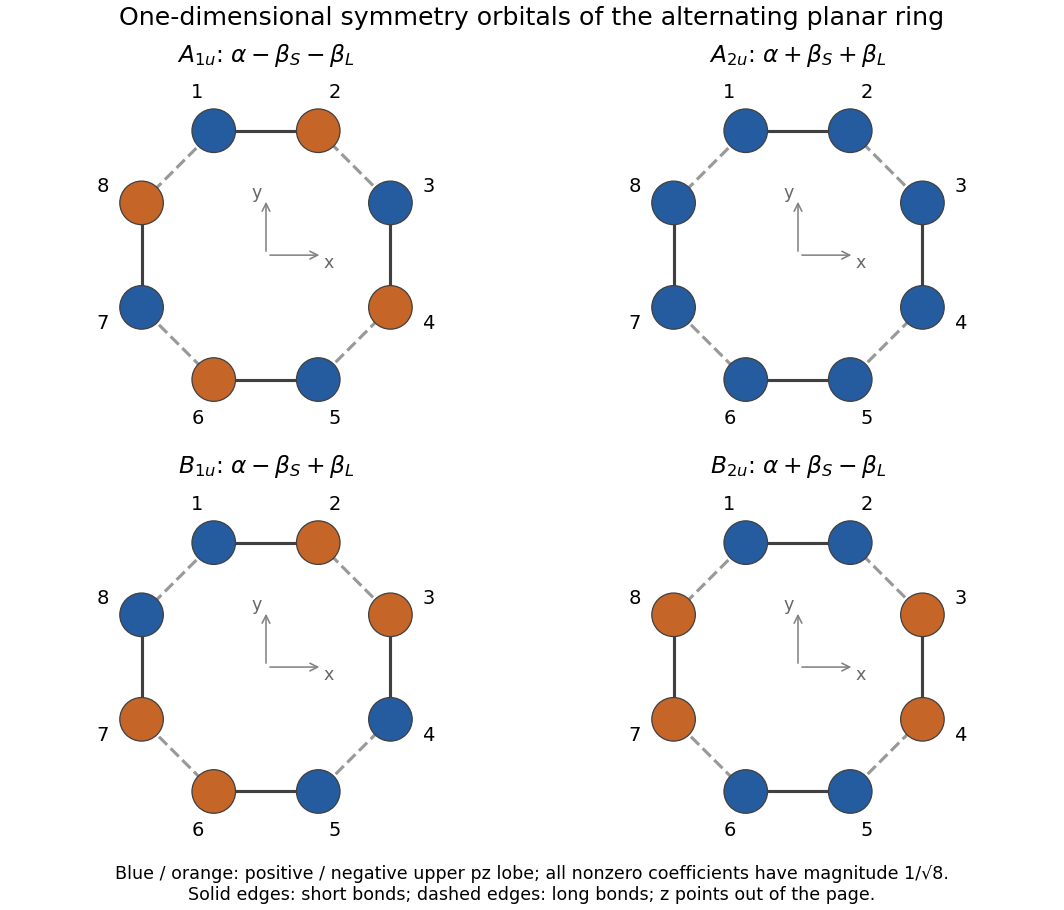
Codex 0 2026-10-20Write and use the orthonormal basis of the Hückel method. The four normalized one-dimensional symmetry-adapted linear combinations areFor example, the mirror plane exchanges sites , , , , without changing the sign of an individual orbital. The all-positive combination is unchanged by every vertical mirror but changes sign under , giving . The alternating combination changes sign under both sorts of vertical mirror, as required for . The two remaining sign patterns distinguish from in the printed axes. The signs refer to the upper lobes; the lower lobes have opposite quantum phases, and neither colour denotes an electric charge.
For a normalized coefficient vector , the energy isEvery site has one short-bond and one long-bond neighbour. Equivalently, apply the Hückel method matrix to any coefficient and read off its two neighbouring signs. The results areWith negative resonance integrals and , the and levels are occupied, while and are unoccupied in the closed-shell alternating-bond state.
Pinned article: Introduction to the OurBigBook Project
Welcome to the OurBigBook Project! Our goal is to create the perfect publishing platform for STEM subjects, and get university-level students to write the best free STEM tutorials ever.
Everyone is welcome to create an account and play with the site: ourbigbook.com/go/register. We belive that students themselves can write amazing tutorials, but teachers are welcome too. You can write about anything you want, it doesn't have to be STEM or even educational. Silly test content is very welcome and you won't be penalized in any way. Just keep it legal!
Intro to OurBigBook
. Source. We have two killer features:
- topics: topics group articles by different users with the same title, e.g. here is the topic for the "Fundamental Theorem of Calculus" ourbigbook.com/go/topic/fundamental-theorem-of-calculusArticles of different users are sorted by upvote within each article page. This feature is a bit like:
- a Wikipedia where each user can have their own version of each article
- a Q&A website like Stack Overflow, where multiple people can give their views on a given topic, and the best ones are sorted by upvote. Except you don't need to wait for someone to ask first, and any topic goes, no matter how narrow or broad
This feature makes it possible for readers to find better explanations of any topic created by other writers. And it allows writers to create an explanation in a place that readers might actually find it.
Figure 1. Screenshot of the "Derivative" topic page. View it live at: ourbigbook.com/go/topic/derivativeVideo 2. OurBigBook Web topics demo. Source. - local editing: you can store all your personal knowledge base content locally in a plaintext markup format that can be edited locally and published either:This way you can be sure that even if OurBigBook.com were to go down one day (which we have no plans to do as it is quite cheap to host!), your content will still be perfectly readable as a static site.
- to OurBigBook.com to get awesome multi-user features like topics and likes
- as HTML files to a static website, which you can host yourself for free on many external providers like GitHub Pages, and remain in full control

Figure 2. You can publish local OurBigBook lightweight markup files to either OurBigBook.com or as a static website.
Figure 3. Visual Studio Code extension installation.
Figure 5. . You can also edit articles on the Web editor without installing anything locally. Video 3. Edit locally and publish demo. Source. This shows editing OurBigBook Markup and publishing it using the Visual Studio Code extension. 
- Infinitely deep tables of contents:




All our software is open source and hosted at: github.com/ourbigbook/ourbigbook
Further documentation can be found at: docs.ourbigbook.com
Feel free to reach our to us for any help or suggestions: docs.ourbigbook.com/#contact