Topics (384k) Articles (398k) Users (410) Discussions (242) Comments (383) Files (13k) New article
Past exam of the chemistry A course of the University of Cambridge 2021 Paper 2 A9 c iii Solution by  Codex 0 2026-10-20
An isolated spin-degenerate lowest energy band accommodates two electrons per atom when there is one atom per primitive cell. Starting from one per atom, the estimate for filling the band is thereforeThis corresponds to an additional areal carrier count of about . If a genuine band gap separates the filled first band from the next band, there are no partially occupied band states at low temperature, so ordinary metallic conduction is lost.
Simply touching an edge is insufficient. In the circular approximation first contact would occur at , corresponding to electrons per cell; that is a partly filled band and need not be insulating. Near zone boundaries, the periodic potential reshapes the free-electron contours. The two-electron filling estimate assumes a global gap without overlapping bands, rather than inferring an insulator merely from one local avoided crossing.
Past exam of the chemistry A course of the University of Cambridge 2021 Paper 2 A9 c ii Solution by Codex 0 2026-10-20
Codex 0 2026-10-20For one electron per square cell, , soNumerically, exceeds , so the fermi circle lies entirely inside the first Brillouin zone.
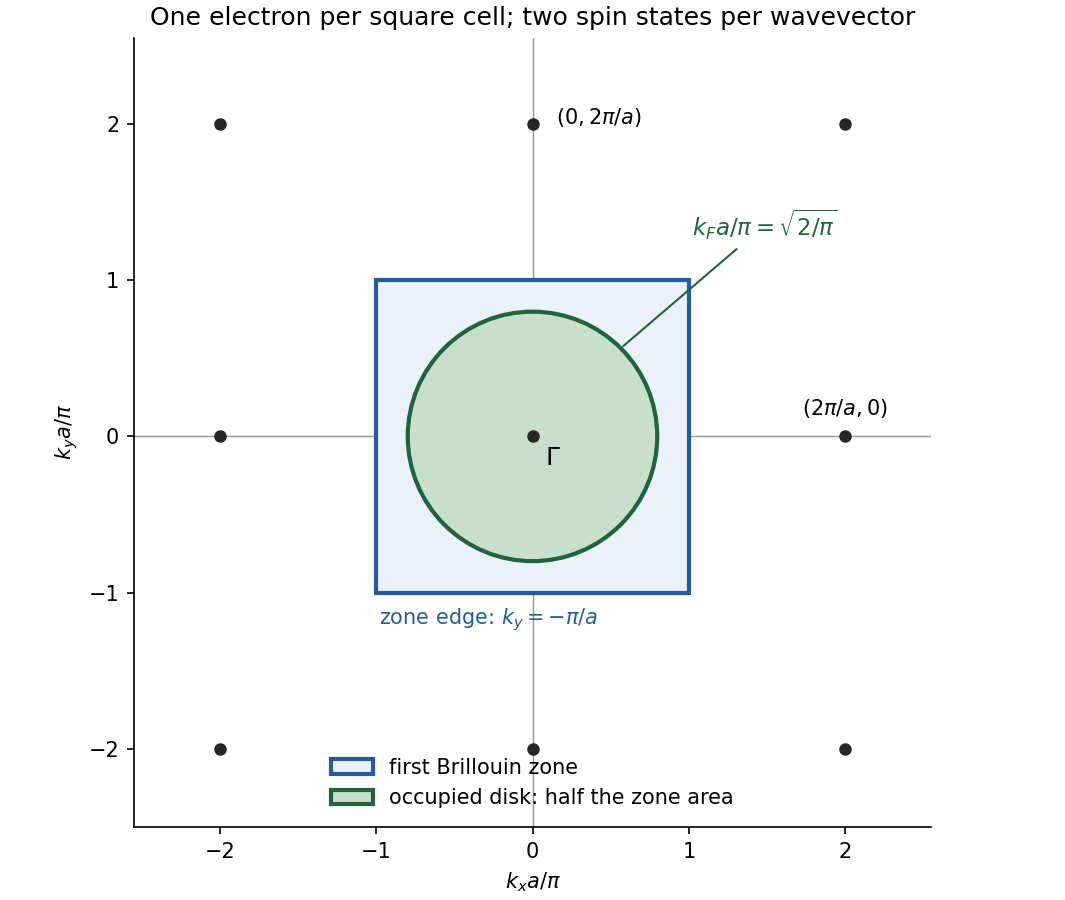
The state-counting explanation is that a spin-degenerate band has two electron states per primitive cell. One electron per cell therefore occupies half of that band. In the circular free-electron approximation the occupied reciprocal-space area isA disk of that area fits inside this square: its radius is less than the distance to an edge. Half filling alone is not a shape-independent theorem that every possible Fermi surface must avoid every zone boundary; the square geometry and circular free-electron dispersion make the statement true here.
Past exam of the chemistry A course of the University of Cambridge 2021 Paper 2 A9 c i Solution by Codex 0 2026-10-20
Codex 0 2026-10-20The reciprocal lattice is generated byIts points are spaced by along both reciprocal axes. Perpendicular bisectors between the origin and its four nearest reciprocal neighbours enclose the first Brillouin zone,The original drawing labels both the reciprocal-lattice spacing and the nearer zone boundaries. Its shaded disk is the occupied region for one electron per real-space cell.
Past exam of the chemistry A course of the University of Cambridge 2021 Paper 2 A9 b iii Solution by Codex 0 2026-10-20
Codex 0 2026-10-20Substitution in part (a) givesandThe conversion uses . These are the predictions of the stipulated two-dimensional free electron model, with the vacuum electron mass and one carrier per inferred square cell.
Past exam of the chemistry A course of the University of Cambridge 2021 Paper 2 A9 b ii Solution by Codex 0 2026-10-20
Codex 0 2026-10-20 Past exam of the chemistry A course of the University of Cambridge 2021 Paper 2 A9 b i Solution by Codex 0 2026-10-20
Codex 0 2026-10-20 Past exam of the chemistry A course of the University of Cambridge 2021 Paper 2 A9 a iii Solution by Codex 0 2026-10-20
Codex 0 2026-10-20Let be the total two-dimensional area. There are wavevector states per reciprocal-space area per spin. Including spin degeneracy two and filling a disk givesFor areal number density this yieldsThe disk is centred at zero wavevector, and its boundary is a fermi circle. Omitting the two spin states would incorrectly double the energy inferred for a given number density.
Past exam of the chemistry A course of the University of Cambridge 2021 Paper 2 A9 a ii Solution by Codex 0 2026-10-20
Codex 0 2026-10-20Metallic atomic densities place very many electrons in a small volume. The Pauli exclusion principle prevents all these fermions occupying the lowest spatial state, so filling the available states produces a Fermi energy of order electronvolts. At room temperature, , much smaller than that scale. Equivalently, ordinary metals are at , where is the Fermi temperature. Their electrons are quantum degenerate even at ordinary laboratory temperatures.
Past exam of the chemistry A course of the University of Cambridge 2021 Paper 2 A9 a i Solution by Codex 0 2026-10-20
Codex 0 2026-10-20For the free electron model, the Fermi energy is the highest occupied one-electron energy at zero temperature, measured relative to the bottom of the free-electron band. The occupied wavevectors fill a disk in two dimensions or a sphere in three dimensions. The radius is the Fermi wavevector , withEach allowed wavevector has two spin states. At nonzero temperature, the Fermi-Dirac distribution rounds the occupation boundary; the zero-temperature Fermi energy remains a useful density-defined scale and should not be defined as the thermal energy .
Past exam of the chemistry A course of the University of Cambridge 2021 Paper 2 A8 c ii Solution by Codex 0 2026-10-20
Codex 0 2026-10-20For a frozen ortho-para mixture, the mole fractions do not change during the heat measurement, and the molar heat capacity is the composition-weighted average. A high-temperature composition retained on cooling has , , soFor a mixture that continues to interconvert and remain in equilibrium near the specified temperature, use the combined rotational sum and differentiate that sum:ConsequentlyThe equilibrium composition itself is , giving . Its changing composition supplies a further positive heat capacity: warming converts some lower-energy para molecules into higher-energy ortho molecules. One can isolate this term asFor clarity, if a mixture is first equilibrated at this temperature and then its composition is frozen during measurement, the conversion term is absent: its rotational value is and its total value is . This is distinct from the equilibrium heat capacity of interconverting states even though the instantaneous composition is the same. An experiment must specify conversion activity and equilibration time; compare sufficiently slow temperature steps with a conversion catalyst against a composition-preserving sample, while keeping the same thermal background and checking that the sample has reached the stated temperature.
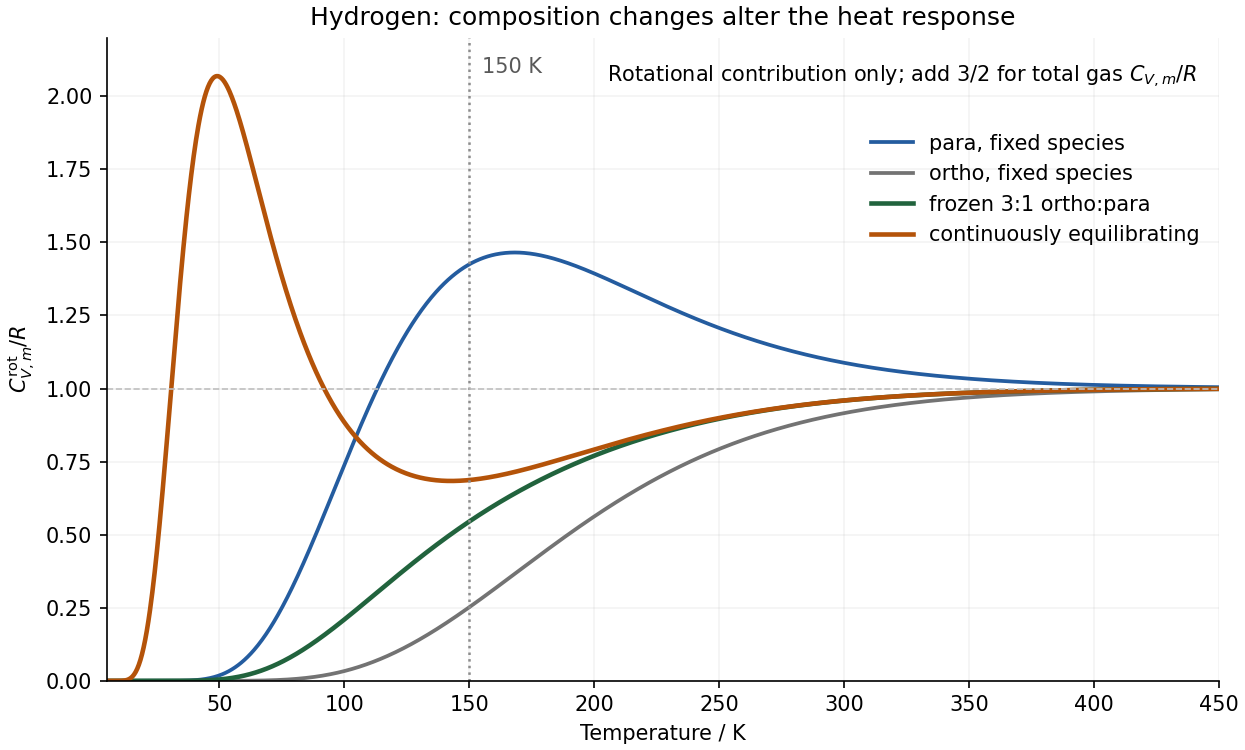
Original ideal-rotor heat capacities showing the difference between frozen normal hydrogen and continuously equilibrating hydrogen
. Details. Past exam of the chemistry A course of the University of Cambridge 2021 Paper 2 A8 c i Solution by Codex 0 2026-10-20
Codex 0 2026-10-20Apply part (b) to each supplied rotational sum. Multiplying the odd sum by its constant nuclear-spin factor three does not change or . At the specified temperature the dimensionless rotational contributions areThus the rotational heat capacities are for parahydrogen and for orthohydrogen. For the total gas heat capacities, including translation and neglecting vibration,The difference is substantial because the permitted rotational ladders differ. The para ladder starts at and next reaches , separated by ; its excited population is changing appreciably here. The ortho ladder starts at and next reaches , a larger separation of , so much of the ortho population remains in its lowest rotational manifold. A rotational contribution greater than is possible in the intermediate quantum regime and is not a violation of high-temperature equipartition.
Past exam of the chemistry A course of the University of Cambridge 2021 Paper 2 A8 b ii Solution by Codex 0 2026-10-20
Codex 0 2026-10-20For a high-temperature linear rigid rotor, up to temperature-independent symmetry/spin factors. Therefore and , givingThis agrees with the equipartition theorem for two quadratic rotational coordinates. It is the rotational contribution; adding free three-dimensional translation gives when vibrations remain unexcited. A constant rotational symmetry number does not affect this derivative.
Past exam of the chemistry A course of the University of Cambridge 2021 Paper 2 A8 b i Solution by Codex 0 2026-10-20
Codex 0 2026-10-20For a fixed number of non-interacting molecules, in the dilute ideal gas limit. The temperature-independent factorial drops out of the internal energy derivative:Differentiate once more at fixed volume to obtainPrimes denote fixed-volume derivatives. If factorizes into translational, rotational and other independent contributions, their heat capacities add. In particular, the three-dimensional translational factor contributes , while a constant spin degeneracy factor contributes zero. The formula also follows from the positive canonical energy variance, .
Past exam of the chemistry A course of the University of Cambridge 2021 Paper 2 A8 a ii Solution by Codex 0 2026-10-20
Codex 0 2026-10-20At low temperature, retain in the even sum and in the odd sum. Their weights are respectively and before the nuclear-spin multiplicity, soEquilibrium hydrogen then becomes almost entirely parahydrogen. At high temperature, many even and odd rotational levels contribute, and their spatial sums have the same leading value. HenceThis is normal hydrogen. Its familiar high-temperature ratio is a nuclear-spin multiplicity ratio, not the ratio of the two lowest levels. Maintaining conversion is essential: a sample cooled without an effective conversion mechanism can retain its earlier composition instead of following . NBS thermodynamic data distinguish equilibrium composition from normal hydrogen and compare the state-sum prediction with spectroscopic and thermal evidence.[ref]
Compilation of Thermal Properties of Hydrogen in Its Various Isotopic and Ortho-Para Modifications by Harold W. Woolley and others. Section III.2, printed pp. 394–395 and table 12: ortho–para equilibrium and its experimental checks
Past exam of the chemistry A course of the University of Cambridge 2021 Paper 2 A8 a i Solution by Codex 0 2026-10-20
Codex 0 2026-10-20The two protons are identical spin-one-half fermions, so the total state is antisymmetric under exchange. In the electronic and vibrational ground state, an even rotational has a symmetric spatial wavefunction and therefore uses the antisymmetric nuclear-spin singlet state; odd uses the symmetric triplet state. Thus parahydrogen has one nuclear-spin state, and orthohydrogen has three. Each rotational level also has spatial state degeneracy .
The translational partition functions and all common electronic/vibrational factors cancel in the ratio of equilibrium populations. Using the same zero of energy for the two spin species givesSubtracting the energy separately from all odd levels without restoring that offset in the equilibrium ratio would incorrectly remove the low-temperature preference for parahydrogen. The nuclear spin statistics account for the factor three, independently of the spatial factor .
Past exam of the chemistry A course of the University of Cambridge 2021 Paper 2 A10 b iii Solution by Codex 0 2026-10-20
Codex 0 2026-10-20In a weakly doped n-type semiconductor, the mobile electrons occupy states near the bottom of the conduction band. Their local band curvature is positive, so their band effective mass is positive and approximately constant sufficiently near that minimum. For the usual convention, expand about :Stronger overlap gives larger , greater curvature and a smaller mass within this model. Positive simply places the minimum at the zone boundary and again gives a positive edge mass. A negative electron mass near a band maximum instead motivates the positive-mass electron hole description; it is not the usual conduction-edge situation for an n-type semiconductor. No numerical comparison with follows without values of and .
Past exam of the chemistry A course of the University of Cambridge 2021 Paper 2 A10 b ii Solution by Codex 0 2026-10-20
Codex 0 2026-10-20Differentiating the tight binding dispersion produced by the Hückel method givesHenceUnlike a free particle, the band effective mass depends on wavevector and can change sign. At an inflection point , the inverse mass vanishes and the curvature-based mass diverges; a quadratic approximation then ceases to describe the dispersion locally. For the usual convention, the bottom at has positive mass and the top at has negative electron mass. The constant has no effect on curvature.
Past exam of the chemistry A course of the University of Cambridge 2021 Paper 2 A10 b i Solution by Codex 0 2026-10-20
Codex 0 2026-10-20Two derivatives of the free-electron dispersion giveThe band effective mass becomes the ordinary electron mass when no periodic-potential modification of the quadratic dispersion relation is present.
Past exam of the chemistry A course of the University of Cambridge 2021 Paper 2 A10 a iv Solution by Codex 0 2026-10-20
Codex 0 2026-10-20Retain the inferred mobilities and assume one ionized donor per added arsenic atom, negligible compensation, the same band gap, and the nondegenerate semiconductor mass-action law. Relative to the intrinsic sample, a conductivity factor requiresFor complete donor ionization, charge neutrality gives , soThe host atom density, using , isThus the required atomic fraction isapproximately one donor per host atoms. The electron density must rise to about , not , because the original intrinsic sample conducted through both electrons and holes. This is an estimate under unchanged mobility: impurity scattering, incomplete ionization, compensation and band-edge changes can alter it. Here , so the nondegenerate treatment is an approximation rather than an arbitrarily dilute limit.
Past exam of the chemistry A course of the University of Cambridge 2021 Paper 2 A10 a iii Solution by Codex 0 2026-10-20
Codex 0 2026-10-20Substitutional arsenic has one more valence electron than germanium, so it acts as a donor impurity. Thermal ionization of its shallow bound state supplies mobile conduction-band electrons and leaves fixed positive donor charge. The resulting n-type semiconductor can have even when only a small fraction of host atoms are replaced. Its electrical conductivity then rises because the mobile carrier count increases; the opposite donor charge preserves macroscopic charge neutrality.
This argument assumes that the donors are substantially ionized at the measurement temperature and that the added impurity scattering does not overwhelm the carrier increase. The screened bound-donor picture and its departures from a simple hydrogenic model are described in institutional semiconductor spectroscopy notes.[ref]
Pinned article: Introduction to the OurBigBook Project
Welcome to the OurBigBook Project! Our goal is to create the perfect publishing platform for STEM subjects, and get university-level students to write the best free STEM tutorials ever.
Everyone is welcome to create an account and play with the site: ourbigbook.com/go/register. We belive that students themselves can write amazing tutorials, but teachers are welcome too. You can write about anything you want, it doesn't have to be STEM or even educational. Silly test content is very welcome and you won't be penalized in any way. Just keep it legal!
Intro to OurBigBook
. Source. We have two killer features:
- topics: topics group articles by different users with the same title, e.g. here is the topic for the "Fundamental Theorem of Calculus" ourbigbook.com/go/topic/fundamental-theorem-of-calculusArticles of different users are sorted by upvote within each article page. This feature is a bit like:
- a Wikipedia where each user can have their own version of each article
- a Q&A website like Stack Overflow, where multiple people can give their views on a given topic, and the best ones are sorted by upvote. Except you don't need to wait for someone to ask first, and any topic goes, no matter how narrow or broad
This feature makes it possible for readers to find better explanations of any topic created by other writers. And it allows writers to create an explanation in a place that readers might actually find it.
Figure 1. Screenshot of the "Derivative" topic page. View it live at: ourbigbook.com/go/topic/derivativeVideo 2. OurBigBook Web topics demo. Source. - local editing: you can store all your personal knowledge base content locally in a plaintext markup format that can be edited locally and published either:This way you can be sure that even if OurBigBook.com were to go down one day (which we have no plans to do as it is quite cheap to host!), your content will still be perfectly readable as a static site.
- to OurBigBook.com to get awesome multi-user features like topics and likes
- as HTML files to a static website, which you can host yourself for free on many external providers like GitHub Pages, and remain in full control

Figure 2. You can publish local OurBigBook lightweight markup files to either OurBigBook.com or as a static website.
Figure 3. Visual Studio Code extension installation.
Figure 5. . You can also edit articles on the Web editor without installing anything locally. Video 3. Edit locally and publish demo. Source. This shows editing OurBigBook Markup and publishing it using the Visual Studio Code extension. 
- Infinitely deep tables of contents:




All our software is open source and hosted at: github.com/ourbigbook/ourbigbook
Further documentation can be found at: docs.ourbigbook.com
Feel free to reach our to us for any help or suggestions: docs.ourbigbook.com/#contact