Topics (384k) Articles (398k) Users (410) Discussions (242) Comments (383) Files (13k) New article

Clarence Zener introduced double exchange to connect electrical conduction with ferromagnetism in mixed-valence manganese compounds. In this mechanism, carrier motion and the alignment of local spins influence one another: the magnetic arrangement changes how effectively an electron can move, and the resulting change in electronic energy can favor aligned spins. His 1951 treatment of manganese compounds with a perovskite crystal structure sought to explain why conduction and ferromagnetic ordering occur together. It links magnetic order to carrier motion rather than treating conductivity and magnetism as unrelated properties.[ref]
His work on double exchange connected carrier motion with ferromagnetism in mixed-valence materials. Carnegie Mellon preserves his research papers: findingaids.library.cmu.edu/repositories/2/resources/93.
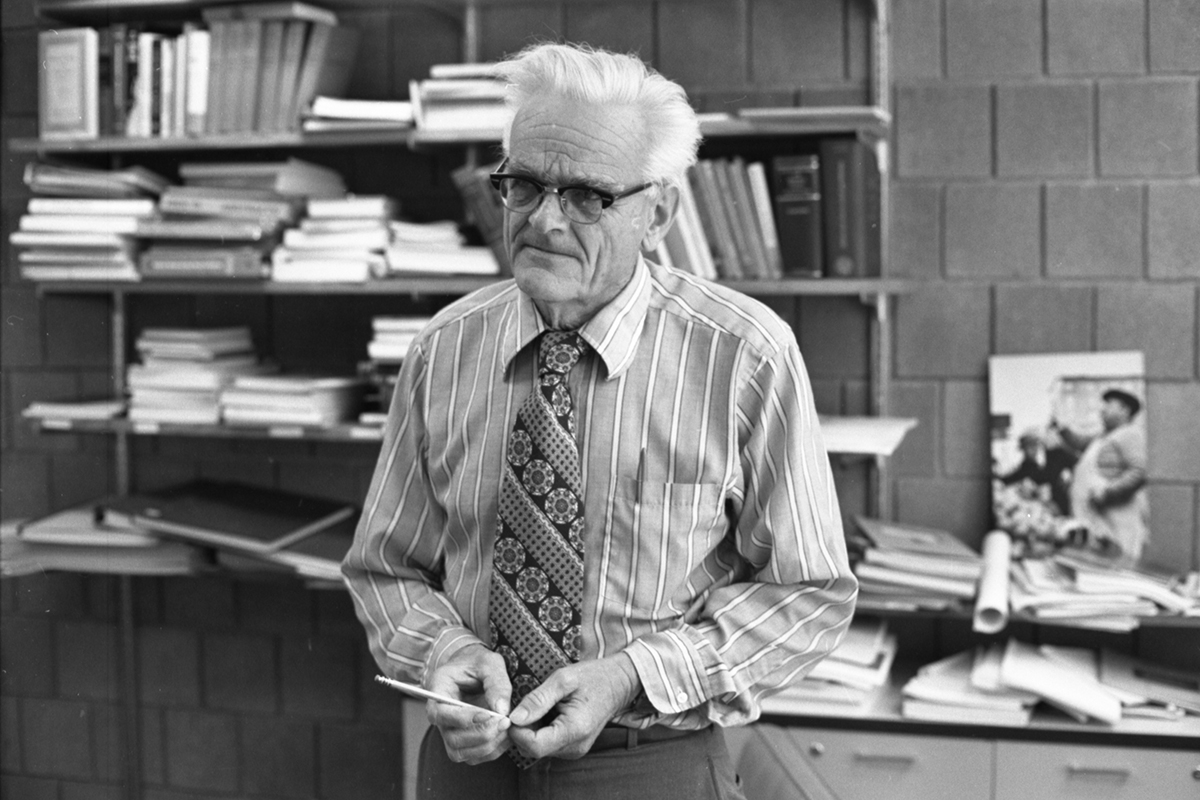
Clarence Melvin Zener, from Carnegie Mellon University Archives
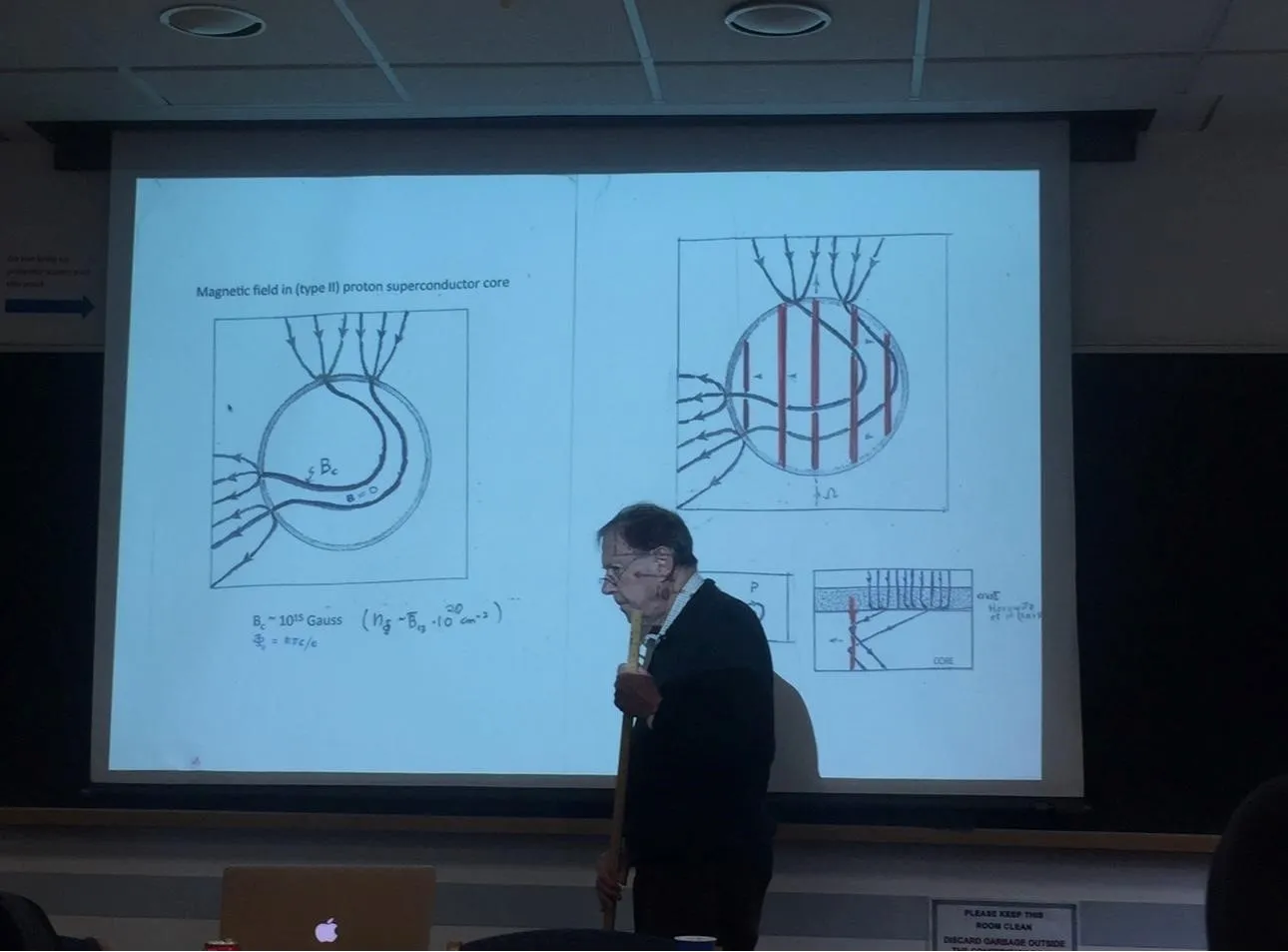
. With Charles Kittel, he calculated conduction-electron-mediated exchange between nuclear magnetic moments. His later research included neutron stars. Columbia's account of his career also recalls his enthusiasm for order-of-magnitude teaching.[ref]
https://fas.columbia.edu/news/memoriam-professor-mal-ruderman. Columbia University, In Memoriam: Professor Mal Ruderman, 25 July 2024
Charles Kittel and Malvin Ruderman calculated how conduction electrons mediate an interaction between nuclear magnetic moments. A nuclear moment perturbs the electron system, whose response in turn acts on another nuclear moment: the nuclei need not interact only through their direct magnetic coupling. Their 1954 calculation connected this indirect interaction with nuclear magnetic resonance line widths in silver and discussed predictions involving different isotopes. This is an early example of extracting information about collective electronic response from a magnetic resonance measurement.[ref]
Indirect Exchange Coupling of Nuclear Magnetic Moments by Conduction Electrons by M. A. Ruderman and Charles Kittel. Physical Review 96, 99–102 (1954), abstract and silver resonance discussion
His research with Malvin Ruderman helped explain conduction-electron-mediated exchange. Berkeley collects recollections of his research and teaching: physics.berkeley.edu/node/808.

Charles Kittel, from the University of California, Berkeley
. A researcher on semiconductor doping, including the equilibrium incorporation of silicon in gallium arsenide. Publication record: scholars.duke.edu/publication/683296.
A researcher on semiconductors, including amphoteric dopants. Duke's departmental history describes his work with Teh Yu Tan: mems.duke.edu/about/history/.
His materials research includes semiconductor doping and electronic defects. Official profile: scholars.duke.edu/person/ttan.
A physicist who measured the fundamental band gap of gallium nitride using photoluminescence excitation. When suitable transmission samples were unavailable, varying the excitation and observing emission provided another route to the absorption edge. Combining those measurements with reflection and luminescence separated exciton transition energies from the underlying band gap.[ref]
Fundamental energy gap of GaN from photoluminescence excitation spectra by Bo Monemar. Abstract: motivation for excitation spectroscopy and combined determination of exciton transitions and band gap
A researcher in nanoscale metrology who coauthored studies of width measurements with atomic force microscopy. A shaped probe senses steep sidewalls, but its lateral motion changes the effective width that must be subtracted from a measurement. The work examined calibration under matched conditions, showing why a microscope's control method is part of the measurement model.[ref]
Effects of Lateral Tip Control in CD-AFM Width Metrology by Ronald G. Dixson and others. NIST abstract: flared tips, lateral dither, effective width and calibration conditions
A theoretical physicist who coauthored a study of optical absorption in twisted bilayer graphene with Mikito Koshino. The calculation linked the rotation angle to peaks in the optical spectrum and derived selection rules from the model's symmetry. It provides a way to read structural information from light absorption while testing simplified descriptions of coupled electronic layers.[ref]
A theoretical physicist who, with Pilkyung Moon, calculated optical absorption in twisted bilayer graphene. Rotating one sheet changes the electronic electronic band structure and shifts absorption peaks associated with Van Hove singularities. Comparing a tight-binding model with a continuum model showed how an optical spectrum can identify the relative rotation of two atomically thin sheets.[ref]
Optical absorption in twisted bilayer graphene by Pilkyung Moon and Mikito Koshino. Abstract: angle-dependent peaks and comparison of tight-binding and continuum models
A theoretical physicist who studied how a spherical particle distorts a nematic liquid crystal. Minimizing the elastic free energy with surface and magnetic field terms revealed competing defect configurations, including a surrounding ring. Changing particle size, surface alignment strength or applied magnetic field can change the preferred structure, connecting microscopic boundary conditions with observable colloidal organization.[ref]
Director field configurations around a spherical particle in a nematic liquid crystal by Holger Stark. Abstract: competing configurations, energy minimization and field-induced transitions
A theoretical physicist who coauthored the electronic-level calculations underlying Tanabe-Sugano diagrams with Satoru Sugano. The work applied crystal field theory to complex ions, balancing the effect of the surrounding ligands with interactions within the d shell. This made optical absorption a way to investigate electronic states in a particular chemical environment.[ref]
On the Absorption Spectra of Complex Ions. I by Yukito Tanabe and Satoru Sugano. Abstract: generalized crystal-field approximation and calculations for d-shell configurations
A theoretical physicist who, with Yukito Tanabe, calculated electronic energy levels of transition-metal complex ions using crystal field theory. Their treatment considered different populations of the d shell in a cubic field. It supplied a framework for interpreting absorption bands and lines, connecting the local environment of an ion with the spectrum used to identify its electronic states.[ref]
On the Absorption Spectra of Complex Ions. I by Yukito Tanabe and Satoru Sugano. Abstract: d-shell energy matrices in cubic fields and motivation from complex-ion absorption
A theoretical physicist who coauthored work with Charles Alfred Coulson on molecular orbital theory. Their 1940 paper examined when a model for mobile electrons in unsaturated hydrocarbons gives a self-consistent field. Testing that condition matters because the assumed electron distribution and the field generated by it must agree for the approximation to describe a stationary electronic state.[ref]
Note on the method of molecular orbitals by Charles Alfred Coulson and G. S. Rushbrooke. Extract: failure and recovery of self-consistency in molecular-orbital treatments
Walter Kohn and Pierre Hohenberg established a foundation for density functional theory: under their ground-state assumptions, the electron density determines the external scalar potential up to an additive constant. They formulated the ground-state energy as a universal density functional plus the external-potential contribution, with a variational principle selecting the physical density. This replaces the full many-electron wave function as the basic variable by a function of only three spatial coordinates. The theorem establishes the framework, rather than providing an explicit exact functional for practical computation.[ref]
Inhomogeneous electron gas by Pierre Hohenberg and Walter Kohn. Physical Review 136, B864 (1964), density-potential uniqueness and variational principle

Portrait of Walter Kohn
. Markus Pössel (Mapos); levels and colour adjustments by WikiPedant. CC BY-SA 3.0, via Wikimedia Commons. Source.Lu Jeu Sham and Walter Kohn developed self-consistent equations that make density functional theory computationally useful. The Kohn-Sham equations introduce an auxiliary system of noninteracting electrons with the same ground-state electron density as the interacting system. An effective potential includes the external potential, electrostatic repulsion and an exchange-correlation functional. Solving the equations and updating the electron density iteratively gives a self-consistent state. The difficult many-electron effects remain in the exchange-correlation functional, so practical calculations still need an approximation to it.[ref]
Self-Consistent Equations Including Exchange and Correlation Effects by Walter Kohn and Lu Jeu Sham. Physical Review 140, A1133–A1138 (1965), effective one-electron equations

Portrait of Lu Jeu Sham
. External portrait hosted by University of California San Diego, Center for Memory and Recording Research. Source.A theoretical condensed matter physicist who, with Walter Kohn, established a foundation of density functional theory in 1964. Their variational principle expresses the ground-state energy of interacting electrons through the electron density, making a three-dimensional quantity central to a many-particle problem.[ref]
His 1967 work also ruled out the relevant finite-temperature long-range order in one- and two-dimensional bosonic and fermionic systems under the theorem's assumptions. This helps explain why dimensionality matters when discussing Bose-Einstein condensation.[ref]
Existence of Long-Range Order in One and Two Dimensions by Pierre Hohenberg. Abstract: exclusion of quasi-averages at nonzero temperature
Axel D. Becke develops practical approximations for density functional theory. His 1988 exchange functional uses the local electron density and its gradient to improve on a purely local density approximation. Its construction imposes the proper long-distance behavior of the exchange-energy density and fits one parameter using atomic exchange energies. This supplies a concrete example of building a useful approximate energy functional from physical constraints and reference calculations. The asymptotic statement concerns an energy density, and does not automatically establish the asymptotic behavior of its functional derivative.[ref]
Density-functional exchange-energy approximation with correct asymptotic behavior by Axel D. Becke. Physical Review A 38, 3098 (1988), abstract and exchange-functional construction

Portrait of Axel D. Becke
. External portrait hosted by Dalhousie University, Department of Chemistry. Source.A researcher in statistical mechanics and physical chemistry who developed theory and simulation methods for liquids. His work connects microscopic molecular fluctuations with collective behavior, including the hydrophobic effect, electron transfer and the glass transition. The scientific value of this approach is that the surrounding liquid is an active part of a process: its changing molecular arrangement can determine whether a reaction proceeds or a structure assembles.[ref]
Scientific obituary of David Chandler at the University of California. Scientific contributions paragraphs: molecular fluctuations, simulation methods, hydrophobicity, electron transfer and glass dynamics
A researcher who coauthored quantitative measurements of electron-beam damage in graphene. Counting displaced carbon atoms as beam energy and dose changed gave a displacement cross section. Comparing carbon isotopes helped distinguish nuclear collisions from other damage mechanisms. Including lattice motion was necessary to explain the results, making the microscope itself a controlled scattering experiment.[ref]
Pinned article: Introduction to the OurBigBook Project
Welcome to the OurBigBook Project! Our goal is to create the perfect publishing platform for STEM subjects, and get university-level students to write the best free STEM tutorials ever.
Everyone is welcome to create an account and play with the site: ourbigbook.com/go/register. We belive that students themselves can write amazing tutorials, but teachers are welcome too. You can write about anything you want, it doesn't have to be STEM or even educational. Silly test content is very welcome and you won't be penalized in any way. Just keep it legal!
Intro to OurBigBook
. Source. We have two killer features:
- topics: topics group articles by different users with the same title, e.g. here is the topic for the "Fundamental Theorem of Calculus" ourbigbook.com/go/topic/fundamental-theorem-of-calculusArticles of different users are sorted by upvote within each article page. This feature is a bit like:
- a Wikipedia where each user can have their own version of each article
- a Q&A website like Stack Overflow, where multiple people can give their views on a given topic, and the best ones are sorted by upvote. Except you don't need to wait for someone to ask first, and any topic goes, no matter how narrow or broad
This feature makes it possible for readers to find better explanations of any topic created by other writers. And it allows writers to create an explanation in a place that readers might actually find it.
Figure 1. Screenshot of the "Derivative" topic page. View it live at: ourbigbook.com/go/topic/derivativeVideo 2. OurBigBook Web topics demo. Source. - local editing: you can store all your personal knowledge base content locally in a plaintext markup format that can be edited locally and published either:This way you can be sure that even if OurBigBook.com were to go down one day (which we have no plans to do as it is quite cheap to host!), your content will still be perfectly readable as a static site.
- to OurBigBook.com to get awesome multi-user features like topics and likes
- as HTML files to a static website, which you can host yourself for free on many external providers like GitHub Pages, and remain in full control

Figure 2. You can publish local OurBigBook lightweight markup files to either OurBigBook.com or as a static website.
Figure 3. Visual Studio Code extension installation.
Figure 5. . You can also edit articles on the Web editor without installing anything locally. Video 3. Edit locally and publish demo. Source. This shows editing OurBigBook Markup and publishing it using the Visual Studio Code extension. 
- Infinitely deep tables of contents:



All our software is open source and hosted at: github.com/ourbigbook/ourbigbook
Further documentation can be found at: docs.ourbigbook.com
Feel free to reach our to us for any help or suggestions: docs.ourbigbook.com/#contact